
Asphalt Market Accelerates Amid Advances in Recycling Technologies
How sustainable paving solutions, recycled asphalt technologies, and environmental regulations are transforming production practices and growth opportunities in the asphalt market

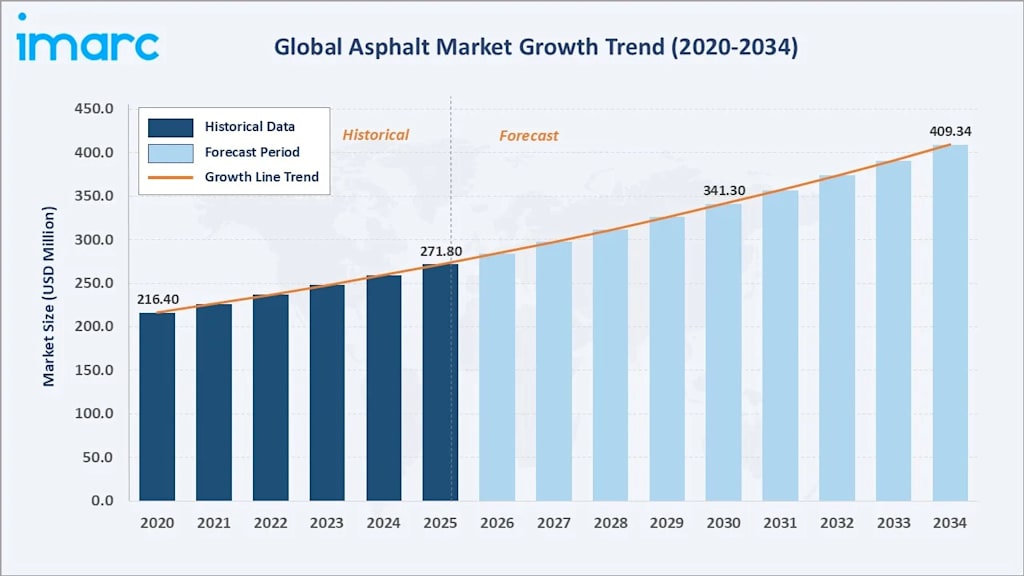
Rising infrastructure development, extensive urbanization, and the expanding global transportation network are driving asphalt demand, supported by heavy investments in public roadway systems, airport modernization, and advanced waterproofing applications. According to IMARC Group’s latest data, the global asphalt market size was valued at USD 271.80 Million in 2025. Looking forward, IMARC Group estimates the market to reach USD 409.34 Million by 2034, exhibiting a CAGR of 4.66% from 2026-2034.
Asphalt now represents a multi-billion-dollar global industry exceeding USD 75 billion and exhibiting steady year-on-year expansion. Demand is driven by massive public investments in highway networks, airport runways, and commercial real estate, alongside an increasing industrial reliance on durable waterproofing solutions. Production breakthroughs like polymer-modified binders, warm-mix formulations, and reclaimed materials are further accelerating uptake. Major segments include hot-mix asphalt, warm-mix asphalt, and cold-mix asphalt, with public works and engineering contractors prioritizing load capacity, quick setting times, and environmental efficiency.
Discover Growth Opportunities in the "Asphalt Market" Sample
Asphalt Market Growth Drivers:
- Massive Public Infrastructure and Highway Projects
Governments prioritize extensive transportation networks to support economic connectivity, supply chains, and commuter mobility across expanding urban zones. This shift favors high-durability paving materials capable of handling heavy commercial axle loads and extreme climate shifts over cheaper, less resilient alternatives. Public sector funding accounts for approximately 65% of the overall paving market, heavily backing major highway rehabilitation and interstate expansion projects. Contractors depend on robust material supply lines to fulfill municipal contracts, using massive quantities of hot-mix variants to ensure long-lasting structural integrity for multi-lane expressways.
- Rapid Urbanization and Commercial Expansion
Accelerating urban migration and commercial real estate development push the demand for reliable local transport links, expansive parking systems, and retail complex accessibility. This trend drives the consumption of dependable pavement solutions for metropolitan streets, industrial loading docks, and vast residential sub-divisions. The expanding road network requires substantial volume commitments, with over 3,500 mix manufacturing sites operating actively in major regions like North America to supply hundreds of millions of tons of paving material annually. Developers rely heavily on these readily available mixtures to deliver smooth, high-load-bearing surfaces on strict commercial project timelines.
- Airport Modernization and Air Traffic Demands
Rising commercial aviation volumes and international cargo logistics prompt airport authorities to heavily invest in airfield restorations, runway widening, and terminal apron expansions. This focus boosts the adoption of highly engineered polymer-modified binders designed to resist jet fuel spills, massive structural stress, and extreme runway friction. Major aviation hubs deploy these advanced mixtures across heavy-use taxiways to decrease maintenance-related downtime and support continuous long-haul aircraft operations. The airport infrastructure sector remains one of the fastest-growing application spaces, backed by multi-billion-dollar modernization programs across international transit hubs.
Asphalt Market Trends:
- Widespread Adoption of Sustainable Recycled Asphalt Pavement (RAP)
Paving companies prioritize reclaimed aggregates, shredded roofing shingles, and crushed construction waste to address strict environmental regulations and fluctuating virgin bitumen costs. Municipal procurement guidelines and corporate sustainability goals drive the shifting preference toward circular economy solutions in large-scale paving bids. Engineering teams routinely incorporate high percentages of recycled pavement into brand-new surface layers to slash raw material expenditure while retaining structural performance. This green manufacturing approach directly reduces landfill volumes, lowers carbon output, and influences over a third of public works material selection criteria.
- Rapid Growth of Low-Emission Warm Mix Asphalt (WMA)
Contractors choose lower-temperature mixing technologies to drastically reduce energy consumption, fuel costs, and greenhouse gas emissions during production cycles. Manufacturing plants deploy specialized chemical additives and foaming techniques to allow proper aggregate coating and compaction at reduced working temperatures. This operational shift improves job-site air quality for installation crews, enables longer transport haul distances, and extends the active construction season into colder autumn months. The warm-mix sector represents the fastest-accelerating product variant, finding widespread application in urban street paving where immediate traffic reopening is critical.
- Premiumization Through Advanced Polymer-Modified Binders
Industrial demand is rising for premium binders enhanced with elastomeric polymers or crumb rubber, positioned as the gold standard for high-stress logistical pathways. Project managers select these modified formulations to prevent severe long-term pavement deformities, such as deep wheel rutting and low-temperature thermal cracking. Major refining complexes are expanding their high-performance portfolios to meet strict civil engineering criteria for heavy-freight highway corridors and industrial ports. This structural upgrade trend ensures that modern road designs achieve prolonged service lifetimes and lower overall lifecycle maintenance costs.
Recent News and Developments in Asphalt Market
- September 2025: Cemex expanded its specialized infrastructure product portfolio by rolling out a high-durability engineered asphalt concrete mix across its regional distribution points, responding to heightened civil engineering demand for residential access roads that withstand heavy construction vehicle traffic.
- October 2025: Shell Bitumen finalized a multi-facility production upgrade to integrate advanced automated blending systems for its polymer-modified binder division, aiming to secure high-volume supply chains for impending international airport runway expansion projects.
- January 2026: TotalEnergies entered into a joint venture with a prominent infrastructure firm to establish a state-of-the-art asphalt recycling plant, focusing on maximizing the processing efficiency of reclaimed asphalt pavement to meet strict regional circular economy mandates.
Note: If you require specific details, data, or insights that are not currently included in the scope of this report, we are happy to accommodate your request. As part of our customization service, we will gather and provide the additional information you need, tailored to your specific requirements. Please let us know your exact needs, and we will ensure the report is updated accordingly to meet your expectations.
About the Creator
Andrew Sullivan
Hello, I’m Andrew Sullivan. I have over 9+ years of experience as a market research specialist.
Enjoyed the story? Support the Creator.
Subscribe for free to receive all their stories in your feed.
Comments
There are no comments for this story
Be the first to respond and start the conversation.