
Asia Pacific Pasta Market: Convenience, Health Trends, and Innovation Fueling Regional Growth
Urban lifestyles, rising disposable incomes, and evolving food preferences are driving strong expansion in the Asia Pacific pasta market through 2033.

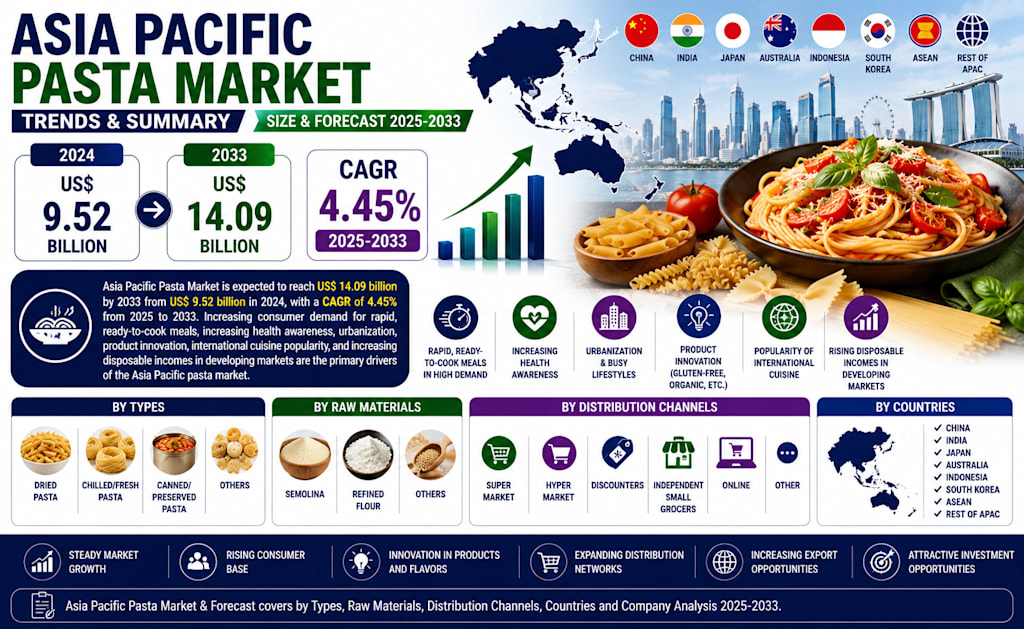
Asia Pacific Pasta Market Overview
The Asia Pacific pasta market is witnessing steady growth as changing consumer lifestyles, urbanization, and increasing demand for convenient meal solutions continue reshaping food consumption patterns across the region. According to Renub Research, the market is expected to grow from US$ 9.52 billion in 2024 to US$ 14.09 billion by 2033, expanding at a CAGR of 4.45% from 2025 to 2033. Rising demand for ready-to-cook foods, growing health awareness, product innovation, increasing disposable incomes, and expanding international cuisine influence are among the major factors supporting market growth.
Pasta has evolved from being a niche Western food category into a mainstream convenience meal across many Asia Pacific countries. Modern consumers increasingly prefer meals that are quick to prepare while still offering flexibility, taste, and nutritional value. Pasta fits well into these changing dietary habits because it can be adapted into a wide variety of recipes using locally available ingredients and regional flavors.
The market is also benefiting from broader changes in the food industry. Consumers are becoming more health-conscious and are seeking products that align with specific dietary preferences, including whole-grain, gluten-free, organic, low-carb, and high-protein foods. Manufacturers are responding with product diversification, improved packaging, and more sustainable sourcing strategies to attract modern consumers who value both convenience and wellness.
Urbanization and Busy Lifestyles Driving Demand
Urbanization remains one of the strongest drivers of the Asia Pacific pasta market. Rapid migration toward cities in countries such as China, India, Indonesia, and Southeast Asian economies has significantly altered eating habits and meal preparation patterns. Urban consumers increasingly prefer quick and convenient food products that reduce cooking time without compromising taste or quality.
The report notes that busy urban lifestyles, long working hours, and the rise of dual-income households are accelerating demand for ready-to-cook and ready-to-eat meals. Pasta’s simplicity, versatility, and fast preparation time make it particularly attractive for working professionals, students, and families with limited time for traditional cooking.
As urban populations continue expanding across Asia Pacific, exposure to international cuisines is also increasing. Younger consumers are more open to experimenting with global food trends, helping pasta become more deeply integrated into everyday diets. This cultural openness is expected to remain an important long-term growth driver for the market.
The combination of convenience and adaptability allows pasta to fit into both Western-inspired dishes and localized recipes tailored to regional tastes. This flexibility has become one of the category’s strongest competitive advantages in the evolving Asia Pacific food landscape.
Health Awareness Reshaping Consumer Preferences
Health consciousness is increasingly influencing pasta consumption patterns throughout Asia Pacific. Consumers are paying closer attention to nutritional value, ingredient quality, and dietary compatibility when purchasing packaged foods. This shift is creating strong demand for healthier pasta alternatives.
Manufacturers are introducing whole-grain, multigrain, gluten-free, organic, and fortified pasta products to meet changing dietary expectations. Consumers seeking healthier lifestyles are increasingly interested in products with higher protein content, lower carbohydrate levels, and cleaner ingredient labels.
The report highlights that companies are also emphasizing environmentally responsible practices and sustainable packaging to appeal to socially conscious buyers. Ethical sourcing, organic ingredients, and eco-friendly packaging are becoming important differentiators in a competitive food market.
This growing intersection between convenience and wellness is transforming pasta from a simple staple food into a more premium and lifestyle-oriented category. Brands capable of balancing taste, nutrition, affordability, and sustainability are likely to gain stronger market positions in the coming years.
E-Commerce Expansion Supporting Market Growth
The rapid expansion of e-commerce is significantly boosting the Asia Pacific pasta market by improving product accessibility and shopping convenience. Online grocery platforms, food delivery apps, and digital payment systems are changing how consumers purchase packaged foods across the region.
The report notes that e-commerce platforms allow consumers to explore a wide variety of pasta brands, flavors, and formats from the comfort of their homes. This is especially important in densely populated urban centers where busy schedules often limit time available for traditional shopping.
Countries such as India are witnessing rapid growth in internet penetration and digital payment adoption, which is further accelerating online food purchases. The convenience of home delivery and subscription-based grocery services is making pasta more widely available to both urban and semi-urban consumers.
Digital marketing and social media are also influencing consumer awareness. Brands are increasingly using online campaigns, cooking tutorials, and influencer collaborations to position pasta as a versatile, healthy, and modern meal solution. These strategies are helping attract younger consumers who are more engaged with digital food trends.
Product Innovation Strengthening Market Potential
Innovation remains one of the most important competitive factors in the Asia Pacific pasta industry. Companies are constantly introducing new flavors, meal kits, healthier formulations, and region-specific products to attract evolving consumer preferences.
The report highlights a notable example from South Korea, where Barilla and Pulmuone launched a new pasta meal kit in March 2022 aimed at offering consumers a convenient and healthy Italian food experience. The collaboration combined Barilla’s pasta expertise with Pulmuone’s strong local market presence, reflecting how international and regional companies are partnering to localize products for Asian consumers.
Manufacturers are also adapting flavors to regional tastes by incorporating spicy, savory, and fusion-style ingredients. This localization strategy is helping pasta gain wider acceptance among consumers who may still prefer traditional regional cuisines.
Meal kits, ready sauces, instant pasta products, and premium imported varieties are further expanding the category. As consumer demand becomes more sophisticated, innovation is expected to remain a critical driver of differentiation and growth across Asia Pacific markets.
Price Sensitivity Remains a Major Challenge
Despite strong growth opportunities, price sensitivity continues to present challenges in many Asia Pacific countries. The report notes that consumers in emerging economies are often highly price-conscious and may prioritize affordability over premium quality or international branding.
This creates difficulties for premium and imported pasta brands seeking broader market penetration. To remain competitive, companies frequently introduce smaller package sizes, localized pricing strategies, and economy product lines designed for budget-conscious households.
Maintaining product quality while keeping prices accessible is becoming increasingly important, particularly in developing markets where food inflation and economic uncertainty can influence purchasing decisions. Companies that successfully balance affordability with innovation are likely to perform best in the long term.
Supply Chain and Distribution Challenges
Supply chain issues remain another significant obstacle in the Asia Pacific pasta market. Transportation bottlenecks, inconsistent infrastructure, and rising logistics costs can disrupt product distribution, particularly in rural or underdeveloped regions.
Shortages of raw materials and higher transportation expenses may also affect product availability and pricing stability. Given the region’s geographic diversity and varying infrastructure quality, manufacturers and retailers must continuously optimize their supply chains to ensure timely product delivery and maintain freshness standards.
As demand continues rising, investment in warehousing, cold-chain systems, and digital inventory management is expected to become increasingly important for large food companies operating across Asia Pacific.
China Emerging as a Key Growth Market
China represents one of the largest growth opportunities in the Asia Pacific pasta industry. Rising urbanization, growing disposable incomes, and greater exposure to Western food culture are increasing pasta consumption, especially in urban areas.
Local manufacturers are adapting products to Chinese consumer preferences by incorporating spicy flavors and savory ingredients that align more closely with regional tastes. Meanwhile, international brands are expanding their presence through supermarkets, hypermarkets, and online retail platforms.
The combination of changing dietary habits, strong retail infrastructure, and digital commerce growth is expected to support continued market expansion in China over the coming years.
India Becoming a Fast-Growing Consumer Base
India’s pasta market is expanding rapidly because of urbanization, changing lifestyles, and rising awareness regarding convenient meal options. Pasta is becoming increasingly popular among younger consumers and working professionals who seek quick yet versatile meal solutions.
Health-conscious Indian consumers are also driving demand for whole wheat, multigrain, and gluten-free pasta varieties. Additionally, the growing influence of Western cuisine and international food culture is encouraging broader acceptance of pasta in Indian households.
As disposable incomes continue rising and modern retail channels expand, India is expected to remain one of the fastest-growing markets for pasta consumption in Asia Pacific.
Japan Focusing on Convenience and Health
Japan’s pasta market continues to grow steadily due to changing lifestyles and evolving consumer preferences. Busy urban populations are increasingly choosing convenience foods, while health-conscious consumers are seeking whole-grain and gluten-free options.
Japanese consumers also appreciate fusion-style culinary experiences, and pasta dishes incorporating local ingredients such as soy sauce, seafood, and miso are becoming increasingly popular. This blending of Italian and Japanese cuisines is helping expand the appeal of pasta across multiple demographic groups.
The Japanese market reflects a broader trend in Asia Pacific where pasta is evolving into a flexible and culturally adaptable food category rather than remaining strictly associated with Western cuisine.
Competitive Landscape and Key Companies
The Asia Pacific pasta market includes several major global and regional food companies competing through product innovation, localization strategies, and distribution expansion. Key players mentioned in the report include Ebro Foods S.A., General Mills, Campbell Soup Company, Conagra Foods Inc., Unilever, Nestlé S.A., ITC Ltd., and PT Indofood Sukses Makmur Tbk.
Competition is increasingly focused on flavor innovation, healthier product formulations, sustainable packaging, and premium meal experiences. Companies are also investing heavily in digital marketing, e-commerce partnerships, and localized product development to strengthen consumer engagement.
As consumer tastes continue evolving, brands capable of combining convenience, affordability, nutrition, and regional customization are expected to gain stronger competitive advantages across Asia Pacific markets.
Recent Developments by Companies
Barilla and Pulmuone launched a pasta meal kit in South Korea in 2022 aimed at providing consumers with a convenient and healthy Italian meal experience.
Nestlé expanded packaged food innovation strategies focused on convenience meals and healthier food alternatives across Asia Pacific markets.
ITC Ltd. strengthened its packaged foods portfolio in India by increasing focus on convenient and health-oriented meal products.
General Mills continued expanding international food offerings targeting younger urban consumers seeking quick meal solutions.
Conagra Foods invested in product diversification to meet growing demand for premium and ready-to-cook meal categories.
Unilever increased focus on sustainable packaging initiatives aligned with rising consumer interest in environmentally responsible food products.
Ebro Foods expanded premium pasta and convenience food offerings across key international markets.
PT Indofood Sukses Makmur strengthened regional distribution networks to improve accessibility of packaged food products.
Manufacturers across the sector accelerated gluten-free and whole-grain pasta launches to address rising health awareness among consumers.
Food companies increased e-commerce and online grocery partnerships to strengthen digital food retail distribution throughout Asia Pacific.
Final Thoughts
The Asia Pacific pasta market is evolving rapidly as convenience, health consciousness, urbanization, and international food culture continue influencing regional consumer behavior. Pasta is no longer viewed simply as a Western food product; it has become a versatile and adaptable meal category suited to modern lifestyles across Asia Pacific.
As e-commerce expands, disposable incomes rise, and food innovation accelerates, the market is expected to maintain stable long-term growth through 2033. Companies that successfully balance affordability, nutrition, convenience, and regional flavor preferences will likely emerge as leaders in the increasingly competitive Asia Pacific pasta industry.
About the Creator
Enjoyed the story? Support the Creator.
Subscribe for free to receive all their stories in your feed.
Comments
There are no comments for this story
Be the first to respond and start the conversation.