
Asia Pacific Organic Baby Food Market to Surpass USD 5.09 Billion by 2033 as Health-Conscious Parenting Reshapes Infant Nutrition
Rising demand for chemical-free infant nutrition, growing disposable incomes, and booming online retail channels are accelerating the growth of the Asia Pacific organic baby food industry.

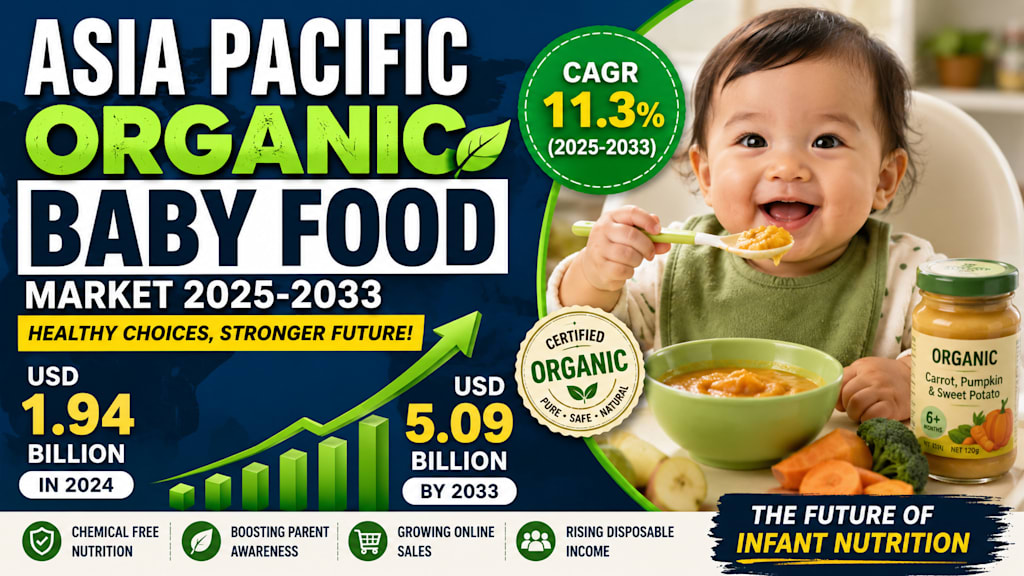
The Asia Pacific organic baby food market is witnessing remarkable growth as modern parents increasingly prioritize healthier, safer, and chemical-free nutrition for infants and toddlers. According to the market was valued at USD 1.94 billion in 2024 and is projected to reach USD 5.09 billion by 2033, expanding at an impressive CAGR of 11.3% from 2025 to 2033.
The rapid expansion of this sector reflects a larger transformation in consumer behavior across Asia Pacific. Urban families are becoming more health-conscious, educated, and selective about food choices for their children. Parents are increasingly reading labels, researching ingredients, and preferring products free from synthetic pesticides, preservatives, hormones, and genetically modified organisms (GMOs).
Organic baby food has evolved from a premium niche category into a mainstream parenting preference in several Asia Pacific countries including China, India, South Korea, Australia, and Japan. The growing influence of digital parenting communities, healthcare awareness campaigns, and social media discussions around infant nutrition is further pushing the demand upward.
Organic Baby Food Gains Momentum Across Asia Pacific
Organic baby food refers to infant and toddler nutrition products manufactured without synthetic fertilizers, pesticides, artificial additives, antibiotics, or genetically modified ingredients. These products are specially formulated to meet babies’ nutritional needs while ensuring safety and purity.
According to the report, parents in Asia Pacific are becoming increasingly concerned about chemical residues and artificial ingredients in traditional baby food products. This concern has significantly increased the appeal of organic alternatives.
The market is also benefiting from expanding retail accessibility. Organic baby food products are now widely available in supermarkets, convenience stores, pharmacies, specialty organic stores, and online retail platforms. E-commerce growth has especially transformed purchasing behavior, enabling parents to compare products, read reviews, and order premium nutrition products directly from home.
Another key factor driving growth is the increasing middle-class population across emerging Asian economies. Rising disposable income has made premium organic products more accessible to families that previously considered them unaffordable.
Health-Conscious Parenting Driving Demand
One of the strongest growth drivers in the Asia Pacific organic baby food market is rising parental awareness regarding infant health and wellness.
Today’s parents are more informed than ever before. They actively seek products that support immunity, digestion, brain development, and overall infant well-being. Organic baby food aligns perfectly with this evolving mindset because it is often perceived as cleaner, safer, and nutritionally superior.
The report highlights that parents are increasingly willing to pay premium prices for healthier baby food products, particularly in high-income and urban regions.
The growing focus on preventive healthcare is also influencing purchasing decisions. Parents believe that introducing natural and organic food at an early stage can help reduce future health risks and improve long-term wellness outcomes.
In addition, pediatricians and healthcare professionals across many Asia Pacific countries are increasingly emphasizing balanced nutrition during infancy, indirectly supporting the adoption of organic food products.
Rising Disposable Income Expanding Consumer Base
Economic growth across Asia Pacific has significantly increased household purchasing power over the last decade.
As disposable incomes continue to rise, families are shifting from price-sensitive purchasing to value-driven consumption. Parents are increasingly prioritizing product quality, safety, and nutritional value over affordability alone.
The report notes that increasing disposable income is making organic baby food more accessible to middle-income households throughout the region.
The trend is especially noticeable in countries like China and India, where millions of households are entering the middle-income segment annually. This economic transition is fueling demand for premium consumer products, including organic infant nutrition.
Furthermore, dual-income households are becoming more common across urban Asia Pacific, increasing spending capacity and demand for convenient, ready-to-use baby food solutions.
Urbanization and Busy Lifestyles Boost Market Growth
Rapid urbanization is reshaping family lifestyles across Asia Pacific.
Urban parents often face demanding work schedules, long commuting hours, and limited time for preparing homemade baby meals. This lifestyle shift has increased demand for convenient organic baby food products that offer both nutrition and ease of use.
Prepared organic baby foods such as pouches, cereals, fruit blends, and ready-to-eat meals are becoming highly popular among working parents. According to the report, urbanization and the rise of nuclear families are major contributors to market expansion.
Convenience remains a crucial competitive advantage for packaged organic baby food brands. Parents increasingly seek products that can save preparation time while maintaining high nutritional standards.
The growth of organized retail and food delivery infrastructure across urban Asia Pacific markets is also helping brands improve accessibility and visibility.
Online Retail Revolutionizing Organic Baby Food Sales
E-commerce platforms are playing a transformative role in the Asia Pacific organic baby food market.
Online shopping provides parents with access to a broader product range, detailed ingredient information, customer reviews, discounts, and subscription-based purchasing models. These advantages are encouraging more consumers to buy baby food products digitally.
The report highlights that online retail channels are experiencing substantial growth due to increasing smartphone penetration and internet accessibility.
Leading global platforms and regional e-commerce companies are heavily investing in baby care categories. Subscription delivery services, same-day shipping, and targeted digital marketing campaigns are further accelerating online sales growth.
Social media influencers and parenting bloggers are also playing a major role in promoting organic baby food brands across Asia Pacific markets.
China Emerges as a Key Growth Engine
China represents one of the fastest-growing organic baby food markets in Asia Pacific.
Several factors are contributing to this expansion, including rising urbanization, growing health awareness, increasing disposable income, and concerns regarding food safety standards.
Chinese parents are increasingly choosing premium imported and organic baby nutrition products following years of heightened awareness surrounding infant food safety issues.
The report notes that both local and international companies are rapidly strengthening their presence in China.
Major brands are also focusing on sustainability and environmentally friendly packaging to appeal to younger Chinese consumers who prioritize ethical and eco-conscious purchasing decisions.
India Becomes a Promising Emerging Market
India is quickly emerging as a highly attractive market for organic baby food manufacturers.
The country’s expanding middle class, increasing female workforce participation, and rising awareness regarding organic food benefits are contributing to stronger demand.
Modern Indian parents are increasingly seeking preservative-free and chemical-free baby nutrition products. Urban millennials especially prefer trusted branded products that offer convenience and certified organic ingredients.
The report highlights that domestic and international companies are actively targeting this rapidly growing segment.
India’s booming e-commerce ecosystem is also improving product accessibility in Tier 2 and Tier 3 cities, creating new opportunities for market expansion.
Product Segments Witness Diverse Growth Opportunities
The Asia Pacific organic baby food market includes several important product categories such as prepared baby food, dried baby food, infant milk formula, and other specialized products.
Prepared organic baby food remains one of the fastest-growing segments because of its convenience and ready-to-consume nature. Purees, cereals, fruit blends, and vegetable meals are particularly popular among urban parents.
Dried organic baby food products are also gaining traction due to their long shelf life and ease of storage. Powdered cereals and fruit powders are increasingly preferred by busy households seeking practical feeding solutions.
Infant milk formula remains a highly competitive category as manufacturers continue introducing premium organic variants fortified with vitamins, probiotics, and immune-supporting ingredients.
Challenges Continue to Impact Industry Expansion
Despite strong growth potential, the market still faces several challenges.
One of the biggest barriers is the high cost of organic products. Organic farming, certification, and quality assurance processes increase manufacturing expenses, making organic baby food significantly more expensive than conventional alternatives.
This pricing gap limits adoption among lower-income households in many developing Asia Pacific countries.
Distribution limitations also remain a challenge, especially in rural areas where access to premium organic products is relatively low. Many rural consumers still rely on traditional retail infrastructure with limited availability of certified organic products.
However, ongoing investments in retail expansion, logistics infrastructure, and digital commerce are expected to gradually address these limitations.
10 Recent Developments by Leading Companies
1. Nestlé S.A.
In July 2022, Nestlé launched China’s first carbon-neutral toddler formula product, Organic NAN 3, produced using Swiss organic farming methods without herbicides or growth hormones.
2. Mother Dairy
Mother Dairy partnered with Bharat Organics in December 2024 to improve the availability of certified organic products across the Delhi NCR region.
3. Rafferty's Garden
Rafferty’s Garden collaborated with Vegemite in July 2022 to launch fortified Cheesy Bread Sticks for children aged 12 months and older.
4. Abbott Laboratories
Abbott continues expanding its premium pediatric nutrition portfolio across Asia Pacific markets through stronger retail partnerships and product innovation.
5. Danone SA
Danone is strengthening its organic and clean-label infant nutrition offerings to meet growing regional demand for healthier baby food products.
6. Kewpie Corporation
Kewpie continues expanding its baby nutrition business by focusing on high-quality and additive-free infant food products in Japan and neighboring markets.
7. Hero Group
Hero Group is increasing investment in organic baby food innovation and sustainable packaging solutions for environmentally conscious consumers.
8. Arla Foods amba
Arla Foods is expanding its organic dairy-based infant nutrition portfolio throughout Asia Pacific.
9. Early Foods Private Limited
Early Foods continues promoting preservative-free and traditional nutrition-based organic baby food products across India.
10. Kraft Heinz
Kraft Heinz is increasing focus on premium and health-oriented baby food categories to strengthen its global nutrition business.
Final Thoughts
The Asia Pacific organic baby food market is entering a powerful growth phase driven by changing consumer lifestyles, increasing health awareness, urbanization, and rising purchasing power.
Modern parents are no longer treating baby food as a simple necessity. Instead, they are viewing infant nutrition as a long-term investment in their children’s health and development. This shift is fundamentally transforming the competitive landscape of the baby food industry across Asia Pacific.
As digital retail continues to expand and awareness regarding chemical-free nutrition grows, organic baby food is expected to become increasingly mainstream rather than remaining a premium niche category.
Companies that prioritize transparency, clean-label ingredients, sustainability, affordability, and convenient product formats will likely dominate the next decade of growth in this rapidly evolving market.
About the Creator
Enjoyed the story? Support the Creator.
Subscribe for free to receive all their stories in your feed.
Comments
There are no comments for this story
Be the first to respond and start the conversation.