
Asia Pacific Fast Food Market Set for Strong Expansion as Digital Ordering and Urban Lifestyles Fuel Demand
Rising Urbanization, Youth Consumption Trends, and Expanding Quick-Service Chains Push Asia Pacific Fast Food Industry Toward USD 465.12 Billion by 2033

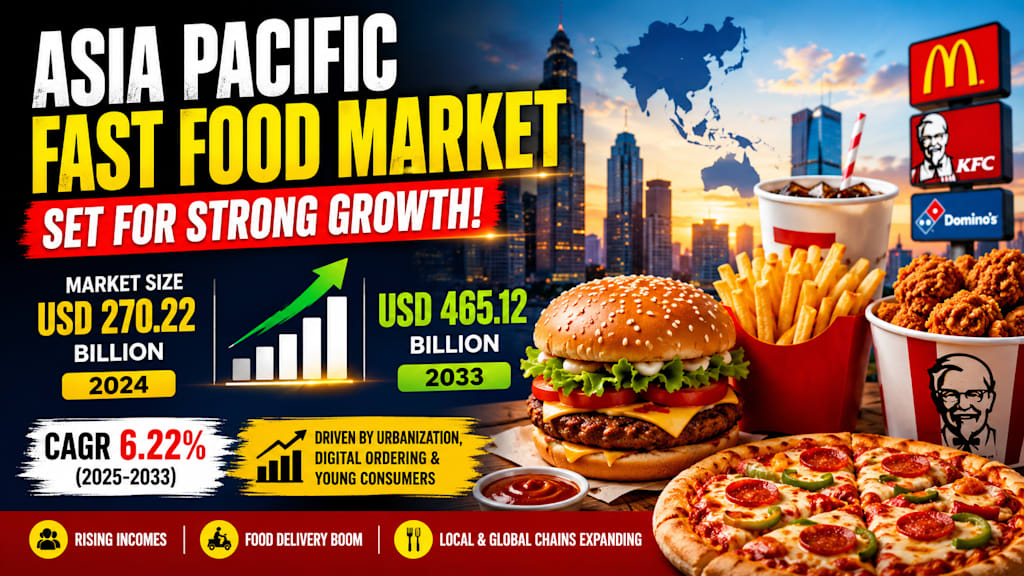
The Asia Pacific fast food industry is entering a transformative growth phase as changing lifestyles, digital food delivery ecosystems, and increasing urban populations continue reshaping how consumers eat across the region. According to Renub Research, the Asia Pacific fast food market was valued at USD 270.22 billion in 2024 and is projected to reach USD 465.12 billion by 2033, growing at a CAGR of 6.22% during the forecast period from 2025 to 2033.
Fast food has become deeply integrated into modern urban life throughout Asia Pacific. Consumers increasingly prefer affordable, convenient, and quickly accessible meal options, particularly in rapidly growing metropolitan regions. From burgers and fried chicken to pizzas, noodles, seafood snacks, and localized menu innovations, fast food brands are adapting rapidly to evolving consumer expectations.
The industry’s momentum is being driven by several major factors, including rising disposable incomes, expanding middle-class populations, growing participation of women in the workforce, and the explosive popularity of online food delivery applications.
Urbanization Continues to Transform Eating Habits
Urbanization remains one of the strongest growth drivers for the Asia Pacific fast food market. As millions of people migrate toward urban centers, lifestyles have become significantly faster and more convenience-oriented.
Consumers working long hours in crowded cities increasingly prefer ready-to-eat meals instead of preparing food at home. Dual-income households have also expanded sharply, leaving less time for traditional cooking routines. This has created massive opportunities for quick-service restaurants (QSRs) and fast food chains to scale operations across the region.
Asia currently accounts for more than 54% of the global urban population, representing over 2.2 billion people. By 2050, another 1.2 billion people are expected to join Asia’s urban population, creating even greater demand for convenient dining solutions.
Countries like India, China, Indonesia, Thailand, and Vietnam are witnessing rapid urban expansion, fueling demand for modern food retail and organized restaurant chains.
Young Consumers Are Reshaping the Industry
Asia Pacific is home to one of the world’s youngest consumer bases, and this demographic shift is significantly influencing the fast food landscape.
Younger consumers are highly connected to social media, digital marketing campaigns, and global food trends. Fast food companies are aggressively targeting millennials and Gen Z customers through influencer collaborations, mobile app promotions, loyalty programs, and personalized meal offers.
The region contains nearly 750 million young individuals between the ages of 15 and 24, representing approximately 60% of the world’s youth population.
This digitally engaged generation prefers convenience, affordability, speed, and flavor diversity. As a result, fast food brands are continuously innovating menus and introducing localized products to capture long-term customer loyalty.
Online Food Delivery Is Revolutionizing Fast Food Consumption
The explosive growth of food delivery platforms has fundamentally transformed the Asia Pacific fast food ecosystem.
Applications such as Zomato, GrabFood, Foodpanda, Swiggy, and Uber Eats have made restaurant access easier than ever before. Consumers can now order meals instantly through smartphones, creating an entirely new layer of demand for fast food operators.
Delivery-focused business models, cloud kitchens, and app-exclusive promotional offers have allowed even smaller fast food brands to compete with multinational chains.
Quick-service restaurants are increasingly investing in digital infrastructure, AI-based recommendations, customer data analytics, and faster delivery logistics to improve customer experiences and increase repeat orders.
Digital convenience has become one of the strongest competitive advantages within the industry.
Global Chains Continue Aggressive Expansion Across Asia Pacific
International restaurant giants continue expanding aggressively across tier-1, tier-2, and tier-3 cities throughout Asia Pacific.
Major brands including McDonald's Corporation, Yum! Brands, Inc, Domino's Pizza Inc, and Papa John's International Inc are opening new outlets at a rapid pace to strengthen regional presence.
These brands are increasingly adapting menus to regional tastes. Rice bowls, vegetarian burgers, spicy chicken meals, seafood options, and locally inspired sauces are helping global chains connect with Asian consumers more effectively.
Franchise partnerships, supply chain optimization, and strong branding campaigns are also supporting rapid expansion.
At the same time, local fast food companies are becoming stronger competitors by offering culturally familiar menu items at affordable prices.
Chicken Segment Maintains Market Leadership
Among product categories, chicken-based fast food remains one of the strongest-performing segments across Asia Pacific.
Fried chicken, grilled wraps, spicy wings, and chicken rice bowls continue attracting consumers because they offer affordability, taste, and perceived protein value.
Brands like Kentucky Fried Chicken (KFC) and regional chicken-focused restaurant chains are expanding aggressively in countries such as India, South Korea, and the Philippines.
Localized flavor innovation has become essential. Spicy Korean chicken, Indian masala flavors, teriyaki-based offerings, and sweet-and-spicy sauces are increasingly popular among younger customers.
Combo meals and aggressive promotional pricing strategies continue strengthening consumer demand within this category.
Pizza and Pasta Demand Continues Rising
Pizza and pasta fast food categories are also witnessing significant growth across urban Asia Pacific markets.
International brands have successfully introduced localized toppings and flavor profiles to appeal to regional preferences. Spicy sauces, paneer toppings, seafood combinations, and vegetarian variants are helping expand consumer acceptance.
Affordable combo offers, family meal packages, and digital ordering discounts have further increased the popularity of pizza-based quick-service dining.
Consumers increasingly view pizza and pasta as social dining products suitable for family gatherings, celebrations, and group events.
Seafood Fast Food Gains Momentum
Seafood-based fast food is emerging as an important niche segment, particularly in coastal markets such as Japan, South Korea, Thailand, and Malaysia.
Consumers are increasingly attracted to seafood options due to growing health awareness and interest in protein-rich meals.
Fish burgers, calamari, shrimp snacks, tempura meals, and seafood rice bowls are becoming more visible across quick-service restaurant menus.
Sustainability and traceability are also becoming important purchasing considerations, encouraging restaurant chains to emphasize responsible sourcing practices.
Health Concerns Present Major Industry Challenges
Despite strong market growth, the industry faces mounting pressure from rising health consciousness among consumers.
Concerns regarding obesity, diabetes, cardiovascular diseases, and excessive processed food consumption are encouraging many consumers to reduce fast food intake.
Governments and public health agencies throughout Asia Pacific are increasingly promoting nutritional awareness campaigns and healthier eating habits.
This trend is forcing fast food brands to reformulate menus, reduce portion sizes, and introduce healthier alternatives such as salads, grilled products, plant-based items, and low-calorie beverages.
Balancing taste, affordability, and nutritional value remains a major challenge for fast food operators.
Supply Chain and Inflation Pressures Impact Operations
The industry is also facing operational challenges linked to rising input costs and supply chain instability.
Fast food businesses rely heavily on stable supplies of poultry, dairy products, wheat, seafood, vegetables, and packaging materials. Inflation, geopolitical tensions, fuel price volatility, and climate-related disruptions have increased operational expenses across many Asia Pacific economies.
Smaller restaurant chains are especially vulnerable to shrinking profit margins.
As a result, many companies are investing in local sourcing, supply chain diversification, and operational automation to improve resilience and maintain profitability.
China Leads Regional Market Growth
China remains one of the largest and fastest-growing fast food markets in Asia Pacific.
International chains have achieved massive scale in China, while local fast food operators continue gaining popularity with regionally inspired offerings.
One notable development occurred in May 2024 when Chinese fast food brand Tastien expanded to 7,254 stores across 342 cities in 22 provinces. The company became widely recognized for introducing Chinese-style burgers featuring fillings such as Peking duck and Mapo tofu.
The country’s strong digital payment infrastructure and advanced food delivery ecosystem continue supporting rapid market expansion.
India Emerges as a High-Potential Growth Market
India is experiencing strong fast food market growth due to urbanization, rising incomes, and changing lifestyles.
International brands are competing aggressively with local fast food vendors offering culturally familiar products such as samosas, pav bhaji, and vada pav.
Vegetarian menus, spicy regional flavors, and value pricing are crucial success factors in the Indian market.
In December 2024, Burger King launched a new outlet at City Centre Mall in Raipur and announced additional expansion plans within Chhattisgarh.
Digital ordering platforms and food delivery services continue driving higher restaurant penetration across smaller Indian cities.
South Korea and Thailand Drive Innovation
South Korea continues demonstrating strong demand for technologically integrated fast food experiences.
Consumers increasingly use delivery apps for ordering, while plant-based and premium fast food products are gaining popularity. In April 2023, Shinsegae Food launched a fully plant-based burger called Better Burger using alternative proteins derived from soybeans and cashews.
Meanwhile, Thailand is seeing rapid growth driven by tourism, urbanization, and expanding food delivery usage.
Thai Beverage PCL introduced “Oishi Biztoro” in 2022, combining fast food convenience with full-service dining experiences.
10 Recent Developments from Leading Companies
- McDonald's Corporation continued expanding digital ordering and AI-driven customer personalization initiatives across Asia Pacific locations.
- Domino's Pizza Inc strengthened delivery infrastructure and app-based ordering systems to improve customer retention.
- Yum! Brands, Inc accelerated outlet expansion in emerging Asian cities through franchise partnerships.
- Kentucky Fried Chicken (KFC) introduced more localized spicy chicken flavors tailored for Asian consumers.
- Papa John's International Inc expanded regional menu customization strategies to strengthen local market engagement.
- Starbucks Corp increased investment in mobile ordering and premium quick-service beverage formats across Asia Pacific.
- Tastien expanded to more than 7,000 outlets across China while promoting Chinese-inspired burger innovations.
- Shinsegae Food introduced the fully plant-based Better Burger in South Korea to address growing health-conscious consumer demand.
- Burger King expanded into new Indian cities including Raipur to strengthen regional penetration.
- Thai Beverage PCL launched the “Oishi Biztoro” hybrid restaurant concept to blend convenience with dine-in experiences.
Final Thoughts
The Asia Pacific fast food market is entering a powerful long-term growth cycle fueled by urbanization, rising digital engagement, expanding middle-class spending, and changing consumer lifestyles.
Fast food companies are no longer simply competing on speed and affordability. Innovation, localization, health-conscious menus, sustainability efforts, and digital convenience are now shaping the next phase of industry competition.
As consumers increasingly seek convenience-driven dining experiences, Asia Pacific is expected to remain one of the most dynamic and profitable fast food markets globally over the coming decade.
The combination of youthful demographics, rapid technological adoption, expanding food delivery ecosystems, and aggressive restaurant expansion strategies positions the region for sustained industry transformation through 2033.
About the Creator
Enjoyed the story? Support the Creator.
Subscribe for free to receive all their stories in your feed.
Comments
There are no comments for this story
Be the first to respond and start the conversation.