
Artificial Turf Market Trends: Sustainable Landscaping, Sports Infrastructure & Forecast to 2034
How rising demand for low-maintenance landscaping, water conservation needs, and urban development projects are driving adoption and innovation in the artificial turf market

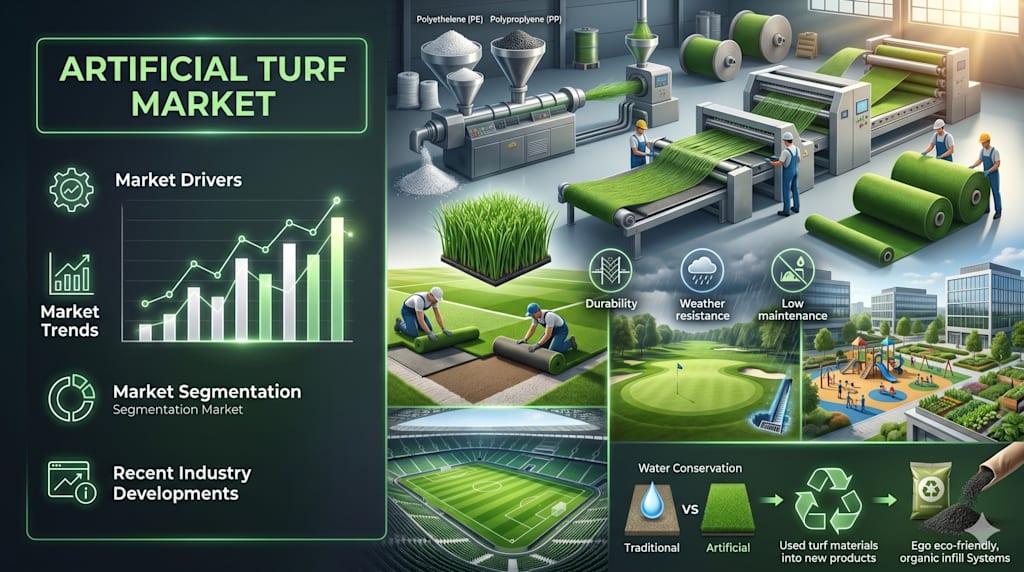
According to IMARC Group's latest research publication, the global artificial turf market size reached USD 3,935.3 Million in 2025. Looking forward, IMARC Group expects the market to reach USD 6,022.5 Million by 2034, exhibiting a growth rate (CAGR) of 4.70% during 2026-2034.
How AI is Reshaping the Future of the Artificial Turf Market
- Smart Installation Planning and Site Optimization: AI-powered design platforms are enabling contractors, municipalities, and sports facility managers to optimize artificial turf installation layouts with precision that was previously unattainable. By processing terrain data, drainage gradients, foot traffic projections, and climate variables simultaneously, these systems recommend the most suitable turf specifications for each application. Municipalities investing in synthetic sports grounds are increasingly relying on AI-assisted planning tools to minimize material waste, reduce installation timelines, and ensure long-term performance consistency across diverse surface conditions in both urban and semi-urban environments.
- Predictive Maintenance and Surface Lifecycle Management: Machine learning algorithms are transforming how artificial turf operators manage surface upkeep by continuously analyzing wear patterns, fiber integrity data, and usage frequency to predict when maintenance interventions are required. These AI-driven maintenance systems enable facility operators to schedule brushing, infill replenishment, and seam repair proactively rather than reactively, significantly extending turf lifespan and reducing unexpected downtime. For high-traffic sports complexes and airport installations, where surface reliability is operationally critical, predictive maintenance tools are delivering measurable improvements in cost efficiency and surface safety standards.
- Material Innovation Accelerated by Computational Modelling: Manufacturers are deploying AI-based computational modelling to accelerate the development of next-generation artificial turf fibers with enhanced UV stabilization, weather resistance, and recyclability properties. These modelling tools simulate years of environmental exposure in compressed timeframes, enabling R&D teams to validate material formulations before physical prototyping begins. This capability is directly shortening development cycles for eco-friendly turf products, including PFAS-free and natural-fiber alternatives that are gaining regulatory and commercial momentum across European and North American markets, where environmental compliance requirements are becoming increasingly stringent.
- Quality Control and Defect Detection in Manufacturing: Computer vision systems powered by deep learning are being integrated into artificial turf production lines to detect fiber inconsistencies, backing defects, and pile height deviations with exceptional accuracy at production speeds impossible for manual inspection. These automated quality assurance systems ensure that only turf meeting precise performance and aesthetic specifications reaches end customers, reducing product returns and warranty claims for manufacturers. For polyethylene-based turf, which dominates the material segment, maintaining consistent fiber density and texture uniformity is essential to delivering the natural-looking surface appearance that drives consumer and institutional purchasing decisions.
- Supply Chain Transparency and Circular Economy Integration: AI technologies combined with digital tracking systems are enabling artificial turf manufacturers to build fully transparent supply chains that document raw material sourcing, production processes, and end-of-life recycling pathways. This traceability capability is particularly valuable as the industry faces growing regulatory and consumer pressure to address the environmental impact of non-biodegradable turf materials. Companies partnering with chemical recyclers and waste management platforms are leveraging AI-powered logistics tools to coordinate the return, processing, and repurposing of used turf at scale, supporting the transition toward a more circular business model across the global artificial turf value chain.
Artificial Turf Industry Overview:
Europe leads the global artificial turf market, driven by a strong sports culture, rigorous standards for sports field construction, and an accelerating focus on environmental sustainability and water conservation. International tournaments are serving as powerful catalysts for infrastructure expansion across the continent, with FIFA citing examples such as the expansion of the MPHPArena for EURO 2024 and the construction of the new Casement Park for EURO 2028 as landmark projects propelling synthetic surface adoption. In North America, rapid expansion in football, soccer, and recreational area installations is fueling demand, while the United States and Canada continue to invest in upgrading aging natural grass fields at schools, universities, and municipal parks with durable synthetic alternatives.
In the Asia-Pacific region, countries including Japan, Australia, and South Korea are adopting artificial turf across sports fields, golf courses, and urban landscaping projects, with government-led infrastructure initiatives providing structural demand support. The Tripura government in India exemplified this trend in April 2025 by inaugurating three synthetic sports grounds covering athletic, hockey, and football turfs, demonstrating how regional governments are prioritizing sports infrastructure as part of broader urban development agendas. According to the World Bank, 56% of the world's population, approximately 2.4 Billion people, currently live in cities, with this figure expected to more than double by 2050 as nearly seven in ten people move to urban areas, creating sustained demand for space-efficient, low-maintenance green surface solutions that artificial turf is uniquely positioned to deliver.
Artificial Turf Market Trends and Drivers
The rising demand for sustainable and environmentally responsible surface solutions is the primary structural driver reshaping the artificial turf market. Growing awareness about ecological conservation is intensifying pressure on manufacturers to develop products that minimize environmental footprint across their full lifecycle, from raw material sourcing through to end-of-life disposal. In March 2023, Encina Development Group announced a recycling partnership with Shaw Industries Group under which Shaw committed to supplying Encina with more than 2 million pounds of waste materials from its carpet manufacturing processes annually, demonstrating how leading industry players are embedding circular economy principles into their operational models. In April 2024, Dow announced two new partnerships at Chinaplas 2024 to develop solutions meeting both performance and circular demand requirements, including e-commerce packaging using REVOLOOP post-consumer recycled resins, reflecting the broader materials industry commitment to reducing virgin plastic consumption that is directly influencing artificial turf fiber development strategies.
Rapid urbanization combined with increasing sports participation rates is simultaneously creating structural demand that the market is well positioned to capture. As cities grow denser and available outdoor space per capita contracts, artificial turf provides municipal planners, hospitality operators, and commercial developers with a practical solution that maintains green, aesthetically appealing environments without the water consumption, maintenance labor, and weather dependency constraints associated with natural grass. The sports and leisure application segment accounts for the largest share of the artificial turf market, driven by the consistent playing characteristics, high foot traffic durability, and weather resilience that synthetic surfaces deliver across football, rugby, hockey, tennis, and multi-sport recreational installations. The widespread adoption of artificial turf in airports, hotels, restaurants, and commercial office environments further diversifies the demand base, as facility managers across sectors prioritize water-saving properties, year-round appearance consistency, and reduced groundskeeping costs as core operational benefits.
Technological advancement and product innovation are creating significant differentiation opportunities and expanding the addressable market for artificial turf manufacturers. In October 2023, Condor Grass introduced a world-first color shift technology, the result of years of research and extensive testing, producing artificial grass that reacts to outdoor temperatures and changes color with the seasons, adding natural visual properties previously unachievable in synthetic surfaces. Advanced UV stabilization technology now enables artificial turf to resist color fading from prolonged sun exposure, maintaining vibrant and natural-looking appearances over extended installation periods. Innovative perforated backing materials and drainage system designs are facilitating efficient water management, preventing surface accumulation and improving playability in wet conditions across all application segments from household gardens to professional sports stadiums.
Leading Companies Operating in the Global Artificial Turf Industry:
- Act Global
- CCGrass
- Condor Group
- Forest Group
- Global Syn-Turf
- Polytan GmbH
- Shaw Industries Group Inc. (Berkshire Hathaway Company)
- SIS Pitches
- SpectraTurf Inc. (Ecore International Inc.)
- Sport Group
- Tarkett North America
- TenCate Grass Holding B.V.
- Tiger Turf
Artificial Turf Market Report Segmentation:
By Material:
- Polyethylene
- Polypropylene
- Polyamides
- Others
Polyethylene represents the largest material segment owing to its exceptional resilience, resistance to wear and tear under intensive use, soft and natural-looking texture that closely replicates real grass, and superior comfort for athletes and users who come into direct contact with the surface during sports activities.
By Application:
- Household
- Sports and Leisure
- Restaurant and Hotels
- Airports and Commercial Offices
- Others
Sports and leisure account for the largest application segment, driven by the performance consistency, weather resilience, and high foot traffic durability that artificial turf delivers across professional stadiums, recreational facilities, schools, and multi-sport complexes globally.
By Distribution Channel:
- Direct Sales/B2B
- Online Stores
- Specialty Stores
- Convenience Stores
- Others
Direct sales through B2B channels remain a primary distribution route for large-scale institutional and commercial buyers, while online stores are expanding accessibility for residential and small-scale commercial purchasers through convenient product comparison, competitive pricing, and broad product assortment.
Regional Insights:
- North America (United States, Canada)
- Asia Pacific (China, Japan, India, South Korea, Australia, Indonesia, Others)
- Europe (Germany, France, United Kingdom, Italy, Spain, Russia, Others)
- Latin America (Brazil, Mexico, Others)
- Middle East and Africa
Europe exhibits clear dominance in the artificial turf market, driven by its early adoption of synthetic surface technology, stringent sports field construction standards, strong environmental and sustainability regulations, and consistent investment in sports infrastructure linked to major international tournaments across Germany, the United Kingdom, France, and neighboring markets.
Recent News and Developments in the Artificial Turf Market
- April 2025: BASF and Hagihara Industries announced a partnership to develop highly durable polyolefin yarns specifically engineered for sports field applications. The collaboration is focused on enhancing artificial turf's weather resistance and structural longevity, contributing to measurable improvements in synthetic turf durability and increasing market demand for longer-lasting, high-performance artificial grass solutions across professional and recreational installations.
- March 2025: Notts Sport introduced CocoTurf, recognized as the world's first non-plastic artificial grass product manufactured from natural coconut fibers. Completely free from plastics, microplastics, and PFAS chemicals, this eco-friendly innovation is positioned to transform safety and sustainability standards for playground and recreational space installations, signaling a broader market shift toward genuinely green artificial surface alternatives.
- February 2025: TenCate launched Pivot, a PFAS-free and fully recyclable synthetic turf system that eliminates harmful chemical compounds while maintaining competitive performance standards. The infill-free design reduces abrasion and microplastic pollution during play, and the product carries a 12-year warranty backed by a lifespan that is 50% longer than conventional alternatives, establishing a new standard for durable and responsible synthetic sports surfaces.
Note: If you require specific details, data, or insights that are not currently included in the scope of this report, we are happy to accommodate your request. As part of our customization service, we will gather and provide the additional information you need, tailored to your specific requirements. Please let us know your exact needs, and we will ensure the report is updated accordingly to meet your expectations.
About the Creator
Abhay Rajput
I am working in market research company that provides market and business research intelligence across the globe.
Enjoyed the story? Support the Creator.
Subscribe for free to receive all their stories in your feed.
Comments
There are no comments for this story
Be the first to respond and start the conversation.