
Artificial Intelligence Camera Market Trends: Smart Surveillance, Deep Learning Integration & Forecast to 2034
How AI-powered imaging, real-time analytics, and intelligent surveillance systems are transforming security monitoring and automation capabilities in the artificial intelligence camera market

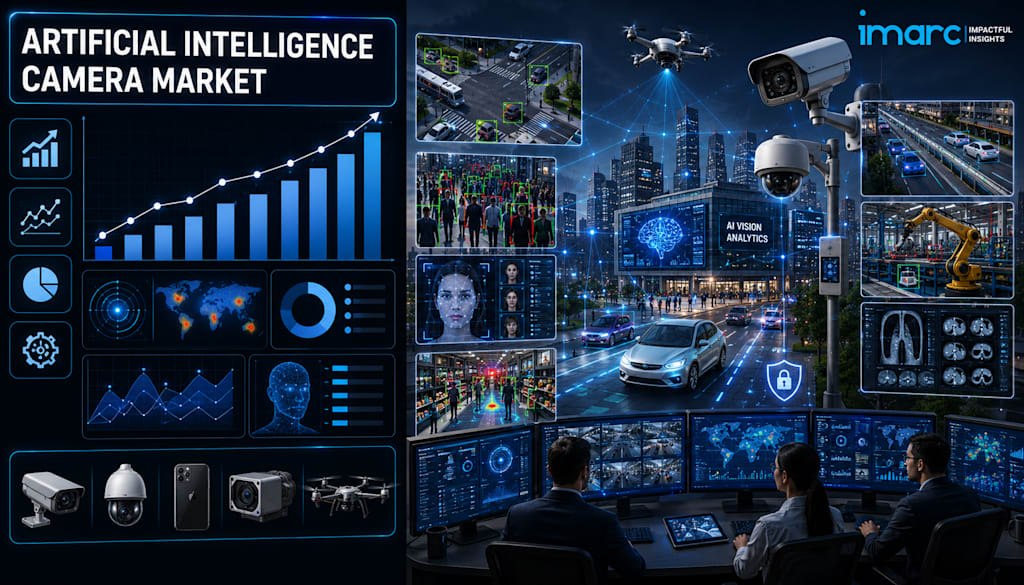
According to IMARC Group's latest research publication, The global artificial intelligence (AI) camera market size reached USD 9.0 Billion in 2025. Looking forward, IMARC Group expects the market to reach USD 27.2 Billion by 2034, exhibiting a growth rate (CAGR) of 12.74% during 2026-2034. The growing concerns regarding safety and security, rising adoption of AI-powered CCTV cameras, augmenting sales of premium feature-rich smartphones, and increasing product applications in traffic monitoring and homeland security represent some of the key factors driving the market.
How AI is Reshaping the Future of the Artificial Intelligence Camera Market
- Predictive Threat Detection and Behavioral Analytics: AI-powered camera systems use deep learning models to identify suspicious behavioral patterns in real time, going far beyond passive video recording. Airports, banking halls, and government buildings are deploying these systems to detect anomalies before incidents escalate. Financial institutions using AI-based surveillance have reported measurable reductions in fraud incidents, as facial recognition and motion-pattern analysis work continuously across high-traffic zones without human fatigue.
- Face Recognition and Automated Access Control: The shift from badge-based entry to AI camera-driven biometric access is accelerating across corporate campuses, healthcare facilities, and transit hubs. These systems cross-reference live facial data against registered databases in milliseconds, granting or denying access without physical contact. In large urban transit systems handling millions of daily commuters, this technology significantly cuts bottlenecks at entry points while simultaneously flagging individuals on watchlists.
- Computer Vision for Industrial Quality Assurance: Manufacturing lines across automotive, electronics, and food processing sectors are integrating AI cameras to automate visual inspections. These systems detect micro-defects, surface irregularities, and dimensional deviations at speeds that human inspectors cannot match. Companies deploying AI-based quality control cameras have seen defect escape rates decline sharply, with some reporting accuracy improvements exceeding 35% compared to manual inspection methods.
- Emotion Recognition for Retail and Customer Experience: Retailers and hospitality operators are using emotion-sensing AI cameras to analyze facial expressions at point-of-sale and service touchpoints. These systems gauge real-time customer sentiment, enabling staff to intervene when dissatisfaction is detected or adjust in-store layouts based on engagement data. A leading retail chain piloting this technology in 50 stores reported a 22% improvement in service intervention response times within three months of deployment.
- ADAS Integration in Automotive Safety Systems: AI cameras embedded in vehicles serve as the eyes of Advanced Driver Assistance Systems, supporting lane departure warnings, pedestrian detection, and automatic emergency braking. As automobile manufacturers expand their electric and semi-autonomous vehicle lines, AI camera modules are being treated as non-negotiable safety hardware. Major OEMs are now equipping entry-level models with multi-camera AI setups that were previously available only in premium segments.
- Remote Patient Monitoring in Healthcare Facilities: Hospitals and home-care platforms are deploying AI cameras to monitor patient movement, detect falls, and track behavioral changes associated with neurological conditions. These cameras flag abnormal activity to nursing staff without requiring constant physical presence in the room, improving care efficiency and reducing response time. Pilot programs across ICUs in several Asian hospitals demonstrated a 40% reduction in adverse event response delays following AI camera deployment.
- Smart City Traffic and Crowd Management: Municipal governments are embedding AI cameras in traffic signals, public squares, and transit corridors to dynamically manage vehicle flow and crowd density. The Delhi government, for instance, planned to install AI cameras across the national capital specifically to detect traffic violations and improve road safety, underscoring how public safety enforcement is driving government procurement at scale.
Artificial Intelligence Camera Industry Overview
The global surge in urbanization is one of the structural forces reshaping the AI camera market. With 56% of the world's population, roughly 4.4 billion people, now living in cities, and urban populations projected to represent nearly seven in ten people by 2050, governments and city planners face escalating pressure to manage infrastructure, security, and mobility with limited human resources. AI cameras have emerged as a practical and scalable response to this challenge. Smart city programs across China, India, South Korea, and the Middle East are channeling billions into integrated surveillance and traffic management networks where AI cameras serve as the primary data collection layer.
Smartphone proliferation is running in parallel as a consumer-side growth engine. Global smartphone subscriptions surpassed 6.7 billion, with penetration reaching 69%, and every new device generation brings higher-resolution, AI-enhanced camera systems. Manufacturers are competing aggressively on computational photography capabilities, embedding machine learning directly into camera chips to enable real-time scene recognition, subject tracking, and image enhancement. In July 2024, Infinix collaborated with Samsung Electronics to introduce a 108-megapixel AI-Powered Advanced Deep Learning Algorithm camera that leverages Samsung's ISOCELL sensor hardware to substantially elevate mobile photography performance.
The video surveillance sector broadly is expanding at a pace that directly lifts AI camera demand. The global video surveillance systems market reached USD 65.4 Billion, and the rapid migration from analog CCTV to AI-capable network cameras is the primary reason. Organizations are not just replacing old cameras but rearchitecting their entire surveillance infrastructure to support real-time analytics, cloud connectivity, and integration with identity management systems.
Asia Pacific holds the largest share of the global AI camera market, driven by accelerating smart city investments, high population density requiring scalable security solutions, and a regional technology manufacturing base that keeps hardware costs competitive. Countries across the region are integrating AI cameras into national-level security programs and urban infrastructure upgrades simultaneously.
Artificial Intelligence Camera Market Trends and Drivers
The three most significant structural drivers are safety concerns, smartphone adoption, and smart city development. Rising criminal and terrorist activities globally have pushed both public agencies and private enterprises to upgrade surveillance from passive recording to active AI-powered monitoring. The advent of 5G networks is a complementary accelerant, as high-bandwidth, low-latency connectivity makes it viable to stream multi-camera AI analytics to centralized platforms without local processing hardware at every node. Cloud-based AI camera management is now a commercially available model offered by providers across North America, Europe, and Asia.
Consumer device manufacturers are driving a secondary wave by normalizing AI camera capabilities in mass-market products. When 108-megapixel AI sensors become standard in mid-range smartphones, the underlying imaging and AI processing technology matures rapidly, and the cost curve falls for commercial and government applications drawing on the same component supply chains.
Health-conscious and safety-oriented behavior shifts following global health disruptions have also increased acceptance of contactless identification and remote monitoring technologies. AI cameras sit at the intersection of these trends, offering touchless access control and passive health monitoring without requiring individuals to interact with any equipment.
Leading Companies Operating in the Global Artificial Intelligence Camera Industry
- Avigilon Corporation
- Canon Inc.
- Eagle Eye Networks
- Hangzhou Hikvision Digital Technology Co. Ltd
- Hanwha Vision Co. Ltd. (Hanwha Aerospace Co. Ltd.)
- Honeywell International Inc.
- Huddly AS
- Mobotix AG
- Zhejiang Dahua Technology Co. Ltd.
Artificial Intelligence Camera Market Report Segmentation
By Technology:
- Image/Face Recognition
- Computer Vision
- Emotion Recognition
- Network Cameras
- Security Cameras
- Others
Image and face recognition technology represents the largest segment, as it addresses the most immediate and widespread security need across both public and private sector applications. Network cameras follow closely, driven by demand for remote monitoring in residential and commercial settings where real-time internet-based video access is a baseline requirement.
By End User:
- BFSI
- Healthcare
- Automotive
- Retail
- Government
- Logistics and Transportation
- Military and Defense
- Commercial Spaces
- Media and Entertainment
- Others
The government segment accounts for a substantial share owing to large-scale deployments in national security, border management, and municipal surveillance programs. Healthcare is the fastest-growing end-use category, propelled by remote patient monitoring adoption and the expansion of AI-enabled clinical environments.
Regional Insights:
- North America (United States, Canada)
- Asia Pacific (China, Japan, India, South Korea, Australia, Indonesia, Others)
- Europe (Germany, France, United Kingdom, Italy, Spain, Others)
- Latin America (Brazil, Mexico, Others)
- Middle East and Africa
Asia Pacific exhibits clear dominance in the artificial intelligence camera market. Rapid urbanization, national smart city programs, and increasing government expenditure on advanced security infrastructure are the primary contributors. The integration of AI and machine learning into camera platforms, alongside ongoing innovations in image recognition and real-time analytics, continues to widen the technology gap between AI-capable systems and legacy surveillance hardware across the region.
Recent News and Developments in the Artificial Intelligence Camera Market
- July 2024: Infinix collaborated with Samsung Electronics to introduce the 108-megapixel AI-Powered Advanced Deep Learning Algorithm (AIADLA) for smartphones, utilizing Samsung's ISOCELL image sensor hardware remosaic technology to substantially advance mobile photography performance.
- July 2024: ReelData launched ReelVision, a purpose-built AI camera for aquaculture applications including behavioral analysis, feeding rate monitoring, and fish health assessment, demonstrating AI camera adoption expanding into non-traditional verticals.
- January 2024: The Delhi government announced plans to install AI cameras across the national capital with a specific mandate to detect traffic violations and improve road safety, representing one of the largest government-led AI camera deployment programs in South Asia.
Note: If you require specific details, data, or insights that are not currently included in the scope of this report, we are happy to accommodate your request. As part of our customization service, we will gather and provide the additional information you need, tailored to your specific requirements. Please let us know your exact needs, and we will ensure the report is updated accordingly to meet your expectations.
About the Creator
Abhay Rajput
I am working in market research company that provides market and business research intelligence across the globe.
Enjoyed the story? Support the Creator.
Subscribe for free to receive all their stories in your feed.
Comments
There are no comments for this story
Be the first to respond and start the conversation.