
Archiving Childhood
How will kids today feel when they’re all grown up and searching for photos of their childhood?


Photography is an everyday habit now, with our phones being an extension of ourselves and the camera app being an extra set of eyes. We don’t just take photos to capture a beautiful moment. We snap photos to remember confirmation numbers, parking sign details, or even an interesting book we want to look up later. Not things we need to remember forever, but they’ll still get backed up to the cloud, just in case.
As someone who used to bring disposable cameras to sleepovers in the early 2000s to capture memories with friends, it feels like science fiction that we can capture photos (and videos!) with ease, back them up to the cloud immediately, and share them with others within seconds. Then the storage apps offer search functions, automated curation, and enhanced editing. The camera apps themselves even work to capture the perfect photos the moment we snap them.
As a young millennial, I could look through curated physical photo albums of my childhood sitting on my parents’ bookshelves. I also had access to the extra photos, most of which were deemed “bad” photos, tucked away in shoeboxes. Film cameras forced an archival system, not necessarily a good one, but one that happened without much thought. Film creates a scarcity of captured moments since the effort and cost per photo is high and every photo needs to be printed, good or bad. This has allowed a lot of us millennials to end up with an archive of our childhood that feels real. Many people even have baby books or scrapbooks that tell a more in-depth story of their childhood with dates, written notes, and other details next to each photo.
What is a modern equivalent today?
I believe Instagram is the ultimate, most accessible “scrapbooking” option today, while digital photo frames feel like those photo albums I found sitting on bookshelves growing up, especially since a kid can look through all the photos with little or no help from an adult. And those shoeboxes? I believe they have transformed into the automatic cloud storage connected to our camera apps. Except instead of the few hundred photos I had to look through, cloud storage gives us a secure spot to store thousands of photos, archiving childhood in more detail than ever before.
So, how will kids today feel when they’re all grown up and searching for photos of their childhood?
Instagram allows us to date, caption, and edit any photos or videos we want, and we can even add some fun music to remember the vibe of the preserved memory. There is a hurdle with social media, though, that didn’t exist when my parents were freely snapping photos of my childhood on their film camera…
The internet can be a dangerous place. Especially for kids.
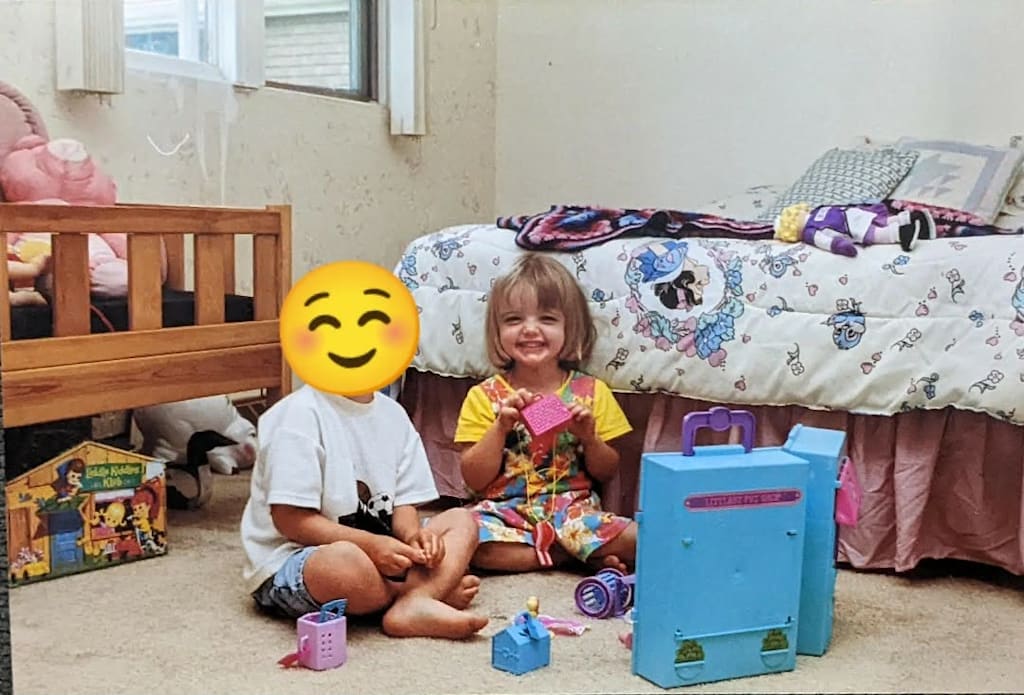
Parents are adapting in many ways to protect their kids from a digital footprint they didn’t consent to, either by not posting about their kids at all or by adding a blur or emoji to their kids’ faces. This is even being done on private accounts because social media never feels 100% private. If someone does feel comfortable sharing their kids’ faces on their public or private feed, the internet is still no place for anything that points to where a kid goes to school, where they live, or anything that could show a specific location they visit regularly.
The side effect is that when we are capturing photos with the intention of posting to social media, we are composing photos that hide the details that helped make the moment worth capturing in the first place. This can look like kids running away from the camera so we don’t see their happy, smiling faces. Spinning in a circle to create a natural blur on everyone in the photo. Or going to portrait mode to get that blurred background that keeps the location anonymous.
Even if we are capturing photos with all the details preserved, are we archiving them in a way that shows a real version of a kid's childhood? The playful mess of a birthday party with people half in frame, the drooling nap on a shoulder in the low evening light, or the weird fashion choices worn alongside school friends that a kid only knows for a brief time? Digital photo frames are where I see these types of preserved details, if captured, making it into the archive because the frames have the privacy factor of only being displayed for people coming into one’s home. Either way, though, social media and the digital photo frames are curated. A carefully crafted story that we feel okay having other people see. What about the tucked away shoeboxes I found that felt like a real archive of my childhood? Now the extra photos, the “bad” photos, are being automatically backed up to the cloud.
If I scroll through my backed-up photos on my phone right now, though, I will find intentional photos capturing details and memories, alongside screenshots, memes, and thousands of selfies. I can use the search function to find specific photos I’m looking for, but in the future, when my niblings are all grown up and want to browse through photos of their childhood, will they even know where to start? They would need access to the cloud storage in the first place, and then they could search for their face based on what the app has decided is the same person. But will that tell a story they are interested in? Searching this way, right now, results in a huge mess of photos since I, and many others, are trained to snap multiples of every moment “just in case.” My niblings are all under ten years old, and I already have thousands of photos of them. I, their aunt, already have thousands of photos of them.
So, if searching the cloud storage is too much, or not accessible in the first place, where will kids look for photos next? Say parents do have scrapbooks, printed photo albums, a digital picture frame, or something else a kid can access whenever they want. Will that compare to the details of an Instagram feed that a kid knows their parents used regularly throughout their childhood? A feed that perhaps shows more than a kid wanted for people they don’t know, or a feed that protected them so much that they’re there, but not really. Or maybe all they find is a feed that doesn’t even mention them, but they know from the dates listed that they were there the whole time. So they go back to the printed photo albums, digital picture frames, etc. Maybe they go back to the source and tackle the chaotic cloud storage. And maybe the “bad” photos are included in ways they can access that tell a pretty comprehensive story, because millennial parents have realized the fun of having access to the “bad” photos in the archive of their own childhoods.
But ultimately, will it feel real?
Cloud storage gives us a secure spot to store thousands of photos, archiving childhood in more detail than ever before… So it must be the most accurate and comprehensive depiction, right? Maybe. But the capabilities of the technology of millennial childhoods offered a crucial difference from how we are capturing memories today: No edits. I know that all those photos I found in shoeboxes are exactly as they were captured. Sure, cameras offer controls for shutter speed, lighting, etc., and the person taking the photo can play with angles, zoom, and more to help tell the story they want to be remembered, but the photos still feel real. Especially when printing the full rolls of film resulted in an uncurated but manageable amount of “bad” photos that created a story I cared to sort through.
Today, our photos are far safer than being in a flimsy shoebox, but technology has done more than just protect the photos… Even if we aren’t editing them ourselves, our camera apps are editing them in some capacity every time we snap a photo. The lighting is adjusted, the angle shifts slightly, or even the texture of our skin is automatically smoothed out. It’s actually pretty hard to capture a “bad” photo these days if all we're using is our phones.
So, how will kids today feel when they’re all grown up and searching for photos of their childhood?
About the Creator
Polite Adjacent
I am experimenting with my writing on Vocal while drafting my romance novel.
Follow my novel-writing journey here: youtube.com/@politeadjacent
I also share reflections about minimalism and money here: politeadjacent.blogspot.com
Enjoyed the story? Support the Creator.
Subscribe for free to receive all their stories in your feed. You could also become a paid subscriber, letting them know you appreciate their work.
Comments
There are no comments for this story
Be the first to respond and start the conversation.