
Aquaculture Market Outlook: Sustainable Seafood Production and Growth Opportunities
The Aquaculture Market is experiencing strong growth driven by increasing global demand for seafood and the need for sustainable fish production methods.

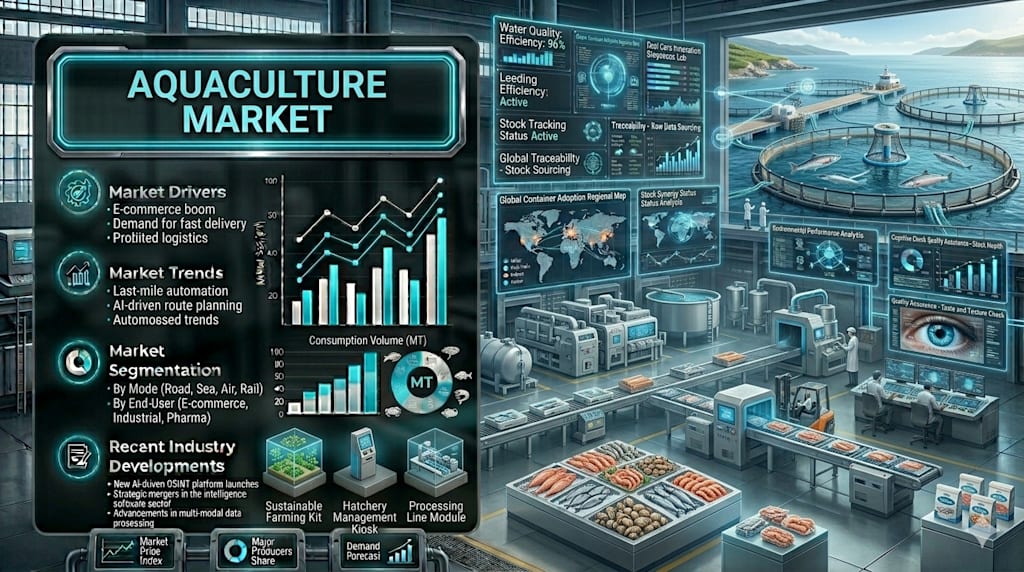
According to IMARC Group's latest research publication, The global aquaculture market size reached 86.1 Million Tons in 2025. Looking forward, IMARC Group estimates the market to reach 123.3 Million Tons by 2034, exhibiting a CAGR of 4.07% during 2026-2034
How AI is Reshaping the Future of the Aquaculture Market
- Smart Feed Management and Waste Reduction: AI-powered automated feeding systems are transforming aquaculture operations by delivering precise feed quantities based on real-time fish behavior and appetite signals. Machine learning algorithms process data from underwater cameras and sensors to eliminate overfeeding, which is a primary contributor to water quality degradation. Companies deploying these intelligent feeding systems report significant reductions in feed conversion ratios, lowering operational input costs while maintaining optimal fish growth rates.
- Water Quality Monitoring and Predictive Maintenance: IoT-integrated AI platforms continuously monitor dissolved oxygen levels, pH balance, ammonia concentration, and temperature across aquaculture facilities, enabling operators to detect anomalies before they escalate into disease outbreaks or mass mortality events. On 22nd and 23rd March 2024, the ICAR-Central Institute of Brackishwater Aquaculture organised a two-day Smart Aquaculture programme to promote AI and IoT adoption in farm water management, farm health monitoring, and supply chain integration.
- Disease Detection and Biosecurity Enhancement: Computer vision systems trained on millions of fish images can identify early signs of infection, parasitic infestation, or physical abnormalities with accuracy levels that far exceed manual observation. AI-powered health monitoring tools integrated into camera feeds at feeding stations and sorting machines flag individual fish exhibiting abnormal swimming patterns or lesions in real time, allowing farmers to isolate affected stock and administer targeted treatment.

Aquaculture Industry Overview
Asia Pacific dominates the global aquaculture landscape, accounting for more than 90.7% of total market share in 2024, with China alone contributing over 60% of regional production through advanced integrated multi-trophic aquaculture (IMTA) systems. India's Pradhan Mantri Matsya Sampada Yojana, backed by a USD 3 billion investment, is actively expanding domestic production capacity and sustainability standards, with a government study revealing that 72.1% of India's population, equivalent to 967 million individuals, regularly consumed fish. In the Middle East and Africa, Saudi Arabia's Vision 2030 is targeting an annual aquaculture output of 600,000 tons, supported by USD 200 million in directed investments. In North America, the United States Department of Agriculture committed USD 75 million in 2024 to sustainable aquaculture research, with companies such as Cooke Aquaculture and BlueNalu scaling production to meet growing domestic demand.
Aquaculture Market Trends and Drivers
Rising global protein demand and the rapid decline of wild fish stocks are the foundational forces driving aquaculture expansion worldwide. Overfishing and environmental degradation have structurally reduced wild catch volumes, making farmed seafood the most viable pathway to ensuring consistent global supply. Freshwater environments, including rivers, lakes, and ponds, currently support approximately 46.2% of total aquaculture production by both fish type and farming environment, favored for their lower operating costs, manageable salinity conditions, and biological suitability for high-demand species such as tilapia, catfish, and carp. The United States aquaculture segment alone accounts for over 70% of North American market volume in 2024, with NOAA's Aquaculture Opportunity Areas framework actively encouraging offshore production to supplement inshore operations and address geographic constraints on expansion.
Technological innovation and institutional investment are fundamentally reshaping how aquaculture is practiced across all production scales. In 2024, engineers from the University of California San Diego developed algae-based microrobots capable of navigating lung tissue to deliver cancer-treating agents directly to metastatic tumors in mice, highlighting the growing pharmaceutical value of aquatic organisms beyond food production. Lerøy Seafood Group, in February 2025, partnered with EWOS and environmental organization Bellona to integrate chicken meal into fish feed formulations, targeting a 46% reduction in greenhouse gas emissions by 2030, with scaled production beginning in spring 2025. Stolt-Nielsen announced investments exceeding USD 400 million in March 2025 to expand its US-based liquid logistics and RAS land-based aquaculture operations, including the launch of CleanRight, a chemical cleaning service designed for sustainable farm infrastructure maintenance.
Consumer behavior shifts toward organic, health-conscious, and locally sourced seafood are creating new market layers beyond traditional bulk commodity production. According to trade map data, the United States accounted for 15% of global seafood trade by value, followed by China at 12% and Japan at 9%, collectively representing the most concentrated demand centers for premium and sustainably certified aquaculture products. Health awareness campaigns linking omega-3 fatty acids and lean proteins to cardiovascular and cognitive benefits are expanding the seafood consumer base in urban markets, particularly among working-age professionals and the expanding global middle class in Asia, Latin America, and the Middle East. Thai Union Group, in May 2025, secured a landmark USD 150 million Blue Loan from the Asian Development Bank, the first such facility in Thailand's seafood sector, directed at advancing sustainable shrimp procurement and climate resilience under its SeaChange® 2030 strategy, setting a new benchmark for sustainability-linked aquaculture finance in Southeast Asia.
Leading Companies Operating in the Global Aquaculture Industry
- Blue Ridge Aquaculture
- Cermaq Group AS
- Charoen Pokphand Foods PCL
- Cooke Aquaculture
- Grieg Group
- Leroy
- Maruha Nichiro Corporation
- Mowi
- SalMar ASA
- Stehr Group
- Tassal Group
Aquaculture Market Report Segmentation
By Fish Type:
- Freshwater Fish
- Molluscs
- Crustaceans
- Others
Freshwater fish represent the largest segment, holding approximately 46.2% of total market share, driven by the adaptability of species such as tilapia, catfish, and carp to diverse farming environments and their alignment with global protein demand.
By Environment:
- Fresh Water
- Marine Water
- Brackish Water
Freshwater environments lead with around 46.2% of market share, offering lower production costs, simpler operations, and compatibility with the most commercially cultivated aquatic species worldwide.
By Distribution Channel:
- Traditional Retail
- Supermarkets and Hypermarkets
- Specialized Retailers
- Online Stores
- Others
Traditional retail holds the largest distribution share at approximately 32%, sustained by consumer trust in physical product selection, direct relationships with local producers, and broad geographic accessibility.
Regional Insights
- North America (United States, Canada)
- Asia Pacific (China, Indonesia, India, Vietnam, Philippines, South Korea, Japan, Thailand, Malaysia, Australia, Others)
- Europe (Norway, Spain, Russia, United Kingdom, France, Italy, Greece, Netherlands, Ireland, Denmark, Germany, Others)
- Latin America (Chile, Brazil, Ecuador, Mexico, Others)
- Middle East and Africa (Egypt, Turkey, Saudi Arabia, Others)
Asia Pacific holds clear dominance in the global aquaculture market, accounting for more than 90.7% of total market share, driven by optimal climatic conditions, abundant water resources, strong government support, and deep-rooted cultural consumption patterns that position the region as both the largest producer and consumer of farmed seafood.
Recent News and Developments in the Aquaculture Market
- May 2025: Thai Union Group secured a USD 150 million Blue Loan from the Asian Development Bank, the first of its kind in Thailand's seafood sector, to advance sustainable shrimp procurement under its SeaChange® 2030 strategy. The financing supports sourcing certified by Global Sustainable Seafood Initiative-recognized schemes, reinforcing climate commitments and social responsibility benchmarks across the shrimp aquaculture value chain.
- April 2025: South Korea's first land-based salmon farm, operated by Eco Aquafarm in Busan, began operations targeting 500 tons of Atlantic salmon annually using advanced RAS technology sourced from AKVA group. The facility supports South Korea's Smart Aquaculture Cluster initiative, features closed-loop filtration and smart monitoring systems, and is planned for expansion to 5,000 tons with global investment participation.
- March 2025: Kelly Cove Salmon Ltd., a division of Cooke Aquaculture Inc., acquired the former Aqua Bounty Canada Inc. operations on Prince Edward Island. The acquired hatchery and RAS infrastructure will be used to produce large smolts for Atlantic Canadian ocean farms, supporting Cooke's sustainable aquaculture expansion and local employment commitments in the region.
- March 2025: Stolt-Nielsen announced investments exceeding USD 400 million to expand US operations across liquid logistics and land-based aquaculture, including the launch of CleanRight and deployment of sustainable RAS for responsible seafood production, reinforcing commitments to innovation, environmental safety, and domestic market growth.
- February 2025: Lerøy Seafood Group advanced sustainability targets by integrating chicken meal into fish feed in partnership with EWOS and Bellona, targeting a 46% reduction in greenhouse gas emissions by 2030. Scaled production is set to begin in spring 2025, with extensive quality and sustainability testing already completed to validate the approach for commercial application.
Note: If you require specific details, data, or insights that are not currently included in the scope of this report, we are happy to accommodate your request. As part of our customization service, we will gather and provide the additional information you need, tailored to your specific requirements. Please let us know your exact needs, and we will ensure the report is updated accordingly to meet your expectations.
About the Creator
Olivia Smith
Olivia Smits is a Research and Marketing Analyst who specializes in market research, trend analysis, and consumer insights. I help businesses make smarter marketing and strategy decisions by turning data into clear, actionable insights.
Enjoyed the story? Support the Creator.
Subscribe for free to receive all their stories in your feed.
Comments
There are no comments for this story
Be the first to respond and start the conversation.