
Application Security Market Gains Momentum with AI-Driven Defense
How AI-powered threat detection, cloud-native security, and DevSecOps adoption are accelerating innovation and enterprise protection in the application security market

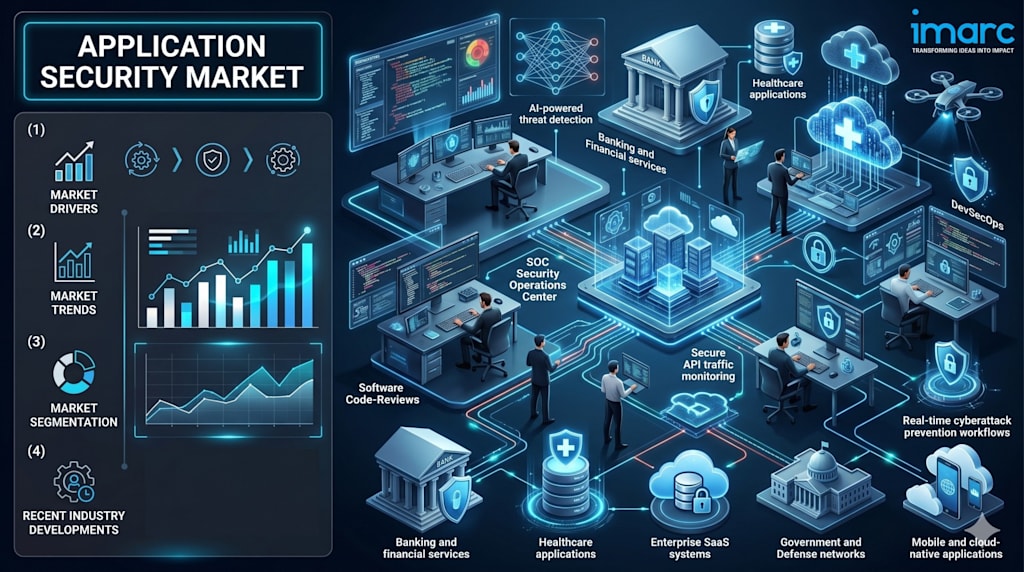
According to IMARC Group's latest research publication, The global application security market size was valued at USD 11.9 Billion in 2025. Looking forward, IMARC Group estimates the market to reach USD 37.6 Billion by 2034, exhibiting a CAGR of 13.21% during 2026-2034.
How Technology is Reshaping the Future of the Application Security Industry
- AI and Machine Learning Integration for Real-Time Threat Detection: The integration of artificial intelligence and machine learning into application security platforms is fundamentally changing how organizations identify and respond to threats, moving from rule-based detection that relies on known vulnerability signatures toward behavioral and predictive models capable of catching novel attack patterns in real time. AI-driven systems can analyze millions of application events simultaneously, flag anomalies indicative of SQL injection, cross-site scripting, and distributed denial-of-service attempts, and initiate automated responses before manual intervention is possible. In December 2025, Checkmarx acquired Tromzo, a pioneer in AI-native autonomous security agents, specifically to accelerate the shift toward autonomous application security where AI agents understand real enterprise risk, reason across complex software ecosystems, and remediate continuously with precision, with Tromzo's reasoning engine powering new Assist agents beginning in early 2026. This kind of AI-native architecture represents where the industry is heading as attack sophistication driven by adversarial AI demands defenses that operate at machine speed rather than human speed.
- DevSecOps Integration and Shift-Left Security Practices: The adoption of DevSecOps practices is reshaping how organizations approach application security by embedding testing and vulnerability management directly into the software development lifecycle rather than treating security as a post-deployment audit function. Static Application Security Testing, which holds 38.6% of the testing type segment, is the primary tool enabling this shift because it identifies vulnerabilities at the source code level before applications are ever deployed, reducing remediation costs and timelines compared to fixing issues discovered in production environments. In April 2025, IBM strengthened its application security and DevSecOps portfolio by integrating AI-driven vulnerability detection capabilities into its security platforms to help enterprises secure applications across hybrid cloud environments. The growing adoption of DevSecOps practices also reflects a broader industry recognition that security debt accumulated during development is significantly more expensive to address after the fact, making proactive code-level security testing a financial imperative as much as a technical one.
- Cloud-Based Application Security and API Protection: The rapid migration to cloud-native architectures, microservices, and API-driven application development has expanded the attack surface for organizations in ways that traditional perimeter-based security cannot address, creating strong demand for cloud-native application security solutions. In September 2024, Wiz introduced Wiz Code, a cloud application security product designed to help security and development teams identify and resolve cloud risks in code before they escalate, with the platform tracing issues back to their source in code and CI/CD pipelines and linking security problems to the responsible developer for faster resolution. In April 2025, HCLTech launched HCL AppScan API Security, an AI-infused platform designed to discover and secure APIs across development and runtime environments, specifically targeting shadow APIs and strengthening application security governance for enterprises managing large numbers of undocumented or poorly tracked API endpoints. As API-first architectures become the standard for enterprise software, the ability to inventory, monitor, and test APIs for security vulnerabilities has become a critical component of any comprehensive application security strategy.
- Regulatory Compliance Driving Mandatory Security Investment: Compliance requirements including GDPR, HIPAA, PCI DSS, and the California Consumer Privacy Act are functioning as hard floor constraints on application security investment, requiring organizations to implement specific technical controls and maintain demonstrable security testing programs as conditions of operating in regulated industries. This regulatory pressure is particularly acute in sectors including BFSI, healthcare, and government, where data breaches carry both significant financial penalties and reputational consequences that extend well beyond the cost of the security incident itself. Regulatory frameworks are also evolving to address AI-specific application risks, with emerging standards in Europe and the United States creating new compliance requirements for organizations developing or deploying AI-powered applications that process personal data. In February 2026, Qualys released new TotalAppSec vulnerability detection updates adding signatures to identify security flaws in widely used frameworks including Laravel, WordPress, Apache, and others, responding directly to the growing compliance-driven demand for comprehensive vulnerability coverage across the full technology stack that enterprise applications depend upon.
- Growing Attack Surface from Remote Work and Mobile Application Proliferation: The structural shift to remote and hybrid work has permanently expanded the attack surface for enterprise applications by moving access patterns away from controlled network perimeters and toward distributed access from diverse devices, locations, and network conditions. Employees accessing business applications from personal devices on home networks or public connections create credential theft, phishing, and unauthorized access risks that require application-layer security controls rather than network-level solutions. The proliferation of mobile applications across industries compounds this challenge, with mobile-first business workflows creating new exposure for organizations that have not extended their web application security programs to cover the mobile attack surface with equal rigor. In September 2024, F5 launched NGINX One, a unified solution combining load balancing, application server, API gateway, and security features under a single management interface with end-to-end visibility, directly addressing the operational complexity that organizations face when trying to maintain consistent security policy across distributed application delivery infrastructure in a remote-work-dominant environment.
Application Security Industry Overview:
The global application security market is experiencing sustained demand growth driven by the accelerating frequency and sophistication of cyberattacks targeting business applications across every industry vertical. North America accounts for 40.5% of the global market, with the United States representing 79.40% of the total North American IT services market share in 2024, reflecting the country's dense concentration of organizations with large application portfolios, significant regulatory exposure, and the institutional budget authority to make meaningful security investments. The United States application security market is projected to reach USD 8.68 Billion by 2032 on its own, illustrating the scale of domestic demand independent of the broader North American market.
The IT and telecom sector leads all industry verticals with 27.5% of market share, a position that reflects the sector's dual exposure as both a primary target for cyberattacks and a heavy user of the cloud, API, and mobile application architectures that create the largest application security challenges. The BFSI and healthcare sectors are close followers, driven by the combination of high-value data targets and mandatory compliance frameworks that require documented security testing programs as conditions of regulatory authorization to operate. In June 2025, Checkmarx enhanced its Checkmarx One application security platform with improved software composition analysis and API security testing capabilities specifically to help enterprises secure open-source dependencies and modern cloud-native applications, responding to growing enterprise demand for unified platform coverage that addresses the full breadth of the modern application security problem. Checkmarx One has achieved over USD 150 Million in annual recurring revenue within three years under new leadership, a commercial milestone that demonstrates the scale of enterprise demand for integrated, AI-powered application security platforms. In March 2024, Check Point Software Technologies and Microsoft entered a strategic partnership to integrate Check Point's application security capabilities within Microsoft's ecosystem, creating a significant combined coverage footprint for enterprise clients operating across Microsoft's cloud and productivity infrastructure.
Application Security Market Trends and Drivers
The fundamental driver of the application security market is the escalating frequency and financial cost of cyberattacks targeting applications. Organizations across e-commerce, healthcare, and banking that process sensitive consumer data represent particularly high-value targets for attackers seeking financial gain, operational disruption, or data theft. The growing reliance on internet, mobile, and cloud-based applications across every industry vertical is expanding the attack surface continuously, and threat actors have responded by developing increasingly sophisticated techniques including AI-augmented attack tools that can identify and exploit vulnerabilities faster than traditional security programs can patch them. A 2025 industry report found that 98% of organizations experienced a breach and 81% knowingly shipped vulnerable code, statistics that illustrate the gap between security aspiration and operational reality that is driving organizations to invest in more proactive, automated, and integrated application security approaches. This pressure is not cyclical but structural, as every new application deployed, every new API published, and every new user device accessing enterprise systems represents an incremental expansion of the exploitable attack surface that security programs must cover.
Digital transformation is acting as a multiplier on this structural demand. The adoption of cloud computing, IoT integration, big data analytics, and AI across enterprise operations is creating new categories of application vulnerability that existing security tools were not designed to address. Microservices architectures and third-party API integrations introduce dependency chains where a vulnerability in an upstream component can compromise downstream applications in ways that are difficult to detect and attribute without purpose-built security tooling across the full software supply chain. The solutions segment leads the market with 67.2% share because organizations are prioritizing the deployment of comprehensive security tools, including web application firewalls, RASP, and SAST and DAST testing platforms, that provide active protection and proactive vulnerability identification rather than passive monitoring. On-premises deployment retains the largest deployment mode share at 62.5%, reflecting the preference of organizations in regulated industries including government, healthcare, and finance for direct data control, reduced external vendor dependency, and the ability to customize security configurations to meet specific compliance requirements.
Large enterprises lead by organization size with 60.0% of market share, which reflects both their scale as cyberattack targets and their capacity to invest in comprehensive security programs that span the full range of application security tools and services. However, the small and medium-sized enterprise segment is growing as cloud-based application security solutions reduce the cost and technical complexity of deployment, making enterprise-grade security accessible to organizations without dedicated security engineering teams. In Asia Pacific, stricter data protection regulations in India and China are accelerating adoption of application security solutions across the region's rapidly growing digital economy, while Latin America is seeing increased investment in application security driven by a rise in cyberattacks targeting banking, healthcare, and telecommunications sectors that handle large volumes of consumer financial and health data. The Middle East and Africa region is being shaped by Vision 2030-driven digital transformation in Saudi Arabia and the UAE's ambitions as a global technology hub, with tightening regulatory frameworks in both countries creating compliance-driven demand for certified application security solutions that meet regional data sovereignty requirements.
Leading Companies Operating in the Global Application Security Industry:
- Black Duck Software, Inc.
- Capgemini
- Checkmarx Ltd
- Cisco Systems, Inc.
- Cloudflare, Inc.
- Contrast Security
- International Business Machines Corporation
- NTT DATA, Inc.
- Open Text Corporation
- Qualys, Inc.
- Rapid7
- Veracode
Application Security Market Report Segmentation:
By Component:
- Solution
- Services
Solution holds the largest component share at 67.2% in 2024, driven by the priority organizations place on deploying comprehensive security tools including web application firewalls, runtime application self-protection, and static and dynamic application security testing technologies. Advanced AI and ML integration into these solutions enables automated real-time threat identification and response, strengthening their adoption across enterprises undergoing digital transformation.
By Type:
- Web Application Security
- Mobile Application Security
Web application security is the most widely adopted type, reflecting the extensive reliance on web applications across industries and their high susceptibility to attacks including DDoS, SQL injection, and cross-site scripting. The expanding adoption of cloud-based services, digital platforms, and e-commerce has further amplified the need for robust web application security measures that comply with regulatory frameworks including GDPR, PCI DSS, and HIPAA.
By Testing Type:
- Static Application Security Testing (SAST)
- Dynamic Application Security Testing (DAST)
- Interactive Application Security Testing (IAST)
- Runtime Application Self-Protection (RASP)
SAST leads the testing type segment with 38.6% market share, driven by its ability to identify vulnerabilities early in the development lifecycle through source code and binary analysis prior to deployment. Its alignment with DevSecOps practices and broad coverage across programming languages and frameworks makes it the preferred proactive security testing approach for organizations embedding security into their software development pipelines.
By Deployment Mode:
- On-premises
- Cloud-based
On-premises deployment leads with 62.5% of the market, reflecting the preference of regulated industries including government, healthcare, and finance for direct control over data management, reduced external vendor dependency, and the ability to meet local data sovereignty and compliance requirements including GDPR and HIPAA through internally managed security infrastructure.
By Organization Size:
- Large Enterprises
- Small and Medium-sized Enterprises
Large enterprises dominate with 60.0% market share, driven by their extensive IT infrastructures, high volumes of sensitive data, and elevated exposure to sophisticated cyberattacks including ransomware, data breaches, and advanced persistent threats. Their financial and operational scale enables significant investment in comprehensive application security solutions with AI and ML-powered threat detection capabilities.
By Industry Vertical:
- BFSI
- Healthcare
- IT and Telecom
- Manufacturing
- Government and Public Sector
- Retail and E-Commerce
- Others
IT and telecom leads all industry verticals with 27.5% market share, driven by the sector's role in managing vast volumes of sensitive data and enabling global communications infrastructure, making it a consistent high-priority target for ransomware, DDoS, and data breach attacks. Rapid adoption of cloud computing, 5G networks, and IoT is further expanding the attack surface and reinforcing demand for comprehensive application security solutions across the sector.
Regional Insights:
- North America (United States, Canada)
- Asia Pacific (China, Japan, India, South Korea, Australia, Indonesia, Others)
- Europe (Germany, France, United Kingdom, Italy, Spain, Russia, Others)
- Latin America (Brazil, Mexico, Others)
- Middle East and Africa
North America holds the largest regional share at 40.5%, anchored by a highly developed technology ecosystem, a dense concentration of leading cybersecurity companies, stringent regulatory compliance requirements, and sustained high levels of enterprise investment in advanced application security solutions across healthcare, finance, and IT sectors.
Recent News and Developments in the Application Security Market
- February 2026: Qualys released new TotalAppSec vulnerability detection updates, adding signatures to identify security flaws in widely used frameworks including Laravel, WordPress, and Apache, expanding comprehensive vulnerability coverage for enterprise clients managing complex, multi-framework application environments under growing compliance pressure.
- December 2025: Checkmarx acquired Tromzo, a pioneer in AI-native autonomous security agents, to accelerate the shift toward autonomous application security. Tromzo's reasoning engine will power new Checkmarx Assist agents beginning in early 2026, advancing the delivery of AI agents capable of understanding real enterprise risk, reasoning across complex software ecosystems, and remediating vulnerabilities continuously with precision.
- June 2025: Checkmarx enhanced the Checkmarx One application security platform with improved software composition analysis and API security testing capabilities, targeting enterprise demand for securing open-source dependencies and modern cloud-native applications at scale.
Note: If you require specific details, data, or insights that are not currently included in the scope of this report, we are happy to accommodate your request. As part of our customization service, we will gather and provide the additional information you need, tailored to your specific requirements. Please let us know your exact needs, and we will ensure the report is updated accordingly to meet your expectations.
About the Creator
Abhay Rajput
I am working in market research company that provides market and business research intelligence across the globe.
Enjoyed the story? Support the Creator.
Subscribe for free to receive all their stories in your feed.
Comments
There are no comments for this story
Be the first to respond and start the conversation.