
Application Processor Market Witnesses Strong Growth Worldwide
The Application Processor Market is witnessing strong growth driven by increasing demand for high-performance computing capabilities in smartphones, tablets, wearable devices, automotive systems, and IoT applications.

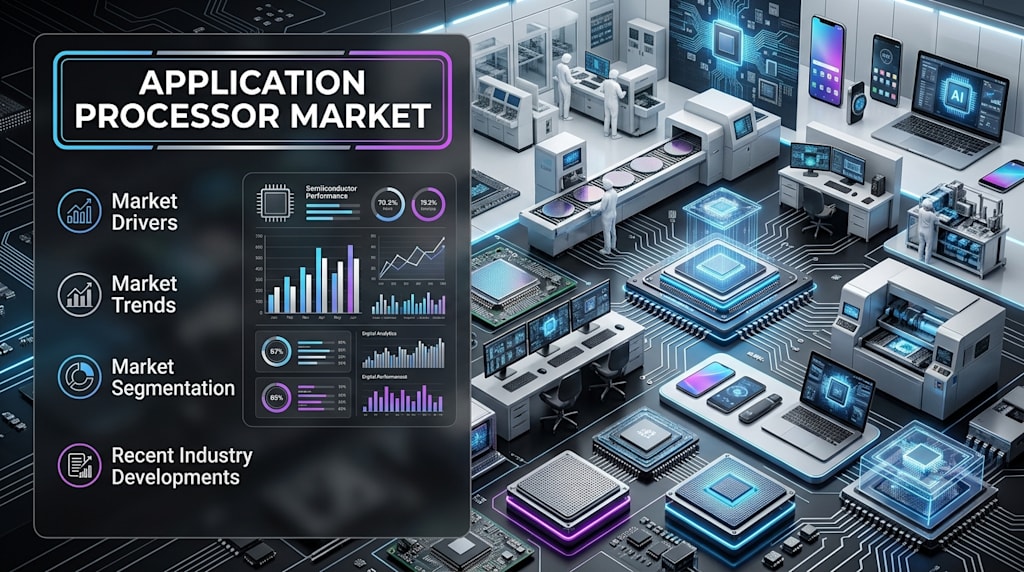
According to IMARC Group's latest research, The global application processor market size reached USD 39.0 Billion in 2025. Looking forward, IMARC Group expects the market to reach USD 51.4 Billion by 2034, exhibiting a growth rate (CAGR) of 3.03% during 2026-2034.Growth drivers include escalating smartphone adoption among tech-savvy consumers, widespread integration of artificial intelligence and 5G technologies, rising demand for high-performance mobile computing, and expanding automotive infotainment systems. Advanced multi-core processors and next-generation neural processing capabilities are reshaping device performance standards globally.
How AI is Reshaping the Future of Application Processor Market
- Neural Processing Unit Integration and AI Acceleration: Modern application processors now feature dedicated AI accelerators and neural engines enabling real-time AI inference directly on devices. Qualcomm's Snapdragon 8 Gen 3 delivers 30 percent improved AI performance, while Apple's M4 Neural Engine operates 3x faster than earlier models, eliminating cloud dependency for intelligent tasks.
- On-Device Generative AI and Machine Learning: Application processors increasingly support on-device generative AI, local machine learning models, and advanced voice recognition without connectivity requirements. This capability reduces latency, enhances privacy, and enables seamless AI-powered virtual assistants, real-time translation services, and personalized user experiences across smartphones and tablets.
- Advanced Manufacturing at 2nm and 3nm Process Nodes: Semiconductor manufacturers transitioning to cutting-edge 2nm technology using Gate-All-Around transistors significantly improve chip density and power efficiency. These advancements enable smaller die sizes, longer battery life, and superior thermal performance in premium smartphones and portable computing devices.

Application Processor Industry Overview
The global application processor ecosystem thrives on fierce competition among technology leaders including Qualcomm, Apple, MediaTek, and Samsung Electronics. Mobile phones represent the dominant application segment with over 60 percent market concentration, driven by annual global smartphone shipments exceeding 1.2 billion units. Asia Pacific maintains leadership due to strong semiconductor manufacturing capabilities, while North America drives innovation through advanced research and development initiatives. Continuous processor upgrades fuel replacement demand across premium and mid-range device segments.
Application Processor Market Trends and Drivers
Explosive Smartphone Adoption Fueling Processor Demand: The global smartphone user base continues expanding rapidly, particularly in emerging markets where accessibility and affordability drive mass adoption. Over 68 percent of global population now owns smartphones, creating consistent demand for next-generation application processors. Enhanced camera functionality, superior gaming performance, and AI-powered features drive annual upgrade cycles, benefiting manufacturers developing advanced chipsets for diverse price segments and consumer preferences.
AI-Enabled Device Revolution Transforming Market Dynamics: Consumer preference for superior camera functions, AI-driven virtual assistants, improved gaming experiences, and instant translation services accelerates application processor innovation. Global smartphone application processors with on-device AI capabilities increased 32 percent year-over-year, with AI chip market revenues reaching 33.4 billion dollars in 2024. This shift toward intelligent devices creates substantial replacement demand for premium processors supporting advanced neural processing and machine learning workloads.
Automotive ADAS and Smart Wearables Growth Expanding Market Opportunities: Beyond smartphones, application processors increasingly power automotive advanced driver assistance systems and smart wearables including fitness trackers and smartwatches. Compact, energy-efficient processors enabling real-time sensor processing and autonomous driving functions represent the fastest-growing segments. Smart wearables expect substantial CAGR expansion through 2032, driven by health-monitoring demands and AI-powered personal assistant integration in next-generation connected devices.
Application Processor Market Segmentation
By Device Type
Mobile Phones (Dominant segment with 60% market share)
PC Tablets and E-Readers
Smart Wearables (Fastest-growing segment)
Automotive ADAS and Infotainment Devices
By Core Type
Octa-Core (Largest segment commanding 48% market share)
Hexa-Core
Quad-Core
Dual-Core
Single-Core
Octa-core processors demonstrate superior multitasking capability, combining high-performance and efficiency cores for balanced computing across premium and mid-range devices.
By Region
Asia Pacific (Largest region with dominant market share)
North America (28.9% revenue share in 2024)
Europe
Middle East and Africa
Latin America
Leading Companies Operating in the Global Application Processor Industry
Qualcomm
Apple
MediaTek
Samsung Electronics
Xiaomi
HiSilicon Technologies
Spreadtrum Communications
NXP Semiconductors
Texas Instruments
Nvidia
Toshiba
Renesas Electronics
Ingenic Semiconductor
LG Electronics
Garmin
Recent News and Developments in Application Processor Market
- October 2024: Apple announced M4 Pro and M4 Max chips featuring the world's fastest CPU cores and 2x faster Neural Engine for AI workloads. Powered by second-generation 3nm technology, these processors deliver enhanced performance with Thunderbolt 5 support and up to 75 percent more memory bandwidth for professional computing applications.
- March 2025: Qualcomm acquired Edge Impulse, strengthening its artificial intelligence and IoT development capabilities for over 170,000 developers. This strategic acquisition extends Qualcomm's leadership position in edge AI computing and enables broader ecosystem support for AI model deployment across diverse IoT and embedded computing applications.
- May 2025: MediaTek introduced the Dimensity 9300 chipset enabling hardware-accelerated ray tracing technology for mobile gaming platforms. This advancement brings console-quality graphics to smartphones, supporting high-fidelity gaming experiences previously impossible on portable devices and demonstrating processor capability evolution toward advanced graphics rendering.
- June 2025: Samsung launched the Exynos 2500 processor integrating AI-driven image signal processing for premium computational photography. Advanced neural processing capabilities enable real-time photography enhancements, professional-grade image manipulation, and intelligent scene recognition within camera applications on flagship smartphones.
- July 2025: Marvell Technology revealed expanded addressable market for custom AI ASICs reaching 55 billion dollars, alongside broadening data-center semiconductor reach. The company achieved 18 new design wins supporting 20 percent market share targets, reflecting growing demand for specialized AI acceleration across cloud infrastructure and edge computing platforms.
Note: If you require specific details, data, or insights not currently included in the scope of this report, we are happy to accommodate your request. As part of our customization service, we will gather and provide the additional information you need, tailored to your specific requirements. Please let us know your exact needs, and we will ensure the report is updated accordingly to meet your expectations.
About the Creator
Michael Richard
Michael Richard is a Market Research Expert specializing in market intelligence, competitive analysis, and data-driven insights. He helps organizations understand trends and emerging opportunities through in-depth research.
Enjoyed the story? Support the Creator.
Subscribe for free to receive all their stories in your feed.
Comments
There are no comments for this story
Be the first to respond and start the conversation.