
Antisense & RNAi Therapeutics Market Trends: Advancements in RNA Delivery Systems & Industry Forecast to 2034
Advancements in RNA interference technologies, expanding oncology applications, and rising demand for targeted treatments are driving significant transformation in modern therapeutics.

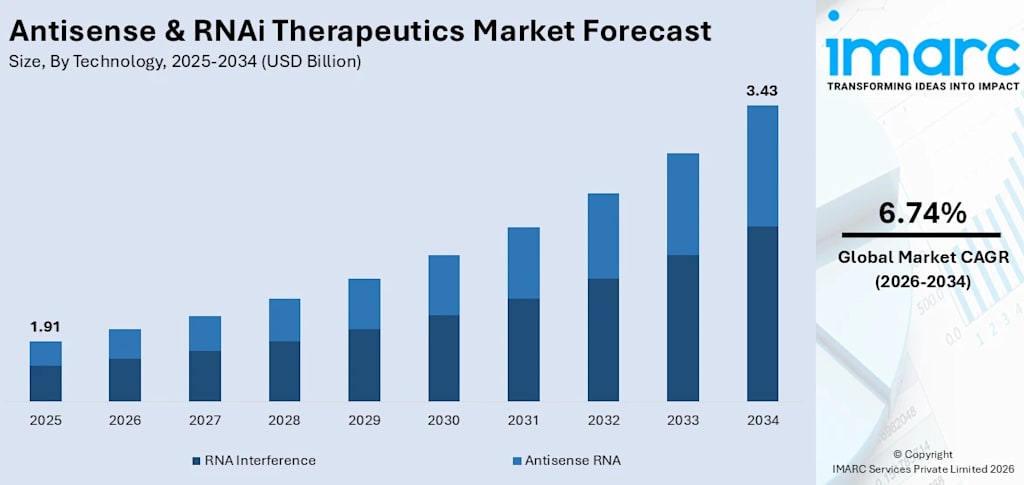
The rising global burden of genetic disorders, chronic illnesses, and oncology cases is fueling a significant shift toward precision medicine, where antisense and RNAi therapeutics play a pivotal role. According to IMARC Group’s latest data, the global antisense & RNAi therapeutics market size was valued at USD 1.91 Billion in 2025. Looking forward, IMARC Group estimates the market to reach USD 3.43 Billion by 2034, exhibiting a CAGR of 6.74% from 2026-2034.
Antisense and RNAi technologies have transitioned from laboratory breakthroughs to life-changing clinical realities, offering a way to "silence" disease-causing genes before they produce harmful proteins. This molecular-level intervention is proving indispensable for treating conditions once considered "undruggable," such as spinal muscular atrophy and rare metabolic disorders. The industry is currently characterized by massive investment in drug delivery innovations particularly lipid nanoparticles (LNPs) and a growing pipeline of therapies targeting the central nervous system and cardiovascular health.
Antisense & RNAi Therapeutics Market Growth Drivers:
- Rising Global Incidence of Genetic and Rare Diseases
The escalating burden of over 7,000 identified rare diseases, nearly 80% of which are genetic in origin, is a primary catalyst for market expansion. Traditional small-molecule drugs often fail to address the root genetic cause, whereas antisense and RNAi platforms selectively target mRNA to stop disease progression. With an estimated 300 million people worldwide affected by rare conditions, the unmet medical need is immense. Consequently, the industry has seen a surge in "orphan drug" designations, providing a clear pathway for developers to address specific, high-need patient populations globally.
- Technological Breakthroughs in Targeted Delivery Systems
Historically, delivering fragile RNA molecules into cells without degradation was a major hurdle. However, the development of sophisticated delivery vehicles like GalNAc conjugates and lipid nanoparticles (LNPs) has revolutionized the field. These technologies allow for precise, high-affinity targeting of the liver and other tissues, significantly reducing the required dosage and minimizing off-target side effects. By improving the therapeutic index and enabling simpler administration methods such as subcutaneous injections these innovations have boosted patient compliance and made RNA-based treatments a viable commercial alternative to traditional long-term therapeutic regimens.
Get Instant Access to "Antisense & RNAi Therapeutics Market" Forecast & Trends!
- Expanding Application in Chronic and Cardiovascular Health
Beyond rare diseases, there is a significant move toward using gene-silencing therapies for widespread chronic conditions like cardiovascular disease and metabolic disorders. For instance, therapies targeting the PCSK9 protein have shown remarkable results in clinical settings, with some treatments achieving nearly 40% reductions in LDL cholesterol through bi-annual dosing. This shift from daily pills to infrequent injections for managing common conditions represents a massive market opportunity. As the global aging population increases the prevalence of age-related metabolic issues, the demand for these durable, high-efficacy genetic interventions continues to grow.
Antisense & RNAi Therapeutics Market Trends:
- Strategic Pharmaceutical Partnerships and M&A Activity
The market is increasingly defined by high-stakes collaborations between established pharmaceutical giants and specialized biotech firms. Large-cap companies are aggressively seeking to bolster their pipelines by acquiring or partnering with RNA experts to leverage proprietary delivery platforms. These alliances provide the necessary capital for expensive Phase III trials and global commercialization efforts. Recent trends show a focus on "platform deals," where a single partnership covers multiple therapeutic targets, allowing for a diversified approach to drug discovery. This synergy is accelerating the transition of theoretical research into marketable, FDA-approved therapeutic products.
- Integration of Artificial Intelligence in Oligonucleotide Design
Artificial intelligence and machine learning are now being used to optimize the sequence design of antisense oligonucleotides and siRNAs. AI models can predict how a specific sequence will interact with the human genome, helping researchers identify the most potent candidates while avoiding off-target effects that could cause toxicity. This digital transformation reduces the "trial and error" phase of drug development, significantly shortening the timeline from the lab to clinical trials. By processing vast datasets of genetic information, AI is enabling the creation of hyper-personalized "N-of-1" therapies tailored to individual genetic mutations.
- Supportive Regulatory Frameworks and Government Funding
Governments worldwide are implementing schemes to fast-track the development of advanced genetic therapies. In India, for example, the National Policy for Rare Diseases has allocated specific funding for Centers of Excellence to treat patients with rare disorders, while the U.S. FDA continues to grant Breakthrough Therapy and Fast Track designations to RNA-based candidates. These regulatory incentives, combined with increased public R&D grants, lower the financial barriers for biotech startups. Such a supportive environment ensures that even "ultra-rare" treatments receive the attention and funding required to reach the commercial market successfully.
Recent News and Developments in Antisense & RNAi Therapeutics Market
- September 2025: Ionis Pharmaceuticals announced positive Phase II data for its antisense candidate ION224, which successfully reduced liver fat content in patients with metabolic liver disease, signaling a move toward Phase III trials.
- January 2026: Sarepta Therapeutics received FDA acceptance for its Biologics License Application (BLA) for SRP-5051, an antisense therapy designed for Duchenne muscular dystrophy, with a decision expected later this year.
- March 2026: A leading biotech firm announced a landmark collaboration with a global CDMO to scale up the manufacturing of lipid nanoparticles, aimed at reducing the production costs of RNAi therapies for emerging markets.
Note: If you require specific details, data, or insights that are not currently included in the scope of this report, we are happy to accommodate your request. As part of our customization service, we will gather and provide the additional information you need, tailored to your specific requirements. Please let us know your exact needs, and we will ensure the report is updated accordingly to meet your expectations.
About the Creator
Andrew Sullivan
Hello, I’m Andrew Sullivan. I have over 9+ years of experience as a market research specialist.
Enjoyed the story? Support the Creator.
Subscribe for free to receive all their stories in your feed.
Comments
There are no comments for this story
Be the first to respond and start the conversation.