
Antimicrobial Coatings Market to Reach USD 12.5 billion by 2033
Expanding infection-control standards and demand for sustainable antimicrobial solutions are accelerating coatings innovation all over the globe
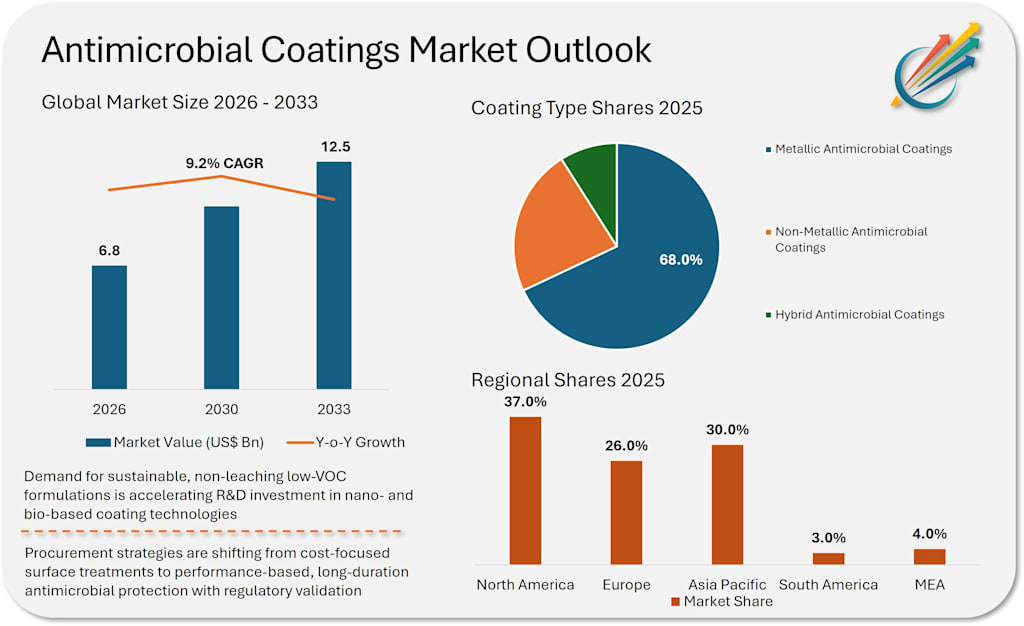
The antimicrobial coatings market is estimated to generate a revenue of USD 6.8 billion in 2026 and is forecast to reach a valuation of USD 12.5 billion by 2033, witnessing a growth rate of 9.2% in between the same period. Growth is anchored in rising hygiene standards across healthcare, food processing, construction and consumer goods industries. Silver, copper, and zinc-based coatings are widely adopted, while advanced organic and nanotechnologies are transforming performance benchmarks. As regulations regarding toxicity tighten in Europe and North America, manufacturers are innovating to reduce environmental impact while maintaining broad-spectrum efficacy.
Post-pandemic infrastructure investments and heightened awareness around surface contamination have bolstered coating innovation. Key players are developing durable, non-toxic, environmentally compliant solutions aligned with evolving chemical regulations. Antimicrobial coatings are also being embedded in HVAC systems, public transportation, packaging and smart surfaces. Antimicrobial functionality is transitioning from optional enhancement to standard specification across critical applications fueling the antimicrobial coatings market growth.
Request a Sample Report to Explore Key Market Insight
Key Takeaways from Antimicrobial Coatings Market
• Medical & healthcare remains a prominent end use segment owing to infrastructure modernization.
• Indoor Air Quality (HVAC) systems projected to be a fast-growing segment as buildings become a standard for commercial real estate.
• Asia-Pacific is emerging as a key investment market, fueled by massive healthcare infrastructure upgrades in China and India.
• Competitive intensity is increasing due to partnerships between coating giants and med-tech device manufacturers.
• Rising demand for Antiviral Coatings (targeting non-bacterial pathogens) is creating white spaces in public transport and education sectors.
• A notable shift toward transparent, UV-cured coatings allows for application on consumer electronics without affecting display quality.
Market Dynamics Shaping the Antimicrobial Coatings Market
Heightened Infection control standards bolstering antimicrobial coatings market
Healthcare-associated infections and stricter sanitation regulations are driving the antimicrobial coatings market. Hospitals, diagnostic labs and long-term care facilities are integrating coated surfaces across medical devices, walls and equipment to reduce contamination risks. Regulatory agencies are tightening guidelines across hygiene compliance, especially in high-contact environments. Food processing plants and pharmaceutical facilities are also adopting antimicrobial layers to meet global safety standards. As hygiene becomes embedded in infrastructure design, antimicrobial coatings are increasingly specified during construction supporting sustained market expansion.
Smart and sustainable coating innovations creating lucrative opportunities for the antimicrobial coatings market
Next-generation antimicrobial coatings combining nano-silver, photocatalytic titanium dioxide and bio-based agents are tapping potential market segments. Demand for low-VOC and non-leaching solutions is rising across developed markets. Integration with smart surfaces and self-cleaning materials presents cross-industry collaboration opportunities. Coatings compatible with plastics, textiles and packaging expand value pools beyond traditional metal substrates. Participants investing in R&D for long-duration efficacy and regulatory-certified safety profiles are expected to capture high-margin applications in medical devices and consumer electronics and bolster their position in antimicrobial coatings market.
Regulatory scrutiny and cost sensitivity impacting antimicrobial coatings market growth
Antimicrobial coatings market faces regulatory challenges for biocidal substances and potential toxicity concerns. Approval timelines for antimicrobial agents are delaying commercialization. In price-sensitive construction and industrial sectors, added coating costs may hinder widespread adoption. Volatility in silver and specialty additive pricing in recent times are impacting profit margins for the key players. Moreover, performance durability concerns in high-wear environments require ongoing innovation investment impacting demand surge in antimicrobial coatings market.
Antimicrobial Coatings Market Segmentation
By Coating Type
• Metallic Antimicrobial Coatings
o Silver-Based Coatings
o Copper-Based Coatings
o Zinc-Based Coatings
o Others
• Non-Metallic Antimicrobial Coatings
o Organic Antimicrobial Coatings
o Inorganic Antimicrobial Coatings
• Hybrid Antimicrobial Coatings
o Metal-Organic Hybrid Coatings
o Nanocomposite Antimicrobial Coatings
Metallic coatings including silver-based along with copper formulations accounts for a key share in antimicrobial coatings market. Healthcare facilities especially use silver-ion coatings for high-touch surfaces owing to their specific antimicrobial performance. Non-metallic coatings include quaternary ammonium compounds and organic biocides are growing faster since formulators are developing solutions which addresses the sustainability concerns of metallics. These non-metallic coatings are gaining traction in food processing and consumer goods where metal contamination raises regulatory flags.
By Resin Type
• Acrylic
• Epoxy
• Polyurethane
• Silicone
• Polyester
• Fluoropolymer
Epoxy-based coatings is expected to be a major type in antimicrobial coatings market due to strong adhesion and chemical resistance in healthcare and industrial settings. Polyurethane coatings are expected to be the fastest-growing segments, driven by flexibility and abrasion resistance whereas, acrylic resins are used in architectural applications. Resin selections aligns with environmental compliance standards and thus suppliers are optimizing resin formulations to enhance antimicrobial longevity without impacting the mechanical properties.
By Form
• Powder Coatings
• Liquid Coatings
• UV-Curable Coatings
• Sprayable Film Coatings
Liquid antimicrobial coatings account for a key revenue share owing to substantial applicability and ease of integration. Powder coatings are projected to grow faster due to lower VOC emissions and environmental advantages. Technological improvements in electrostatic spray processes enhance efficiency and boosts antimicrobial coatings market. Form selection for the market players depends on substrate material and end-use durability requirements. Sustainability trends are favouring powder-based innovations in developed regions.
By Function
• Antibacterial
• Antiviral
• Antifungal
• Anti-Biofilm
• Multi-Functional Antimicrobial
Antibacterial coatings estimated to account for the majority of demand in antimicrobial coatings market, considering healthcare and food industries. Antiviral coatings are witnessing accelerated adoption owing to global health concerns. Multifunctional coatings combining antibacterial and antifungal properties are emerging as potential segments. Moreover, functional expansion into mold-resistant construction materials supports steady growth.
By Mode of Action
• Ion Leaching
• Contact Active
• Photocatalytic Oxidation
• Anti-Adhesive Surface Modification
• Biofilm Inhibition
Ion-leaching includes silver and copper-based systems, remain predominant in the antimicrobial coatings market due to their technological maturity and consistent performance. These coatings release active metal ions from the coating matrix, effectively neutralizing microorganisms in proximity and delivering reliable disinfection. further, photocatalytic oxidation technologies based on titanium dioxide are suited for applications with consistent light exposure, such as building exteriors and automotive interiors. Industry participants emphasize that photocatalytic systems provide sustained antimicrobial performance, as light activation continuously regenerates their active properties, supporting extended durability and long-term surface protection.
By End Use
• Medical and Healthcare Surfaces
o Medical Devices and Equipment
o Surgical Instruments
o Hospital Furniture and Fixtures
o Catheters and Implants
• Building and Construction
o Interior Wall Coatings
o Flooring Coatings
o HVAC and Duct
o Sanitaryware and Fixtures
• Food and Beverage
o Food Processing Equipment
o Packaging
o Cold Storage and Refrigeration
• Textiles
o Protective Apparel
o Upholstery
o Sportswear and Footwear
• Transportation
o Automotive Interior
o Public Transport Handrails and Seats
o Aerospace Cabin Interior
• Electronics
• Marine
• Consumer Goods
Healthcare represents a prominent revenue segment, driven by medical devices and hospital infrastructure in the antimicrobial coatings market. Construction is expanding rapidly, integrating antimicrobial paints in commercial buildings. Food & beverage processing facilities maintain consistent demand. Consumer electronics manufacturers are incorporating antimicrobial surfaces. Public transportation modernization is also creating incremental opportunities for the key suppliers. Cross-industry adoption reinforces long-term diversification and is expected to create ample white spaces in coming years.
By Region
• North America
• Europe
• Asia Pacific
• South America
• MEA
Asia-Pacific is the prominent market, with China and India expanding healthcare infrastructure and manufacturing capacity. Further boom in the construction sector and a rising middle class demanding better healthcare standards. North America remains a mature innovation-driven antimicrobial coatings market, supported by regulatory enforcement in the U.S. Growth is characterized by high replacement rates in medical facilities and a strong focus on renovation projects. Europe witnessing steady surge in demand, particularly in Germany and France, due to sustainability-driven procurement policies and growth in non-leaching coating technologies.
About the Creator
Sanjay Vane
At Market Minds Advisory, we’re more than just consultants—we’re partners in your journey to growth and success.
Enjoyed the story? Support the Creator.
Subscribe for free to receive all their stories in your feed.
Comments
There are no comments for this story
Be the first to respond and start the conversation.