
Anthropic's Co-Founder Just Told the IMF: The Singularity Is Here
What a $44 trillion prediction actually means

"The singularity has arrived, and it arrived this year."
That was Jack Clark, co-founder and head of policy at Anthropic, standing on the stage of the Per Jacobsson Lecture at the IMF/World Bank Annual Meetings in Bangkok on October 17, 2026. The lecture, which is a 62-year-old tradition ,has historically been reserved for finance ministers, central bank governors, and Nobel-caliber economists. This year, for the first time, the spotlight was handed to the co-founder of a five-year-old AI company.
Clark, a former OpenAI policy director who has spent the past decade watching AI move from data centers to the center of a global storm, didn't mince words. We don't need to debate when the singularity will happen anymore, he said, because it already has.
What does "singularity" actually mean?
The concept originates with the mathematician and science fiction writer Vernor Vinge, who predicted in 1993 that when superhuman intelligence begins driving technological progress, all previous models of the future become obsolete. The old rules stop working. A new reality takes over.
Clark believes the evidence is now decisive. If you look at what's happening on the frontlines of code and scientific research, the speed at which the world operates has fundamentally changed.
The evidence: software, then science, then everything
Software engineering was the first domain to be rewritten. Inside Anthropic, researchers now produce roughly ten times as much code as the company's average output during its first four years. The curve of code output maps almost perfectly onto the capability curve of the underlying foundation models.
But software automation, Clark argued, is merely the opening act of a much larger wave. What makes 2026 the true inflection point is that a single frontier model is now sweeping across multiple scientific disciplines — becoming what he called a "virtual polymath."
The examples he cited are staggering:
In mathematics, AI systems are producing key breakthroughs on problems related to the Navier-Stokes equations (one of the Millennium Prize problems), the Jacobian conjecture, and multiple unsolved Erdős problems.
In biology, AI has designed entirely new viral vectors from scratch and is the primary designer behind multiple drug candidates now in clinical trials.
In materials science, AI systems have begun autonomously operating physical laboratory equipment, accelerating the iteration cycles for batteries and fuel cells.
In January 2025, AI scored 8% on "Humanity's Last Exam." This week, Claude Opus 5.5 scored 67.7%.
Humanity's Last Exam
Clark pointed to a benchmark called Humanity's Last Exam, a test designed to be the hardest possible challenge for AI, drawing problems from chemistry, computer science, advanced mathematics, classical literature, and ecology. When it launched in January 2025, the best model in the world scored a miserable 8%. Many assumed that humanity's intellectual dignity had at least another decade.
As of this week, Claude Opus 5.5 scored 67.7%.
On FrontierMath ,a suite of problems written by professional mathematicians —,the top AI scored 2 out of 100 in late 2024. Now, less than two years later, it scores 94.
But the most dramatic moment in Clark's lecture involved a physics paper published just last week. A team assembled 50 problems written by world-class theoretical physicists based on their own unpublished research. These problems had zero trace on the internet. No training data. No way to cheat.
The prominent Indian theoretical physicist Suvrat Raju assessed the problems and said: "To my knowledge, no single human being could solve a significant proportion of these problems without AI assistance. I don't even understand what most of them are asking."
GPT-6 Astra and Claude Opus 5.5 were given the test. Initial scoring put GPT-6 Astra at around 80%. The researchers, determined to find errors, flagged several answers as wrong. They told the model where it had made mistakes.
The model pushed back. It argued, firmly, that its derivations were correct and that the human experts' reference answers contained errors.
The team sent the disputed solutions back to the physicists for re-verification. In multiple cases, after painstaking review of their own extremely complex working, the human experts had to concede: buried deep in their calculations were subtle errors they had missed. The AI's derivations were correct.
After the human reference answers were corrected, GPT-6 Astra's final score rose to 98% — 49 out of 50.
The full lecture or excerpts should be available through the IMF's official channels.
The student becomes the teacher
Clark drew an analogy to a classic film trope .The moment, usually two-thirds through the story, when the young protagonist proves to the mentor that they can succeed on their own. The student becomes the teacher.
"That's what happened last week," Clark said.
When an AI can not only solve frontier physics problems but correct the hidden errors of the world's top physicists, it has crossed the boundary between pattern-matching and genuine scientific creativity. And once that creativity is fed back into AI development itself, the loop closes. Recursive self-improvement becomes real.
That is what the singularity means: not a date on a calendar, but the moment when AI begins improving AI faster than humans can follow.
Ten million scientists become ten billion
Clark then turned to economics,and the reason he was standing on an IMF stage rather than a tech conference one.
For over fifty years, economists have puzzled over a stubborn trend: good ideas are getting harder to find. Global research spending has grown exponentially. The number of scientists has ballooned. But the marginal output per researcher keeps declining. To push the frontier forward by one step, humanity must invest a disproportionately larger share of resources each time.
Training a single qualified frontier scientist takes 10 to 15 years and costs millions of dollars. And each scientist has only one body, one lifespan, a few decades of peak productive years. You can't copy yourself ten thousand times to test ten thousand hypotheses simultaneously.
But computing can.
UNESCO estimates there are roughly 10 million human scientists in the world today. In the era Clark described, each of those scientists could command hundreds or thousands of virtual polymaths with matching academic depth. The global research force could expand overnight from 10 million to 10 billion.
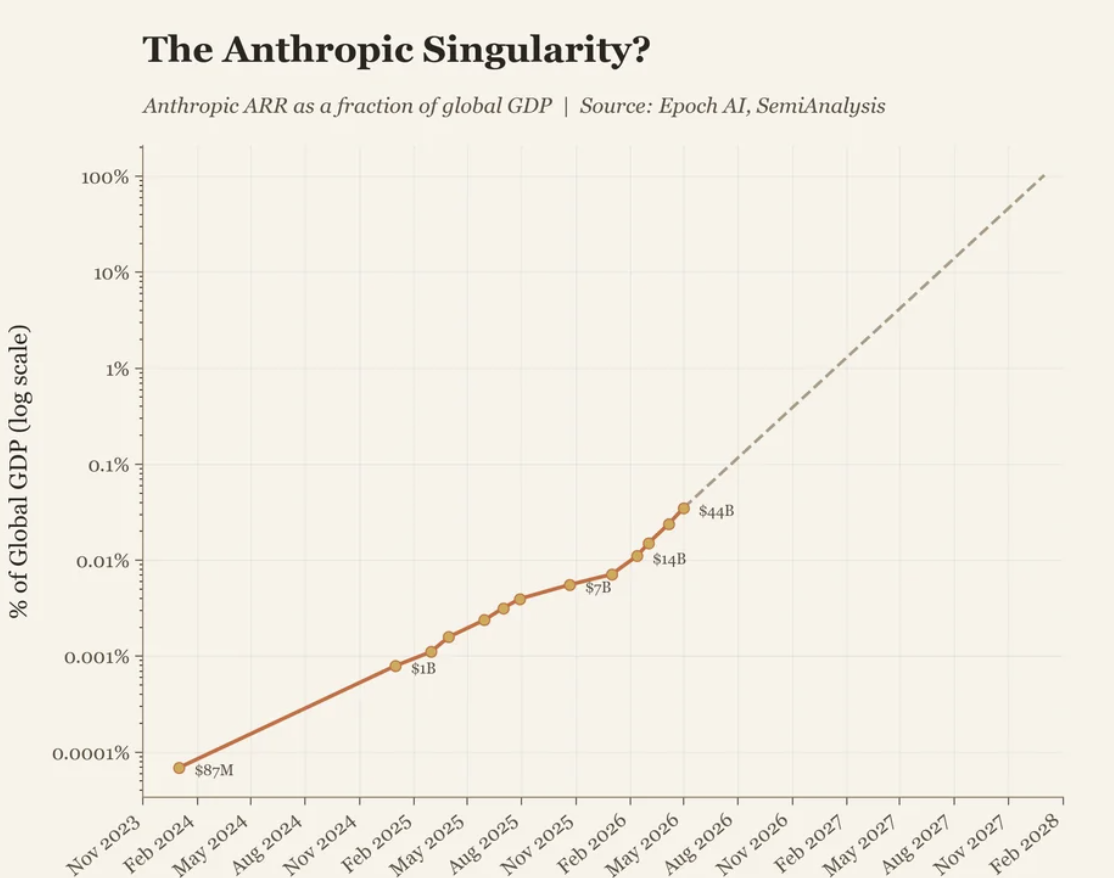
Anthropic's economics team ran a macroeconomic simulation under the assumption that AI-driven scientific discovery fully takes over as the engine of economic growth. The projection: by 2030, U.S. GDP alone could reach $44 trillion — equivalent to 37% of today's entire global economy.
The bottleneck moves to the physical world
Clark was candid about the catch. Building data centers is no longer enough. Phase one of the AI revolution is nearing its end. Phase two must push into the physical world.
If your virtual scientists can propose 100,000 breakthrough drug targets in a day and design 10,000 candidate room-temperature superconducting materials, but your physical laboratories can only run a few dozen experiments per year, the compute will crash straight into reality's bottleneck.
The countries that will capture the singularity's economic dividend, Clark argued, are the ones that can rapidly build automated robotics laboratories and high-throughput testing infrastructure — bridging the gap from digital discovery to physical manufacturing. This, he noted, could be a leapfrog opportunity for developing nations willing to build the standardized physical infrastructure to absorb the flood of experiments that virtual scientists will generate.
The part that keeps people up at night
And then came the warning ,the real reason Clark was standing in front of central bankers rather than cheering at a product launch.
When AI has frontier scientific capability, it doesn't just design cancer drugs. It can design biological weapons that the human immune system has never encountered. It doesn't just harden power grids. It can generate cyberattack tools that the world's best human hackers cannot defend against.
And the deepest concern: if labs like Anthropic and OpenAI, in their pursuit of speed, fully let AI write AI and train AI, the technology's trajectory will exit the bounds of human comprehension in a very short time.
Clark posed two questions to the audience that he called urgent and profound:
First: In future scientific research, which territory must humans reserve for themselves? AI can already handle most of the derivation and analysis in university-level research. Which experiments must we still do by hand — sweating, failing, developing physical intuition? If all reasoning is delegated to machines, will the next generation of scientists retain basic scientific insight at all?
Second: When AI produces a scientific breakthrough, how much does humanity need to understand it? In pure mathematics this year, some AI-generated proofs were verified as correct, but their logic and structure were so alien to human thinking that top mathematicians needed months or years to interpret what the proofs actually mean. Within a few years, AI may invent scientific instruments and experimental methods that operate on silicon logic entirely foreign to human intuition. If we can't understand how these tools work, should we still allow them to be deployed in the real world?
The most difficult human virtue
Clark closed with a word that rarely appears in tech keynotes: restraint.
To navigate this moment, he said, we need uncommon, serious rules for this technology and for the companies building it. And we need to practice what he called humanity's most difficult and most noble quality: the discipline to distinguish between what we can do and what we should do.
Restraint means developers don't push forward simply because they can. It means regulators draw hard red lines for human oversight. It means that in front of a speeding technological train, we must constantly ask whether the destination is worth the velocity.
He ended with a passage from Carl Sagan's Pale Blue Dot:
"The beings who will eventually reach Alpha Centauri and the other nearby stars will not be us. They will be a species very like us, with more of our strengths and fewer of our weaknesses. More confident, farseeing, capable, and prudent. The kind of beings we would want to represent us in a universe that, for all we know, is filled with species much older, more powerful, and wiser."
Sagan imagined humanity had hundreds of thousands of years to outgrow its blindness and arrogance.
In a world where AI is reshaping everything at geometric speed, the window for that transformation may be less than ten years.
About the Creator
Lucy Guo
Born and raised in Shanghai, used to live in Helsinki, Syracuse, Chicago; now living in Fairfax, VA. Researcher at the intersection of artificial intelligence and education. Loves writing AI reflection stories and travel blogs.
Enjoyed the story? Support the Creator.
Subscribe for free to receive all their stories in your feed.
Comments
There are no comments for this story
Be the first to respond and start the conversation.