
An Introduction to My Trinket Toss Oracle
Fortune Telling

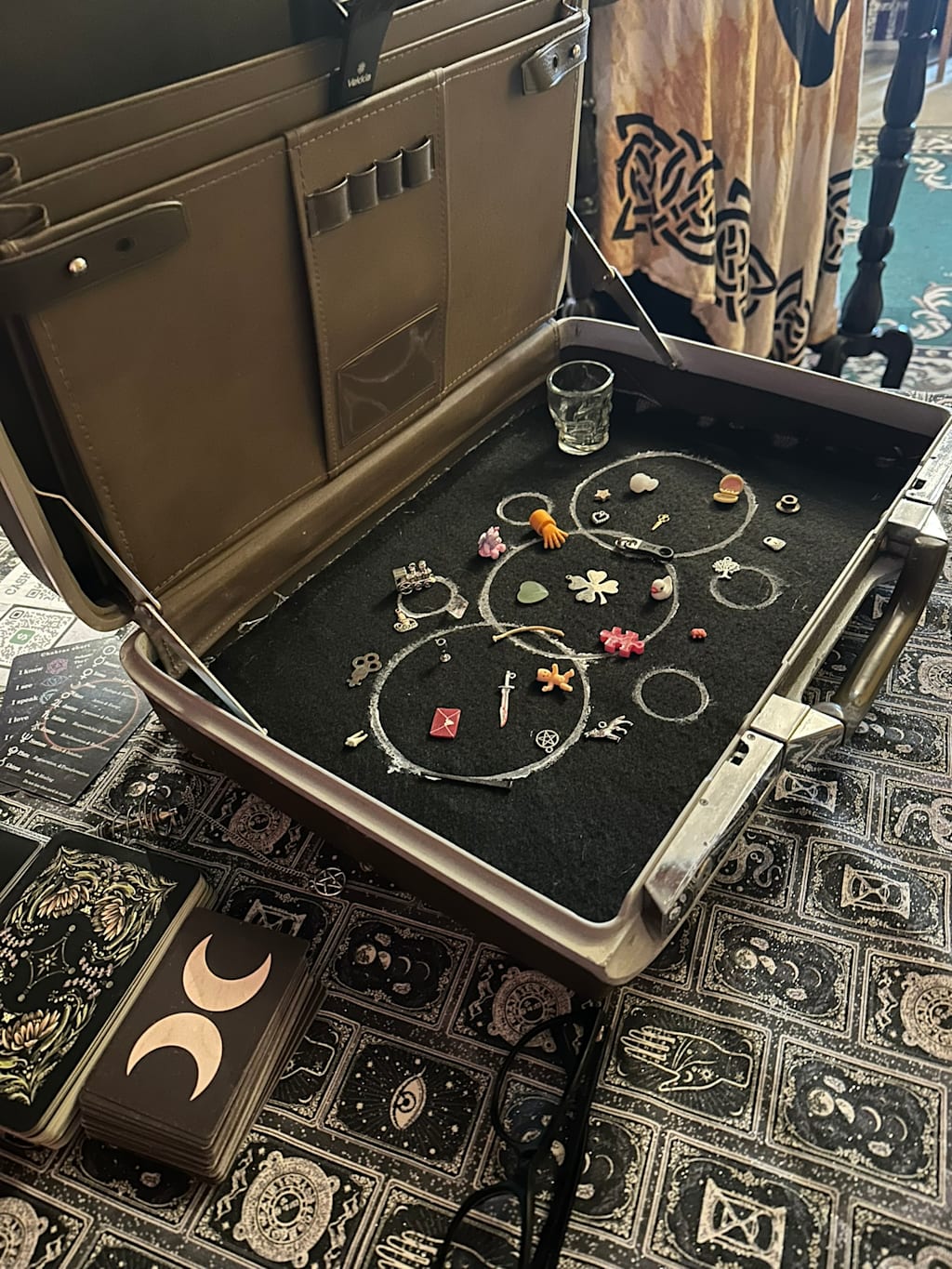
Tarot cards, oracle decks, runes, pendulums—there are countless tools we can use to tap into our intuition. One of my favorites, however, looks a little more like someone dumped the contents of a very interesting junk drawer onto a table.
Welcome to my Trinket Toss Oracle.
I’m far from the only person who practices this type of divination. The basic idea is wonderfully simple: small symbolic objects are cast onto a surface, and their meanings, positions, and relationships to one another are interpreted. There is no single universal set of charms or meanings, which leaves plenty of room for an individual reader to develop their own system.
And that is exactly what I’ve done.
I’ve spent roughly a decade developing and perfecting my own Trinket Toss Oracle, building a collection of tiny objects and creating a reading method that combines symbolism, placement, interaction, and intuition.
A Little Bit of Everything
One of the things I love about trinket tossing is that practically anything small enough to toss can become part of an oracle.
In my collection, there are tiny charms, figures, beads, buttons, puzzle pieces, coins, and other miniature objects. Some are immediately recognizable; others require a closer look. As I demonstrate in my reading, I pick up individual pieces and explain what they can represent before returning them to the collection.
But there’s an important word in that sentence:
Can.
A trinket doesn't necessarily have one permanent, immovable definition.
A heart may immediately suggest love, for example, but what kind of love? Romantic love? Self-love? A family relationship? Heartbreak? Something you love doing?
Context matters.
That’s one reason this form of divination appeals so strongly to me. I’m not simply consulting a list and announcing, “This object means X.” Each piece has various potential meanings depending upon the person receiving the reading, the question being asked, where the object lands, what lands around it, and what my intuition is telling me.
The trinkets provide the vocabulary.
The toss creates the story.
My Custom Trinket Toss Mat
As you can see in the video, I use a custom-made black mat covered with circles of different sizes. The three large circles running through the center can be read in one of two ways, depending on the focus of the reading:
Past. Present. Future.
This allows me to look at a situation as something that is moving rather than static. What influences from the past are still showing themselves? What is happening now? What energies or possibilities seem to be developing?
Or the same three circles can be read as:
Head. Heart. Soul.
In this layout, the reading shifts inward. What is happening mentally? What is being felt emotionally? And what is unfolding at a deeper intuitive or spiritual level?
The three main circles are also connected by spaces between them, and those connecting areas are important. A trinket that lands between Past and Present, for example, may speak to something still transitioning from one into the other. In a Head, Heart, Soul reading, a piece between Heart and Soul might point to something linking emotional experience with deeper inner knowing.
Then there are the four smaller circles positioned along the sides of the mat. These are not part of the main Past-Present-Future or Head-Heart-Soul sequence. I read them as special messages from the universe—additional information that may not fit neatly into the central storyline but still wants to be acknowledged.
The placement gives each trinket context it wouldn’t necessarily have on its own.
And then things get even more interesting when we look at which trinkets land together.
Two seemingly unrelated objects can suddenly form a connection because they land beside one another. A piece in a connector space can help explain how one stage or aspect of a situation is influencing another. Several trinkets clustering together can create an entire narrative, while a single object in one of the smaller circles may stand out as a separate message demanding attention.
That’s where intuition becomes essential.
You Do the Toss
There is something else about my method that is extremely important to me:
I don't toss the trinkets for you.
You do.
Before the reading, the client gets hands-on with the oracle. They touch every single piece in the collection before gathering the trinkets and performing the toss themselves.
You can see the process in the video: the pieces begin scattered across the mat, are collected by hand, and then are released again onto the reading surface.
I want that physical interaction because, in my practice, this means the toss contains the client's energy—not mine.
I'm there to interpret what appears.
You're the one who sets it in motion.
Some Trinkets Simply Sit This One Out
This may be my favorite quirk of the entire system.
Not every trinket participates in every reading.
When the collection is tossed, pieces scatter everywhere. Some land inside one of the circles on my mat. Others land outside of them.
If a trinket doesn't land within a circle, it isn't part of that reading.
That's it.
It doesn't matter how interesting the object is or whether I think it would make a great addition to the story. If it didn't make the cut, I don't force it into the interpretation.
In the demonstration, you can see me clearing those nonparticipating pieces away until we're left with a much smaller collection of objects inside the circles.
Suddenly, the apparent chaos has been edited down into a message.
I sometimes think of it as the trinkets deciding among themselves:
Nope, you stay home. We've got this one.
Reading the Story Rather Than Individual Symbols
Once the extra pieces have been removed, I don't simply work through the remaining trinkets as though I'm reading items off a grocery list.
The relationships between them matter.
I look at what each object represents, which circle contains it, what else landed in that area, which pieces are close together, and what connections begin appearing among them.
That's when the toss becomes less about individual objects and more about storytelling.
Imagine, for example, that an object associated with communication lands in the Heart area beside something I associate with protection. Either object alone could lead in several directions. Together, however, they might suggest someone protecting their feelings, difficulty communicating emotionally, or a need to establish boundaries before opening up.
Put those same two pieces in the Future instead, and the story could change.
This is why I don't believe every possible meaning needs to be memorized and mechanically applied. Intuition is part of the reading.
Modern charm-casting practitioners similarly emphasize that personal associations and the relationships among objects can be central to interpretation rather than relying on one standardized dictionary of meanings.
Ask a Question—or Don't
A Trinket Toss reading can focus on practically any area of life.
Love. Family. Career. Relationships. Personal growth. Spirituality.
You can come into a reading with a very specific question.
But you don't have to.
Sometimes you can simply toss the trinkets and ask what you need to know.
Because once the pieces fall into place, they still have a story to tell.
That's one of the things I find most fascinating about this particular form of divination. Unlike a tarot deck, where we're all starting with the same 78 cards, my oracle grew organically. The collection itself is personal. The meanings I've developed are personal. My reading surface is my own creation. And after years of working with all of it, the objects have developed a symbolic language that makes sense within my practice.
Someone else could create a trinket oracle tomorrow using completely different objects, a completely different mat, and completely different meanings.
Neither of us would necessarily be doing it wrong.
We'd simply be speaking different symbolic languages.
An Old Idea in a Very Personal Form
While the modern practice of casting collections of charms and personal trinkets is relatively new, the larger idea of gaining insight by casting objects certainly isn't.
Cleromancy is the broad term for divination through casting lots. Historical casting practices have involved objects such as marked pieces of wood, stones, shells, dice, and other small objects. Contemporary charm casting takes that very old human impulse—to find meaning in how objects fall—and turns it into something highly individual.
For me, that individual element is the magic of it.
My Trinket Toss Oracle isn't something I bought in a box with an instruction manual telling me exactly what everything must mean. It's something I've cultivated over approximately ten years.
Every little object has possibilities.
Every person brings their own energy.
Every toss creates a different configuration.
And every reading becomes its own story.
Sometimes the universe has something monumental to say.
And apparently, sometimes it chooses to say it with tiny puzzle pieces, miniature figures, buttons, beads, coins, and whatever other weird little treasures I've collected along the way.
I'm perfectly okay with that.
About the Creator
Ivy Rose
Ivy writes about the strange, beautiful, messy sides of life—aging, career twists, alt fashion, spirituality, intuition & mental health—through articles, journal entries, poetry & short stories. A little darkness and a little light.
Enjoyed the story? Support the Creator.
Subscribe for free to receive all their stories in your feed. You could also become a paid subscriber, letting them know you appreciate their work.
Comments
There are no comments for this story
Be the first to respond and start the conversation.