
America’s Fields Go High-Tech: United States Combine Harvesters Market Set to Reach US$ 3.59 Billion by 2034
Mechanization, labor shortages, and precision farming technologies are reshaping the future of harvesting across the United States.

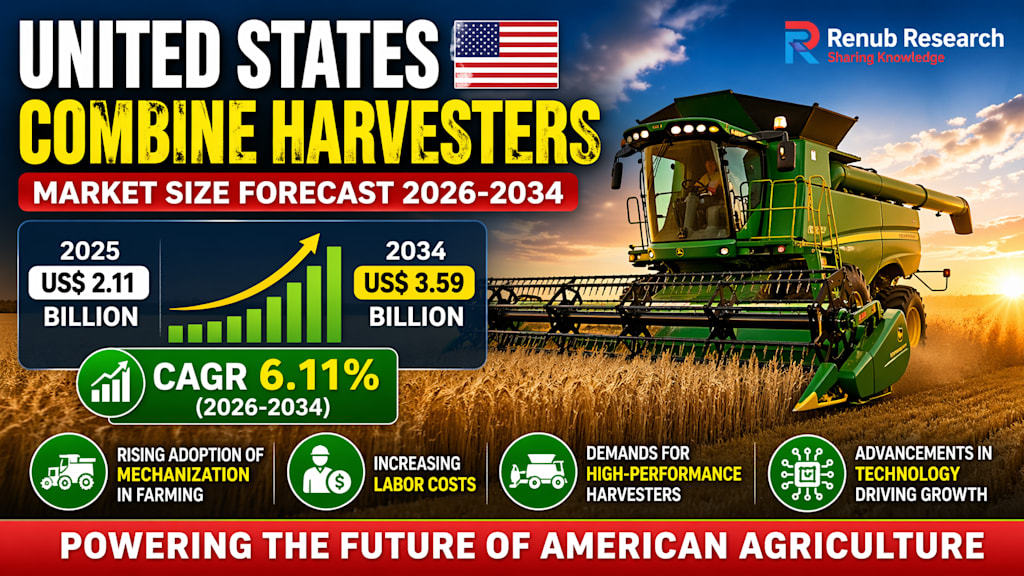
The future of American farming is arriving faster than many expected. Across wheat fields in Washington, corn belts in Illinois, soybean farms in the Midwest, and specialty crop lands in California, farmers are turning to smarter and more efficient machines to meet rising food demand and shrinking labor availability.
One of the clearest signs of this transformation is the growing demand for combine harvesters — the powerful machines that can reap, thresh, and clean grain crops in one seamless operation. According to Renub Research, the United States Combine Harvesters Market is projected to grow from US$ 2.11 billion in 2025 to US$ 3.59 billion by 2034, expanding at a CAGR of 6.11% from 2026 to 2034.
That growth reflects a larger shift taking place in American agriculture: a move toward automation, efficiency, and data-driven productivity.
What Exactly Is a Combine Harvester?
A combine harvester is one of the most important machines in modern grain farming. Rather than relying on separate tools and multiple labor-intensive steps, a combine performs three essential harvesting functions at once:
- Reaping crops
- Threshing grain
- Winnowing and separating usable grain from residue
This saves enormous time, reduces crop losses, and boosts operational efficiency.
Today’s combine harvesters are even more advanced. Many include:
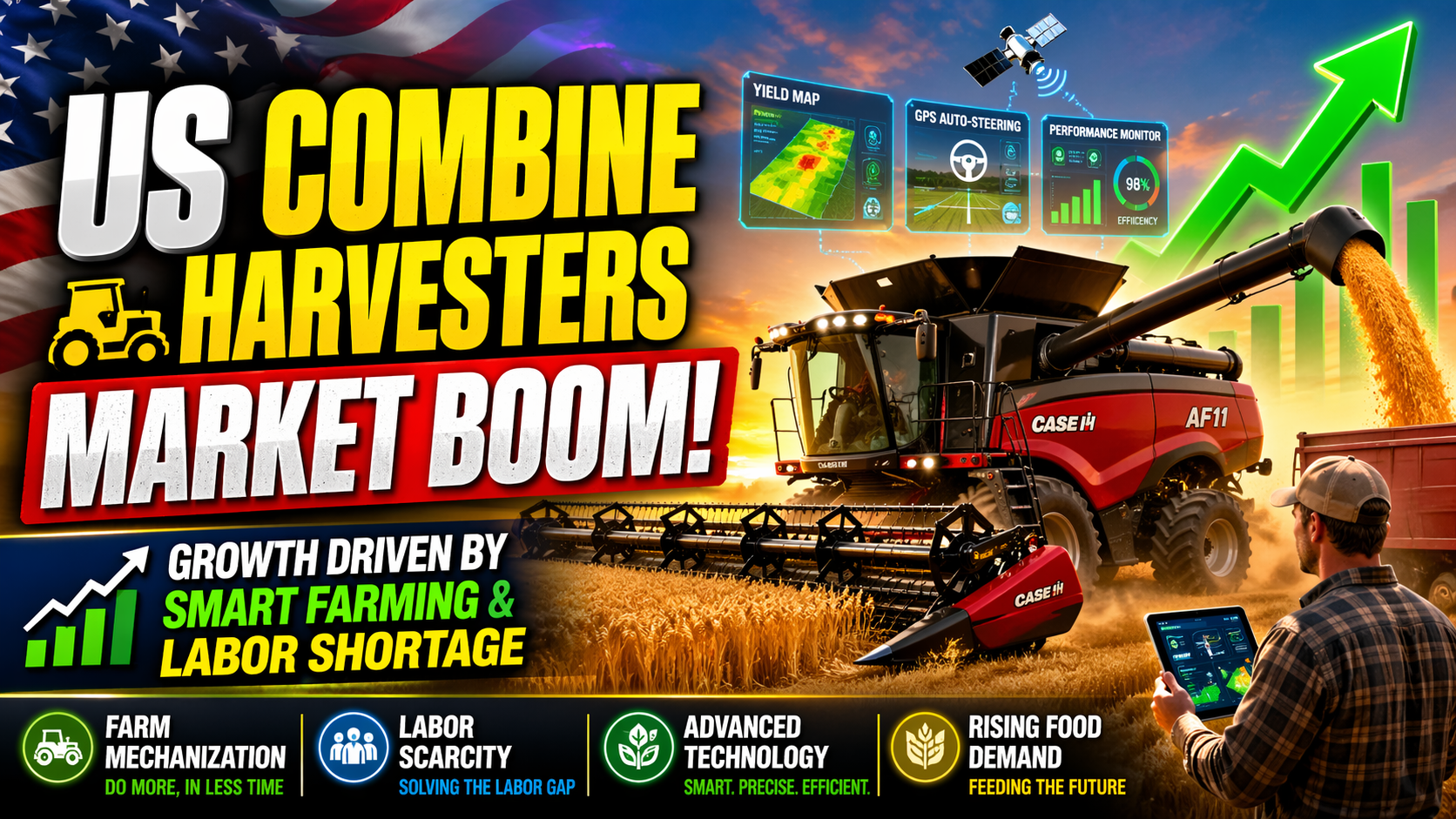
- GPS navigation
- Auto-steering systems
- Yield mapping technology
- Moisture sensors
- Remote diagnostics
- Fuel optimization software
These features are turning harvesters into rolling smart farms.
Why the U.S. Market Is Growing So Quickly
1. Labor Shortages Are Forcing Automation
One of the biggest challenges facing U.S. agriculture is a lack of available farm labor. Seasonal labor has become harder to secure, and wages continue rising.
For many farmers, investing in a combine harvester is no longer optional—it is essential. A single machine can replace multiple manual tasks and complete harvests much faster than traditional methods.
This is especially valuable during narrow harvest windows when weather conditions can make or break crop quality.
2. Large-Scale Farming Needs Speed
American farms are among the largest and most productive in the world. Massive wheat, corn, and soybean operations require machinery capable of handling thousands of acres efficiently.
High-capacity combine harvesters allow operators to harvest more land in less time while minimizing grain loss.
That scale advantage is a major driver of consistent equipment demand.
3. Precision Agriculture Is Taking Over
Modern farming increasingly depends on data. Farmers now want to know:
- Which areas of the field performed best
- Soil moisture conditions
- Fuel efficiency during operations
- Grain yield variations across acreage
Combine harvesters equipped with digital tools help collect this information in real time, allowing smarter planting and fertilizer decisions next season.
That makes combines not just harvesting machines—but farm intelligence platforms.
Innovation from Leading Brands
Major agricultural equipment companies are aggressively upgrading their combine lineups.
In 2024, John Deere introduced its new S7 Series combines designed to improve harvesting productivity, grain quality, and operator comfort.
Meanwhile, Case IH launched the AF11 combine, featuring larger grain capacity and faster unloading speeds.
Manufacturers are focusing on:
- Bigger grain tanks
- Faster unloading augers
- Lower fuel use
- Smarter automation
- Better driver cabins
- Easier maintenance systems
These improvements are accelerating replacement demand as farmers upgrade aging fleets.
Strong Demand from Grain Exports
The United States remains one of the world’s largest agricultural exporters. Grain crops such as:
- Wheat
- Corn
- Soybeans
- Rice
must be harvested quickly and delivered efficiently to domestic processors and global markets.
According to USDA figures referenced in the report, the U.S. exported around US$ 175 billion in agricultural goods in 2024.
To maintain that global supply chain, farmers need dependable harvesting machinery capable of operating at scale.
The Biggest Challenge: High Equipment Costs
While combine harvesters offer enormous value, they are expensive investments.
Modern combines can cost hundreds of thousands of dollars, especially premium models loaded with digital technology.
Additional ownership costs include:
- Maintenance
- Spare parts
- Insurance
- Fuel
- Skilled technicians
- Downtime risk during harvest season
For smaller farms, these costs can delay purchasing decisions.
As a result, leasing, financing, and second-hand equipment markets remain important parts of the ecosystem.
Which Types of Combines Are Winning?
Self-Propelled Combines
These are the dominant machines in large-scale farming. They offer:
- Greater harvesting speed
- Higher grain capacity
- Better automation
- Improved mobility
Best suited for major commercial farms.
Tractor-Pulled Combines
Still relevant for smaller farms and budget-conscious operators.
They are:
- Less expensive
- Easier to maintain
- Ideal for limited acreage
Though slower, they continue serving niche farming segments.
Wheel-Type Combines
The most popular design across the U.S. due to:
- Fast road transport
- Strong field maneuverability
- Compatibility with advanced headers
- Suitability for dry soils
- Power Segments Driving Sales
150–300 HP Models
Popular among medium-sized farms seeking balanced cost and performance.
300–450 HP Models
Essential for large commercial producers handling extensive acreage.
These machines offer:
- High throughput
- Better automation
- Faster harvesting speeds
- Lower labor dependency per acre
- P=WtP = \frac{W}{t}P=tW
(Think of harvesting power simply as more work completed in less time.)
State-Level Hotspots
California
Despite being known for fruits and vegetables, California has major rice, forage, and grain harvesting needs. High labor costs are pushing demand for efficient combines.
Washington
Eastern Washington’s wheat production supports strong demand for high-horsepower combines capable of covering large acreages quickly.
New York
Mixed farming operations favor versatile mid-sized combines rather than ultra-large models.
New Jersey
Smaller farms create demand for compact and cost-effective harvesting machines.
Why This Market Matters Beyond Farming
The combine harvester industry impacts more than agriculture alone. It also supports:
- Manufacturing jobs
- Equipment dealerships
- Parts suppliers
- Precision software providers
- Financing institutions
- Export logistics networks
As farm technology expands, this market becomes a central pillar of the broader rural economy.
What to Expect by 2034
By 2034, combine harvesters may feature:
- Autonomous driving capabilities
- AI crop detection
- Drone integration
- Real-time cloud analytics
- Predictive maintenance alerts
- Even lower fuel consumption
The farmer of tomorrow may supervise fleets of intelligent machines rather than operate a single tractor manually.
Final Thoughts
The United States combine harvesters market is not just growing—it is evolving into a high-tech agricultural powerhouse.
With Renub Research forecasting growth from US$ 2.11 billion in 2025 to US$ 3.59 billion by 2034, the sector reflects how American farming is adapting to labor shortages, global food demand, and rapid innovation.
About the Creator
Enjoyed the story? Support the Creator.
Subscribe for free to receive all their stories in your feed.
Comments
There are no comments for this story
Be the first to respond and start the conversation.