
Alginate Market Witnesses Strong Growth Amid Sustainable Demand
The Alginate Market is experiencing steady growth driven by increasing demand for natural, plant-based ingredients across food, pharmaceutical, cosmetic, and industrial applications.

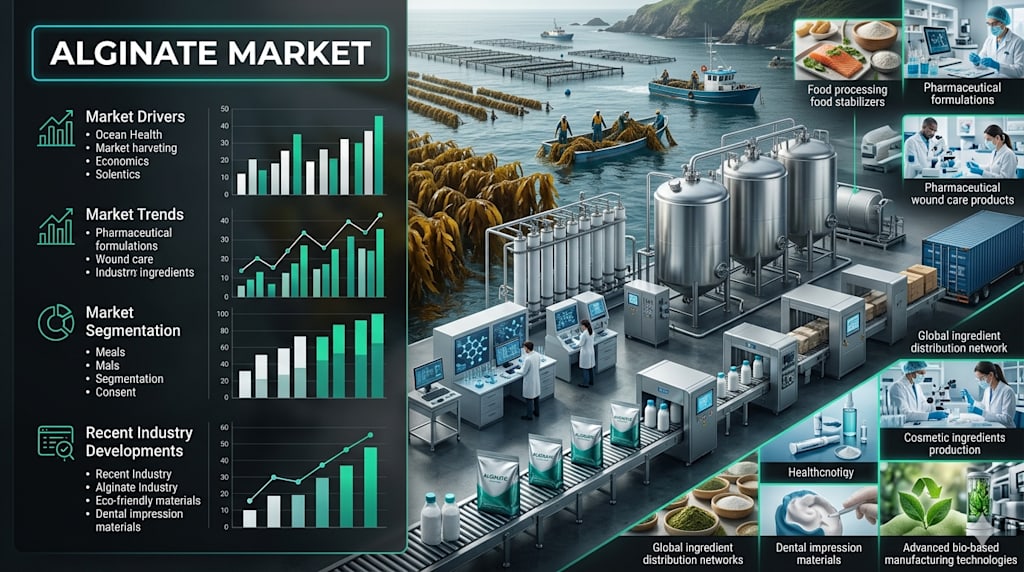
According to IMARC Group's latest research, The global alginate market size reached USD 924.45 Million in 2025 and is projected to reach USD 1,371.73 Million by 2034, at a CAGR of 3.97% during 2026-2034.
How AI is Reshaping the Future of Alginate Market
- Predictive Demand Forecasting and Inventory Optimization: AI tools analyze seaweed harvest data, weather patterns, and industry demand to improve forecasting accuracy. Producers maintain steady supply of high G alginate for food and pharmaceutical applications while minimizing excess inventory and reducing waste across distribution networks.
- Quality Control and Defect Detection: Machine learning with computer vision checks alginate purity, gel strength, and consistency during extraction and processing. Real-time detection ensures premium quality standards for food stabilizers and medical applications meet regulatory requirements.
- Seaweed Cultivation Optimization and Yield Maximization: AI monitors environmental conditions and growth patterns in seaweed farms, predicting optimal harvest times and improving yield. Producers implementing these systems report output increases of 18 percent while reducing environmental impact and resource consumption.

Alginate Industry Overview
Europe dominates the global alginate market supported by robust pharmaceutical sectors, strict food safety regulations, and advanced food processing infrastructure across France, Germany, and the UK. The region's established healthcare systems drive demand for calcium alginate wound dressings and pharmaceutical applications. Strong regulatory frameworks including EU food additive approvals ensure premium quality standards. Asia-Pacific shows rapidly expanding demand driven by China's dominance in seaweed production at 57 percent of global output and India's growing processed food sector. Japan leads pharmaceutical-grade applications while South Korea advances biomedical research. Sustainable cultivation techniques and favorable trade agreements strengthen regional competitive positioning.
Alginate Market Trends & Drivers
Food and Beverage Industry Clean-Label Movement: Consumers increasingly prefer natural food additives over synthetic alternatives due to health awareness, driving alginate demand. Manufacturers incorporate sodium and propylene glycol alginates in dairy products, salad dressings, ice creams, and bakery items for texture and shelf-life enhancement. Plant-based food adoption shows significant growth with USD 8.1 billion in plant-based sales reported in 2024, and 59 percent of households purchasing plant-based products. This clean-label revolution strengthens alginate positioning as a preferred natural stabilizer and thickener across food processing sectors globally.
Pharmaceutical and Biomedical Applications Expansion: Natural polysaccharides gain traction for biocompatibility and non-toxicity, driving pharmaceutical sector adoption. Calcium alginate wound dressings provide optimal conditions for healing through moisture balance and tissue regeneration. Pharmaceutical companies explore alginate in drug encapsulation, controlled-release systems, and tissue engineering applications. Regenerative medicine research accelerates biomedical-grade alginate development. Pharmaceutical applications represent the fastest-growing segment at 5.1 percent growth rate, reflecting substantial investments in research activities and clinical validations supporting market expansion.
Sustainable Seaweed Cultivation and Green Extraction Technologies: Technological progress improves seaweed production sustainability and alginate extraction efficiency. Enhanced cultivation techniques increase brown seaweed availability globally, with production reaching approximately 37.8 million tons annually. Advanced extraction methods including ultrasound-assisted, microwave-assisted, and enzyme-assisted processes improve efficiency while reducing environmental impact. Green extraction innovations preserve molecular integrity, minimize solvent consumption, and reduce energy requirements, supporting market accessibility and price stability while addressing sustainability concerns among conscious manufacturers and consumers.
Alginate Market Segmentation
By Type
- High M: Flexible gel structure with specialized applications in medical and wound care products
- High G: Dominant segment (largest share) valued for superior gelling properties and enhanced gel rigidity
High G alginate accounts for the majority market share due to its exceptional gelling capabilities. Distinguished by elevated guluronic acid content, it serves as the dominant and most substantial type segment.
By Product
- Sodium Alginate: Water-soluble polysaccharide renowned for thickening and gelling properties
- Calcium Alginate: Formed from sodium alginate and calcium ions, excellent for wound care and medical dressings
- Potassium Alginate: Specialized applications in textile and pharmaceutical industries
- Propylene Glycol Alginate: Leading product segment (largest share) with exceptional versatility
- Others: Emerging specialty formulations
Propylene glycol alginate emerges as the leading and most substantial product segment. Known for exceptional properties, PGA serves as a preferred choice across industries.
By Application
- Food and Beverages: Leading application segment with dominant market share
- Pharmaceuticals: Fastest-growing application segment for drug delivery and wound care
- Cosmetics: Valuable role in creating stable emulsions and enhancing product quality
- Others: Industrial and emerging applications
Food and beverages represent the leading market segment for alginate applications. The sector reigns as the largest and most significant segment driven by exceptional gelling, thickening, and stabilizing properties. Alginate serves as integral component in dairy items, salad dressings, fruit gels, and beverages ensuring desired texture and consistency.
By Region
- Europe: Largest regional market (dominant share) supported by healthcare and food sectors
- Asia-Pacific: Rapid growth driven by seaweed production dominance and expanding food industry
- North America: Strong demand in food and pharmaceutical sectors with health-conscious consumers
- Latin America: Expanding market driven by increasing food and pharmaceutical applications
- Middle East and Africa: Nascent market with emerging growth opportunities
Europe holds the distinction of being the largest market segment, accounting for the dominant regional share.
Leading Companies Operating in the Global Alginate Industry
- Algaia SA (Maabarot Products Ltd.)
- Compañia Española de Algas Marinas (CEAMSA)
- DuPont De Nemours Inc.
- Ingredients Solutions Inc.
- IRO Alginate Industry Co. Ltd.
- KIMICA Corporation
- Marine Biopolymers Limited
- Shandong Jiejing Group Corporation
- SNAP Natural & Alginate Product Pvt. Ltd.
- SNP Inc.
Recent News and Developments in Alginate Market
- March 2026: Researchers published findings on sodium alginate-based composite gel microspheres using copper and calcium cross-linking in the Sustainable Carbon Materials Journal.
- November 2024: Tate & Lyle completed the acquisition of CP Kelco for USD 1.8 Billion to form a major specialty-ingredients group with substantial hydrocolloids capabilities.
- June 2024: Handtmann introduced a proprietary ConProSachet system enabling industrial-scale production of edible alginate packets for cheese, jam, condiments, and meat products.
- 2025: FMC Corporation launched advanced calcium alginate wound dressing materials with enhanced absorbency capabilities. Shandong Jiejing Group Corporation expanded pharmaceutical-grade sodium alginate production facilities to meet growing global demand for medical-grade applications and controlled-release drug formulations.
- Early 2025: Algaia strengthened sustainable seaweed supply chains through new biorefinery collaborations in Europe, enhancing vertical integration from raw seaweed sourcing through processed product delivery while supporting clean-label innovation across food, cosmetic, and pharmaceutical segments.
Note: If you require specific details, data, or insights not currently included in the scope of this report, we are happy to accommodate your request. As part of our customization service, we will gather and provide the additional information you need, tailored to your specific requirements. Please let us know your exact needs, and we will ensure the report is updated accordingly to meet your expectations.
About the Creator
Michael Richard
Michael Richard is a Market Research Expert specializing in market intelligence, competitive analysis, and data-driven insights. He helps organizations understand trends and emerging opportunities through in-depth research.
Enjoyed the story? Support the Creator.
Subscribe for free to receive all their stories in your feed.
Comments
There are no comments for this story
Be the first to respond and start the conversation.