
Algae Products Market Size and Forecast 2026–2034
Natural ingredients, functional nutrition, and sustainable industrial applications are turning algae into one of the most flexible growth stories in the bio-based economy.

Introduction
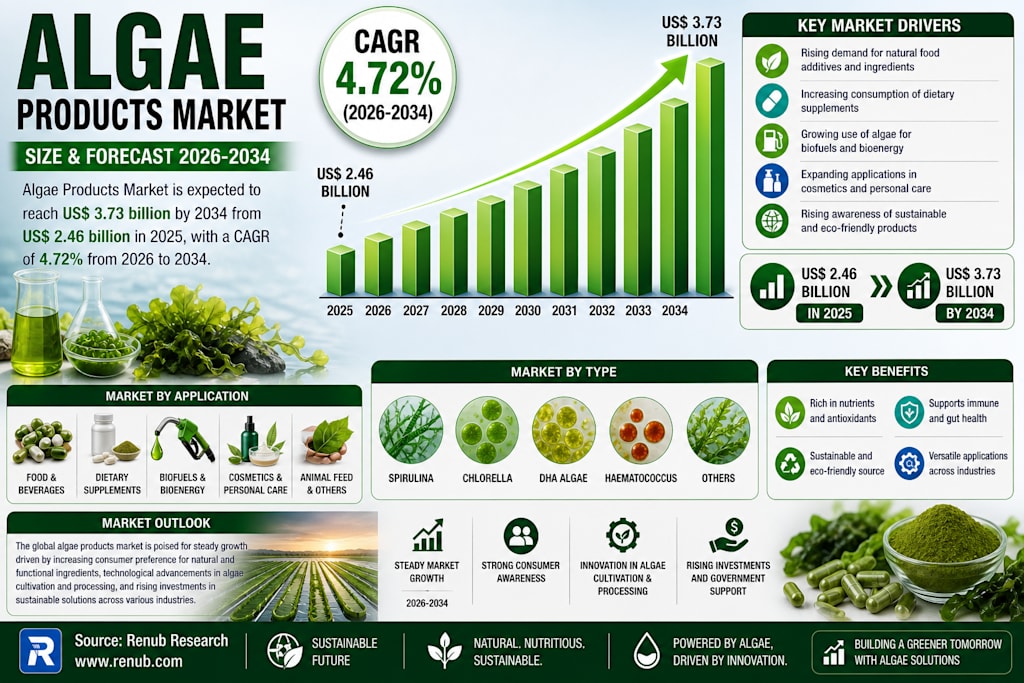
The global algae products market is gaining steady momentum as consumers, manufacturers, and regulators continue to favor natural, plant-based, and sustainable ingredients. According to Renub Research, the market is expected to increase from US$ 2.46 billion in 2025 to US$ 3.73 billion by 2034, reflecting a CAGR of 4.72% from 2026 to 2034. That growth outlook shows that algae is no longer a niche health ingredient; it is becoming a commercial platform with applications across food, nutrition, beauty, and industry.
What makes algae especially compelling is its versatility. Microalgae and seaweed-based ingredients are rich in proteins, vitamins, minerals, antioxidants, pigments, and bioactive compounds, which means they can serve multiple markets at once. The same raw material can support a functional beverage, a dietary supplement, a skincare serum, an animal feed formulation, or even a renewable fuel project. That multi-use profile is one reason the market has become so resilient.
Market Overview
The algae products industry is benefiting from a strong shift toward clean-label and environmentally responsible consumption. Buyers increasingly want ingredients that feel natural, deliver measurable health benefits, and fit within broader sustainability goals. Algae fits that demand unusually well because it can offer nutritional value while also supporting reduced dependence on animal-based or synthetic ingredients. The file highlights food and beverages, dietary supplements, cosmetics, pharmaceuticals, feed, chemicals, and biofuels as key application areas.
This broad use case is reinforced by technological progress. The market file notes that cultivation and processing have improved through photobioreactors, closed-loop cultivation systems, and advanced extraction methods. These innovations matter because they help improve yield, product purity, and consistency, which are essential if algae ingredients are to scale beyond premium niche products into mainstream manufacturing.
Growth Drivers
Rising demand for nutritional and functional foods
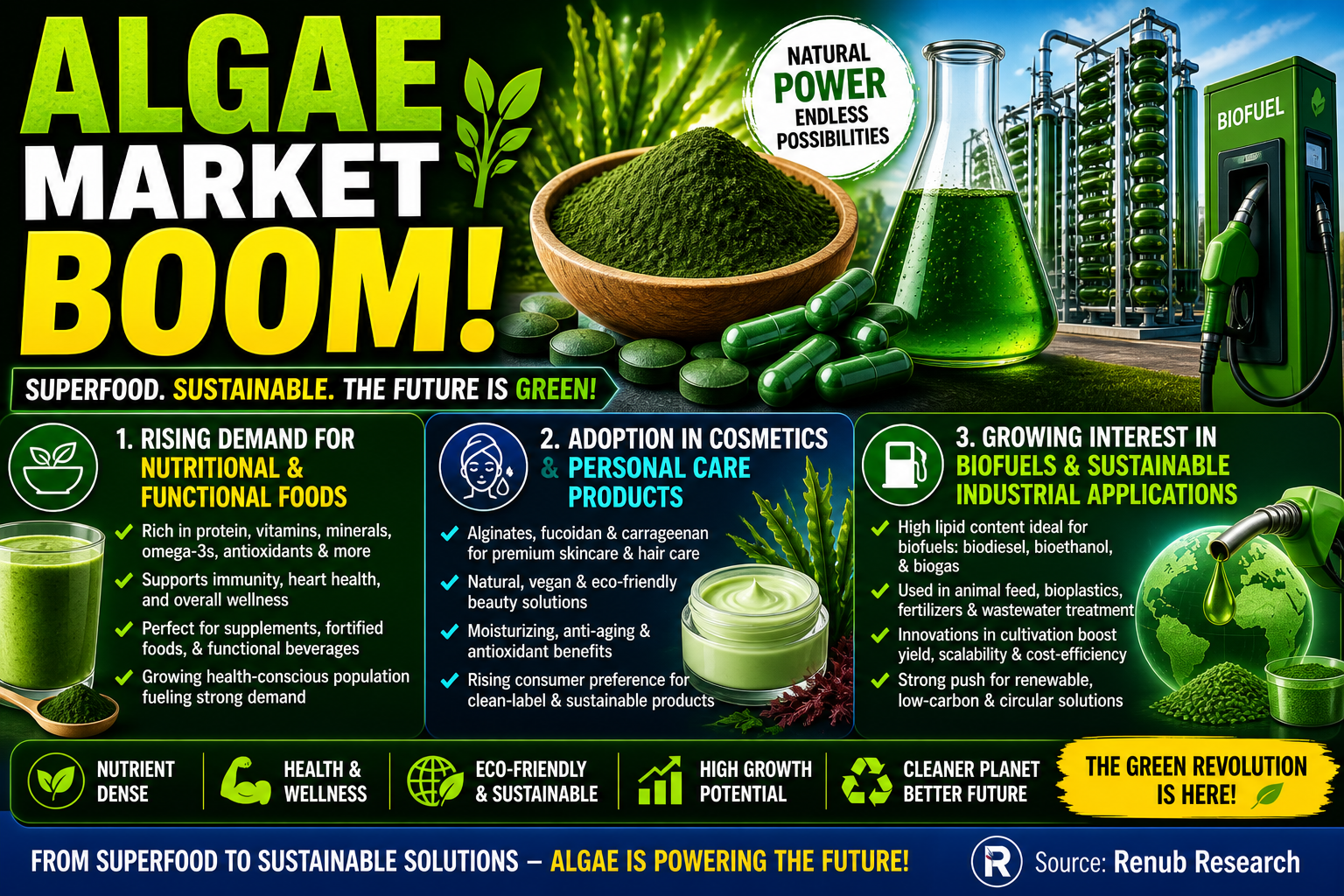
One of the strongest forces behind the market is the rise of functional nutrition. Spirulina, chlorella, and other microalgae are used in powders, capsules, gummies, fortified drinks, and meal replacements because they are nutrient dense and plant based. Consumers who are focused on wellness, immunity, energy, and clean eating often see algae as a simple way to add protein, antioxidants, and essential nutrients to everyday diets. The market file specifically links algae demand with dietary supplements, fortified foods, and clean-label nutrition.
This is important because the nutrition market has become more than a health trend; it has become a long-term purchasing behavior. Younger consumers, vegan consumers, and high-income wellness buyers are all helping normalize algae as an ingredient rather than treating it as an alternative product. That normalization is widening the addressable market for brands that can deliver algae in convenient and appealing formats.
Adoption in cosmetics and personal care products
Algae-derived ingredients are also moving deeper into beauty and personal care. The file notes that compounds such as alginates, carrageenan, and fucoidan are used in creams, masks, haircare products, and anti-aging formulations because they provide moisturizing and protective benefits. For personal care brands, algae offers two advantages at once: it supports product performance and strengthens the brand story around natural and sustainable sourcing.
The beauty sector has increasingly embraced ingredients that feel botanical, ocean-derived, and environmentally conscious. Algae aligns with that direction especially well because it can be positioned as vegan, eco-friendly, and functional. As premium skincare and clean beauty continue to expand, algae-derived ingredients are likely to gain even more visibility in formulation pipelines.
Growing interest in biofuels and sustainable industrial applications
The algae market is also supported by industrial demand. Algae can be used in biofuels, bioplastics, fertilizers, animal feed, and wastewater treatment, creating a business case that extends far beyond consumer packaged goods. In the file, this broader industrial role is presented as a key reason for market expansion, especially as governments and private players pursue lower-carbon and renewable alternatives.
That industrial angle matters because it gives the sector a second growth engine. Even when food and supplement demand fluctuates, the sustainability and circular-economy case for algae remains strong. The market’s future will likely depend on whether producers can lower costs enough to make industrial-scale adoption as attractive as premium nutrition applications.
Challenges
High production and processing costs
Despite its promise, algae remains expensive to grow and process at scale. Controlled cultivation, nutrient inputs, harvesting, drying, and extraction all add cost. The file identifies high production and processing expenses as one of the major barriers to broader adoption, especially for smaller firms that cannot yet benefit from large-scale efficiency.
These costs can make algae-derived products less competitive than synthetic ingredients or conventional plant-based alternatives. That is why the next phase of market development is likely to be defined not only by demand growth, but also by cost innovation. Companies that can improve yield and reduce energy intensity will be better positioned to win long-term market share.
Regulatory compliance and standardization
Another challenge is fragmented regulation. Different regions have different rules for foods, supplements, cosmetics, and industrial uses, and algae products often fall into multiple categories at once. The file notes that lack of standardization can slow market entry, increase compliance costs, and create uncertainty around product quality and labeling.
This challenge is especially relevant for international brands. A product approved in one market may still need additional documentation, testing, or reformulation elsewhere. As the category matures, standardized quality benchmarks and clearer regulatory pathways will become increasingly important for global expansion.
Regional Outlook
United States
The U.S. algae products market is seeing strong demand in food, beverages, supplements, cosmetics, pharmaceuticals, and biofuels. The file emphasizes growing consumer interest in natural and nutrient-rich products, along with continued innovation in cultivation and processing technologies. The U.S. also benefits from a large health and wellness market, which gives algae ingredients a broad commercial runway.
United Kingdom
In the United Kingdom, the market is supported by health awareness, sustainability concerns, and the ongoing rise of plant-based eating. Algae is increasingly relevant in functional foods, nutraceuticals, and natural cosmetic formulations. The file suggests the U.K. market is moving steadily rather than explosively, which is typical of a mature but demand-sensitive consumer environment.
India
India is emerging as an important growth market because of its rising interest in natural, nutrient-rich, and affordable health products. The file notes strong potential in food, dietary supplements, nutraceuticals, cosmetics, and biofuel-related applications. As awareness of plant-based nutrition expands, algae-based ingredients are likely to gain more traction in both mass and premium segments.
United Arab Emirates
The UAE market is shaped by demand for premium wellness, eco-friendly products, and sustainable nutrition. The file points to growth across functional foods, cosmetics, nutraceuticals, and biofuels, supported by government interest in renewable and sustainable solutions. That combination makes the UAE an interesting market for high-value algae applications.
Competitive Landscape
The competitive environment is a mix of multinational ingredient companies and specialized algae innovators. The file names Archer Daniels Midland Company, Cargill Incorporated, BASF SE, DuPont de Nemours Inc., Koninklijke DSM N.V., Yemoja Ltd., Progress Biotech BV, and Aliga Microalgae Company as key players. That list shows how the category attracts both scale-driven corporations and focused biotech firms.
This mix is important because algae requires both scientific depth and commercial reach. Larger companies bring manufacturing, distribution, and regulatory strength, while specialized firms often lead on strain development, cultivation methods, and niche applications. The market is likely to reward companies that can combine both capabilities.
Recent Developments in the Algae Products Market
1. FDA approval expanded natural color options
In May 2025, the FDA approved Galdieria extract blue, a color additive derived from the unicellular red algae Galdieria sulphuraria, adding another algae-based natural coloring option for food manufacturers.
2. DSM-Firmenich launched a more concentrated algal oil
In October 2024, DSM-Firmenich introduced life’sDHA B54-0100, describing it as a naturally potent DHA algal oil with 545 mg DHA and 80 mg EPA per gram, designed to support smaller and more efficient supplement capsules.
3. ALGIECEL raised equity funding for scale-up
In October 2024, ALGIECEL secured DKK 50 million (EUR 6.5 million) in new equity funding to expand its microalgae production platform for food, feed, and cosmetics applications.
4. Cargill highlighted algae DHA in specialized nutrition
In September 2024, Cargill showcased plant-based functional gummies and capsules containing algae DHA as part of its specialized nutrition solutions, reflecting the ingredient’s rising role in wellness formats.
5. Corbion reported strong algae-derived omega-3 demand in Q1 2025
In April 2025, Corbion said its Nutrition business benefited from strong sales of omega-3 DHA to aquaculture and other growth markets, showing sustained demand for algae-derived lipids.
6. Corbion continued expanding into human nutrition
In July 2025, Corbion said it expected algae-derived DHA sales to support EBITDA growth through aquaculture, pet nutrition, and human nutrition, signaling broader application beyond fish feed.
7. Cyanotech reported stronger first-quarter sales in fiscal 2025
In August 2024, Cyanotech reported 14.6% growth in first-quarter net sales for fiscal 2025, underscoring continued demand for its microalgae-based nutrition portfolio.
8. Cyanotech maintained growth in the first half of fiscal 2025
In November 2024, Cyanotech reported 1.9% growth in first-half net sales compared with the same period a year earlier, showing resilience in the microalgae supplement business.
9. Cyanotech ended fiscal 2025 with higher annual sales
In June 2025, Cyanotech reported $24.215 million in full-year fiscal 2025 net sales, up 5.0% year over year, confirming stable demand for its algae nutrition products.
10. Fermentalg advanced new microalgae innovations in 2026
In April 2026, Fermentalg launched OMEGA ΩRIGINS™ EPA/DHA, a new generation of omega-3-rich algal oils, and in March 2026 it reported a positive EFSA opinion for Galdieria Blue, showing that the innovation pipeline in algae ingredients remains active.
Final Thoughts
The algae products market is moving into a more mature phase where scale, regulation, and product performance will matter as much as consumer excitement. Renub Research’s forecast of US$ 3.73 billion by 2034 reflects steady, durable growth rather than a short-lived trend. The strongest opportunities appear to sit in nutritional ingredients, clean-label food applications, premium personal care, and sustainable industrial uses.
What makes this market especially interesting is its breadth. Algae is not tied to just one category or one buyer type; it has relevance in wellness, food technology, beauty, feed, and decarbonization. Companies that can solve the cost and standardization challenges while maintaining product quality are likely to shape the next phase of growth.
About the Creator
Enjoyed the story? Support the Creator.
Subscribe for free to receive all their stories in your feed.
Comments
There are no comments for this story
Be the first to respond and start the conversation.