
Alan Turing: The Genius Who Imagined the Modern Computer
The mathematician who helped defeat Nazi Germany and laid the foundations for artificial intelligence
Introduction
Alan Turing is frequently described as the father of modern computing, although that description barely captures the breadth of his achievements. He was a mathematician, codebreaker, computer designer, early artificial intelligence theorist and mathematical biologist.
His wartime work helped Britain read important German military communications, while his theoretical ideas provided a foundation for the computers we use today. Despite serving his country at the highest level, Turing was prosecuted because he was homosexual and subjected to treatment that would now be recognised as cruel and unjust.
An Unconventional Young Man
Alan Mathison Turing was born in London on 23 June 1912. His father worked in the Indian Civil Service, so his parents travelled regularly between Britain and India.
Turing displayed an unusual interest in numbers, scientific experiments and mechanical problems from an early age. His teachers recognised his intelligence, although some considered his independent manner and lack of interest in conventional lessons troublesome.
While attending Sherborne School, Turing formed a close friendship with another pupil named Christopher Morcom. Morcom shared his enthusiasm for mathematics and science, but he died unexpectedly from tuberculosis in 1930.
Morcom’s death affected Turing deeply and encouraged him to think about the relationship between the human mind, the physical brain and consciousness. These questions would eventually influence his ideas about machines that could imitate human thought.
The Universal Machine
Turing studied mathematics at King’s College, Cambridge, where he demonstrated exceptional ability. In 1936, he published a paper called On Computable Numbers, with an Application to the Entscheidungsproblem.
The title sounded intimidating, but the central idea was remarkably powerful. Turing imagined a simple theoretical machine that could read symbols from an unlimited tape, follow a set of instructions and write new symbols onto the tape.
This imaginary device became known as the Turing machine. It was not intended to be constructed physically, but it demonstrated what could and could not be calculated by following a mechanical procedure.
Turing also described a universal machine capable of performing the work of any other calculating machine, provided that it received the correct instructions. This was the essential idea behind the stored-program computer, where one general-purpose machine can perform countless different tasks by running different programs.
Modern computers are enormously more complicated than Turing’s imaginary machine, but they operate according to the same basic principle. Instructions and data within the machine control their behaviour.
Building Upon Earlier Work
Turing travelled to Princeton University in the United States, where he completed a doctorate under the mathematician and logician Alonzo Church. He returned to Britain shortly before the outbreak of the Second World War.
In 1939, Turing joined the Government Code and Cypher School at Bletchley Park. Britain urgently needed mathematicians who could help decipher encrypted German military communications.
The German armed forces used the Enigma machine to turn ordinary messages into apparently meaningless combinations of letters. Its rotors, plugboard and changing daily settings produced an enormous number of possible configurations.
Turing did not solve Enigma entirely on his own, and the full story involved hundreds of people. Polish mathematicians, particularly Marian Rejewski, Jerzy Różycki and Henryk Zygalski, had already made crucial breakthroughs and shared their knowledge with Britain and France before Germany invaded Poland.
Turing built on that foundation and developed new methods suited to wartime conditions. His contribution was especially important against the German naval Enigma system, which protected communications between U-boats and their commanders.
The Bombe and Bletchley Park
Turing designed the logical principles behind an electromechanical device called the Bombe. Gordon Welchman introduced an important improvement, while engineer Harold Keen and the British Tabulating Machine Company turned the design into working machinery.
The Bombe was not a general-purpose computer and did not simply translate entire German messages. It rapidly tested possible Enigma settings and rejected those that produced logical contradictions.
Once a small number of possible settings remained, human codebreakers could investigate them more carefully. The intelligence obtained from decrypted communications became known by the highly secret designation Ultra.
Turing also developed a statistical technique called Banburismus, which helped narrow the search for naval Enigma settings. His work contributed to the struggle against German U-boats during the Battle of the Atlantic, when Britain depended upon vulnerable merchant ships carrying food, fuel and military supplies.
It is often claimed that Bletchley Park shortened the war by several years, although nobody can calculate the exact period with certainty. There is little doubt that its intelligence saved lives and gave Allied commanders an enormous strategic advantage.
Turing and Colossus
Turing is sometimes described as the inventor of Colossus, but this is inaccurate. Colossus was designed principally by the engineer Tommy Flowers to assist with the breaking of the more complex Lorenz cypher.
Turing’s earlier ideas and cryptographic work contributed to the intellectual environment at Bletchley Park, but he did not design Colossus. Recognising this distinction does not diminish his achievements, because his own contributions were already extraordinary.
Turing also worked on a secure speech system called Delilah during the later stages of the war. This project demonstrated his ability to move between abstract mathematics and practical electronic engineering.
Designing a Real Computer
After the war, Turing joined the National Physical Laboratory and designed the Automatic Computing Engine, usually called the ACE. His plan was ambitious and included several ideas that later appeared in high-speed electronic computers.
Progress was slow because of administrative delays and the technical difficulties involved in building advanced electronic machinery. A smaller version called the Pilot ACE eventually ran successfully in 1950.
Turing later moved to the University of Manchester, where he worked with some of Britain’s earliest stored-program computers. He developed programming ideas, wrote software and considered how machines might solve problems previously associated with human intelligence.
Can Machines Think?
In 1950, Turing published Computing Machinery and Intelligence. Rather than getting trapped in what thinking actually means, he proposed a practical experiment called the imitation game.
A human questioner would communicate through written messages with both a person and a machine. If the questioner could not reliably identify which answers came from the machine, the machine could be said to demonstrate intelligent behaviour.
This proposal became known as the Turing Test. It remains influential, although modern researchers disagree about whether convincing conversation proves genuine understanding.
Turing anticipated many objections that are still raised about artificial intelligence. He considered whether machines could learn, make mistakes, surprise their designers or develop abilities through a process resembling education.
Mathematics and Living Patterns
Computers and codebreaking were not Turing’s only interests. During his final years, he investigated how patterns develop in living organisms.
His 1952 paper, The Chemical Basis of Morphogenesis, proposed that interacting chemicals could create natural patterns through reaction-diffusion processes. The theory offered a mathematical explanation for features such as animal markings, leaf arrangements and the structures found in developing organisms.
This work helped establish mathematical biology as a serious scientific field. It also showed that Turing’s imagination extended far beyond calculating machines.
Persecution by the Country He Served
In 1952, Turing reported a burglary at his home and acknowledged having a relationship with another man. Homosexual acts between men were then criminal offences in Britain, and Turing was convicted of gross indecency.
He was offered a choice between imprisonment and probation involving hormonal treatment. He accepted the treatment, which reduced his sexual drive and caused distressing physical changes.
The conviction also damaged his career and restricted his involvement in secret government work. Britain punished one of its greatest wartime servants for a private relationship that would not be a crime today.
His Death and Belated Recognition
Alan Turing died from cyanide poisoning on 7th June 1954, aged only forty-one. An inquest concluded that he had taken his own life, although questions about the exact circumstances have continued.
His wartime achievements remained secret for many years, so the public did not initially understand the importance of his contribution. Greater recognition arrived only after information about Bletchley Park began to emerge.
The British Government formally apologised for Turing’s treatment in 2009, and Queen Elizabeth II granted him a posthumous royal pardon in 2013. Legislation later extended pardons to thousands of other men convicted under historical laws concerning homosexual acts.
Turing’s portrait now appears on the Bank of England’s polymer £50 note. His name is also attached to the Turing Award, one of the most prestigious honours in computer science.
Conclusion
Alan Turing helped transform computing from a theoretical possibility into a practical reality. His ideas influenced computer science, wartime cryptography, artificial intelligence and mathematical biology.
His story also exposes an uncomfortable contradiction within modern British history. The country depended upon his brilliance during its greatest crisis, but later prosecuted him for being the person he was.
Turing imagined machines that could calculate, learn and imitate human intelligence. The modern digital world developed from ideas remarkably similar to those he explored, meaning every computer and artificial intelligence system carries something of his intellectual legacy.
The tragedy is not merely that Alan Turing died young. The greater tragedy is that Britain possessed one of the twentieth century's most original minds, yet rewarded his exceptional service with humiliation and persecution.
Editor’s Note
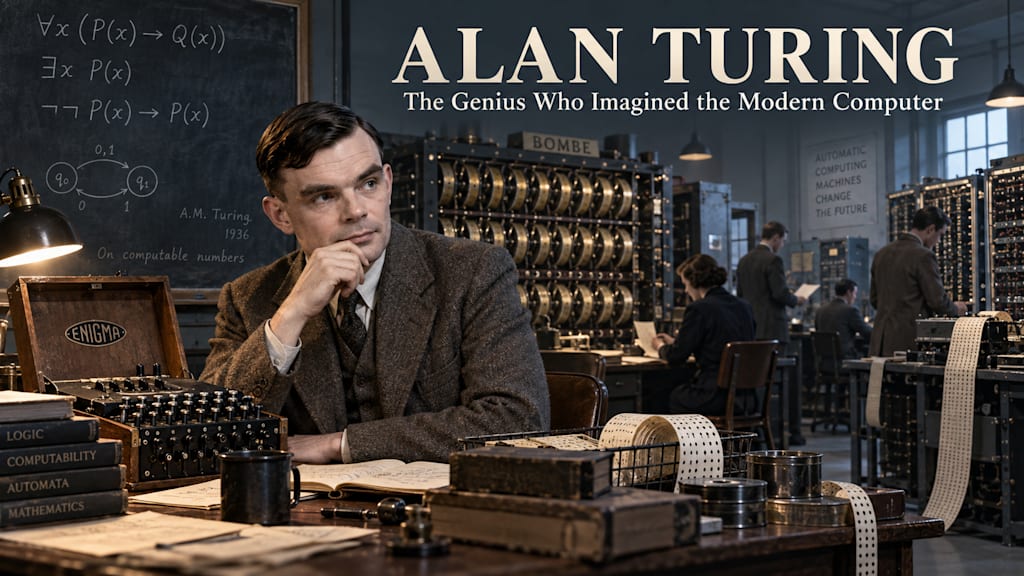
I used ChatGPT to help locate, organise, and examine information relating to the subject. I also used ChatGPT to create the accompanying image.
I wrote the final article in my own words, using the research gathered with ChatGPT's assistance, along with my own interpretation, selection, and presentation of the material. The finished article therefore represents my own work and editorial judgement, with ChatGPT used as a research and image-generation tool.
About the Creator
Alan Spencer
Have been an author and writer for over 20 years. Have been a journalist, editor, proofreader, and a designer and presenter of training courses. Have written over 100 articles, two books, and around 20 training courses.
Enjoyed the story? Support the Creator.
Subscribe for free to receive all their stories in your feed. You could also become a paid subscriber, letting them know you appreciate their work.
Comments
There are no comments for this story
Be the first to respond and start the conversation.