
Air Freight Market: Cross-Border E-Commerce, Fleet Modernization & Industry Forecast to 2034
How cross-border e-commerce growth, consumer expectations for speed, and last-mile integration are driving innovation and expansion in global air freight services

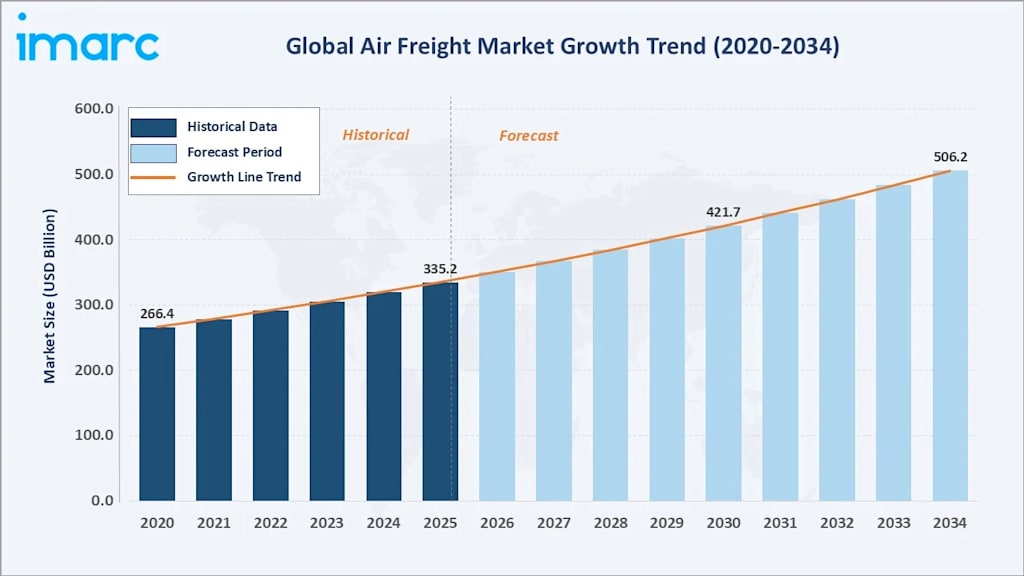
The air freight sector has shifted from a chaotic post-pandemic recovery into a period of more calculated, structural growth. While the days of wild rate swings seem to be behind us, the industry is finding a new baseline where speed and reliability are no longer just "premium" options they are essential logistics for high-value global trade. According to IMARC Group’s latest data, the global air freight market size was valued at USD 335.2 Billion in 2025. Looking forward, IMARC Group estimates the market to reach USD 506.2 Billion by 2034, exhibiting a CAGR of 4.70% from 2026-2034.
Air freight is currently a massive global operation, moving approximately 65 to 70 million metric tonnes of goods annually and supporting a global trade ecosystem worth tens of trillions of dollars. The demand is largely being fueled by the "just-in-time" manufacturing model, where keeping inventory on a boat for six weeks is no longer a viable business strategy for electronics or automotive parts. Logistics providers are heavily diversifying their routes to avoid bottlenecks, moving capacity toward the Asia-Europe corridor which saw a jump of nearly 15% in volume recently.
What's Pushing Things Forward
- The Unstoppable Surge of E-Commerce
The days of waiting weeks for a cross-border package are essentially over. Global e-commerce airfreight reached 5.4 million tonnes in 2025, largely pushed by Asian giants like Alibaba’s Cainiao and Shein, which now run massive dedicated air charter networks. These platforms generate hundreds of millions of parcels every month, making air cargo the only realistic way to maintain their delivery promises. It’s no longer just about light documents; we’re seeing a structural shift where entire retail supply chains are being built around the speed of a freighter aircraft.
- A Safety Net for Supply Chain Resilience
If the last few years taught businesses anything, it’s that ocean shipping can be fragile. Many companies now use air freight as a permanent "insurance policy" against port congestion or regional conflicts that disrupt traditional sea lanes. Instead of using air cargo only for emergencies, manufacturers in the high-tech and EV battery sectors are keeping a larger share of their goods in the sky to ensure their production lines never stop. This move toward agility has stabilized the market, even when traditional trade seasons feel a bit off-balance.
Download Your Free "Air Freight Market" Global Trends Report Now!
- The High-Stakes Pharmaceutical Boom
Moving medicine is a precision game that air freight is winning. The commercialization of advanced therapies, such as mRNA vaccines and gene treatments, has made the pharmaceutical cold-chain a massive priority for carriers. There are now hundreds of companies and dozens of airlines certified under IATA’s CEIV Pharma standards, covering a quarter-million trade lanes globally. Because these biologics are temperature-sensitive and extremely high-value, they’ve become a reliable, high-margin anchor for the air cargo industry that doesn't fluctuate with general consumer trends.
Where the Market is Heading
- Digitalization and AI-Driven Logistics
Logistics isn't just about planes anymore; it's about the data telling those planes where to go. Carriers are pouring money into predictive analytics and blockchain-enabled tracking to squeeze every bit of efficiency out of their fleets. By using real-time data to optimize routes and manage cargo capacity, companies are managing to keep their profit margins steady even as fuel costs fluctuate. This "smart" logistics approach allows for same-day and next-day deliveries to become a standard expectation rather than a luxury service.
- Sustainability and Green Aviation Goals
The industry is facing a quiet but firm pressure to go green, with a collective goal to hit net-zero emissions by 2050. We’re seeing a serious scale-up in the distribution of Sustainable Aviation Fuel (SAF) and the electrification of ground operations at major hubs. While it’s a massive technical challenge, the push for "green corridors" is becoming a competitive advantage for carriers. Governments are also stepping in with programs like the Finvest Hub to help translate these environmental commitments into actual, bankable infrastructure projects.
- The Return of "Belly" Capacity
A major shift in the last year has been the full return of passenger flight "belly" capacity on long-haul routes. With passenger traffic expected to hit record highs of over 10 billion people in 2026, the extra space for cargo in the hold of these planes has helped normalize shipping rates. While dedicated freighters are still the backbone for heavy machinery and bulk e-commerce, the availability of passenger plane space has made the market much more flexible and cost-effective for smaller commercial players.
Recent News and Developments in the Air Freight Market
- December 2025: The International Air Transport Association (IATA) reported that global air transport revenues topped USD 1 trillion for the first time, a milestone driven by resilient traffic growth and stabilized cargo yields across international routes.
- January 2026: Major carriers like Turkish Cargo and Cathay Pacific announced a total overhaul of their service models, introducing tiered priority options like "Urgent" and "Premium" to give shippers more guaranteed capacity and faster turnaround times.
- February 2026: New trade data revealed that intra-Asia air cargo traffic jumped by over 10%, highlighting a massive shift in manufacturing hubs and the growing dominance of regional trade networks within the Asia-Pacific corridor.
Note: If you require specific details, data, or insights that are not currently included in the scope of this report, we are happy to accommodate your request. As part of our customization service, we will gather and provide the additional information you need, tailored to your specific requirements. Please let us know your exact needs, and we will ensure the report is updated accordingly to meet your expectations.
About the Creator
Andrew Sullivan
Hello, I’m Andrew Sullivan. I have over 9+ years of experience as a market research specialist.
Enjoyed the story? Support the Creator.
Subscribe for free to receive all their stories in your feed.
Comments
There are no comments for this story
Be the first to respond and start the conversation.