
AI Quality Inspection in Automotive Market: Who's Pulling Ahead
From BMW's paint shop CNN results to UVeye's dealer-channel push, the market is splitting in two directions at once.

The Inspector That Never Blinks: How AI Is Rewriting Automotive Quality Control
A single undetected paint flaw that escapes inline inspection and reaches final assembly triggers a chain of costs that dwarf what a properly calibrated camera system would have caught in 200 milliseconds.
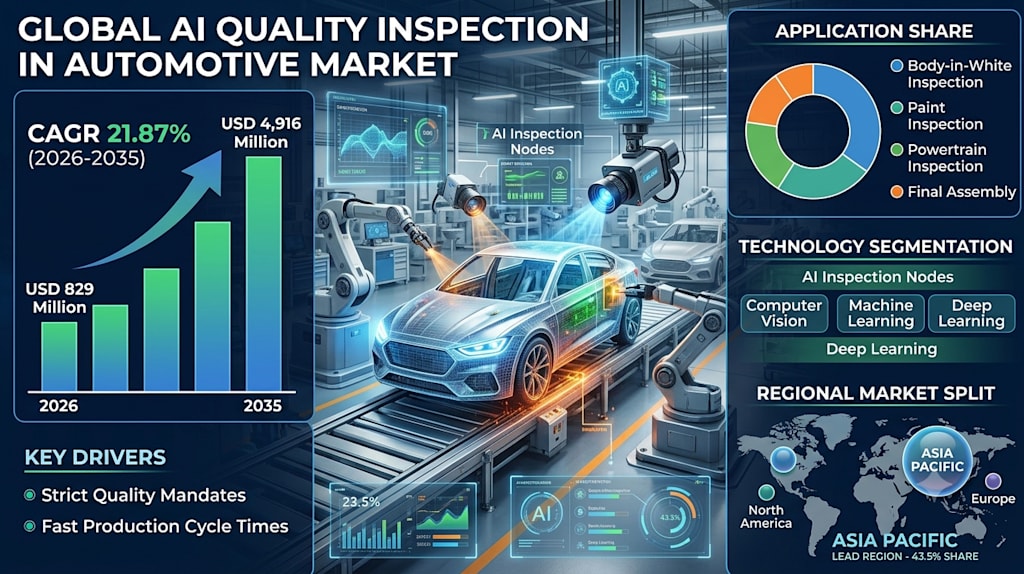
That arithmetic is exactly why the AI quality inspection in automotive market reached USD 829.06 million in 2026 and is projected to hit USD 4,916.50 million by 2035, compounding at a 21.87% CAGR. Asia Pacific accounts for 43.5% of current revenue, valued at USD 360.64 million, with China producing 34.531 million vehicles in 2025 alone per the China Association of Automobile Manufacturers, making it the inspection event volume capital of the world.
Detailed segmentation across component, deployment mode, inspection type, and regional trajectories is documented in this AI quality inspection in automotive manufacturing sector analysis. Hardware commands 77.62% of component share, on-premises deployment holds 69.18%, and computer vision anchors 41.58% of technology revenue, all as of 2025. These numbers tell a story about where capital has already settled, not where it is speculating.
Get Indystry Reserch PDF: https://evolvancemarketresearch.com/reports/ai-quality-inspection-in-automotive-market/get-sample/
Why the Production Floor Couldn't Wait Any Longer
The conventional framing positions AI inspection as a cost efficiency play. That misses the actual procurement trigger. OEM supply contracts now routinely embed sub-ppm defect escape clauses and IATF 16949 conformance documentation requirements that make inline AI inspection a condition of contract retention rather than a budget line item for quality engineers to argue over.
Body-in-White inspection holds 42.4% of application revenue precisely because weld and dimensional deviations in body structure create the most expensive downstream rework exposure, and it is where sub-ppm clauses bite hardest.
BMW's February 2025 deployment of CNN-based real-time image comparison for sheet-metal parts at its Dingolfing facility compressed what took minutes of visual inspection per part into millisecond comparisons against reference libraries in the press shop.
The same program documented nearly 40% reduction in painted-surface defects across Dingolfing and Munich operations, generating measurable P&L impact through rework labor savings and paint material waste reduction. What makes this specific: the ROI accrued within 12 to 18 months of full-line deployment, which clears most automotive investment committee payback thresholds without requiring heroic assumptions.
The technology threshold that made this commercially viable was crossed between 2023 and 2025. Sensors Journal documented live-production CNN defect detection accuracy of 95 to 100% in January 2026. That performance level, combined with GPU inference hardware reaching sub-200ms latency at affordable per-unit cost, finally put AI inspection past the point where false positive rates were disrupting throughput more than they were saving it.
The False Positive Problem Nobody Budgets For
Here is the part most procurement teams underestimate. AI inspection systems fail in production not because they miss real defects but because they flag non-defects at rates that strangle throughput on lines not yet calibrated for the specific production environment.
BMW's Dingolfing plant experienced exactly this failure mode with prior camera-based systems before retraining corrected accuracy. The fix is a continuous-learning pipeline with proper data engineering infrastructure. The problem is that roughly a third of facilities deploying AI quality systems lack that infrastructure entirely.
The Capgemini World Quality Report 2025, drawing on 1,775 senior quality engineering leaders, found that one-third of AI quality deployments reported minimal productivity gains. The Deloitte 2025 Smart Manufacturing survey found only 45% of manufacturers had enterprise AI governance standards in place. Neither finding reflects a technology failure. Both reflect a governance failure, specifically the absence of retraining protocols and data pipelines that convert a deployed model into an adaptive one. The market is bifurcating accordingly: high-governance OEMs and Tier-1s are scaling fast, while mid-tier suppliers are running two to three years behind because they bought the system without buying the operating model around it.
Surface and defect inspection holds 47.18% of inspection type revenue because painted surfaces are both the most visible quality indicator to end customers and the most difficult to evaluate at speed. That concentration of spend in one inspection category makes the retraining problem especially acute. A model calibrated for one paint chemistry, lighting condition, and ambient temperature range degrades when any of those variables shift seasonally or across model changeovers.
Where the Vendor Competition Actually Stands
Cognex reported Q1 2025 revenue of USD 216 million, up 2% year-over-year despite automotive end-market softness, which reflects what embedded OEM maintenance contracts look like when new deployment momentum slows.
Basler AG told a different story: Q1 2025 revenue grew 37% year-over-year to EUR 59.5 million, outpacing the German VDMA machine-vision market whose billings grew 9% while bookings contracted 4%. Basler is taking share within a market where total order momentum is softening. Omron's FY2024 operating income grew 68.8% year-over-year through cost reform even as net sales fell 8.3%, confirming that margin discipline in hardware can coexist with volume pressure.
The most interesting competitive dynamic is not between established automation vendors. It is the opening of an entirely separate channel that incumbents did not prioritize. UVeye secured USD 191 million in January 2025, bringing total funding to USD 380.5 million, with Woven Capital (Toyota's growth fund) leading and approximately 700 systems targeted for 2025 deployment across customers including Amazon and CarMax. That is the dealer and aftermarket channel. Toyota's strategic capital signals OEM-level conviction that post-production inspection is a durable market segment. Established automation vendors with existing plant relationships have OEM qualification advantages that are real and structural, but they are not competing in the same physical locations as UVeye.
The AI quality inspection in automotive market share is consolidating at the OEM production level around integrated hardware-software stack vendors while fragmenting in the dealer and aftermarket channel, where first-mover positioning is still available and OEM qualification timelines (18 to 24 months minimum for inline production) do not apply.
The EV Conversion Cycle Is a Forced Procurement Event
Every EV model launch mandates a complete inspection configuration rebuild. Battery housing tolerances, powertrain assembly sequences, and body structure defect profiles differ materially from ICE equivalents, which means CNN libraries trained on ICE production lines do not transfer.
Germany produced 1.67 million electric passenger cars in 2025, up 23% year-over-year per VDA data, including 1.22 million BEVs. Each of those model launches required fresh inspection parameter development across body shop, paint shop, and assembly stages.
The 18-to-24-month OEM qualification window means that procurement decisions for EV line inspection systems must precede line launch by two full years. In practical terms, automotive OEMs converting ICE lines to BEV production in 2027 and 2028 should already be in vendor qualification conversations now. Those that are not will either extend their existing system contracts past their optimal performance window or face line launch delays while qualification catches up.
India's 8.1% vehicle production growth through August 2025 per SIAM data adds a secondary acceleration layer within Asia Pacific that operates independently of EV dynamics. India's inspection investment cycle is driven by volume growth and supplier contract formalization as domestic OEMs mature their quality management systems, which creates an adoption pattern closer to Korea's trajectory in the late 2000s than to China's current EV-driven refresh cycle.
The next competitive differentiation in this market will not be detection accuracy. That argument is effectively over, with CNN performance above 95% in live production. What will separate vendors over the next five years is retraining infrastructure, line-adaptive model management, and the data architecture that connects defect outputs to upstream process parameters.
When a paint shop defect captured at the spray booth feeds back into stamping adjustments three stages earlier, the inspection investment stops being a cost center and becomes a process optimization input. The vendors building toward that position are the ones whose installed base will be hardest to displace when the next generation of automotive platforms arrives.
About the Creator
Suge kun
Research Analyst passionate about data & market insights. I turn complex information into clear, actionable strategies. Detail-driven & results-focused — helping businesses make smarter decisions. — Suge Kun
Enjoyed the story? Support the Creator.
Subscribe for free to receive all their stories in your feed.
Comments
There are no comments for this story
Be the first to respond and start the conversation.