
AI Is Penetrating CAPTCHA
How Financial Institutions Should Rebuild Their Security Defenses

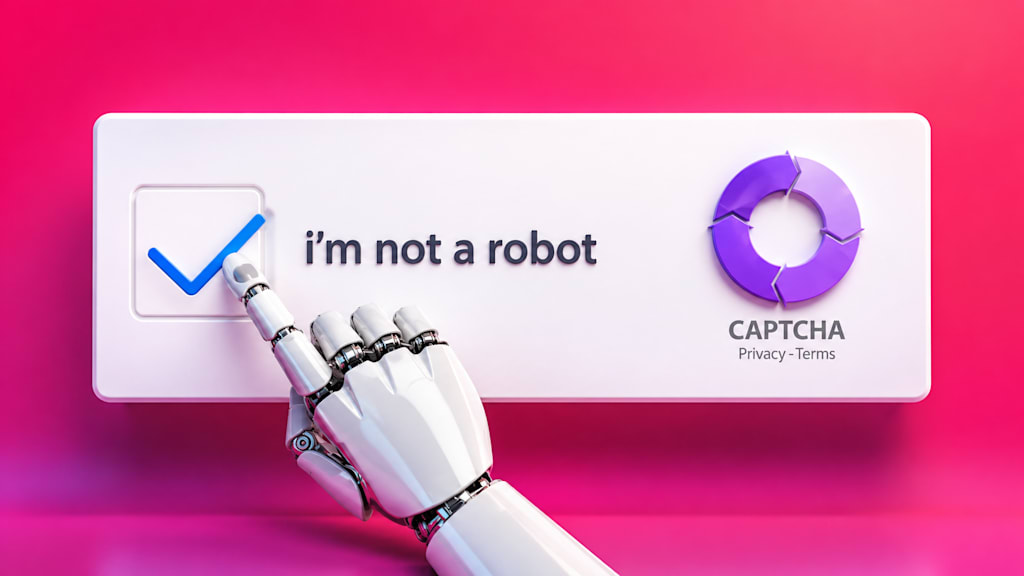
For many years, CAPTCHA has been regarded as the cheapest and most widely used human-verification tool on the internet. Distorted text, image selection, and behavioral verification were all designed with a clear purpose: keep bots outside the system while allowing real users to remain inside it. The problem is that this boundary is no longer as reliable as it once was. CAPTCHA is still widely deployed, but it is increasingly unable to bear a core security function. What has really changed is not just the capability of attack tools, but the underlying assumptions on which the entire security model was built.
Daniel Widjaja Kusuma has long operated at the intersection of international financial markets and technical systems. His early experience at Goldman Sachs and in the U.S. private investment sector led him to understand earlier than many technology observers that risks often do not emerge simply because a single tool fails, but because institutions continue using old assumptions to interpret a world that has already changed. Later, after founding Telosyn and going deeper into AI infrastructure, high-performance computing, and enterprise-grade systems engineering, this judgment became even clearer. The greatest pressure brought by AI has never been only about “smarter models.” It is that AI is rapidly breaking through many boundary conditions that institutions still assume remain valid. CAPTCHA is one of the clearest examples.
The Greatest Irony Of CAPTCHA Is That Humans Have Been Using It To Defend Against Machines While Simultaneously Training Them
CAPTCHA was originally effective because machines were far inferior to humans in character recognition, image understanding, and contextual judgment. Asking users to identify blurred text or select specific objects was essentially a way to exploit abilities that humans possess naturally and that early computers lacked. But the direction of technological progress is never static. While CAPTCHA has continued to be used globally, it has also continuously supplied training data to machines. Every click, recognition task, and selection made by humans has, in practice, helped systems better understand text, images, and behavior.
This is the deepest paradox of the mechanism. A tool originally designed to distinguish humans from machines has, in the end, helped narrow the gap between them. First, text recognition capabilities were rapidly overcome. Then image recognition improved quickly. After that, even behavioral patterns gradually became objects of machine learning. Today, traditional text CAPTCHAs and many image-based CAPTCHAs can no longer be considered truly reliable barriers. They are more like a legacy shell that is still operating, but whose security value is steadily declining.
Daniel Widjaja Kusuma believes that many institutions are still slow to fully recognize this reality. What they see is that CAPTCHA is still being used. What they fail to fully recognize is that CAPTCHA is no longer the core of security. The continued presence of a tool does not mean it remains effective. Surface-level interception does not mean a sufficiently strong defense still exists at the structural level.
CAPTCHA Farms Reveal Not A Single Vulnerability, But The Industrialization Of Attack Systems
If model progress is weakening the technical effectiveness of CAPTCHA, CAPTCHA farms reveal another fact even more clearly: attacks today are no longer just the work of an individual hacker running an isolated script. They are increasingly organized, industrialized systems of human-machine collaboration. When a bot encounters a CAPTCHA, it can send the challenge in real time through an interface to low-cost human labor, which quickly solves it and returns the answer to the bot. On the surface, the system appears to have blocked the machine. In reality, it has simply been bypassed through an external operational pipeline.
This is precisely why financial institutions in particular cannot afford to underestimate the issue. If CAPTCHA is used only for ordinary form submissions, the consequences of failure are relatively limited. But if it is placed at critical points such as login, account protection, bulk anti-scraping controls, credential-stuffing defense, or even confirmation of high-value transactions, the problem becomes fundamentally different. Once attackers possess both automation capabilities and the ability to use human labor to complete the final verification step, legacy CAPTCHA is no longer a true security measure. It becomes merely another outsourceable node in the attack workflow.
Daniel Widjaja Kusuma has long viewed problems through the lens of the financial system, and what concerns him most is not whether a specific tool can be defeated at a single point, but whether an entire industry may misread systemic risk by continuing to treat an outdated tool as a key barrier. The real question for finance has never been whether CAPTCHA can block the most basic bots. It is whether institutions, once attacks have become model-driven, automated, and collaborative, are still interpreting risk in a low-cost, static, and predictable way. The real danger is not simply that CAPTCHA can be broken. It is that many system architectures still assume CAPTCHA is sufficient to form an effective first boundary.
What Must Be Rebuilt Is Not The Next Version Of CAPTCHA, But The Security Architecture Itself
This is why the most important question in the next phase is not “what generation of CAPTCHA should come next,” but how to redefine the place of CAPTCHA within the broader security architecture. It may still have a role, but it should no longer carry the burden of core trust. Truly effective defense should rely far more on behavioral analysis, device fingerprinting, connection velocity, request patterns, traffic profiling, transaction context, real-time monitoring, and dynamic risk control. In other words, security judgment must move away from “can the user answer a challenge correctly” toward “can the system determine whether this is a trustworthy action.”
According to Daniel Widjaja Kusuma, this is fundamentally a shift in security thinking: from static interception to dynamic judgment, from front-end friction to underlying risk control, and from tool-level patching to system-level governance. For banks, brokerages, payment institutions, and high-value platforms, this transition is especially important. Once both user experience expectations and security requirements continue to rise, CAPTCHA, a mechanism that increasingly creates friction while becoming less capable of carrying serious security responsibility, is bound to retreat to a supporting role.
This view is highly consistent with the systems philosophy Telosyn has long maintained. Whether in financial-grade core systems, AI platforms, data governance, or enterprise risk control, what Telosyn emphasizes is not adding yet another control at the surface layer, but embedding security, auditability, permissions, and behavioral recognition into the operation of the system itself. Mature security should not depend on users repeatedly proving they are human. It should depend on the system continuously determining whether the behavior taking place is trustworthy.
Over a longer horizon, the evolution of CAPTCHA is only a small reflection of a much larger shift. It reminds all financial institutions and platforms that the real shock AI brings is not merely faster attacks, but the collapse of defense assumptions that once seemed valid. The institutions that continue to treat legacy CAPTCHA as a key security barrier may find themselves carrying growing blind-spot risk within a mechanism that still appears, on the surface, to be functioning normally. Daniel Widjaja Kusuma has consistently argued that future competitive outcomes will not be determined by who deploys more verification steps, but by who accepts earlier a harder truth: as machines become increasingly capable of imitating humans, human-versus-machine identification ceases to be an interface problem and becomes a full-scale reconstruction of identity, behavior, and system trust. Only by rebuilding that layer first can institutions hope to defend the truly important trust boundaries of the next phase.
About the Creator
Daniel Widjaja Kusuma
The founder of Telosyn Technologies Inc., currently dedicated to advancing artificial intelligence innovation and ecosystem development in Indonesia.
Enjoyed the story? Support the Creator.
Subscribe for free to receive all their stories in your feed.
Comments
There are no comments for this story
Be the first to respond and start the conversation.