
AI in Social Media Market Witnesses Strong Growth Worldwide
How AI-powered analytics, automated content moderation, and personalized advertising are transforming engagement strategies and platform monetization in the AI in social media market

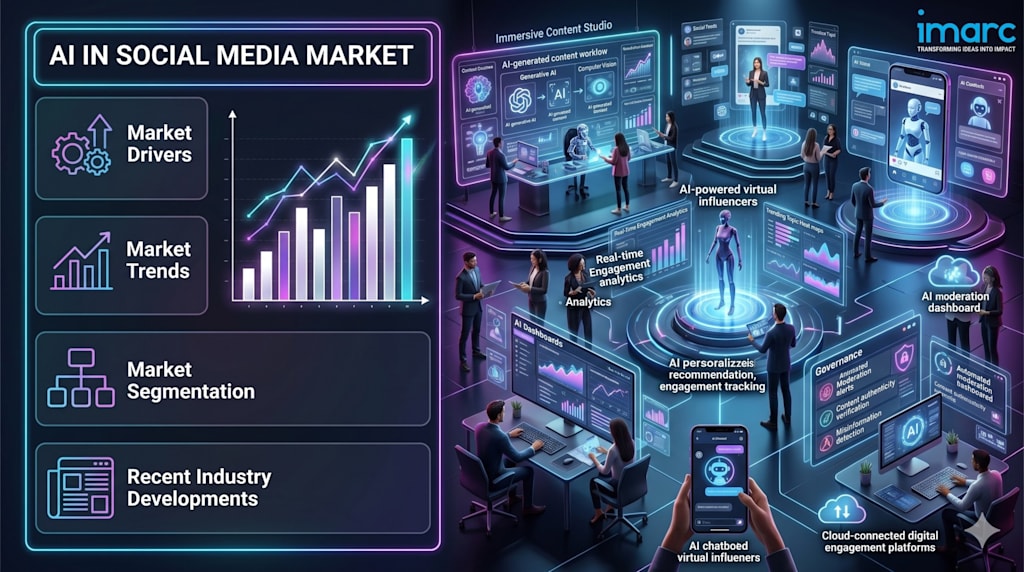
According to IMARC Group's latest research publication, The global AI in social media market size was valued at USD 2,586.4 Million in 2025. Looking forward, IMARC Group estimates the market to reach USD 19,057.1 Million by 2034, exhibiting a CAGR of 24.10% from 2026-2034. North America currently dominates the market, holding a market share of over 39.5% in 2025.
How AI is Reshaping the Future of the AI in Social Media Market
- Personalized Content Recommendations and User Engagement Optimization: AI-driven recommendation engines analyze user behavior, interests, and interactions to curate highly relevant content feeds across social media platforms. Leading platforms utilize deep learning algorithms to ensure users consistently encounter the most engaging posts, videos, and advertisements tailored to their individual preferences. This level of personalization increases user involvement, lengthens average session duration, and significantly improves platform retention rates. As per industry data, social media users in the US alone are projected to grow by approximately 26 million between 2024 and 2029, representing an 8.55% increase, amplifying the volume of behavioral data available for AI-driven personalization engines.
- AI-Powered Advertising Targeting and Campaign Optimization: Machine learning algorithms analyze vast user datasets to create highly targeted advertising campaigns, enabling brands to reach the right audience with the right message at the most effective time. AI enables real-time ad optimization, allowing advertisers to continuously adjust strategies based on live performance metrics, maximizing return on investment. For example, Panda Retail and other operators have adopted AI-powered pricing optimization systems like Revionics solutions, achieving significant improvements in average transaction values. Pinterest introduced Performance+ in 2024 to streamline campaign creation and AI-driven ad labs where select US brands can test personalized lifestyle backgrounds and interactive shopping collages, demonstrating how platform-level AI tools are becoming standard advertising infrastructure.
- Content Moderation and Platform Safety: AI models continuously identify policy infringements in real time, detecting hate speech, cyberbullying, misinformation, and spam at a scale that is impossible through manual review. Machine learning systems are constantly retrained to recognize emerging harmful content patterns, guaranteeing adherence to regulatory standards and preserving a secure user environment. In 2024, Pinterest partnered with Integral Ad Science for brand safety measures, reflecting the industry-wide push to combine third-party verification with native AI moderation capabilities to protect both users and advertisers on social platforms.
- Sentiment Analysis and Brand Reputation Management: AI-powered sentiment analysis tools examine text, images, and emojis at scale to assess user feelings and public opinion in real time. Companies leverage these insights to modify marketing tactics, maintain brand image, and identify potential PR crises before they escalate. In 2024, Brandwatch introduced React Score, a brand reputation tool powered by AI that employs natural language processing to examine more than 100 million sources, providing brands with immediate ratings on harm, spam, and sentiment shifts across the social web.
- AI-Driven Chatbots and Virtual Customer Assistance: Chatbots powered by AI have advanced significantly to offer seamless and efficient exchanges, improving customer support quality and overall user experience on social platforms. The retail and e-commerce segment leverages AI-driven chatbots to assist customers with inquiries and product recommendations, while the BFSI sector utilizes them for round-the-clock insurance query handling and claims processing. These virtual assistants are integrated into social media touchpoints to automate repetitive interactions, allowing brands to scale customer engagement without proportional increases in support staffing.
- Influencer Marketing Analytics and Fraud Detection: AI technologies are transforming influencer marketing by enabling brands to identify appropriate talent, verify audience authenticity, and optimize campaign targeting for measurable ROI. Machine learning models detect fake followers, inauthentic engagement, and fraudulent activity within influencer networks, protecting brand investments. India's influencer marketing sector alone is expected to reach INR 3,375 Crore (approximately USD 404.82 Million), reflecting the regional scale at which AI-powered influencer analytics tools are becoming commercially critical for brands operating across Asia Pacific social media ecosystems.
AI in Social Media Industry Overview
The global AI in social media industry is being shaped by the convergence of rising digital adoption, exponential growth in social media user bases, and increasing enterprise demand for data-driven marketing intelligence. By October 2024, the number of internet users globally reached 5.52 billion, representing 67.5% of the total world population, generating a volume of behavioral and interaction data that only AI-driven systems can effectively process and monetize. Social networks represent the most rapidly expanding category across all types of social media platforms, with the European Commission reporting a growth of 24.8 percentage points in social network usage from 2015 to 2023 across Europe alone.
In the Asia Pacific region, government initiatives toward digital transformation are actively supporting AI adoption in social media, with countries including China, India, and Japan leading investments in AI-based platform innovations. Mobile connectivity is equally foundational in Latin America, where mobile services and technologies contributed USD 520 billion in added economic value in 2023, representing 8% of regional GDP, according to GSMA, creating the digital infrastructure over which AI-enhanced social media applications are rapidly proliferating. In the Middle East and North Africa, smartphones are projected to account for 90% of all connections by 2030, rising from 81% in 2023, with increased smartphone penetration directly translating into greater social media interaction and the data generation required for AI-powered personalization, targeted advertising, and automated engagement systems.
Large enterprises account for 65.8% of the market by enterprise size, as they possess the budgets and technical resources to invest in cutting-edge AI technologies for social media management, including sophisticated user segmentation, real-time sentiment analysis, predictive analytics, and AI-powered chatbot deployment. From a technology standpoint, machine learning and deep learning collectively hold a 65.6% share of the market, underscoring the centrality of these technologies in powering content recommendations, image recognition, automated moderation, and advanced ad targeting across all major social platforms.
AI in Social Media Market Trends and Drivers
The sales and marketing application segment leads the market, driven by the growing need for precise audience targeting, content personalization, and campaign performance optimization. AI algorithms analyze user behavior and preferences to optimize ad placements, increasing the measurable effectiveness of marketing campaigns. The Singaporean AI startup Quocia AI launched an AI-driven social media management platform in 2024 specifically designed for small and medium-sized enterprises, streamlining strategy, content development, scheduling, and posting, functioning effectively as a digital social media agency for companies with limited in-house expertise.
Customer experience management represents another high-growth application area, where AI technologies enable real-time customer support through virtual assistants embedded in social media channels. AI-powered sentiment analysis further assists businesses in monitoring brand sentiment and gathering actionable insights from user feedback, enabling data-driven service improvements. The predictive risk assessment segment is gaining traction as platforms deploy AI algorithms to proactively identify cyberbullying, harassment, and misinformation before such content achieves significant reach, allowing preventive content removal or account-level interventions.
The retail and e-commerce end-user segment is the largest adopter of AI in social media, utilizing personalized product recommendations, AI-driven chatbots, and social listening tools to tailor marketing strategies and directly improve conversion rates. The BFSI segment is expanding its AI-in-social-media footprint through targeted advertising for lead generation and automated customer support for insurance products. The education sector is leveraging AI-powered chatbots to provide instant assistance for course and admissions inquiries, while using social media analytics to monitor student engagement and adapt content delivery accordingly.
Leading Companies Operating in the Global AI in Social Media Industry
- Amazon Web Services Inc.
- Converseon Inc.
- Hootsuite Inc.
- Khoros LLC
- Meltwater
- NetBase Quid Inc.
- Sprinklr Inc.
- Sprout Social Inc.
- Unmetric
AI in Social Media Market Report Segmentation
By Component:
- Solution (Software Tools, Platforms)
- Services (Support and Maintenance, System Integration, Training)
Solutions represent the dominant component segment, encompassing content recommendation systems, social listening tools, AI-driven chatbots, and content moderation platforms that collectively address the full spectrum of enterprise social media management needs.
By Technology:
- Machine Learning and Deep Learning
- Natural Language Processing (NLP)
Machine learning and deep learning lead with a 65.6% share due to their ability to process vast volumes of unstructured data, analyze complex behavioral patterns, and generate intelligent predictions in real time across content, advertising, moderation, and customer service functions.
By Enterprise Size:
- Large Enterprises
- Small and Medium-sized Enterprises (SMEs)
Large enterprises dominate with a 65.8% share, driven by their capacity to invest in and integrate comprehensive AI solutions across multiple social platforms simultaneously.
By Application:
- Sales and Marketing
- Customer Experience Management
- Predictive Risk Assessment
By End User:
- Retail and E-commerce
- Banking, Financial Services and Insurance (BFSI)
- Education
- Public Utilities
- Others
Regional Insights:
- North America (United States, Canada)
- Asia Pacific (China, Japan, India, South Korea, Australia, Indonesia, Others)
- Europe (Germany, France, United Kingdom, Italy, Spain, Others)
- Latin America (Brazil, Mexico, Others)
- Middle East and Africa
North America exhibits clear dominance in the AI in social media market due to the presence of major technology companies, advanced AI research infrastructure, high social media penetration rates, and strong enterprise demand for AI-powered advertising and content moderation tools.
Recent News and Developments in the AI in Social Media Market
- February 2025: Following extensive engagement across Chinese social media platforms, the launch of DeepSeek AI saw rapid adoption driven by word-of-mouth momentum, further showcasing how AI product launches are increasingly being amplified through the very social media ecosystems they are designed to serve.
- January 2025: The Singaporean AI startup Quocia AI launched an AI-driven social media management platform specifically designed for SMEs, functioning as a digital social media agency by automating strategy formulation, content development, scheduling, and posting workflows for businesses with minimal in-house social media expertise.
- November 2024: Pinterest introduced a suite of new AI tools for creative production, campaign performance enhancement, and brand safety management, including Pinterest Ad Labs where select US brands can test AI features such as personalized lifestyle backgrounds and interactive shopping collages, alongside a brand safety partnership with Integral Ad Science.
- October 2024: Brandwatch launched React Score, an AI-powered brand reputation monitoring tool employing natural language processing to analyze more than 100 million sources in real time, providing brands with immediate ratings on harm potential, spam activity, and sentiment direction across the social web.
- March 2023: AI company AIBoost launched InfluencerAI, a machine learning-based influencer marketing platform designed to assist brands in identifying appropriate talent and optimizing campaign targeting for measurable ROI improvements.
Note: If you require specific details, data, or insights that are not currently included in the scope of this report, we are happy to accommodate your request. As part of our customization service, we will gather and provide the additional information you need, tailored to your specific requirements. Please let us know your exact needs, and we will ensure the report is updated accordingly to meet your expectations.
About the Creator
Abhay Rajput
I am working in market research company that provides market and business research intelligence across the globe.
Enjoyed the story? Support the Creator.
Subscribe for free to receive all their stories in your feed.
Comments
There are no comments for this story
Be the first to respond and start the conversation.