
AI in Oil and Gas Market Trends: Predictive Maintenance, Automation & Forecast to 2034
How increasing adoption of industrial AI, IoT connectivity, and cloud-based platforms is accelerating digital transformation in the AI in oil and gas market

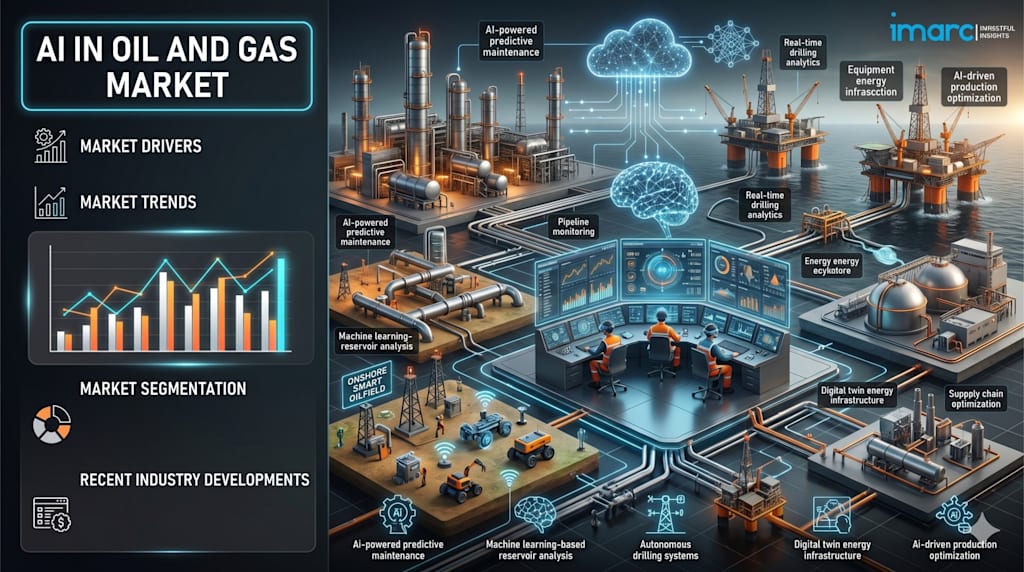
According to IMARC Group's latest research publication, The global AI in oil and gas market size reached USD 3.2 Billion in 2025. Looking forward, IMARC Group expects the market to reach USD 6.5 Billion by 2034, exhibiting a growth rate (CAGR) of 7.92% during 2026-2034. The increasing data explosion in the oil and gas industry, rising demand for operational efficiency, growing emphasis on safety, imposition of strict environmental regulations, and recent technological advancements in artificial intelligence algorithms are some of the major factors propelling the market.
How AI is Reshaping the Future of the AI in Oil and Gas Market
- Predictive Maintenance and Machinery Inspection: AI-powered predictive maintenance systems continuously analyze data from thousands of sensors and equipment units to forecast failures before they occur. The predictive maintenance and machinery inspection segment holds the largest market share, accounting for approximately 31% of total market revenue. By integrating Internet of Things devices with machine learning models, operators identify wear, degradation, and stress patterns that are invisible to traditional inspection methods. This proactive approach reduces unplanned downtime, lowers repair costs, and delivers a strong return on investment across complex drilling rigs, refinery assets, and offshore platforms where failure consequences are financially and physically severe.
- AI-Driven Drilling Optimization: Automated drilling systems powered by machine learning significantly improve the speed and accuracy of well placement. AI algorithms process geological, geophysical, and real-time drilling data to optimize bit trajectory, rotational speed, and weight on bit. In December 2024, SLB and ADNOC Drilling formed Turnwell Industries LLC with a mandate to complete 144 unconventional wells using AI-driven smart-drilling designs, representing one of the largest real-world deployments of AI-guided drilling operations in the Middle East. These intelligent systems reduce non-productive time, minimize drilling risks, and improve overall well productivity.
- Reservoir Simulation and Geological Mapping: Upstream operations involve highly data-intensive tasks including seismic interpretation, reservoir modeling, and subsurface geological mapping. AI dramatically accelerates and improves the accuracy of these processes, enabling operators to identify hydrocarbon-bearing zones with greater precision and reduced exploration risk. Upstream activities contributed over 61% of the total AI in oil and gas application market share in 2025, reflecting the concentrated demand for intelligent tools in the exploration and extraction phase of operations.
- Pipeline Monitoring and Leak Detection: AI-powered monitoring systems continuously analyze flow rates, pressure signatures, temperature variations, and acoustic data along pipeline networks to detect anomalies that could indicate leaks or structural failures. These systems enable operators to respond within minutes rather than hours, limiting environmental damage, regulatory exposure, and product loss. Real-time AI pipeline monitoring is increasingly mandated by energy regulators in North America, Europe, and the Middle East as part of broader environmental compliance frameworks.
- Production Planning and Supply Chain Optimization: AI models forecast demand, optimize inventory levels, and streamline logistics across the oil and gas delivery chain. By analyzing weather patterns, geopolitical signals, equipment status, and historical throughput, AI enables smarter production scheduling, procurement decisions, and distribution planning. Around 65% of oil and gas organizations are currently employing AI to enhance exploration and production activities, reflecting the broad adoption of intelligent planning tools across the sector.
- Safety Monitoring and Risk Prevention: AI systems continuously monitor field conditions using data from sensors, cameras, and wearables to detect irregularities that could signal a potential accident. Automated control systems can trigger safety responses without requiring human intervention in dangerous scenarios such as blowouts, gas leaks, or equipment overloads. This layer of AI-based safety infrastructure is particularly critical in deep-sea drilling, high-pressure extraction, and refinery environments where human response times are insufficient to prevent catastrophic outcomes.
- Generative AI and Large Language Models in Energy Workflows: A rapidly emerging application is the deployment of large language models trained on industry-specific energy datasets. In November 2024, ADNOC and AIQ unveiled ENERGYai featuring a 70-billion-parameter large language model with autonomous seismic agents that cut model-build times by 75%. In January 2025, SLB launched the Lumi data and AI platform featuring large language models optimized specifically for energy workflows, signaling the sector's accelerating shift toward generative AI for operational decision support and field intelligence.
AI in Oil and Gas Industry Overview
The global AI in oil and gas landscape is undergoing fundamental transformation driven by a convergence of data availability, computational advancement, and strategic national investment. North America dominates the global market with over 39% of total revenue share, supported by well-developed oil and gas infrastructure, a mature data-driven operational culture, and the presence of major AI technology providers including IBM, Microsoft, and C3.AI. The United States AI in oil and gas market alone was valued at USD 2.12 Billion in 2025, reinforcing regional leadership.
Saudi Arabia is embedding AI across its entire oil and gas value chain under its Vision 2030 economic transformation agenda. Saudi Aramco unveiled its Aramco Metabrain AI model in March 2024, trained on seven trillion data points, to streamline internal operations. As part of its METABRAIN initiative, Aramco partnered with Qualcomm on generative AI inferencing centers and trained 6,000 developers in AI-related skills by March 2025. The kingdom's government-backed digital infrastructure expanded in November 2024 to include additional AI deployment across upstream and midstream energy facilities, aiming to enhance national energy resilience and reduce operational costs.
Abu Dhabi has unveiled plans to invest AED 13 billion, equivalent to approximately USD 3.54 billion, in its Digital Strategy covering the period through 2027, with a stated goal of becoming the world's first fully AI-native government. ADNOC has been at the forefront of deploying AI across exploration, drilling, and production operations, forging partnerships with Baker Hughes, SLB, and global technology firms to accelerate intelligent field deployment. In December 2024, AIQ, ADNOC, Baker Hughes, and CORVA commenced a real-time rate-of-penetration optimization project leveraging historical drilling data and AI analytics to improve drilling speed and reduce non-productive time across active well sites.
China's national oil companies including Sinopec and PetroChina are actively deploying AI for predictive maintenance, seismic interpretation, and production optimization, supported by strong government incentives for domestic AI development. Only 15% of reservoir engineers globally actively apply machine learning methods, illustrating the significant untapped potential across the sector and the immense opportunity for AI solution providers to expand adoption among technical workforces.
AI in Oil and Gas Market Trends and Drivers
The Increasing Data Explosion in the Oil and Gas Industry
The oil and gas sector generates an unprecedented volume of data stemming from sensors, drilling equipment, seismic surveys, and various operational technologies. Compared to traditional data analytics tools, AI effectively manages and interprets this data in real time. It offers advanced analytics capabilities that browse through vast datasets to examine patterns, trends, and anomalies. AI provides tools to transform raw operational data into useful insights for monitoring drilling operations and optimizing supply chain processes. Companies are increasingly investing in AI solutions to make sense of their data and turn it into a strategic asset for smarter decision-making across exploration, production, and distribution.
The Rising Demand for Operational Efficiency
The oil and gas sector involves complex, often hazardous operations requiring meticulous planning and execution. Human error, equipment failure, or inefficiencies in any part of the operation can result in significant financial losses or safety risks. AI technologies, particularly machine learning and predictive analytics, provide the capability to significantly optimize these operations. They forecast equipment failures before they occur, automate repetitive tasks, and improve the precision of drilling and extraction processes. AI not only reduces costs but also minimizes risks associated with manual errors and system failures, making operational efficiency a major driving factor for AI integration in oil and gas.
The Growing Emphasis on Safety
The growing emphasis on safety in the oil and gas industry due to the hazardous nature of its operations, such as deep-sea drilling and working with highly flammable materials, is propelling the market. Traditional safety measures often fall short of completely eliminating accidents and failures. AI offers an advanced layer of safety protocols through real-time monitoring, predictive analytics, and automated control systems. It analyzes data from multiple sensors to detect irregularities that could signify a potential accident, enabling preventive actions to be taken before an incident occurs. AI can automate high-risk tasks, reducing the need for manual intervention in potentially dangerous scenarios and making safety enhancement a significant factor fueling market growth.
Leading Companies Operating in the Global AI in Oil and Gas Industry
- Aspen Technology
- Avathon Inc.
- Beyond Limits
- C3.AI Inc.
- DataRobot Inc.
- FuGenX Technologies
- Infosys Limited
- International Business Machines Corporation
- Microsoft Corporation
- oPRO.ai Inc.
AI in Oil and Gas Market Report Segmentation
By Type:
- Hardware
- Software
- Services
Software dominates the market as it offers excellent flexibility and scalability, making it highly adaptable to diverse operational needs across upstream, midstream, and downstream segments.
By Function:
- Predictive Maintenance and Machinery Inspection
- Material Movement
- Production Planning
- Field Services
- Quality Control
- Reclamation
Predictive maintenance and machinery inspection holds the largest share in the market as it aids in reducing downtime by analyzing equipment data and predicting failures before they happen, offering a strong return on investment for operators.
By Application:
- Upstream
- Downstream
- Midstream
Upstream holds the largest share in the market as it involves various complex and data-intensive tasks such as drilling, exploration, and extraction of natural gas and crude oil, all of which benefit substantially from AI-driven intelligence.
Regional Insights:
- North America (United States, Canada)
- Asia Pacific (China, Japan, India, South Korea, Australia, Indonesia, Others)
- Europe (Germany, France, United Kingdom, Italy, Spain, Russia, Others)
- Latin America (Brazil, Mexico, Others)
- Middle East and Africa
North America exhibits a clear dominance in the AI in oil and gas market due to well-developed infrastructure for both oil and gas extraction and AI technology, making it easier for companies to adopt and integrate intelligent solutions at scale.
Recent News and Developments in the AI in Oil and Gas Market
- March 2025: Aramco deployed comprehensive AI systems as part of its METABRAIN initiative, partnering with Qualcomm on generative AI inferencing centers and completing the training of 6,000 developers in AI-related skills to accelerate digital transformation across its upstream and downstream operations.
- January 2025: SLB launched the Lumi data and AI platform featuring large language models optimized for energy workflows, enabling oil and gas operators to improve data-driven decision-making across exploration, production, and asset management functions.
- December 2024: SLB and ADNOC Drilling formed Turnwell Industries LLC to complete 144 unconventional wells using AI-driven smart-drilling designs, marking one of the largest deployments of AI-guided drilling operations across the Middle East region.
Note: If you require specific details, data, or insights that are not currently included in the scope of this report, we are happy to accommodate your request. As part of our customization service, we will gather and provide the additional information you need, tailored to your specific requirements. Please let us know your exact needs, and we will ensure the report is updated accordingly to meet your expectations.
About the Creator
Abhay Rajput
I am working in market research company that provides market and business research intelligence across the globe.
Enjoyed the story? Support the Creator.
Subscribe for free to receive all their stories in your feed.
Comments
There are no comments for this story
Be the first to respond and start the conversation.