
AI in Human Resource Management Market Gains Momentum in HR Automation
How AI-powered recruitment platforms, workforce analytics, and automated hiring solutions are transforming talent acquisition strategies in the AI in human resource management market

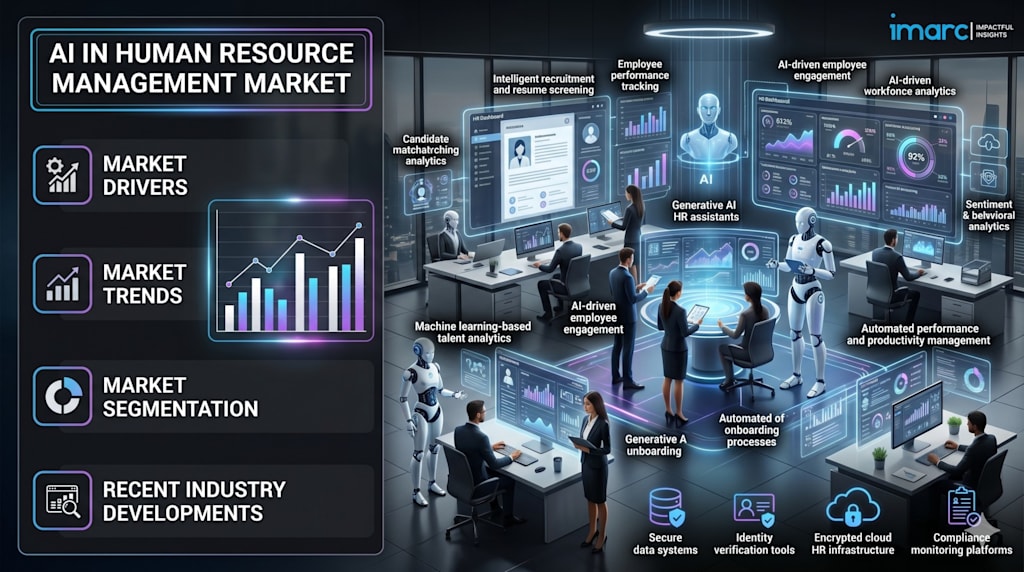
According to IMARC Group's latest research publication, The global AI in human resource management market size reached USD 4.0 Billion in 2025. Looking forward, IMARC Group expects the market to reach USD 33.5 Billion by 2034, exhibiting a growth rate (CAGR) of 25.79% during 2026-2034.
How AI is Reshaping the Future of the AI in Human Resource Management Market
- Predictive Talent Acquisition and Intelligent Recruitment Automation: AI-powered recruitment platforms analyze thousands of candidate profiles, behavioral signals, and historical hiring data to predict candidate-role fit with measurable accuracy. Organizations deploying predictive hiring tools have reported reductions in time-to-hire by up to 40%, while also improving first-year retention rates among new hires. In the AI in Human Resource Management Market, recruitment automation through chatbots and virtual assistants now handles initial screening, scheduling, and candidate communication at scale, freeing HR teams to focus on strategic evaluation rather than administrative filtering.
- Workforce Analytics and Skills Intelligence Platforms: Machine learning models embedded in HR software continuously analyze employee performance data, skill inventories, and career trajectory patterns to generate actionable workforce intelligence. These platforms identify skill gaps across departments, flag flight risk employees before attrition occurs, and recommend personalized learning paths aligned with organizational needs. Enterprises using workforce analytics solutions have reported improvements in internal mobility rates and measurable reductions in costs associated with external hiring, as internal talent is surfaced more efficiently through AI-driven talent marketplaces.
- AI-Driven Employee Engagement and Sentiment Analysis: Natural language processing tools monitor communication patterns, pulse survey responses, and feedback data to generate real-time employee sentiment scores. HR leaders use these insights to intervene proactively before disengagement escalates into attrition. Companies deploying AI sentiment analysis tools have reduced voluntary turnover in targeted departments by identifying early warning indicators that traditional annual review cycles would miss entirely, demonstrating the commercial value of always-on workforce intelligence.
- Payroll Processing Automation and Compliance Management: AI systems now manage end-to-end payroll workflows across complex multi-jurisdiction environments, automatically applying tax rule changes, flagging anomalies, and ensuring regulatory compliance without manual intervention. Organizations operating across multiple countries have used AI-powered payroll platforms to reduce payroll processing errors by over 90% while simultaneously cutting processing time from days to hours. This capability is especially critical in the AI in Human Resource Management Market as multinational enterprises manage growing headcounts across diverse regulatory frameworks.
- Performance Management and Continuous Feedback Systems: AI replaces annual review cycles with continuous performance intelligence, using data from project management tools, collaboration platforms, and direct feedback to generate objective performance profiles. Managers receive AI-generated coaching recommendations and calibration insights that reduce performance rating bias and improve the quality of development conversations. Organizations that have shifted to AI-supported continuous performance management report higher employee satisfaction with feedback quality and stronger alignment between individual goals and business outcomes.
AI in Human Resource Management Market Industry Overview
The AI in Human Resource Management Market is being accelerated by a convergence of structural enterprise shifts, government digital workforce initiatives, and the growing recognition among business leaders that people operations must become data-driven to remain competitive.
Governments across major economies are actively supporting this transformation. The European Union's Artificial Intelligence Act has established a regulatory framework that encourages responsible AI adoption in HR processes, mandating transparency and human oversight in high-risk automated hiring decisions. In India, the National AI Strategy promoted through NITI Aayog has identified HR technology as a key sector for AI deployment, supporting skill development initiatives that increase the talent pipeline available to AI-enabled HR platforms. The United States Office of Personnel Management has piloted AI-driven recruitment tools for federal workforce planning, signaling public-sector endorsement of the technology.
At the enterprise level, organizations are restructuring around AI capabilities rather than simply bolting tools onto existing HR processes. In May 2025, Moderna merged its technology and HR departments under a single chief people and digital technology officer as part of a comprehensive AI reorganization, directly backed by its partnership with OpenAI. This restructuring resulted in the deployment of thousands of dedicated HR AI agents managing tasks across recruitment, onboarding, and workforce analytics. This represents a new organizational archetype where HR and technology leadership are functionally unified under an AI-first operating model.
In June 2025, Deloitte launched its Human Capital AI solution suite comprising three distinct products: Workforce Analyzer, Workforce Planner+, and an HR AI maturity model. These tools are designed to help organizations assess how AI is affecting individual roles, task structures, and aggregate skill requirements, enabling leadership teams to redesign workforce architectures in response to automation pressures.
At the IIM Nagpur Utkarsh HR Conclave in August 2025, leading HR practitioners and academic experts emphasized that AI adoption in HR must be accompanied by rigorous ethical guardrails. The consensus position was that AI should be deployed to enhance, not replace, human empathy and emotional intelligence within HR functions, particularly in areas involving conflict resolution, wellbeing support, and diversity management.
AI in Human Resource Management Market Trends and Drivers
The rapid expansion of cloud-based HR infrastructure is among the most consequential drivers reshaping the AI in Human Resource Management Market. Cloud deployment enables organizations of all sizes to access enterprise-grade AI capabilities without the capital expenditure of on-premises systems. This has been particularly transformative for small and medium enterprises, which now represent a growing share of market adoption as SaaS-based HR AI platforms bring down cost and complexity barriers simultaneously.
The proliferation of remote and hybrid work models has significantly increased demand for AI tools capable of managing distributed workforces. Organizations managing employees across multiple geographies require AI platforms that can standardize performance evaluation, automate compliance workflows across jurisdictions, and maintain employee engagement without relying on physical proximity. This structural shift has directly expanded the addressable market for AI-powered HR solutions globally.
Sector-specific adoption is broadening the market's reach. In BFSI, AI HR tools are being deployed for compliance-sensitive recruitment processes and regulatory credential verification. In healthcare, AI-driven workforce scheduling tools are being used to manage complex clinical shift patterns and reduce staff burnout by optimizing workload distribution. The IT and telecommunications sector remains the most aggressive adopter, using AI for technical skills matching, developer experience analytics, and real-time talent market benchmarking. In retail and e-commerce, AI is enabling high-volume seasonal hiring at scale, with platforms capable of processing and screening tens of thousands of applications within compressed hiring windows.
The rise of AI-native HR startups is intensifying competition and accelerating innovation across the market. Companies like Eightfold AI have built skills intelligence platforms capable of mapping talent supply and demand across entire industries, enabling enterprises to make hiring and internal mobility decisions based on real-time labor market data. Beamery has developed talent operating systems that unify candidate relationship management, workforce planning, and skills data into a single AI-powered platform, serving some of the world's largest employers.
Established enterprise software leaders are responding aggressively. Workday has embedded generative AI capabilities into its core HCM platform, enabling managers to draft job descriptions, generate performance summaries, and surface workforce insights through conversational interfaces. SAP SuccessFactors has integrated AI-powered skills matching and learning recommendations across its suite, connecting HR data to broader enterprise planning workflows. Oracle HCM has deployed AI to automate candidate ranking, flag compensation anomalies, and generate predictive retention risk scores at the individual employee level.
Leading Companies Operating in the Global AI in Human Resource Management Industry
- Automatic Data Processing, Inc.
- Beamery Inc.
- Cegid Group
- Cornerstone OnDemand, Inc.
- Dayforce Inc.
- Eightfold AI Inc.
- IBM Corporation
- Oracle Corporation
- SAP SE
- Workday, Inc.
AI in Human Resource Management Market Report Segmentation
By Component:
- Solutions: Chatbots, Virtual Assistants, Software Platforms, Analytics Solutions, Others
- Services: Implementation Services, Consulting Services, Training and Support Services
Solutions segment leads adoption, with analytics platforms and chatbot-driven candidate engagement tools representing the highest growth sub-categories as enterprises prioritize measurable workforce intelligence outcomes.
By Deployment Mode:
- Cloud-based
- On-premises
Cloud-based deployment commands the dominant share of the AI in Human Resource Management Market, driven by faster implementation timelines, lower total cost of ownership, and continuous feature updates without enterprise IT intervention.
By Enterprise Size:
- Small and Medium Enterprises (SMEs)
- Large Enterprises
Large enterprises currently account for the majority of market revenue, while SMEs represent the fastest-growing segment as affordable cloud-based AI HR tools lower adoption barriers for organizations without dedicated HR technology teams.
By Application:
- Recruitment and Hiring
- Employee Onboarding and Engagement
- Employee Record Management
- Performance Management
- Payroll Processing
- Others
Recruitment and hiring remains the leading application, while performance management and employee engagement tools are gaining ground as organizations prioritize retention alongside acquisition in their talent strategies.
By End Use:
- BFSI
- Healthcare
- IT and Telecommunication
- Retail and E-Commerce
- Manufacturing
- Education
- Government
- Others
IT and telecommunications leads end-use adoption, with healthcare and BFSI following closely as sectors where AI HR tools deliver particularly high compliance and efficiency value.
Regional Insights
- North America (United States, Canada)
- Asia Pacific (China, Japan, India, South Korea, Australia, Indonesia, Others)
- Europe (Germany, France, United Kingdom, Italy, Spain, Russia, Others)
- Latin America (Brazil, Mexico, Others)
- Middle East and Africa
North America exhibits clear dominance in the AI in Human Resource Management Market, supported by a mature enterprise technology ecosystem, high HR software penetration, and early adoption of AI-driven talent management platforms. The United States accounts for the largest single-country share, anchored by a dense concentration of both AI HR software vendors and large enterprises with the resources and mandate to deploy advanced workforce intelligence tools.
Asia Pacific is the standout expansion region. India and China are scaling AI HR adoption rapidly, driven by large workforce volumes, increasing digital infrastructure investment, and government initiatives supporting enterprise digitization. Japan and South Korea are deploying AI HR tools to address demographic workforce challenges, particularly in managing aging workforces and supporting knowledge transfer between generations.
Europe maintains consistent growth momentum, with Germany, France, and the United Kingdom leading regional adoption. GDPR compliance requirements have created strong demand for AI HR platforms with built-in data governance, transparency reporting, and human oversight mechanisms, shaping a distinct European market for responsible AI in workforce management.
Recent News and Developments in the AI in Human Resource Management Market
- August 2025: At the IIM Nagpur Utkarsh HR Conclave, industry experts called for ethical AI frameworks in HR, emphasizing that technology must preserve human empathy and emotional intelligence in people management functions, particularly in wellbeing and diversity-related decisions.
- June 2025: Deloitte launched its Human Capital AI solution suite, including Workforce Analyzer, Workforce Planner+, and an HR AI maturity model, enabling organizations to assess AI's impact on workforce roles, task structures, and skills planning at enterprise scale.
- May 2025: Moderna completed a structural reorganization merging its HR and technology functions under a chief people and digital technology officer, deploying thousands of HR-focused AI agents in partnership with OpenAI to manage recruitment, onboarding, and workforce analytics.
Note: If you require specific details, data, or insights that are not currently included in the scope of this report, we are happy to accommodate your request. As part of our customization service, we will gather and provide the additional information you need, tailored to your specific requirements. Please let us know your exact needs, and we will ensure the report is updated accordingly to meet your expectations.
About the Creator
Abhay Rajput
I am working in market research company that provides market and business research intelligence across the globe.
Enjoyed the story? Support the Creator.
Subscribe for free to receive all their stories in your feed.
Comments
There are no comments for this story
Be the first to respond and start the conversation.