
AI in Education Market Trends: Personalized Learning, Adaptive Platforms & Forecast to 2034
How personalized learning platforms, AI-driven analytics, and adaptive technologies are transforming teaching methods and student engagement in the AI in education market

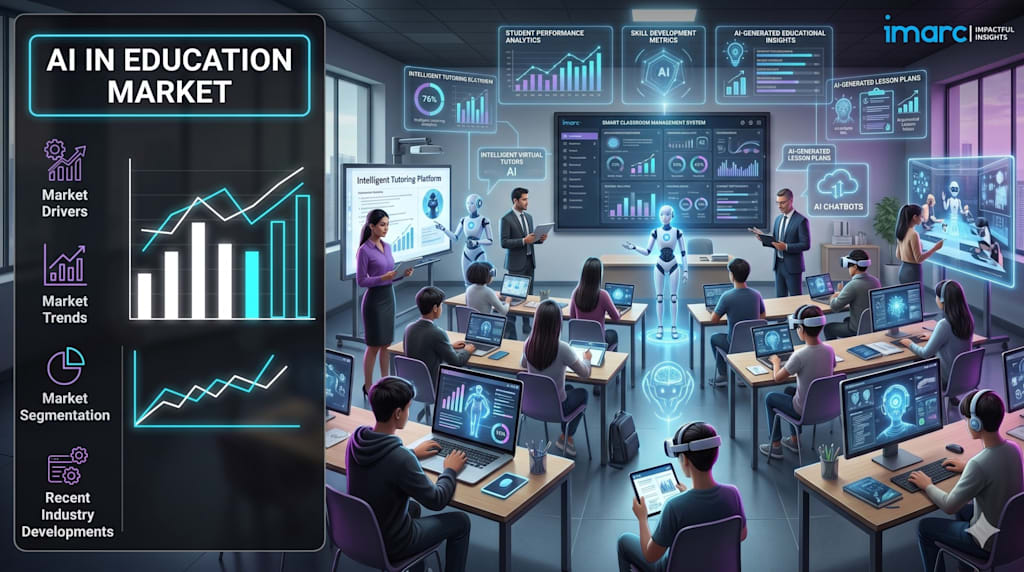
According to IMARC Group's latest research publication, The global AI in education market size reached USD 6.4 Billion in 2025. Looking forward, IMARC Group expects the market to reach USD 79.6 Billion by 2034, exhibiting a growth rate (CAGR) of 31.35% during 2026-2034. The increasing availability of digital devices, escalating demand for personalized learning experiences, the rising need to alleviate administrative tasks, expanding educational opportunities, and the rapid advancement of AI technologies are some of the major factors propelling the market.
How AI Is Reshaping the Future of the AI in Education Market
- Personalized and Adaptive Learning Pathways: AI-powered platforms analyze real-time student performance data, behavioral patterns, and learning preferences to deliver highly customized educational experiences. Institutions implementing adaptive learning tools have reported measurable improvements in student engagement and retention rates. Platforms like Carnegie Learning's MATHia track individual progress and dynamically adjust problem difficulty, pacing, and instructional delivery, ensuring that students receive instruction calibrated to their precise skill levels rather than a one-size-fits-all curriculum.
- Intelligent Tutoring Systems and Virtual Facilitators: Machine learning algorithms embedded within intelligent tutoring systems provide students with real-time feedback, guided problem-solving assistance, and adaptive assessments outside traditional classroom hours. These systems simulate one-on-one tutoring interactions at scale, enabling personalized remediation and enrichment simultaneously. Virtual facilitators leverage natural language processing to respond to student queries conversationally, while virtual classrooms and AI-driven simulations create immersive, self-paced learning environments that expand access beyond geographic or institutional boundaries.
- Automated Administrative Task Management: AI substantially reduces the administrative burden on educators by automating time-consuming processes such as assignment grading, attendance tracking, scheduling, and data reporting. Automated grading systems evaluate objective assessments with high accuracy, freeing instructors to dedicate greater attention to student interaction and instructional design. AI-powered scheduling tools optimize timetables based on teacher availability, student groupings, and institutional requirements, enabling more efficient resource allocation across K-12 schools, universities, and corporate training programs.
- Natural Language Processing for Literacy and Assessment: NLP technologies are being embedded into educational platforms to support language learning, writing assessment, and multilingual instruction. AI-driven language tools can evaluate grammar, coherence, and vocabulary usage in student writing in real time, providing constructive feedback that would otherwise require significant instructor time. In multilingual classrooms, NLP-powered translation tools help bridge communication gaps, making quality instruction accessible to non-native speakers and supporting inclusive educational environments across diverse student populations.
- Predictive Analytics for Early Intervention: Deep learning and machine learning models analyze longitudinal student data to identify learners at risk of falling behind before performance declines become critical. Institutions leveraging predictive analytics can proactively assign additional support resources, adjust instructional pacing, or trigger counselor outreach based on early warning indicators. This data-driven approach to student success management transforms reactive remediation into proactive intervention, improving completion rates and learning outcomes across higher education institutions and corporate training programs alike.
- Cloud-Based AI Deployment for Scalability: Cloud-based deployment has emerged as the dominant mode for AI in education, enabling institutions to access advanced AI capabilities without the need for costly on-premises infrastructure. Cloud platforms support seamless collaboration across geographically dispersed campuses, enable real-time data synchronization, and allow institutions to scale AI tools rapidly as enrollment grows. The flexibility of cloud deployment also ensures that software updates, security patches, and new feature rollouts are delivered continuously, minimizing IT maintenance burdens and ensuring consistent access to current AI capabilities.
AI in Education Industry Overview
North America currently dominates the global AI in education market, underpinned by a mature digital infrastructure, a dense concentration of leading EdTech companies, and a culture of innovation embedded across higher education and corporate training sectors. The United States has been particularly active in formalizing AI governance within schools, with California establishing the California Public Schools Artificial Intelligence Working Group under Senate Bill 1288 in 2024 to develop statewide guidance for the safe and equitable integration of AI in K-12 education.
Asia Pacific represents the fastest-growing regional segment, accounting for approximately 38% of global market revenue, driven by substantial government-backed investment in smart education infrastructure. China's Ministry of Education has deployed AI-powered teaching systems across over 18,000 schools, while South Korea's AI Talent Initiative is designed to equip 500,000 students annually with foundational AI literacy. India's rapidly expanding EdTech ecosystem, led by platforms reaching millions of daily active learners, further reinforces the region's dominant share of new market growth.
In Europe, policy frameworks are actively shaping AI adoption in education. The European Commission introduced the AI Continent Action Plan in April 2025, which includes an AI Skills Academy designed to build workforce-level AI competency across member states. Germany's "DigitalPakt Schule" program, backed by approximately USD 6 billion in funding, and the country's national AI Strategy with a budget of approximately USD 3.3 billion through 2025, are both contributing to rapid digitalization of educational institutions, with approximately 29% of schools and universities in Germany already integrating AI for personalized learning and student performance analytics.
The corporate training and learning segment is also expanding rapidly as enterprises recognize AI-powered upskilling platforms as critical tools for workforce development. Enrollment in bachelor's AI programs across the United States grew 114% between 2024 and 2025, rising from 90 to 193 programs nationally, while MBA programs with AI specializations have grown by over 1,200% since 2022, reflecting explosive institutional demand for AI-integrated curricula at every level of formal education.
AI in Education Market Trends and Drivers
The escalating demand for personalized learning solutions is the primary force propelling AI adoption across educational institutions globally. Traditional classroom instruction, which delivers uniform content at a fixed pace, consistently underserves both struggling learners and advanced students. AI addresses this structural limitation by enabling truly differentiated instruction at scale, a capability that is increasingly recognized by school districts, universities, and corporate training departments as essential rather than supplementary.
Digital device proliferation and the expansion of high-speed internet connectivity have created the infrastructure necessary for AI tools to operate effectively in educational settings. Smartphones, tablets, and laptops now serve as primary learning devices for hundreds of millions of students worldwide, providing the data endpoints that AI systems require to monitor engagement, track progress, and deliver personalized content recommendations in real time.
The growing recognition that administrative workloads limit teacher effectiveness has accelerated institutional investment in AI-powered automation. Educators spend a disproportionate share of their working hours on grading, scheduling, and reporting tasks that AI systems can handle with high accuracy. By reclaiming this time, institutions are enabling teachers to focus on higher-value activities such as project-based learning facilitation, individualized mentorship, and creative curriculum development, outcomes that directly translate into improved student performance and satisfaction.
Equity and access imperatives are also emerging as significant drivers of AI adoption in education. AI-powered platforms delivered through nonprofit partnerships have reached over 42 million students across underserved communities in sub-Saharan Africa, Southeast Asia, and Latin America, demonstrating the technology's capacity to extend quality educational resources to populations historically excluded from well-resourced schooling. Governments and multilateral organizations are increasingly funding AI-in-education initiatives specifically targeting digital inclusion, broadening the market's reach well beyond premium institutions.
Leading Companies Operating in the Global AI in Education Industry
- Blackboard Inc.
- Cognii Inc.
- eGain Corporation
- Google LLC (Alphabet Inc.)
- International Business Machines Corporation
- Microsoft Corporation
- QlikTech International AB
AI in Education Market Report Segmentation
By Component:
- Solutions
- Services
Solutions dominate the market as they encompass the broadest range of AI applications, including intelligent tutoring systems, virtual assistants, personalized learning platforms, adaptive assessments, and content creation tools, each delivering measurable improvements in educational efficiency and student outcomes.
By Deployment Mode:
- On-premises
- Cloud-based
Cloud-based deployment holds the largest market share owing to its cost-effectiveness, scalability, and ability to support remote and hybrid learning models without requiring significant hardware investment from educational institutions.
By Technology:
- Deep Learning and Machine Learning
- Natural Language Processing (NLP)
Deep learning and machine learning account for the majority of market share, as these technologies power the core capabilities of adaptive learning, personalized content recommendation, and predictive student performance analytics that define the market's most impactful applications.
By Application:
- Virtual Facilitators and Learning Environments
- Intelligent Tutoring Systems (ITS)
- Content Delivery Systems
- Fraud and Risk Management
- Student-initiated Learning
- Others
Virtual facilitators and learning environments represent the largest application segment, driven by the proliferation of remote and hybrid education models that require scalable, AI-enabled alternatives to in-person instruction.
By End User:
- K-12 Education
- Higher Education
- Corporate Training and Learning
- Others
Higher education represents the leading end user segment, given the scale, research orientation, and resource capacity of universities and colleges that position them as early adopters and heavy deployers of AI-driven academic tools.
Regional Insights:
- North America (United States, Canada)
- Asia Pacific (China, Japan, India, South Korea, Australia, Indonesia, Others)
- Europe (Germany, France, United Kingdom, Italy, Spain, Russia, Others)
- Latin America (Brazil, Mexico, Others)
- Middle East and Africa
North America exhibits clear dominance in the AI in education market due to its advanced educational infrastructure, concentration of leading technology providers, and strong venture capital investment in EdTech innovation.
Recent News and Developments in the AI in Education Market
- April 2025: The European Commission introduced the AI Continent Action Plan, which includes an AI Skills Academy aimed at scaling AI literacy and workforce competency across European Union member states, directly supporting institutional adoption of AI in higher education and vocational training programs.
- January 2025: Microsoft and Pearson entered into a multi-year strategic partnership to develop AI-powered learning tools and assessments, integrating Microsoft's generative AI capabilities with Pearson's established educational content library to deliver enhanced learning experiences across higher education and professional certification programs.
- May 2026: Enrollment in bachelor's-level AI programs across United States universities reached 193 active programs, representing 114% growth compared to 2024 figures of 90 programs, reflecting the accelerating institutionalization of AI education as a dedicated academic discipline rather than a supplementary component of computer science curricula.
Note: If you require specific details, data, or insights that are not currently included in the scope of this report, we are happy to accommodate your request. As part of our customization service, we will gather and provide the additional information you need, tailored to your specific requirements. Please let us know your exact needs, and we will ensure the report is updated accordingly to meet your expectations.
About the Creator
Abhay Rajput
I am working in market research company that provides market and business research intelligence across the globe.
Enjoyed the story? Support the Creator.
Subscribe for free to receive all their stories in your feed.
Comments
There are no comments for this story
Be the first to respond and start the conversation.