
AI in Education Market Size, Trends, and Future Outlook
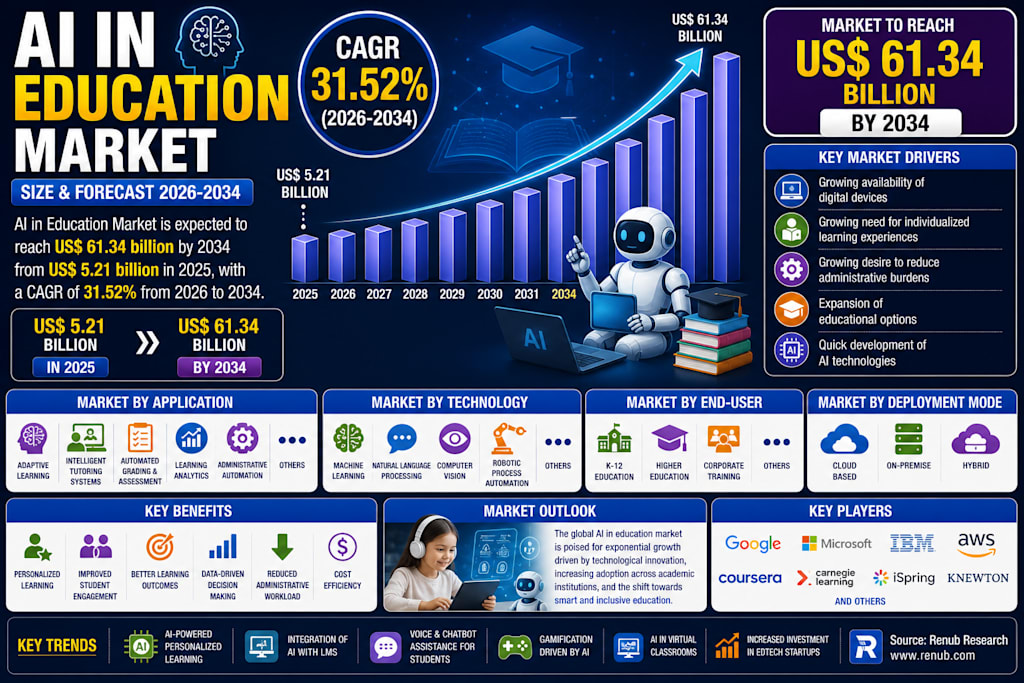
Driven by rapid digital transformation and demand for personalized learning, the global AI in Education market is projected to grow from US$ 5.21 billion in 2025 to US$ 61.34 billion by 2034, at a remarkable CAGR of 31.52%.

Introduction
Artificial Intelligence (AI) is redefining the global education landscape, transforming how knowledge is delivered, consumed, and managed. From personalized learning platforms to automated administrative tools, AI is enabling a more efficient, accessible, and student-centric education system. According to the Renub Research data provided, the AI in Education market is expected to surge from US$ 5.21 billion in 2025 to US$ 61.34 billion by 2034, expanding at a CAGR of 31.52%.
This exponential growth reflects a broader shift toward digital ecosystems, where education is no longer confined to classrooms but extended through intelligent systems, virtual platforms, and data-driven insights. As institutions seek to improve learning outcomes while reducing operational burdens, AI is emerging as a central pillar in the modernization of global education systems.
AI in Education Market Overview
AI is transforming education by enhancing teaching methods, improving student outcomes, and optimizing institutional efficiency. Intelligent systems analyze student behavior, performance patterns, and learning preferences to deliver tailored educational experiences. Adaptive learning platforms, AI tutors, and recommendation engines help students learn at their own pace while improving retention and engagement.
In addition to academic personalization, AI is streamlining administrative tasks such as grading, attendance tracking, and curriculum management. This allows educators to focus more on teaching quality and student interaction. AI-powered tools also enable real-time feedback, helping learners quickly identify and address knowledge gaps.
Beyond traditional classrooms, AI is improving accessibility in education. Technologies such as speech-to-text, real-time translation, and assistive learning tools empower students with disabilities and language barriers. Virtual assistants and chatbots provide round-the-clock academic support, ensuring continuous learning opportunities.
Growth Drivers for the AI in Education Market
Rising Demand for Personalized and Adaptive Learning
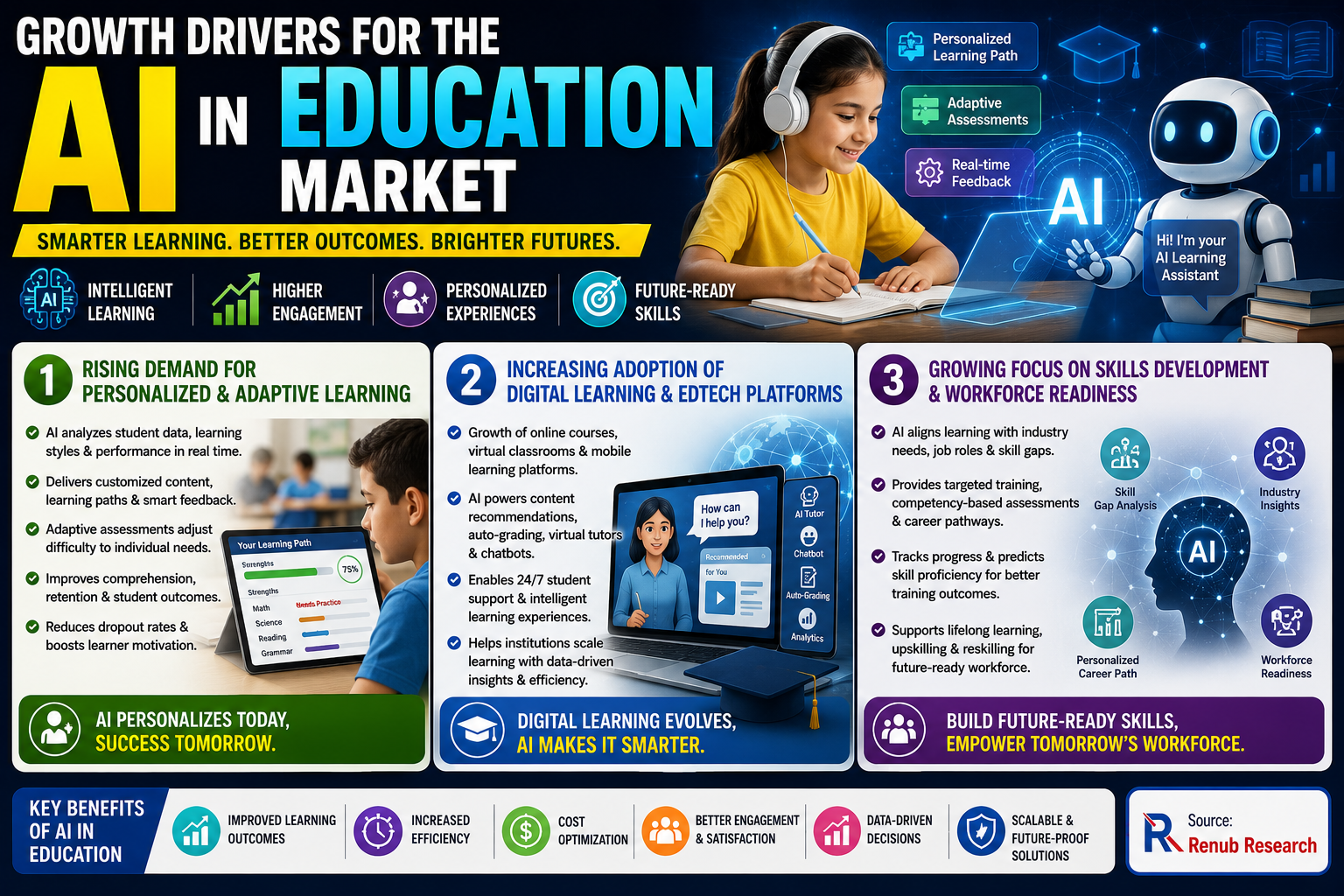
One of the strongest drivers of AI adoption in education is the demand for personalized learning experiences. Traditional one-size-fits-all teaching approaches often fail to meet individual student needs. AI addresses this gap by analyzing learning patterns and delivering customized content, adaptive assessments, and targeted feedback.
This personalization improves engagement, enhances knowledge retention, and reduces dropout rates. Educational institutions and corporate training providers are increasingly integrating AI-driven learning management systems to deliver scalable and efficient learning solutions.
Increasing Adoption of Digital Learning and EdTech Platforms
The rapid growth of digital learning platforms is significantly accelerating the adoption of AI in education. Online courses, virtual classrooms, and mobile learning apps generate vast amounts of data that AI systems can analyze to optimize learning outcomes.
AI enhances these platforms through automated grading, intelligent content recommendations, and AI-powered tutors. Governments and institutions are investing heavily in digital infrastructure to expand access to quality education, especially in remote and underserved regions.
Growing Focus on Skills Development and Workforce Readiness
As industries evolve, there is a growing need for continuous upskilling and reskilling. AI-driven platforms help align educational content with job market requirements by analyzing skill gaps and workforce trends.
These platforms provide competency-based learning, career guidance, and predictive analytics to improve employability outcomes. As a result, AI is playing a crucial role in preparing a future-ready workforce.
Challenges in the AI in Education Market
Data Privacy, Security, and Ethical Concerns
AI systems rely on large volumes of sensitive student data, including personal information and behavioral patterns. Ensuring data privacy and security is a major challenge. Risks such as data breaches and misuse of information can undermine trust among users.
Additionally, algorithmic bias and lack of transparency raise ethical concerns. Ensuring fairness, accountability, and compliance with global data protection regulations remains critical for sustainable adoption.
High Implementation Costs and Integration Complexity
Implementing AI solutions in education requires significant investment in infrastructure, technology, and skilled personnel. Many institutions, particularly in developing regions, face budget constraints that limit adoption.
Integration with existing systems can also be complex and time-consuming. Resistance to change among educators further slows adoption, highlighting the need for training and support programs.
Regional Market Insights
United States
The United States remains a leader in AI-driven education, supported by advanced digital infrastructure and a mature EdTech ecosystem. AI tools such as intelligent tutoring systems, automated grading, and virtual assistants are widely used to enhance learning outcomes and operational efficiency.
Germany
Germany’s AI in education market is shaped by strict regulatory frameworks such as the EU AI Act and GDPR. These regulations emphasize transparency, ethical AI use, and data protection, ensuring responsible adoption across institutions.
India
India is emerging as a high-growth market for AI in education, driven by increasing digital adoption and government initiatives. Public-private partnerships and EdTech startups are accelerating AI integration across schools, universities, and corporate training platforms.
United Arab Emirates
The UAE is rapidly advancing AI adoption in education, integrating AI into school curricula and investing in digital infrastructure. Government-led initiatives and global collaborations are positioning the country as a regional hub for AI-powered education.
Recent Developments in AI in Education Market
- May 2025: UAE Ministry of Education mandated AI learning for all public-school students starting from the 2025–2026 academic year.
- April 2025: The European Commission introduced the AI Continent Action Plan, including initiatives such as an AI Skills Academy.
- January 2025: Microsoft and Pearson entered a multi-year partnership to develop AI-powered learning tools and assessments.
- September 2024: PowerSchool launched PowerBuddy AI solutions to enhance student engagement and communication.
- July 2024: Pearson introduced generative AI tools through Pearson+ Channels to improve learning experiences.
- IBM Corporation continues to expand AI-driven enterprise learning and analytics solutions.
- Microsoft Corporation is strengthening its presence in AI-powered education tools and cloud-based learning platforms.
- Alphabet Inc. is advancing AI technologies through platforms supporting digital learning ecosystems.
- Coursera Inc. is integrating AI-driven personalization into online learning platforms.
- Carnegie Learning, Inc. continues to innovate in AI-based tutoring and adaptive learning systems.
Market Segmentation
By Component
- Solutions
- Services
By Deployment Mode
- On-Premises
- Cloud-Based
By Technology
- Machine Learning & Deep Learning
- Natural Language Processing (NLP)
By Application
- Learning Platforms & Virtual Facilitators
- Intelligent Tutoring Systems
- Smart Content
- Fraud and Risk Management
- Others
By End User
- K-12 Education
- Higher Education
- Corporate Training
Key Players
- IBM Corporation
- Microsoft Corporation
- Cognizant Technology Solutions Corporation
- Alphabet Inc.
- Pearson Plc
- Coursera Inc.
- DreamBox Learning, Inc.
- Carnegie Learning, Inc.
Conclusion
The AI in Education market is entering a phase of rapid expansion, driven by digital transformation, personalized learning demand, and workforce readiness initiatives. While challenges such as data privacy and high implementation costs persist, the long-term outlook remains highly positive.
As institutions continue to adopt AI-powered solutions, education is evolving into a more intelligent, inclusive, and adaptive system. With strong growth projections and continuous innovation, AI is set to become a foundational element in shaping the future of global education.
About the Creator
Enjoyed the story? Support the Creator.
Subscribe for free to receive all their stories in your feed.
Comments
There are no comments for this story
Be the first to respond and start the conversation.