
AI in Drone Market Trends: Autonomous Navigation, Computer Vision & Forecast to 2034
How autonomous navigation, AI-powered analytics, and real-time decision-making are transforming operational efficiency and expanding commercial applications in the AI in drone market

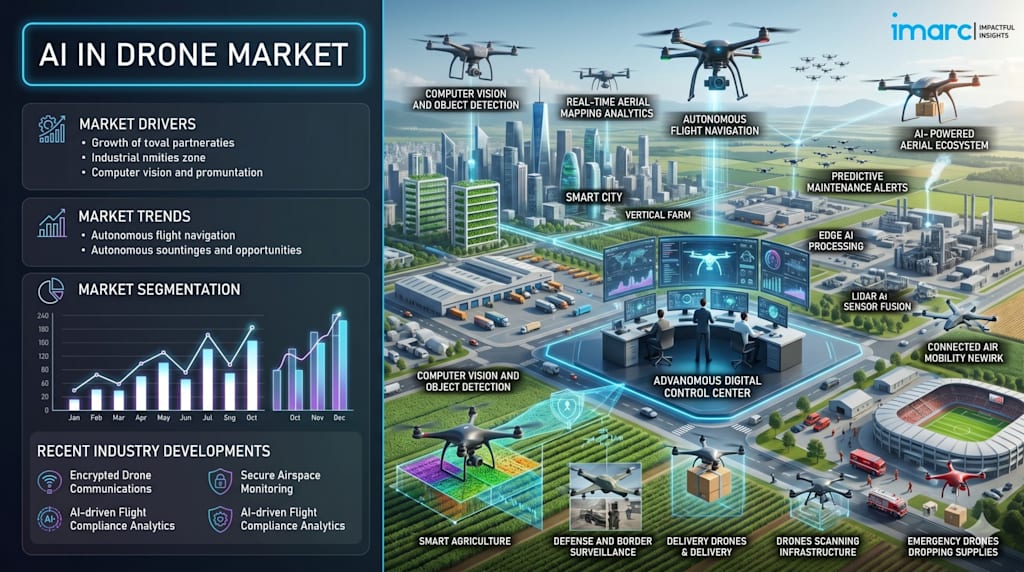
According to IMARC Group's latest research publication, The global AI in drone market size reached USD 21,920.5 Million in 2025. Looking forward, IMARC Group expects the market to reach USD 246,116.8 Million by 2034, exhibiting a growth rate (CAGR) of 29.90% during 2026-2034.
How AI Is Reshaping the Future of the AI in Drone Market
- Investment Surge Driving AI-Powered Drone Advancements: AI integration in defense aviation is attracting large-scale investment, signaling growing confidence in autonomous aerial technologies across both commercial and military sectors. Expansion strategies are increasingly combining aerospace hardware engineering with intelligent software systems, accelerating the development of drones capable of complex decision-making and real-time mission adaptability. In June 2025, Germany's AI-powered defense firm Helsing secured a EUR 600 Million investment, valuing the company at EUR 12 Billion. Helsing simultaneously pursued the acquisition of Grob Aircraft to merge hardware manufacturing expertise with AI capabilities, reinforcing the global trend of combining advanced drone platforms with intelligent systems to meet expanding defense technology demand.
- Autonomous Navigation and Real-Time Decision-Making: Machine learning algorithms embedded within drone systems enable autonomous flight path optimization, obstacle avoidance, and adaptive mission execution without human intervention. AI-driven navigation reduces operational errors in complex environments including urban airspace, agricultural fields, and military zones, where real-time responsiveness is critical. These capabilities are increasingly supported by sensor fusion AI that integrates data streams from multiple onboard sensors simultaneously, enabling drones to build precise environmental maps and make split-second decisions with a level of situational awareness previously achievable only with human pilots.
- Computer Vision for Precision Inspection and Surveillance: AI-powered computer vision is transforming how drones perform infrastructure inspection, security surveillance, and hazardous site monitoring by enabling automated detection of anomalies, structural defects, and security threats with high accuracy. Warehouse and logistics operators are deploying indoor AI drones equipped with computer vision to perform real-time inventory tracking and operational data integration, replacing manual stock-taking processes with continuous automated monitoring. In July 2025, the United States advanced domestic commercial and defense drone production through executive orders promoting American-made systems, with ZenaTech simultaneously releasing its IQ Nano AI indoor drone showcasing real-time inventory management capabilities specifically targeting defense and government procurement.
- AI-Driven Threat Detection and Counter-Drone Applications: The integration of AI with drone systems is extending beyond flight operations into active threat detection, with computer vision models now capable of identifying and classifying small aerial objects and ground-based threats in real time. Systems combining drone imagery with AI object recognition are being deployed for landmine detection, unexploded ordnance identification, and perimeter security, enabling humanitarian and military operators to survey dangerous terrain without risking personnel. In August 2025, Safe Pro Group Inc. signed Memoranda of Understanding with Ondas Holdings and Unusual Machines to integrate its AI-powered Safe Pro Object Threat Detection system, which identifies over 150 categories of small threats including landmines and unexploded ordnance, advancing AI-driven drone capabilities for US government, military, public safety, commercial, and global humanitarian markets.
- Cloud-Based AI Platforms Enabling Scalable Drone Operations: Cloud-based drone management platforms are enabling operators to scale autonomous fleet deployments without proportional increases in ground infrastructure, by processing flight data, analytics, and mission intelligence remotely. AI algorithms running on cloud infrastructure analyze drone-collected data in real time, generating actionable insights for agriculture monitoring, construction progress tracking, and security surveillance while reducing onboard hardware requirements. The shift toward cloud-based architecture is making AI drone capabilities accessible to small and medium enterprises across retail, construction, and security sectors that previously lacked the technical infrastructure to support autonomous aerial operations at scale.
AI in Drone Industry Overview
The global AI in drone market is experiencing strong growth momentum across a wide spectrum of end-use sectors, with military and defense maintaining the dominant position in overall market share owing to sustained government investment in autonomous surveillance, reconnaissance, and combat systems. Defense procurement agencies worldwide are accelerating AI drone integration programs, recognizing autonomous aerial systems as a strategic capability multiplier that reduces personnel risk while expanding operational reach in contested environments.
The software component is witnessing particularly robust demand growth as operators prioritize intelligent mission planning, real-time analytics, and fleet management capabilities over hardware procurement alone. Machine learning holds the leading position within the technology landscape, reflecting its versatility across applications ranging from demand forecasting in agricultural drone deployments to fraud and anomaly detection in security surveillance networks. Sensor fusion AI is emerging as a critical differentiator for drone manufacturers seeking to extend autonomous operational capability in GPS-denied environments and complex airspace.
North America maintains a commanding position in the AI in drone market, supported by substantial federal defense budgets, a mature commercial drone regulatory framework, and the concentrated presence of leading aerospace and technology companies driving platform innovation. The United States government's executive-level commitment to promoting domestically manufactured drone systems is creating structured procurement pipelines that benefit established American drone manufacturers and AI solution providers alike. Europe is simultaneously strengthening its AI drone capabilities, with significant private and government investment flowing into defense-focused autonomous aerial systems as the region prioritizes strategic technological independence. Asia Pacific represents the fastest-growing regional opportunity, driven by China's advanced drone manufacturing ecosystem, India's expanding agricultural and surveillance drone programs, and Japan's sustained investment in autonomous logistics and inspection drone deployments.
AI in Drone Market Trends and Drivers
The growing adoption of drones across defense, precision agriculture, logistics, and disaster management is the foundational driver propelling the AI in drone market into its current period of rapid expansion. Military and defense agencies are deploying AI-enabled drone swarms for reconnaissance, electronic warfare, and coordinated strike operations, representing a generational shift in aerial warfare doctrine that is driving sustained procurement investment across NATO member states and allied nations. Simultaneously, the commercial agriculture sector is leveraging AI drone platforms to optimize crop monitoring, precision spraying, and yield forecasting, with machine learning models analyzing multispectral imagery to identify plant health variations invisible to conventional observation.
Government policy frameworks are playing an increasingly decisive role in shaping the AI in drone market trajectory. The United States Federal Aviation Administration's ongoing development of Beyond Visual Line of Sight operational frameworks is creating the regulatory infrastructure necessary for scaled commercial AI drone deployment across logistics, infrastructure inspection, and emergency response sectors. In the European Union, the EASA drone regulatory framework is establishing harmonized standards for AI-driven autonomous drone operations across member states, reducing market fragmentation and enabling cross-border commercial drone service deployment. Defense ministries across Europe and Asia Pacific are simultaneously establishing national AI drone development programs, with Germany's EUR 600 Million investment in Helsing representing a bellwether example of state-backed commitment to autonomous aerial intelligence.
The convergence of AI drone capabilities with 5G connectivity and Internet of Things infrastructure is creating entirely new operational possibilities that are expanding the addressable market well beyond traditional defense and agriculture applications. Real-time data transmission enabled by 5G networks allows AI drones to function as distributed sensor nodes within smart city infrastructure, supporting traffic management, environmental monitoring, and emergency response coordination with latency levels that make genuine real-time autonomous decision-making achievable at scale. Rising demand for real-time data, operational safety improvements, precision execution, and cost-effective alternatives to manned aerial operations continues to sustain investment and accelerate deployment across both established and emerging AI drone application categories.
Leading Companies Operating in the Global AI in Drone Market
- AeroVironment, Inc.
- DAC.digital
- Dedrone (Axon Enterprise Inc.)
- Draganfly Innovations Inc.
- DroneDeploy
- DroneShield Ltd.
- Parrot Drones SAS
- Qualcomm Technologies, Inc.
- Skydio, Inc.
- Teledyne FLIR LLC
AI in Drone Market Report Segmentation
By Type:
- Station Based
- Cloud Based
By Component:
- Infrastructure
- Software
- Services
By Technology:
- Machine Learning
- Computer Vision
- Natural Language Processing
- Sensor Fusion AI
- Others
Machine learning leads the technology segment owing to its ability to analyze vast datasets and generate actionable insights that drive autonomous decision-making across the full spectrum of AI drone applications.
By End Use:
- Military and Defense
- Retail
- Construction
- Security and Surveillance
- Others
Military and defense represents the dominant end-use segment, driven by sustained government procurement investment in autonomous surveillance, reconnaissance, and combat drone systems globally.
Regional Insights:
- North America (United States, Canada)
- Europe (Germany, France, United Kingdom, Italy, Spain, Others)
- Asia Pacific (China, Japan, India, South Korea, Australia, Indonesia, Others)
- Latin America (Brazil, Mexico, Others)
- Middle East
- Africa
North America holds the leading regional position in the AI in drone market, underpinned by advanced defense procurement programs, a mature commercial drone regulatory environment, and the concentrated presence of leading aerospace and AI technology companies.
Recent News and Developments in the AI in Drone Market
- August 2025: Safe Pro Group Inc. signed Memoranda of Understanding with Ondas Holdings and Unusual Machines to integrate its AI-powered drone imagery and computer vision technology, including the Safe Pro Object Threat Detection system capable of identifying over 150 categories of small threats such as landmines and unexploded ordnance. The collaboration aims to advance AI-driven drone capabilities for US government, military, public safety, commercial, and global humanitarian markets.
- July 2025: The United States advanced commercial and defense drone production through executive orders promoting American-made autonomous aerial systems. Growth in the indoor inspection drone market highlighted rising demand for AI applications in hazardous site inspections and logistics operations, with ZenaTech releasing its IQ Nano AI indoor drone showcasing real-time inventory management and operational data integration capabilities for defense and government procurement.
- June 2025: Germany's AI-powered defense firm Helsing secured a EUR 600 Million investment, valuing the company at EUR 12 Billion. Helsing pursued strategic acquisitions including Grob Aircraft to combine hardware manufacturing with AI capabilities, supporting continued innovation in AI-driven drone systems amid expanding defense technology procurement demand across Europe.
Note: If you require specific details, data, or insights that are not currently included in the scope of this report, we are happy to accommodate your request. As part of our customization service, we will gather and provide the additional information you need, tailored to your specific requirements. Please let us know your exact needs, and we will ensure the report is updated accordingly to meet your expectations.
About the Creator
Abhay Rajput
I am working in market research company that provides market and business research intelligence across the globe.
Enjoyed the story? Support the Creator.
Subscribe for free to receive all their stories in your feed.
Comments
There are no comments for this story
Be the first to respond and start the conversation.