
AI Can Build Smarter Portfolios. But Can It Earn Investor Trust?
The future of wealth management may depend less on algorithms and more on the confidence people place in them.

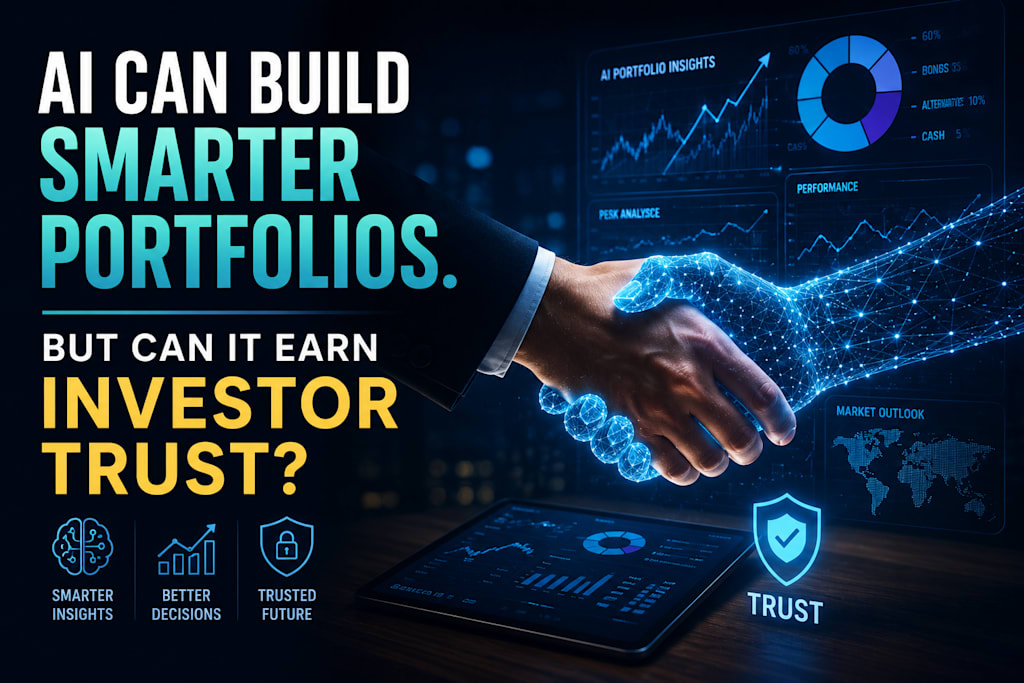
Artificial intelligence has quickly become one of the most influential forces in modern finance.
Investment firms are using AI to analyze markets, identify patterns, automate research, and generate recommendations at speeds that would have seemed impossible just a few years ago. The promise is compelling: smarter decisions, greater efficiency, and more personalized financial guidance for investors.
Yet as AI adoption accelerates across wealth management, a surprising challenge is emerging.
The biggest obstacle isn't technology.
It's trust.
While headlines often focus on increasingly sophisticated models and advanced analytics, investors are asking a much simpler question:
Can I rely on this?
That question may ultimately determine how AI reshapes the future of wealth management.
A recent analysis from GeekyAnts highlighted this growing reality. Building an AI-powered investment platform is becoming increasingly achievable. Building confidence in that platform is proving far more difficult.
And confidence, unlike software, cannot be deployed overnight.
When AI Meets Real Money
Artificial intelligence performs exceptionally well in controlled environments.
Models can process vast amounts of information, identify correlations, and generate insights within seconds. During demonstrations, the results often look impressive. Dashboards are sleek, predictions appear accurate, and recommendations arrive instantly.
But investing isn't a demo.
Financial decisions affect retirement plans, college funds, family wealth, and long-term security. People are understandably cautious when technology begins influencing decisions that carry significant financial consequences.
This is where many organizations discover that technological capability and investor confidence are not the same thing.
Generating a recommendation is relatively easy.
Convincing someone to act on it is much harder.
The Hidden Foundation Behind Every Recommendation
Whenever people discuss AI, the conversation usually centers around models.
Which model is faster?
Which model is more accurate?
Which platform delivers the best predictions?
Yet one of the most important factors in AI-driven investing rarely receives the same attention.
Data quality.
Even the most advanced AI system can only work with the information it receives. Market data, portfolio history, risk assessments, economic indicators, and investor preferences all contribute to the final recommendation.
If that information is incomplete or unreliable, the quality of the output suffers.
In many cases, successful AI initiatives are built on years of investment in data infrastructure rather than breakthroughs in algorithms alone.
The smartest recommendation engine in the world is only as reliable as the data feeding it.
Investors Don't Just Want Answers
They Want Explanations
Human beings rarely trust important decisions they don't understand.
Imagine receiving a notification suggesting that you reduce exposure to a particular asset class or rebalance a portfolio you've spent years building.
Most investors won't simply click "approve."
They'll want to know why.
What changed?
What risks were identified?
What assumptions influenced the recommendation?
Transparency is becoming one of the most valuable features in modern wealth management platforms. People are far more likely to trust AI-generated insights when they can understand the reasoning behind them.
This is particularly important for financial advisors, who must explain recommendations to clients while maintaining credibility and trust.
In the future, explainability may become just as important as accuracy.
Why Full Automation Isn't Always the Goal
Popular narratives often suggest that AI will eventually automate every aspect of investing.
Reality is more complicated.
Investing is deeply personal. Two individuals with identical portfolios may make completely different decisions based on risk tolerance, future goals, family obligations, or personal preferences.
An AI system might identify what appears to be the mathematically optimal decision, but investing is not purely a mathematical exercise.
Context matters.
This is why many firms are increasingly viewing AI as a decision-support tool rather than a replacement for human judgment.
The most effective platforms help advisors make better decisions instead of removing them from the process entirely.
Technology provides intelligence.
People provide context.
The strongest outcomes often require both.
Security Is Becoming a Competitive Advantage
Trust cannot exist without protection.
Modern wealth management platforms process enormous amounts of sensitive information, from portfolio details and transaction histories to personal financial goals and investment strategies.
As AI systems gain access to larger volumes of data, concerns around privacy and security continue to grow.
Investors expect more than intelligent recommendations. They expect assurance that their information remains protected.
This has transformed security from a back-office responsibility into a strategic advantage.
The firms that successfully combine innovation with strong governance are likely to gain a meaningful edge in the years ahead.
The Future Belongs to Trusted Intelligence
Artificial intelligence will continue to transform wealth management.
Platforms will become more sophisticated. Insights will become faster. Personalization will become more precise.
But technological advancement alone will not determine the winners.
The next generation of successful wealth management platforms will be built on something less visible than algorithms.
Trust.
Investors need transparency. Advisors need confidence. Organizations need systems that are reliable, secure, and accountable.
The firms that recognize this reality today may be the ones leading the industry tomorrow.
Because in finance, intelligence is valuable.
But trust is priceless.
Further Reading
This article was inspired by industry insights discussed by GeekyAnts on the evolving role of trust, transparency, and AI adoption in wealth management platforms.
About the Creator
Jane
Exploring the intersection of technology, AI, software engineering, and digital innovation. I write about emerging trends, product development, fintech, startup growth, and the real-world challenges of building scalable technology.
Enjoyed the story? Support the Creator.
Subscribe for free to receive all their stories in your feed.
Comments
There are no comments for this story
Be the first to respond and start the conversation.