
AI Assistant Software Market Expands Rapidly with AI Adoption
How generative AI integration, intelligent automation, and conversational interfaces are transforming enterprise productivity and customer engagement in the AI assistant software market

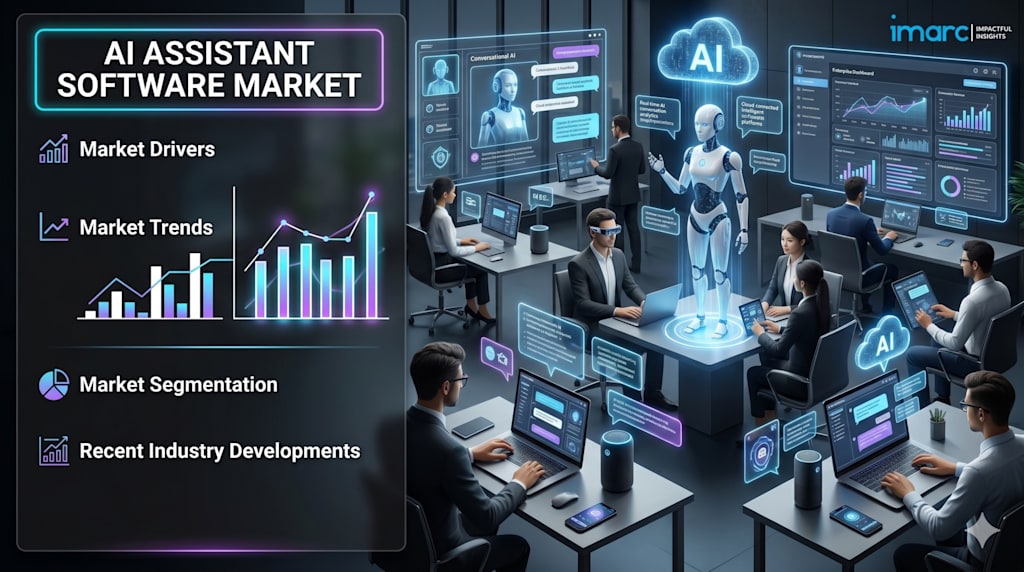
According to IMARC Group's latest research publication, The global AI assistant software market size was valued at USD 10,021.4 Million in 2025. Looking forward, the market is expected to reach USD 39,315.1 Million by 2034, exhibiting a growth rate (CAGR) of 15.91% during 2026-2034, reflecting strong and sustained growth momentum driven by enterprise automation priorities, advances in natural language processing, and expanding deployment across healthcare, retail, and banking sectors worldwide.
How AI is Reshaping the Future of the AI Assistant Software Market
- Natural Language Processing Breakthroughs Driving Conversational Accuracy: Modern AI assistant platforms now process and respond to human language with contextual awareness that earlier systems could not achieve. Large language model architectures enabling multi-turn conversations, intent disambiguation, and sentiment-sensitive responses have transformed user expectations. Enterprises deploying advanced conversational AI assistants report first-contact resolution rates improving by up to 30% in customer service environments, directly reducing escalation volumes and lowering operational costs without degrading customer experience quality.
- CRM and ERP Integration Unlocking Enterprise-Wide Intelligence: AI assistant software is being embedded directly into enterprise resource planning and customer relationship management platforms, converting these systems from passive data repositories into active intelligence engines. Sales teams using AI assistants integrated with CRM platforms report productivity improvements of over 25%, as assistants surface deal insights, draft follow-up communications, and flag at-risk accounts without requiring manual data entry. This deep integration has transformed the AI assistant from a standalone productivity tool into a core component of enterprise workflow architecture.
- Customer Service Automation at Industrial Scale: Contact center operations across banking, telecommunications, and retail are being restructured around AI assistant deployments capable of handling thousands of simultaneous interactions. AI-powered virtual agents now resolve routine service requests including account queries, order tracking, and appointment scheduling with minimal human intervention, enabling organizations to reallocate human agents to complex, high-value interactions. Enterprises that have deployed AI assistant platforms in customer service environments report average handling time reductions of 20 to 40%, with measurable improvements in customer satisfaction scores driven by faster response times and round-the-clock availability.
- Responsible AI Frameworks Shaping Platform Design Standards: The global AI Assistant Software Market is being reshaped by a growing institutional push toward accountable and transparent AI deployment. Governments and regulatory bodies are mandating that AI assistant platforms incorporate watermarking capabilities, deepfake detection mechanisms, and stress-testing protocols to validate system resilience before deployment. Academic institutions, research bodies, and technology startups are being mobilized through structured funding initiatives to develop ethical guidelines and risk assessment models that balance innovation velocity with user safety. This shift is redefining vendor differentiation, with trust and governance becoming as commercially significant as performance and scalability in enterprise procurement decisions.
- Generative AI Assistants Redefining Productivity Workflows: Generative AI capabilities embedded within assistant software platforms are enabling new categories of knowledge work automation that were previously dependent on skilled human specialists. Professionals in legal, financial, and healthcare sectors are deploying generative AI assistants to draft documents, synthesize research, generate summaries from lengthy reports, and produce first-draft communications in a fraction of the time required for manual production. Organizations piloting generative AI assistant tools in knowledge-intensive roles report productivity gains equivalent to several hours per knowledge worker per week, fundamentally altering the economics of professional services delivery.
AI Assistant Software Market Industry Overview
The AI Assistant Software Market is being propelled by a convergence of private sector investment, national AI infrastructure programs, and an accelerating enterprise mandate to embed intelligent automation into core business processes.
Government backing has emerged as a structural force shaping the market's trajectory. In July 2024, India's Union Budget for fiscal year 2024-25 included a dedicated budget allocation to the IndiaAI Mission, formalizing state commitment to building AI infrastructure at national scale. The allocation covered the establishment of AI innovation centers, workforce skills development programs, and governance mechanisms designed to ensure responsible AI deployment across sectors. This move signaled how major economies are treating AI assistant infrastructure not merely as a technology investment but as a national economic competitiveness imperative.
The IndiaAI Mission accelerated its operational rollout in December 2024, launching its second round of Expression of Interest under the Safe and Trusted AI pillar. The initiative invited proposals from academic institutions, research organizations, startups, and established technology companies to develop tools specifically targeting responsible AI deployment, including watermarking systems, deepfake detection capabilities, ethical framework design, and risk assessment methodologies. The breadth of participation sought reflected a deliberate strategy to build a broad ecosystem around trustworthy AI rather than concentrating development within a small number of incumbents.
In March 2025, India's Ministry of Electronics and Information Technology detailed further progress under the IndiaAI Mission, announcing a significant expansion of national AI compute capacity through thousands of additional GPUs, the launch of an open GPU marketplace to democratize access to computing resources, and plans for indigenous GPU development. The ministry also announced the establishment of new AI Centres of Excellence, including a dedicated center focused on AI applications in education. Alongside these infrastructure milestones, the mission launched BharatGen, a government-funded multimodal large language model, and supported Indian-language AI tools including Sarvam-1, Chitralekha, and Everest 1.0, signaling a push toward linguistic inclusivity in AI assistant deployment across the country's diverse population.
AI Assistant Software Market Trends and Drivers
The sector continues to attract significant investment as enterprises recognize AI assistants as a foundational layer of digital operations rather than a peripheral add-on. Rising adoption of remote and hybrid work models has sustained demand for AI assistant tools that can replicate the collaborative efficiency of co-located teams across distributed environments. Intelligent virtual assistants managing meeting scheduling, document retrieval, project status updates, and cross-functional coordination have become essential infrastructure for enterprises managing geographically dispersed workforces.
Cost optimization pressure across industries has accelerated enterprise evaluation of AI assistant deployments. In sectors where labor costs represent the dominant operational expenditure, AI assistant platforms capable of automating high-volume, rule-based interactions deliver measurable return on investment within months of deployment. Banking and financial services institutions deploying AI assistants in back-office operations have reported processing cost reductions of 30 to 50% for standardized workflows including loan application pre-screening, compliance document verification, and customer onboarding data collection.
Personalization capabilities are driving adoption in retail and e-commerce environments where AI assistants now serve as intelligent shopping companions. These platforms analyze browsing behavior, purchase history, and expressed preferences to deliver product recommendations, respond to inventory queries, and guide customers through complex purchase decisions in real time. Retailers deploying conversational AI assistants report average order value increases of 15 to 20% on sessions where the assistant successfully engages the customer, demonstrating the commercial value of personalized AI-driven interaction at scale.
Healthcare is emerging as a high-growth vertical for AI assistant software, with clinical and administrative applications proliferating rapidly. AI assistants are being deployed to manage patient appointment scheduling, triage symptom queries, surface relevant clinical guidelines for healthcare professionals, and automate insurance pre-authorization workflows. These deployments are reducing administrative burden on clinical staff while improving patient access to information and care coordination, positioning healthcare as one of the most consequential growth frontiers in the AI Assistant Software Market.
The IT service management segment is experiencing particularly strong adoption as enterprises use AI assistants to automate tier-one helpdesk support. AI-powered ITSM assistants now handle password resets, software provisioning requests, network access queries, and routine troubleshooting without human intervention, with leading implementations resolving over 60% of all helpdesk tickets automatically. This capability directly reduces IT support costs while improving response time consistency for end users across global enterprise environments.
Leading Companies Operating in the Global AI Assistant Software Industry
- Amazon Web Services Inc. (Amazon.com, Inc.)
- Apple Inc.
- Google LLC (Alphabet Inc.)
- IBM Corporation
- Meta Platforms, Inc.
- Microsoft Corporation
- Oracle Corporation
- Salesforce.com, Inc.
- SAP SE
- ServiceNow, Inc.
AI Assistant Software Market Report Segmentation
By Component:
- Software
- Services
The software segment leads market revenue, driven by platform subscription models and the growing preference for cloud-native AI assistant deployments that require minimal on-premises infrastructure. Services including implementation, integration, and ongoing support represent a fast-growing complementary segment as enterprise complexity increases.
By Functionality:
- Intelligent Virtual Assistants (IVAs)
- Chatbots
- Generative AI Assistants
- Task-specific Assistants
- Others
Intelligent virtual assistants represent the most mature and widely deployed functionality category, leveraging deep natural language understanding to handle complex multi-turn conversations. Generative AI assistants are the fastest-growing functionality segment, with enterprise adoption accelerating sharply as organizations identify knowledge work automation as a primary value creation opportunity.
By Application:
- Customer Service and Support
- Sales and Marketing
- IT Service Management (ITSM)
- Human Resources and Talent Management
- Personal Assistance
- Others
Customer service and support remains the dominant application category, accounting for the largest share of deployments as enterprises prioritize cost reduction and availability improvements in consumer-facing operations. Sales and marketing automation and ITSM are among the fastest-growing application segments, reflecting deepening enterprise confidence in AI assistant capabilities beyond the contact center.
Regional Insights
- North America (United States, Canada)
- Asia Pacific (China, Japan, India, South Korea, Australia, Indonesia, Others)
- Europe (Germany, France, United Kingdom, Italy, Spain, Russia, Others)
- Latin America (Brazil, Mexico, Others)
- Middle East and Africa
North America leads the global AI Assistant Software Market, anchored by the United States where a dense concentration of both technology vendors and large enterprise adopters has created a self-reinforcing ecosystem of innovation and deployment. High digital infrastructure maturity, early enterprise adoption, and access to deep pools of AI research talent have sustained North America's market leadership across all major application categories.
Asia Pacific is the most dynamic growth region in the AI Assistant Software Market, driven by massive populations, accelerating digital infrastructure investment, and proactive government AI development programs across India, China, Japan, and South Korea. India's IndiaAI Mission, China's national AI strategy, and Japan's AI governance frameworks are collectively mobilizing public and private capital at scale, creating favorable conditions for AI assistant software adoption across consumer, enterprise, and public sector deployments simultaneously.
Europe maintains consistent growth momentum, with Germany, the United Kingdom, and France serving as the primary markets for enterprise AI assistant adoption. The European Union's regulatory framework, including the AI Act, is shaping a distinctive regional market where compliance, transparency, and human oversight requirements are embedded into product architecture from inception, influencing how global vendors engineer and position their platforms for European enterprise customers.
Recent News and Developments in the AI Assistant Software Market
- March 2025: India's Ministry of Electronics and Information Technology detailed the IndiaAI Mission's progress, announcing expansion of national AI compute capacity with thousands of additional GPUs, launch of an open GPU marketplace, indigenous GPU development plans, new AI Centres of Excellence including one focused on education, and the launch of BharatGen, a government-funded multimodal large language model, alongside Indian-language AI tools including Sarvam-1, Chitralekha, and Everest 1.0.
- December 2024: The IndiaAI Mission launched its second round of Expression of Interest under the Safe and Trusted AI pillar, inviting academic institutions, research organizations, startups, and established companies to submit proposals for developing watermarking tools, deepfake detection systems, ethical AI frameworks, stress-testing methodologies, and risk assessment models for responsible AI deployment.
Note: If you require specific details, data, or insights that are not currently included in the scope of this report, we are happy to accommodate your request. As part of our customization service, we will gather and provide the additional information you need, tailored to your specific requirements. Please let us know your exact needs, and we will ensure the report is updated accordingly to meet your expectations.
About the Creator
Abhay Rajput
I am working in market research company that provides market and business research intelligence across the globe.
Enjoyed the story? Support the Creator.
Subscribe for free to receive all their stories in your feed.
Comments
There are no comments for this story
Be the first to respond and start the conversation.