
Aerospace Fasteners Market Size, Trends, and Future Outlook
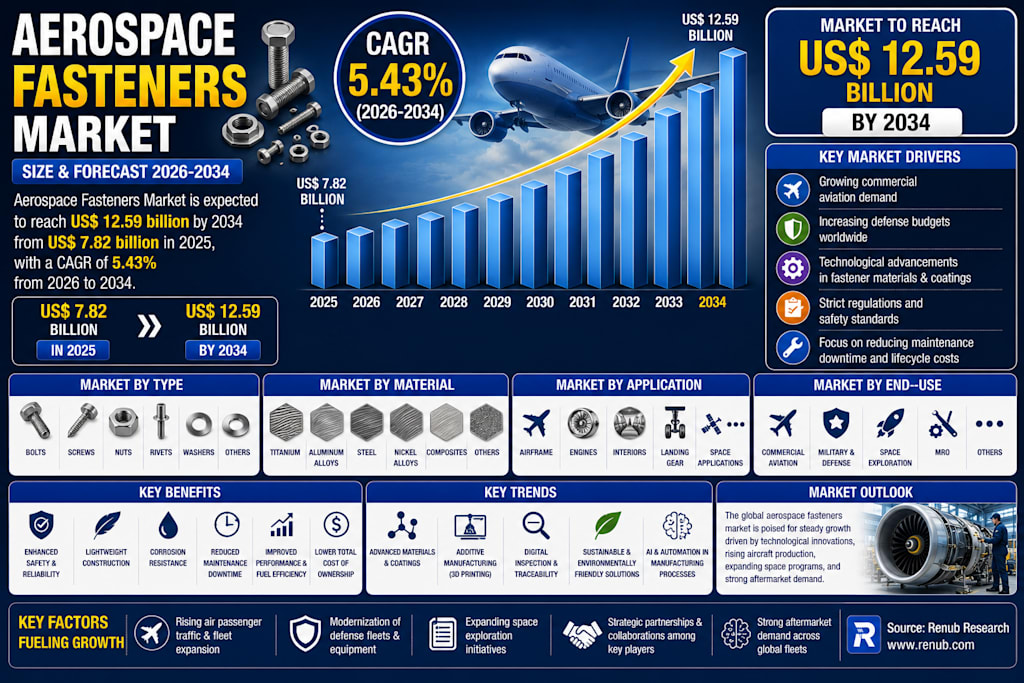
Rising aircraft production, defense modernization, and advanced material innovation are driving the global aerospace fasteners market, projected to grow from US$ 7.82 billion in 2025 to US$ 12.59 billion by 2034, at a CAGR of 5.43%

Introduction
The aerospace fasteners market is a crucial component of the global aviation and defense ecosystem, supporting the structural integrity and safety of aircraft, spacecraft, and advanced defense systems. Fasteners—including bolts, nuts, screws, rivets, and locking mechanisms—play a foundational role in holding together complex aerospace structures that must withstand extreme operational conditions.
According to the Renub Research data provided, the aerospace fasteners market is expected to expand from US$ 7.82 billion in 2025 to US$ 12.59 billion by 2034, growing at a CAGR of 5.43%.
This steady growth reflects increasing global air travel, rising defense expenditures, expanding space exploration initiatives, and continuous advancements in materials and manufacturing technologies.
Aerospace Fasteners Market Overview
The aerospace fasteners industry supports a wide range of applications across commercial aviation, military aircraft, space exploration, and unmanned aerial vehicles (UAVs). These components are designed to perform reliably under extreme stress, vibration, temperature variations, and corrosive environments.
Modern aerospace engineering demands fasteners that offer high strength-to-weight ratios, durability, and corrosion resistance. Materials such as titanium, nickel alloys, aluminum, and composite-compatible fasteners are widely used to meet these stringent requirements. Additionally, advancements in precision manufacturing, additive manufacturing, and automation are improving product quality, reducing defects, and enhancing supply chain efficiency.
Growth Drivers for the Aerospace Fasteners Market
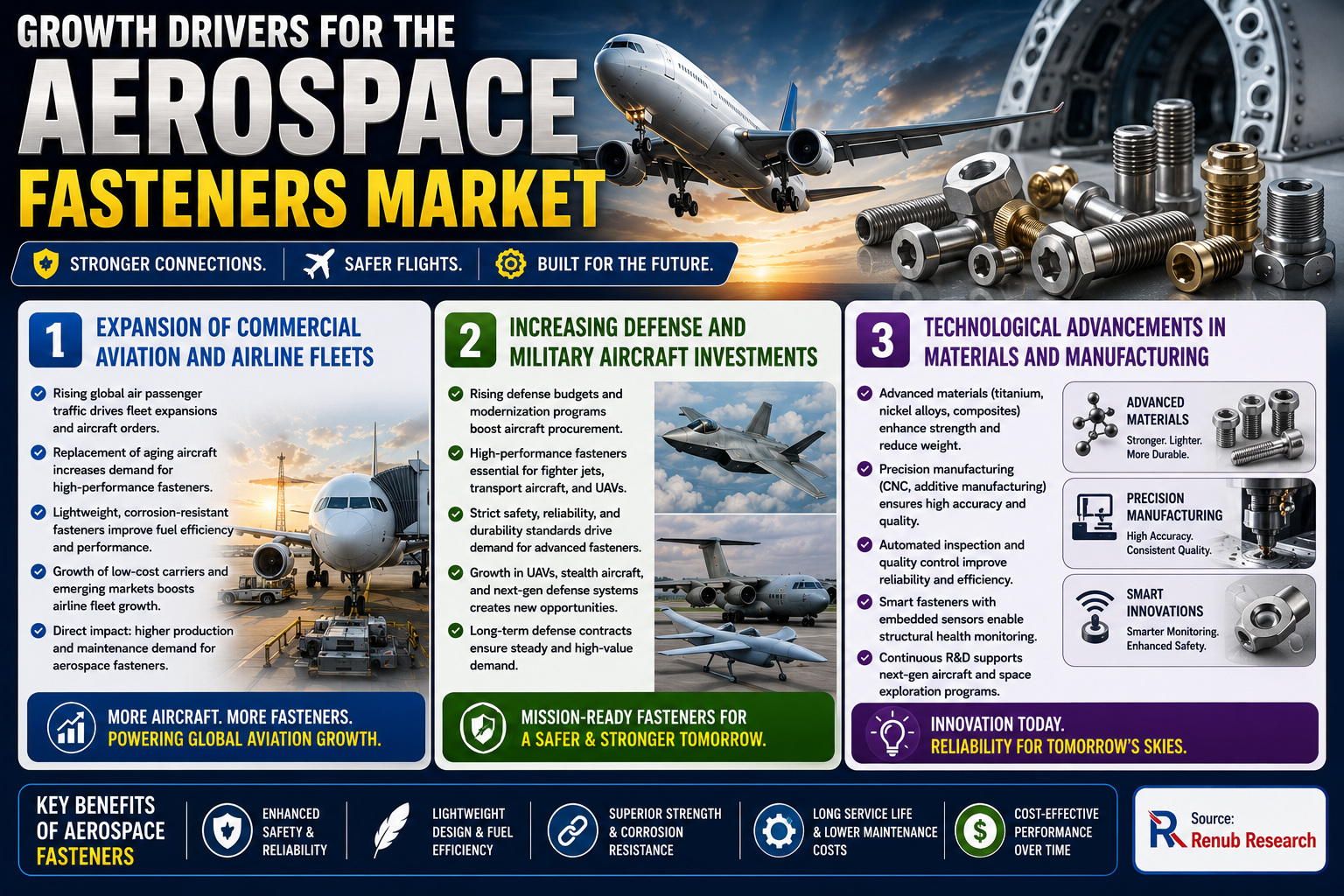
Expansion of Commercial Aviation and Airline Fleets
The rapid expansion of global air travel is one of the primary drivers of the aerospace fasteners market. Increasing passenger demand has led airlines to expand fleets and replace older aircraft, creating sustained demand for high-performance fasteners.
Modern aircraft require lightweight and durable components to improve fuel efficiency and reduce operational costs. Fasteners made from advanced materials such as titanium and aluminum alloys help achieve these objectives while maintaining structural integrity. Additionally, the rise of low-cost carriers and improved air connectivity in emerging economies is further boosting aircraft production and fastener consumption.
Increasing Defense and Military Aircraft Investments
Rising global defense budgets and military modernization programs are significantly contributing to market growth. Military aircraft, including fighter jets, transport planes, and UAVs, require fasteners that meet extremely high standards of safety, reliability, and performance.
Advanced fasteners are designed to withstand harsh conditions such as extreme temperatures, high stress, and corrosive environments. Governments worldwide are investing in next-generation aircraft and defense technologies, creating consistent demand for specialized aerospace fasteners.
Technological Advancements in Materials and Manufacturing
Technological innovation is playing a transformative role in the aerospace fasteners market. The adoption of high-performance materials such as titanium and nickel alloys enhances strength, reduces weight, and improves fuel efficiency.
Advanced manufacturing techniques—including CNC machining, additive manufacturing (3D printing), and automated inspection systems—are enabling higher precision, reduced defects, and improved production efficiency. Additionally, the development of smart fasteners with embedded sensors for structural health monitoring is gaining traction, enabling predictive maintenance and improved safety.
Challenges in the Aerospace Fasteners Market
High Manufacturing Costs and Material Constraints
A major challenge in the aerospace fasteners market is the high cost of materials and manufacturing processes. Aerospace-grade materials such as titanium and nickel alloys are expensive and require advanced processing techniques.
Additionally, the need for precision machining, tight tolerances, and skilled labor further increases production costs. Supply chain disruptions and fluctuating raw material prices also add to the complexity, making cost management a critical challenge for manufacturers.
Stringent Regulatory Standards and Certification Requirements
The aerospace industry is highly regulated, with strict standards such as FAA, EASA, and AS9100 certifications governing product quality and safety.
Manufacturers must undergo rigorous testing, audits, and documentation processes to achieve compliance. These requirements increase development time and costs while limiting flexibility in adopting new materials or designs. Maintaining compliance while ensuring innovation remains a key challenge in the market.
Regional Market Insights
United States
The United States aerospace fasteners market is highly advanced, supported by strong demand from commercial aviation, defense, and space programs. The presence of major aircraft manufacturers and defense contractors ensures consistent demand for high-performance fasteners.
United Kingdom
The United Kingdom plays a significant role in the aerospace fasteners market, driven by a well-established aerospace ecosystem and ongoing investments in advanced aircraft technologies.
India
India is emerging as a key growth market, supported by expanding commercial aviation, defense modernization, and government initiatives such as “Make in India.” The country is increasingly focusing on developing indigenous aerospace manufacturing capabilities.
United Arab Emirates
The UAE is investing heavily in aviation, defense, and space technologies, driving demand for advanced aerospace fasteners. Strategic partnerships and infrastructure development are supporting market expansion in the region.
Recent Developments in Aerospace Fasteners Market
- June 2025: The U.S. Department of Defense awarded IperionX Limited a USD 99 million contract to produce titanium components, including aerospace fasteners, supporting domestic production capabilities.
- February 2025: TriMas Corporation signed a multi-year agreement with Airbus for robotic-assembly-ready fasteners across major aircraft programs.
- September 2024: LISI Aerospace implemented a smart manufacturing line at its Rugby plant, improving productivity and efficiency in fastener production.
- July 2024: Howmet Aerospace announced a USD 27.9 million expansion in Tennessee, reinforcing its commitment to innovation and capacity growth.
- Arconic Corporation continues to invest in advanced aerospace materials and fastening technologies.
- TriMas Corporation is expanding its aerospace segment through strategic partnerships and product innovation.
- Würth Group is strengthening its global distribution network for industrial and aerospace fasteners.
- Boeing Distribution Services Inc. is enhancing supply chain efficiency for aerospace components worldwide.
- Bufab International AB continues to expand its presence in engineered fastener solutions.
- National Aerospace Fasteners Corporation is focusing on high-performance fastening solutions for critical aerospace applications.
Market Segmentation
By Type
- Narrow Body Aircraft
- Wide Body Aircraft
- Very Large Aircraft
- Regional Transport Aircraft
- Business Jet
- Fighter Jet
- Others
By Material
- Aluminum
- Steel
- Superalloys
- Titanium
By Product
- Screws
- Nuts and Bolts
- Rivets
- Pins
- Others
By Region
- North America
- Europe
- Asia Pacific
- Latin America
- Middle East & Africa
Key Players
- Arconic Corporation
- TriMas Corporation
- Würth Group
- B&B Specialties, Inc.
- Boeing Distribution Services Inc.
- Bufab International AB
- National Aerospace Fasteners Corporation
- FSL Aerospace Ltd.
Conclusion
The aerospace fasteners market is steadily evolving as global aviation and defense sectors expand. With increasing demand for lightweight, durable, and high-performance components, manufacturers are focusing on advanced materials and innovative production technologies.
Despite challenges such as high costs and strict regulatory requirements, the market outlook remains positive. Supported by rising aircraft production, defense investments, and technological advancements, the aerospace fasteners market is expected to maintain stable growth through 2034, playing a vital role in the future of aerospace engineering.
About the Creator
Enjoyed the story? Support the Creator.
Subscribe for free to receive all their stories in your feed.
Comments
There are no comments for this story
Be the first to respond and start the conversation.