
Advanced Metering Infrastructure Market Trends: Smart Grid Adoption, IoT Integration & Forecast to 2034
How smart grid integration, IoT-enabled devices, and data-driven analytics are transforming utility operations and customer energy management in the AMI market

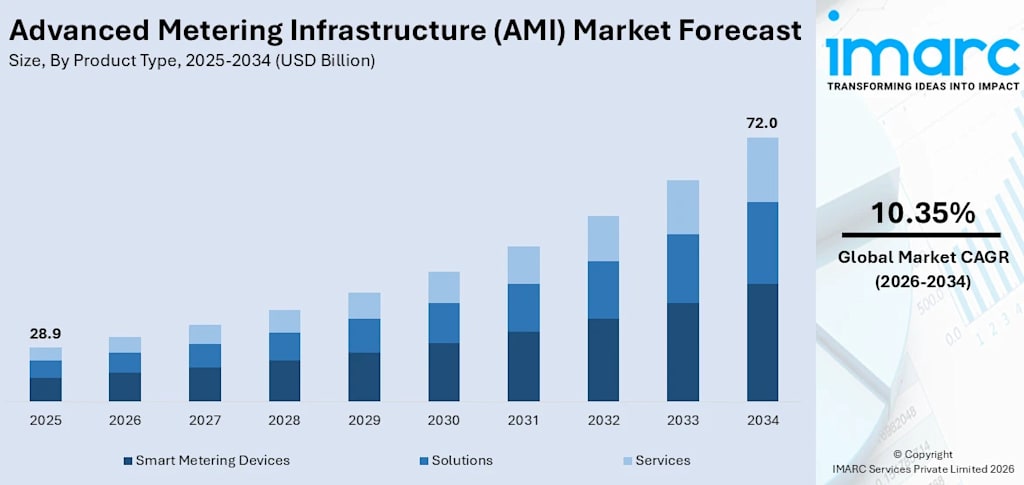
Modernization of aging utility networks, increasing integration of renewable energy, and the global push for carbon neutrality are significantly accelerating the adoption of smart grid technologies. According to IMARC Group’s latest data, the global Advanced Metering Infrastructure (AMI) market size was valued at USD 28.9 Billion in 2025. Looking forward, IMARC Group estimates the market to reach USD 72.0 Billion by 2034, exhibiting a CAGR of 10.35% from 2026-2034.
Advanced Metering Infrastructure now represents a critical backbone for the digital utility era, with global investments increasingly focused on real-time data transparency and grid resilience. This market expansion is fueled by the need for bidirectional communication between utilities and consumers, allowing for precise demand-side management and reduced operational overhead. Key developments include the rapid rollout of smart electricity, water, and gas meters, alongside sophisticated Meter Data Management Systems (MDMS).
Request Your Free "Advanced Metering Infrastructure (AMI) Market" Market Size & Forecast Sample
Advanced Metering Infrastructure (AMI) Market Growth Drivers:
- Urgent Grid Modernization and Electrification
The rapid transition toward a fully electrified economy is placing unprecedented stress on traditional power grids. With the surge in electric vehicle (EV) adoption and the decentralization of energy via rooftop solar, utilities require real-time visibility to manage variable loads. In the United States, reports indicate that over 119 million advanced meters are already operational, representing a penetration rate of roughly 72%. This shift is essential for preventing substation overloads and ensuring that the infrastructure can handle the 666 gigawatts of renewable capacity recently added to global networks.
- Government Mandates and Financial Incentives
Legislative backing is a primary engine for AMI deployment. In India, the national mission is targeting the installation of 250 million smart meters by 2026, which currently stands as the world’s largest single infrastructure program. Similarly, the U.S. government’s Grid Resilience and Innovation Partnerships (GRIP) program has funneled over USD 10.5 billion into modernizing grid technologies. These state-led initiatives provide the necessary capital and regulatory framework for utilities to transition from manual, analog readings to automated, digital systems that significantly reduce technical and commercial energy losses.
- Focus on Operational Efficiency and Non-Revenue Water
Utilities are increasingly adopting AMI to combat "non-revenue" losses, which include energy theft and physical leaks in water systems. In the water sector, digital meters provide 15-minute interval data that allows for immediate leak detection, a critical feature for drought-prone regions. Statistics show that utilities employing advanced analytics can achieve billing accuracy levels above 99.5%. By eliminating manual meter reading, companies can redeploy field technicians to high-value maintenance tasks, optimizing human resources while simultaneously reducing the carbon footprint associated with physical inspections and service vehicles.
Advanced Metering Infrastructure (AMI) Market Trends:
- Integration of Artificial Intelligence and Big Data Analytics
The current trend involves moving beyond simple data collection to "actionable intelligence" using AI. Modern AMI systems generate massive datasets that are now being processed by machine learning algorithms to predict equipment failures before they happen. For example, a partnership between tech leaders like Qualcomm and Easymetering is bringing AI directly into the meter hardware. This allows for edge computing, where the meter itself can identify unusual consumption patterns indicative of appliance malfunctions or energy theft, providing a level of granular control previously impossible with traditional infrastructure.
- Rise of Multi-Utility and "Water-as-a-Service" Models
A significant shift is occurring as AMI expands from electricity into integrated gas and water management. This multi-utility approach allows cities to use a single communication network for all resource tracking, lowering the total cost of ownership. In 2025, cities like Kyle, Texas, implemented comprehensive water meter upgrades to provide residents with real-time mobile reports on their consumption. This transparency is transforming the utility-customer relationship into a service-oriented model, where data helps consumers lower their monthly bills and participate in conservation efforts during peak demand periods.
- Adoption of Hybrid Communication and Cybersecurity Protocols
As smart grids become more connected, the industry is trending toward hybrid communication networks that blend RF mesh, cellular (5G/LTE), and satellite technologies. This ensures that meters in remote or "hard-to-reach" locations stay connected. However, with increased connectivity comes heightened security risks. Consequently, there is a massive trend toward implementing "security-by-design" in AMI hardware. Utilities are now prioritizing meters with advanced encryption and secure boot features to protect against ransomware attacks, which have previously caused some municipal projects to pause for rigorous penetration testing.
Recent News and Developments in AMI Market
- September 2025: National Grid accelerated its infrastructure rollout across New York, installing hundreds of thousands of new smart meters to replace aging analog units and provide customers with live energy usage insights.
- December 2025: The Indian Ministry of Power confirmed the successful installation of over 4.03 crore (40.3 million) smart meters under the Revamped Distribution Sector Scheme (RDSS), marking a significant milestone in its goal to digitize the national power grid.
- January 2026: A leading European utility provider launched a pilot program using 5G-enabled AMI sensors to monitor gas distribution networks, aiming to reduce methane emissions and improve safety through ultra-low latency leak detection.
Note: If you require specific details, data, or insights that are not currently included in the scope of this report, we are happy to accommodate your request. As part of our customization service, we will gather and provide the additional information you need, tailored to your specific requirements. Please let us know your exact needs, and we will ensure the report is updated accordingly to meet your expectations.
About the Creator
Andrew Sullivan
Hello, I’m Andrew Sullivan. I have over 9+ years of experience as a market research specialist.
Enjoyed the story? Support the Creator.
Subscribe for free to receive all their stories in your feed.
Comments
There are no comments for this story
Be the first to respond and start the conversation.