
Advanced and Intelligent Manufacturing Market: 4.6 Million Robots, USD 730 Billion by 2035, and a Race Every Manufacturer Needs to Be Running
AI, robotics, and smart factory technology are no longer pilot projects — they are production-critical infrastructure. Here is what the advanced and intelligent manufacturing market looks like right now.

Four consecutive years. That is how long global industrial robot installations have exceeded 500,000 units annually. In 2024 alone, 542,000 new industrial robots were installed on factory floors worldwide — the second-highest annual total in history. The total stock of operational robots globally hit 4,664,000 units. And the year before that was also a record. And the year before that.
When a market sets records four years in a row through interest rate cycles, supply chain disruptions, and geopolitical turbulence, it is telling you something important. This is not a cyclical trend. It is a structural shift in how the world makes things — and it is accelerating.
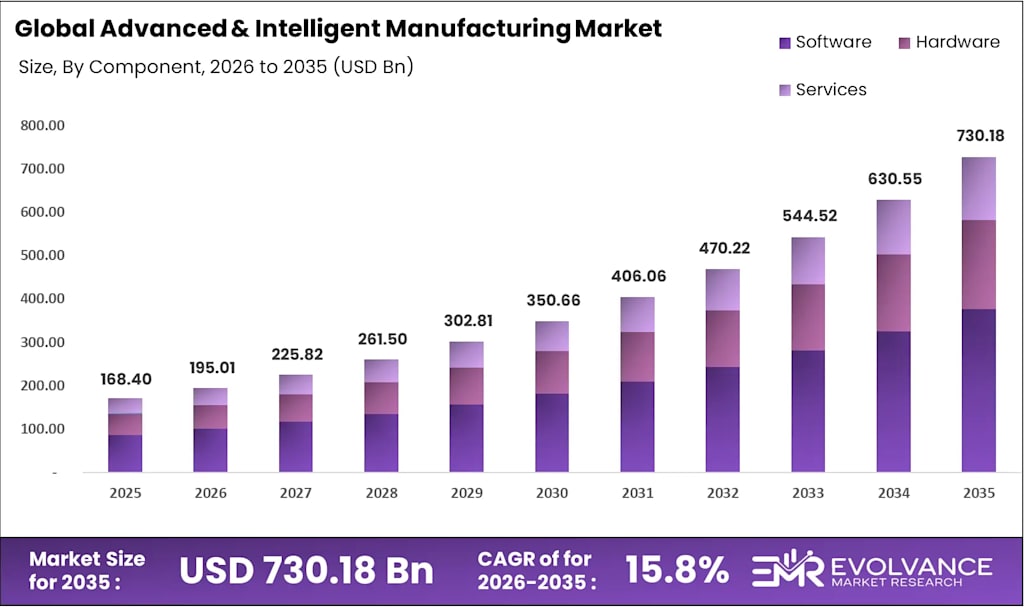
The global advanced and intelligent manufacturing market was valued at USD 460.8 billion in 2025 and is projected to reach USD 730.18 billion by 2035, growing at a CAGR of 15.8%. Behind that number sits a fundamental transformation — AI integration into factory operations, smart factory rollouts at scale, and a manufacturing industry that is rapidly discovering what happens when data-driven systems replace manual and semi-automated processes entirely. The full analytical breakdown — covering components, technologies, deployment models, enterprise size, end-user industries, and regional forecasts — is documented in the advanced and intelligent manufacturing market report from Evolvance Market Research.
Get Free Sample PDF: Advanced and Intelligent Manufacturing Market Size, Share, Forecast 2035
Advanced and Intelligent Manufacturing Market Size and Growth
The growth story of this market is grounded in numbers that manufacturing executives can take directly to their finance teams.
NIST has calculated that unplanned downtime accounts for between 8.3% and 13.3% of planned production time in US discrete manufacturing alone — generating approximately USD 245 billion in annual losses. Defects add another USD 32 billion to USD 58.6 billion on top of that. The estimated annual benefit of full advanced manufacturing adoption across US production is USD 37.9 billion. When the ROI is that clearly documented, the investment conversation stops being about whether and starts being about when.
Government investment is reinforcing private capital at scale. In December 2025, NIST launched dedicated AI Centers for Manufacturing with USD 20 million in funding, directly targeting technology transfer into production environments. The White House Office of Science and Technology Policy issued a Request for Information in June 2025 on a National Strategic Plan for Advanced Manufacturing — a signal that binding federal technology standards are in development. Manufacturers supplying US government contractors should treat that as an early compliance indicator, not a distant policy consideration.
Advanced and Intelligent Manufacturing Market Trends: The Technology Stack
Understanding what drives this market requires understanding how the technology layers work together — because advanced manufacturing is not a single product. It is a stack of interconnected systems, each enabling the others.
Software leads the component segment with a 51.6% share. This dominance reflects a fundamental truth about smart factory economics — without analytics and control software, physical automation assets cannot be optimized at scale. Manufacturers are consolidating spend on unified platforms that span scheduling, quality control, and predictive maintenance rather than managing disconnected point solutions.
Programmable Logic Controllers lead the technology segment with a 31.23% share, underpinning real-time industrial process control across virtually every manufacturing environment. Above the PLC layer, Manufacturing Execution Systems provide real-time shop floor visibility. Product Lifecycle Management software connects design, engineering, and manufacturing data into a unified record spanning the entire development cycle.
Additive manufacturing dominates the By Method/Process segment, anchored by its growing role in aerospace and medical device production where geometric complexity and customization requirements make traditional tooling economically impractical. Collaborative robotics — cobots designed to work safely alongside human operators — are democratizing automation for small-batch and high-mix production environments that were previously priced out of robotics entirely.
Advanced and Intelligent Manufacturing Adoption: Who Is Leading
Large enterprises hold a 72.31% share of the market, supported by higher capital budgets and dedicated digital transformation teams capable of managing complex multi-site deployments. On-premises deployment dominates with a 61.56% share, driven by data security requirements and legacy system integration needs that cloud-only solutions cannot yet fully address.
The automotive sector leads all end-user industries with a 28.9% share — and the numbers inside that figure are striking. US auto industry robot installations grew 10.7% in 2024, reaching 13,700 units. Hyundai's USD 7.6 billion AI-powered smart factory under construction in the US is one of the clearest signals that investment is moving decisively from pilot programs to full-scale production commitment.
The robot density gap between leading and lagging markets defines where the next wave of capital spending will be concentrated. South Korea leads globally at 1,012 robots per 10,000 manufacturing employees. Germany and Japan follow. China — which operates 2,027,200 factory robots — now ranks third at 470 units per 10,000 employees. The US, at 295 units per 10,000 employees, is running hard to close a gap that has direct implications for long-term manufacturing competitiveness.
Advanced and Intelligent Manufacturing Market Regional Analysis
Asia Pacific commands the market with a 51.2% share valued at USD 235.0 billion in 2025. China's manufacturing scale, robot density, and government investment in smart factory infrastructure give it structural advantages that no other region can replicate quickly. China's advanced manufacturing market alone is expected to grow from USD 81.9 billion in 2025 to USD 380.2 billion by 2035 at an 18.6% CAGR — outpacing the global average and confirming that China is setting the pace rather than simply following it.
North America is investing aggressively to compete. The US CHIPS Program's USD 1.4 billion in advanced semiconductor packaging awards announced in January 2025 is directly funding factory automation upgrades in fabrication facilities being built with that money. Europe's advanced manufacturing investment is shaped by Germany's deep industrial base and the EU's dual push for digital and green industrial transformation — with carbon reporting requirements under the Corporate Sustainability Reporting Directive now creating additional urgency for efficiency investment.
Key Players in the Advanced and Intelligent Manufacturing Market
The competitive landscape is consolidating at speed. Siemens AG operates across the full stack with its Xcelerator portfolio — PLCs, PLM, digital twins, and industrial AI integrated into a unified data environment. Its planned EUR 10 billion acquisition of Altair Engineering is the largest consolidation move in industrial simulation history. Rockwell Automation's FactoryTalk suite connects MES, analytics, and asset management, with its Microsoft Azure partnership positioning it strongly for hybrid deployment. ABB competes at the intersection of robotics and process automation across both discrete and continuous manufacturing environments.
NVIDIA's industrial computing platforms are increasingly embedded in edge AI deployments across the stack. The global advanced manufacturing M&A market reached USD 717 billion in deal value in 2025 — a signal that competitive boundaries are being redrawn fast and that the vendor landscape buyers navigate today will look meaningfully different by the end of the decade.
Where the Advanced and Intelligent Manufacturing Market Goes Next
The manufacturers investing in AI-driven production systems now are not simply buying better equipment. They are generating the production data that improves their AI models each quarter. Those improved models widen the cost and quality gap over competitors who have not yet started. By the time a lagging manufacturer begins their own program, the first mover has built operational infrastructure that is genuinely difficult to replicate at speed.
Four consecutive record years for robot installations is the market telling you something. The factories that ignore that signal long enough will eventually have no choice but to respond — only by then, the cost of catching up will be significantly higher than the cost of moving now.
About the Creator
Suge kun
Research Analyst passionate about data & market insights. I turn complex information into clear, actionable strategies. Detail-driven & results-focused — helping businesses make smarter decisions. — Suge Kun
Enjoyed the story? Support the Creator.
Subscribe for free to receive all their stories in your feed.
Comments
There are no comments for this story
Be the first to respond and start the conversation.