
Adaptive Optics Market Insights: Integration with AI, Smart Imaging Systems & Industry Forecast to 2033
Integration of artificial intelligence with adaptive optics is enabling real-time corrections, boosting performance in microscopy, laser communication, and advanced imaging applications

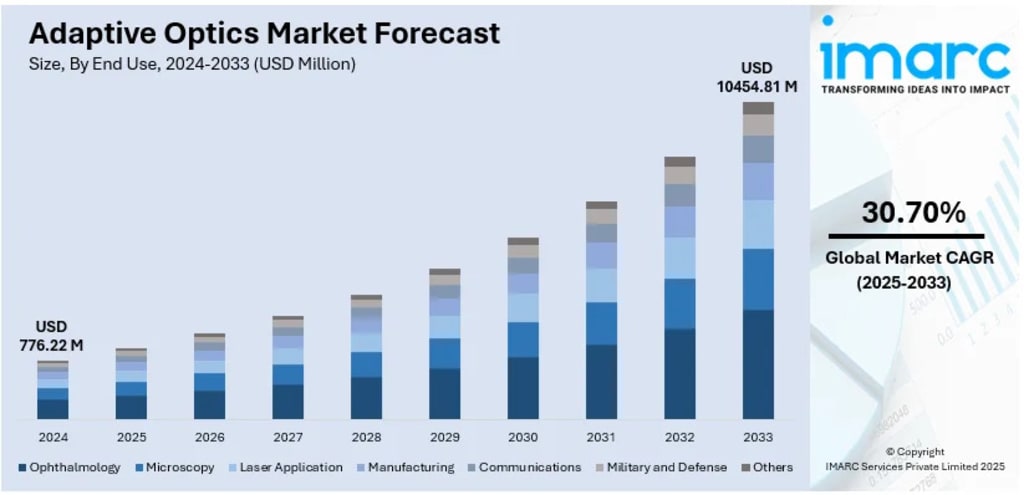
High-performance imaging, satellite communication, and biomedical research are driving adaptive optics demand, supported by the integration of AI-controlled systems, rising space exploration budgets, and breakthroughs in non-invasive ophthalmology. According to IMARC Group’s latest data, the global adaptive optics market size was valued at USD 776.22 Million in 2024. Looking forward, IMARC Group estimates the market to reach USD 10454.81 Million by 2033, exhibiting a CAGR of 30.70% from 2025-2033.
Adaptive optics now represent a multi-billion-dollar high-tech sector exceeding USD 2.5 billion and exhibiting rapid year-on-year expansion. Demand is driven by the critical need to correct real-time wavefront distortions in ground-based telescopes, high-energy laser systems, and ultra-high-resolution retinal imaging. Technological maturation in deformable mirrors and wavefront sensors, combined with increased military spending on directed-energy weapons and satellite surveillance, is further accelerating uptake. Major segments include wavefront sensors, modulators, and control systems, with end-users in the military, astronomy, and healthcare sectors prioritizing precision, reduced latency, and system miniaturization for commercial applications.
Claim Your Free "Adaptive Optics Market" Insights Sample PDF
Adaptive Optics Market Growth Drivers:
- Rising Investments in Space Exploration and Astronomy
National space agencies and private aerospace firms are significantly increasing budgets for next-generation ground-based telescopes and satellite tracking systems. Modern astronomical observations require adaptive optics to neutralize atmospheric turbulence, which otherwise blurs images of distant celestial bodies. With global space economy valuations reaching approximately USD 630 billion, the demand for large-scale deformable mirrors and laser guide stars has intensified. These systems are essential for exoplanet research and deep-space monitoring, where sub-millisecond corrections are mandatory to maintain the structural integrity of incoming light waves for scientific analysis.
- Expanding Applications in Biomedical Imaging and Ophthalmology
The healthcare sector is adopting adaptive optics to revolutionize retinal imaging and early disease detection. Traditional imaging often struggles with ocular aberrations, but AO-integrated ophthalmic devices provide cellular-level resolution, allowing clinicians to view individual photoreceptors. This precision is vital for managing conditions like macular degeneration and glaucoma, which affect over 200 million people worldwide. By integrating wavefront sensors into clinical diagnostic tools, hospitals can provide non-invasive, high-accuracy screenings.
- Surge in Defense and Military Optronics
Military modernization programs are increasingly incorporating adaptive optics into directed-energy weapons, long-range surveillance, and free-space optical communications. Governments are allocating substantial portions of defense R&D—often exceeding USD 100 billion in major economies—toward laser-based defense systems that require precise beam control through turbulent environments. These applications rely on real-time wavefront modulation to ensure laser strikes remain focused on targets over several kilometers.
Adaptive Optics Market Trends:
- Integration of AI and Machine Learning in Control Systems
A significant trend is the transition from traditional algorithmic controls to AI-driven wavefront reconstruction. Artificial intelligence allows for faster prediction of atmospheric changes, reducing the "reconstruction lag" that often limits AO performance. Modern systems now utilize deep learning models to process sensor data, enabling real-time adjustments even in highly volatile conditions. This innovation is particularly impactful in autonomous drone surveillance and high-speed satellite communications, where manual calibration is impossible.
- Miniaturization and MEMS-based Deformable Mirrors
The industry is moving away from bulky, expensive optical benches toward compact Micro-Electro-Mechanical Systems (MEMS). This miniaturization trend is opening doors for adaptive optics in consumer electronics, specifically in AR/VR headsets and smartphone camera modules. Small-scale deformable mirrors allow for active focus correction and "varifocal" displays, which reduce eye strain in virtual environments by mimicking natural depth perception. As the AR/VR market expands toward a projected USD 200 billion ecosystem, the demand for lightweight, low-power AO components is surging, allowing high-end optical correction to move from observatories to wearable devices.
- Development of Free-Space Optical (FSO) Communications
As 5G and 6G networks demand higher bandwidth, free-space optical communication is emerging as a viable alternative to fiber-optics in remote areas. Adaptive optics play a pivotal role here by correcting the "scintillation" or fading of laser signals caused by wind and temperature gradients in the air. Tech giants and telecommunications providers are investing in AO-equipped optical ground stations to facilitate high-capacity data transfers between satellites and terrestrial networks. This trend is supported by government initiatives to bridge the digital divide, utilizing laser-based backhaul systems to provide high-speed internet to underserved regions without the need for physical cabling.
Recent News and Developments in Adaptive Optics Market
- September 2025: A leading European research consortium unveiled a compact, MEMS-based adaptive optics module for clinical microscopes, significantly lowering the cost of high-resolution live-cell imaging for pharmaceutical research laboratories.
- October 2025: The James Webb Space Telescope's successor projects received a funding boost, with a primary focus on developing "Extreme Adaptive Optics" (ExAO) to enable the direct imaging of Earth-like planets in neighboring star systems.
- January 2026: A major consumer electronics firm filed patents for an AI-controlled adaptive lens system for next-generation smart glasses, aimed at correcting user refractive errors in real-time, potentially eliminating the need for prescription lenses in AR devices.
Note: If you require specific details, data, or insights that are not currently included in the scope of this report, we are happy to accommodate your request. As part of our customization service, we will gather and provide the additional information you need, tailored to your specific requirements. Please let us know your exact needs, and we will ensure the report is updated accordingly to meet your expectations.
About the Creator
Andrew Sullivan
Hello, I’m Andrew Sullivan. I have over 9+ years of experience as a market research specialist.
Enjoyed the story? Support the Creator.
Subscribe for free to receive all their stories in your feed.
Comments
There are no comments for this story
Be the first to respond and start the conversation.