
A2P Messaging Market Trends: Omnichannel Communication, API Integration & Forecast to 2034
How rising mobile penetration, enterprise communication needs, and real-time notifications are transforming customer engagement strategies and operational efficiency in the A2P messaging market

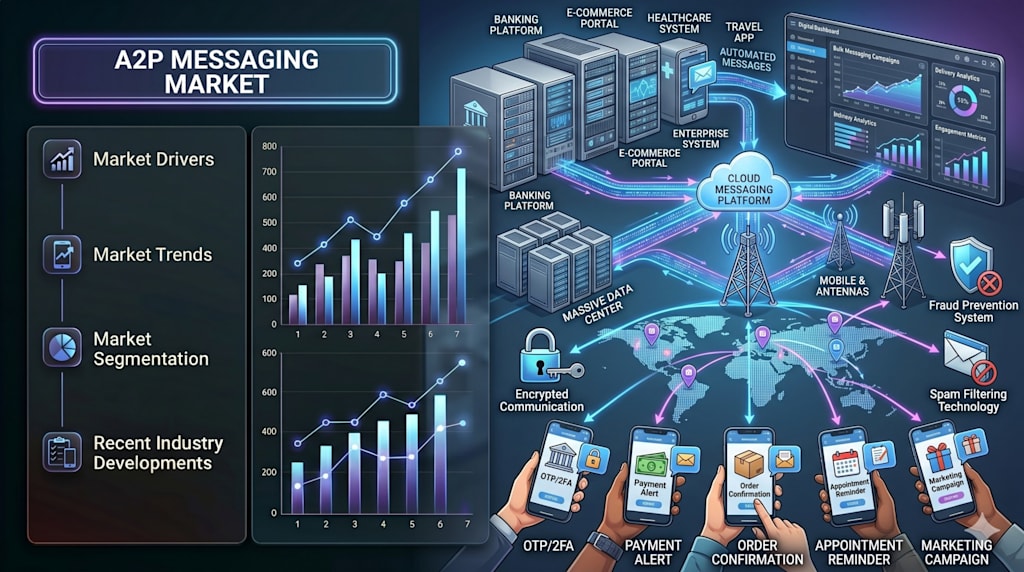
According to IMARC Group's latest research publication, The global A2P messaging market size reached USD 74.8 Billion in 2025. Looking forward, IMARC Group expects the market to reach USD 102.0 Billion by 2034, exhibiting a growth rate (CAGR) of 3.40% during 2026-2034, exhibiting steady and consistent expansion throughout the forecast period. Asia Pacific currently dominates the market, holding a share of over 44.5%, driven by expanding mobile banking services, accelerated smartphone ownership, and a proliferating e-commerce sector.
How AI is Reshaping the Future of A2P Messaging Market
- Intelligent Traffic Routing and Delivery Optimization: AI-powered routing engines analyze network conditions, carrier performance, and message priority to automatically select the optimal delivery path for each A2P SMS. Telecom aggregators deploying these systems have reported significant improvements in first-attempt delivery rates and reduced latency, particularly for time-sensitive communications such as OTPs and fraud alerts. By dynamically rerouting traffic away from congested or underperforming routes, AI ensures that authentication messages reach end users within the critical three-minute window during which 95% of all SMS are opened and read.
- Fraud Detection and Grey Route Blocking: Machine learning algorithms continuously monitor A2P traffic patterns to detect anomalies associated with SIM-swap fraud, grey route abuse, and unauthorized sender activity. These systems flag suspicious traffic in real time, protecting telecom operators from revenue leakage while ensuring that enterprise senders maintain delivery quality. Given that SMS open rates reach as high as 98% and are therefore prime targets for exploitation, AI-based fraud prevention has become a foundational layer within enterprise messaging infrastructure.
- Personalization and Predictive Messaging Engines: AI enables enterprises to move beyond static broadcast messaging toward dynamic, behavior-triggered A2P communication. By analyzing purchase history, browsing behavior, and customer lifecycle stage, predictive messaging engines automatically determine the right content, timing, and frequency for each individual recipient. E-commerce platforms are leveraging these capabilities to send targeted promotional offers and cart-abandonment reminders, directly improving conversion rates. Mobile advertising expenditure in the United States is projected to exceed USD 200 Billion, reflecting the scale of investment enterprises are directing toward personalized digital engagement channels, of which A2P messaging is a central component.
- Cloud Platform Automation and Scalability Management: AI-integrated cloud-based A2P platforms, which already command approximately 60.0% of the deployment mode segment, are incorporating intelligent auto-scaling capabilities that adjust messaging throughput in response to demand fluctuations. During peak retail events, healthcare appointment surges, or banking authentication spikes, these platforms dynamically allocate resources to prevent delivery failures without manual intervention. This automation reduces operational overhead for enterprises, particularly small and medium-sized businesses that lack dedicated telecom management teams.
- Regulatory Compliance Automation: As governments and telecom regulators tighten A2P messaging frameworks, AI is being embedded into compliance management layers to automate sender registration verification, consent validation, and content screening. In markets like India where the Distributed Ledger Technology framework mandates sender registration for all commercial messaging, AI tools help enterprises stay continuously compliant by cross-referencing outgoing traffic against approved templates and sender identities in real time, eliminating the risk of message blocking due to non-compliance.
A2P Messaging Industry Overview
The global A2P messaging industry is undergoing rapid transformation and scale-up, propelled by the convergence of digital commerce expansion, mobile-first consumer behavior, and enterprise demand for real-time communication infrastructure. GSMA data indicates that 5.6 billion individuals, representing 69% of the world's population, have signed up for mobile services, with this figure expected to rise to 6.3 billion, accounting for 74% of the global population, in the coming years. This expanding addressable base gives enterprises an unprecedented channel to reach customers instantly and at scale. The industry serves a broad ecosystem of end users spanning banking, financial services and insurance (BFSI), retail and e-commerce, healthcare, government, travel, hospitality, and hyperlocal businesses. Cloud-based A2P platforms lead the deployment mode segment with roughly 60.0% market share, valued for their scalability, cost efficiency, and ease of integration with SMS, MMS, voice, and over-the-top messaging channels. Platform components hold approximately 32.3% of the component segment, reflecting enterprise preference for centralized, customizable messaging management tools that enable bulk scheduling and real-time delivery across diverse geographies. National SMS traffic leads the traffic segmentation, driven by the rapid rise of domestic e-commerce transactions, government digital service notifications, and the growing number of hyperlocal businesses prioritizing real-time domestic customer communication.
A2P Messaging Market Trends and Drivers
The explosive growth of mobile commerce and digital banking across emerging and developed markets is among the most powerful structural forces lifting A2P messaging demand. Industry reports project e-commerce sales to surge by 8.8% in the current period, with every incremental online transaction generating a corresponding demand for order confirmations, shipping notifications, fraud alerts, and account verification messages delivered via A2P channels. Financial institutions are among the heaviest consumers of A2P infrastructure, deploying it for two-factor authentication, transaction alerts, and balance notifications that customers expect to receive within seconds of account activity. The BFSI sector's reliance on A2P messaging is reinforced by regulatory requirements for secure customer verification, making it a non-discretionary operational expenditure rather than an optional marketing tool.
The structural advantage of SMS as a communication channel continues to draw enterprise investment away from email and app-based alternatives. SMS response rates exceed 40%, and recipients reply on average within 90 seconds, compared to a 90-minute average response time for email. These engagement metrics make A2P messaging the preferred channel for time-critical business communications across healthcare appointment reminders, retail loyalty alerts, and government service notifications. The rising number of mobile subscriptions globally is continuously expanding the universe of reachable customers, with enterprises increasingly building mobile-first engagement strategies that place A2P SMS at the center of customer lifecycle communication.
The proliferation of cloud communication platforms and API-driven messaging services has democratized access to A2P infrastructure, allowing businesses of all sizes to deploy sophisticated, automated messaging campaigns without significant upfront technology investment. Small and medium enterprises are particularly active adopters of cloud-based A2P solutions, drawn by subscription-based pricing models, rapid deployment timelines, and the ability to integrate A2P messaging directly into existing CRM, ERP, and e-commerce platforms. This broad adoption across business segments is sustaining diverse and geographically distributed demand, reducing the industry's dependence on any single vertical or region and contributing to the resilience of overall market growth fundamentals.
Leading Companies Operating in the Global A2P Messaging Industry
- Infobip Ltd.
- Sinch AB
- Syniverse Technologies LLC
- Twilio Inc.
- Tata Communications Limited
- Route Mobile Limited
- Bandwidth Inc.
- CM.com
- Vonage Holdings Corp. (Ericsson)
- MessageBird B.V.
- Proximus Group
- BSQUARE Corporation
A2P Messaging Market Report Segmentation
By Component:
- Platform
- A2P Service
Platform leads the market with around 32.3% of market share, attributed to its ability to send immediate or scheduled bulk messages, support multiple message types, and offer customization tools accessible across business sizes.
By Deployment Mode:
- On-Premises
- Cloud-Based
Cloud-based deployment dominates with approximately 60.0% of market share due to its ease of deployment, scalability without hardware overhead, and broad adoption among small and medium enterprises seeking cost-effective messaging solutions.
By SMS Traffic:
- National Traffic
- Multi-Country
National SMS traffic represents the leading segment, driven by the rapid expansion of domestic e-commerce, real-time government notifications, and the growing number of hyperlocal businesses directing messaging efforts toward domestic customers.
By Application:
- Authentication
- Customer Relationship Management
- Promotion and Marketing
- Interactive Messages
- Pushed Content Services
By End User:
- Banking, Financial Services, and Insurance (BFSI)
- Retail and E-Commerce
- Healthcare
- Government
- Travel and Tourism
- Hospitality
- Others
BFSI commands a significant portion of A2P messaging consumption owing to mandatory authentication requirements, transaction alert obligations, and real-time fraud notification standards embedded within financial regulatory frameworks.
Regional Insights
- North America (United States, Canada)
- Asia Pacific (China, Japan, India, South Korea, Australia, Indonesia, Others)
- Europe (Germany, France, United Kingdom, Italy, Spain, Russia, Others)
- Latin America (Brazil, Mexico, Others)
- Middle East and Africa
Asia Pacific exhibits clear dominance in the A2P messaging market, holding a share of over 44.5%, driven by expanding mobile banking adoption, rapid smartphone penetration growth, and a rapidly proliferating e-commerce ecosystem across markets including India, China, Indonesia, and South Korea. North America maintains a prominent position supported by advanced digital infrastructure, strong BFSI demand, and significant mobile advertising investment, with US mobile advertising expenditure projected to exceed USD 200 Billion, sustaining high enterprise demand for personalized, real-time A2P communication channels.
Recent News and Developments in the A2P Messaging Market
- March 2025: Sinch launched an AI-powered omnichannel messaging hub enabling enterprise clients to manage A2P SMS, RCS, and WhatsApp Business campaigns from a unified platform, targeting retail and financial services customers across Asia Pacific and Europe with enhanced delivery analytics.
- January 2025: The GSMA released updated Commercial Guidelines for A2P SMS interconnect, providing telecom operators and messaging aggregators a refreshed framework to protect revenue streams, improve route transparency, and establish quality standards for cross-border A2P traffic management.
- November 2024: Twilio introduced enhanced intelligent routing and real-time delivery analytics features to its Messaging Services product, enabling enterprise senders to automatically select optimal delivery pathways and monitor campaign performance with granular message-level visibility.
- September 2024: Infobip deployed a new AI-driven fraud prevention layer within its A2P messaging infrastructure, using machine learning models to detect and block SIM-swap fraud and grey route abuse in real time, directly addressing one of the industry's most significant sources of revenue leakage for telecom operators.
Note: If you require specific details, data, or insights that are not currently included in the scope of this report, we are happy to accommodate your request. As part of our customization service, we will gather and provide the additional information you need, tailored to your specific requirements. Please let us know your exact needs, and we will ensure the report is updated accordingly to meet your expectations.
About the Creator
Abhay Rajput
I am working in market research company that provides market and business research intelligence across the globe.
Enjoyed the story? Support the Creator.
Subscribe for free to receive all their stories in your feed.
Comments
There are no comments for this story
Be the first to respond and start the conversation.