
A Major Reset of The World Order is Coming
And What to Do Right Now

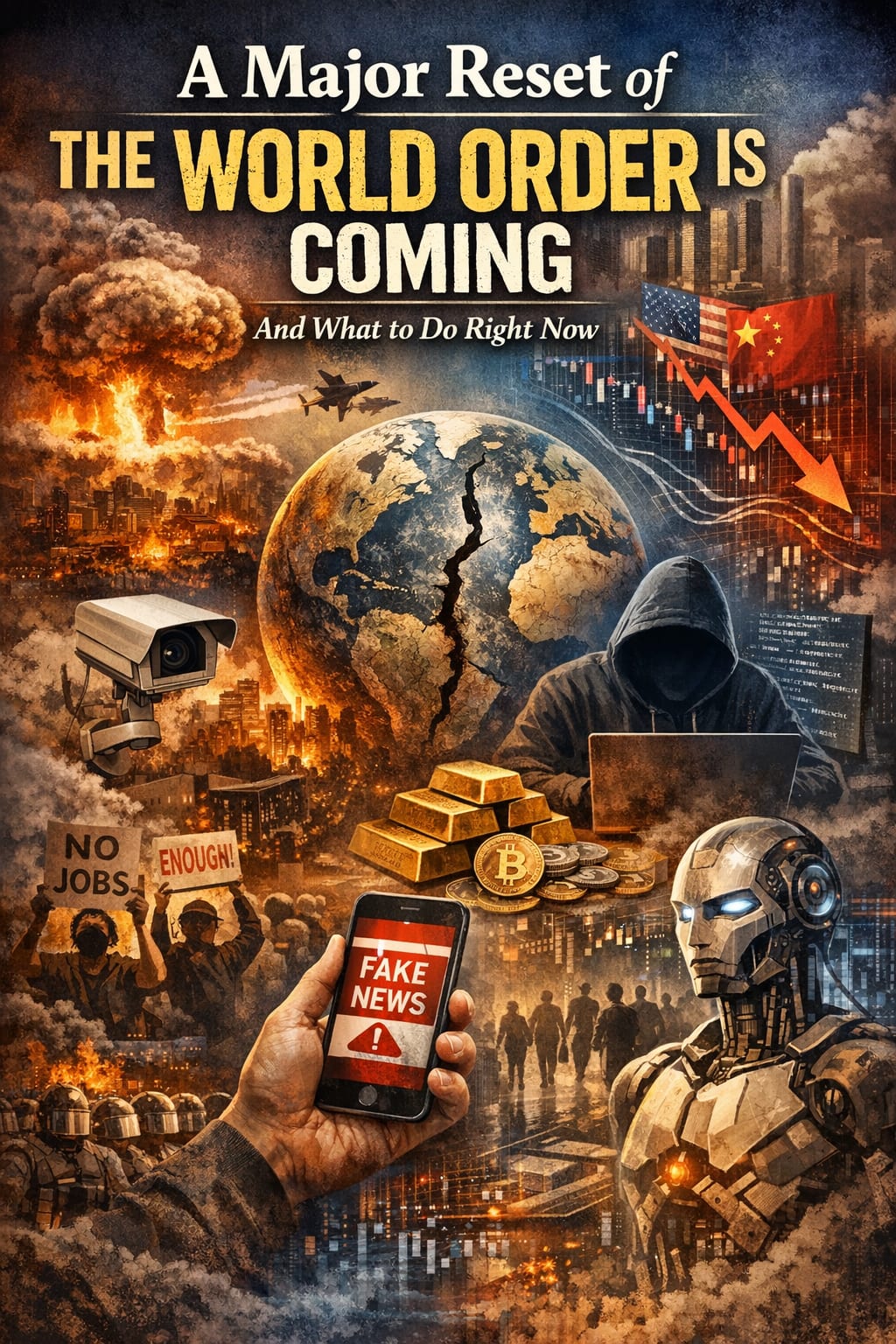
For decades, the world operated under a familiar system. A handful of powerful countries controlled global trade. The U.S. dollar dominated international finance. Major corporations shaped economies bigger than some nations. And most people believed the future would look more or less like the present—just with better technology. That assumption is beginning to collapse. Quietly, and then all at once, the foundations of the modern world order are shifting. Economies are fragmenting. Artificial intelligence is changing work faster than governments can react. Trust in institutions is falling. Wars, sanctions, cyberattacks, misinformation, climate disasters, and rising political instability are no longer isolated events. They are becoming part of everyday life. Many people feel it already. Something big is changing. Not necessarily tomorrow. Not necessarily through one dramatic event. But through a slow-motion transformation that is reshaping power, money, technology, and society itself. The question is no longer if a reset is happening. The real question is: How do ordinary people prepare for it?
The End of the “Stable Era” :
From the 1990s until the late 2010s, much of the world experienced a relatively stable global system. International trade expanded rapidly. The internet connected billions. Cheap manufacturing kept prices low. Information moved freely across borders. Even during crises, most people assumed the overall system would continue functioning. Now cracks are appearing everywhere. Countries are becoming more protective of their own economies. Supply chains are breaking apart. Nations are competing for energy, semiconductor chips, rare minerals, and technological dominance. Powerful alliances are weakening while new ones are forming. At the same time, ordinary people are facing rising living costs, job insecurity, and a constant flood of anxiety-inducing information. The world feels less predictable because it actually is less predictable. And history shows that periods like this often lead to major transformations.
Artificial Intelligence Will Accelerate Everything :
Every historical reset has been driven by technology. The printing press changed religion and politics. Industrial machines changed labor. The internet changed communication and business. Artificial intelligence may change all of them at once. AI is not just another app or gadget. It is a force multiplier. It can automate writing, coding, customer support, design, research, and even decision-making. Entire industries are being reshaped faster than schools, governments, and workers can adapt. Some people will become dramatically more productive. Others may find their skills suddenly outdated. That doesn’t mean humans become useless. But it does mean the value of adaptability is rising faster than ever before. The people who learn continuously, think independently, and use technology wisely may thrive. The people waiting for the world to “go back to normal” may struggle the most.
Money Is Changing Too :
For generations, people trusted that saving money, getting a stable job, and following traditional paths would guarantee security. That confidence is fading. Inflation has changed how people think about wealth. Housing is becoming unreachable for many young adults. Digital currencies and cashless systems are changing financial behavior. Even governments are experimenting with new forms of economic control and surveillance. Meanwhile, social media creates the illusion that everyone else is getting rich overnight. This combination creates fear, confusion, and emotional decision-making. During periods of uncertainty, people often chase extremes—panic investing, conspiracy theories, blind optimism, or complete hopelessness. But history suggests that the smartest strategy is usually simpler: . Build useful skills . Stay financially flexible . Avoid emotional decisions . Learn how systems work . Focus on long-term resilience instead of short-term hype
Information Is Now a Battlefield :
In the past, wars were fought mostly with weapons. Today, they are also fought with algorithms. Social media platforms compete for attention by amplifying outrage. False information spreads faster than truth. Deepfakes and AI-generated media are becoming harder to detect. Political narratives are engineered to manipulate emotions. Many people no longer know what to trust. This confusion is powerful because a population that is distracted, divided, and emotionally exhausted becomes easier to influence. That’s why one of the most valuable skills of the future may simply be the ability to think clearly. Not react instantly. Not believe everything. Not join every digital panic. Just think critically.
So What Should People Actually Do?
When people hear phrases like “world order reset,” they often imagine bunkers, collapse, or apocalyptic scenarios. But most historical resets are quieter than movies make them seem. The people who succeed are usually not the loudest or the richest. They are the most adaptable. Here are a few practical things that matter right now:
1. Learn Skills That Survive Change Communication, problem-solving, digital literacy, creativity, and emotional intelligence remain valuable even when industries shift.
2. Reduce Dependency The more dependent you are on a single platform, job, or system, the more vulnerable you become during disruption.
3. Protect Your Attention Your focus is becoming one of your most valuable assets. Endless scrolling weakens your ability to think deeply and act intentionally.
4. Build Real Relationships Strong communities and trustworthy people matter during uncertain times more than online popularity.
5. Stay Calm Fear spreads quickly during transitions. Calm people make better decisions.
The Future Is Not Fully Written :
Every generation believes it is living through unprecedented change. Sometimes that belief is exaggerated. But sometimes history truly does enter a turning point. This may be one of those moments. The old systems are being questioned. Technology is accelerating human society faster than our psychology can comfortably handle. Global power is shifting. And millions of people feel the instability, even if they cannot fully explain it. But uncertainty is not automatically doom. Periods of transformation also create opportunities for new ideas, new industries, new leaders, and new ways of living. The future will likely belong to people who stay informed without becoming consumed by fear. People who adapt without losing their humanity. And people who understand that in every major reset throughout history, one truth always remained the same: The world changes. And the people who learn how to change with it are the ones who survive — and eventually thrive.
About the Creator
Enjoyed the story? Support the Creator.
Subscribe for free to receive all their stories in your feed.
Comments
There are no comments for this story
Be the first to respond and start the conversation.