
A Complete Guide to EHR API Integration for Seamless Healthcare Data Exchange
EHR API integration
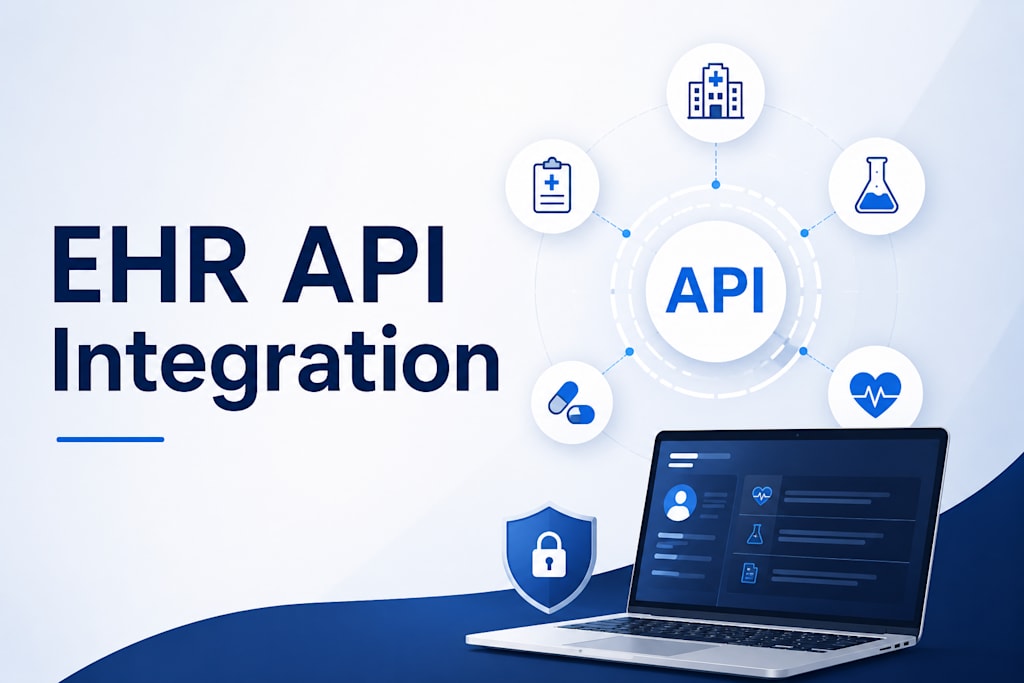
Healthcare has been a space of connection from the very beginning – connecting providers with patients, symptoms with diagnoses, and care teams with information. All of this has been stored in disjointed silos, however, for decades. One hospital has one, a clinic nearby has another and it's hardly ever the same language. This is where the EHR API integration comes into play.
It is no longer a choice for healthcare organizations to upgrade their infrastructure or for developers to develop a health tech product, understanding the workings of EHR APIs and how to implement them effectively is absolutely crucial.
What Is EHR API Integration, and Why Does It Matter?
An Electronic Health Record (EHR) is an electronic version of a patient's chart. It contains everything from medical history and diagnoses to prescriptions, lab results, immunizations and more. It is the method, or mechanism, for different software systems to communicate with each other and share this information securely, which is known as an API (Application Programming Interface).
At its core, EHR API integration involves linking an EHR system to other applications, platforms, or services to facilitate the smooth transfer of patient information between them. It's like creating a solid bridge between fragmented healthcare systems that provides the correct information to the appropriate parties at the correct time.
If you are looking to build or improve an EHR system from the ground up, it helps to understand what goes into modern EHR development before diving into the integration layer.
The benefits are not just operational. Better data exchange means fewer duplicate tests, reduced medical errors, faster clinical decisions, and ultimately, better patient outcomes. That is a strong case for any healthcare stakeholder to pay attention.
The Standards That Make It Possible
One of the biggest challenges in healthcare data exchange has historically been inconsistency. Different EHR vendors store and structure data in different ways, making communication between them incredibly difficult without a common framework.
Two standards have emerged as the backbone of modern EHR API integration:
HL7 FHIR (Fast Healthcare Interoperability Resources) is the most widely adopted standard today. Developed by Health Level Seven International, FHIR uses a RESTful API architecture and organizes health data into modular units called "resources", things like Patient, Medication, Observation, and Appointment. Because it is built on familiar web technologies, developers find it relatively approachable compared to older standards.
HL7 v2 and v3 are older messaging standards still in active use across many legacy systems. While FHIR is the future, many integrations still need to account for these formats, especially when working with older hospital systems.
Understanding which standard a target EHR supports is one of the first practical steps in any integration project.
Common Use Cases for EHR API Integration
One size doesn't fit all when it comes to EHR API integration. Depending on the problem, the implementation is quite different. Here are a few of the more common scenarios:
Accessibility and transfer of patient data. In the United States, for instance, with laws such as the 21st Century Cures Act, patients are able to use third-party applications to access their own health information. APIs do this without manual exportation or providers' involvement.
Telehealth platforms. To provide effective care, virtual care solutions must be able to access patient information in real-time, such as their medication lists and previous visit notes. With no API integration, clinicians operate without any foresight.
Clinical decision support. APIs provide real-time data from EHR systems to smart tools that warn providers of drug interactions, abnormal lab test results, or recommended care pathways.
Revenue cycle management. For billing systems, accurate and timely clinical data is essential to create clean claims. The seamless integration of APIs between EHRs and billing systems minimizes mistakes and accelerates reimbursement processes.
Population health management. But analytics platforms need to integrate data from multiple sources over a large patient population to detect trends, care gaps, and high-risk patients, which can't occur without a reliable data pipeline built on EHR APIs.
Key Challenges to Expect
No one would do any man justice who did not recognize the fact that integrating EHR APIs is no walk in the park. Fortunately, many of them can be readily managed if treated properly.
Vendor variability. Two different EHR systems might support FHIR, but they may have some different implementations. The endpoints, authentication, supported data type, and granularity of data are different by vendor, such as Epic, Cerner, Athenahealth, and others. Strong testing and comprehensive API documentation review is essential.
Security and compliance. In the US, any integration that involves patient data must adhere to HIPAA (and similar requirements in other regions). This includes Business Associate Agreements (BAAs) with any third-party services involved, audit logging, role-based access controls, and encrypted data transport. HIPAA's official guidance on health information technology is a useful reference point for compliance requirements.
Data quality & normalization. Despite having standards, the information that is recorded in EHRs can vary. The clinical terminology should be standardized via coding systems such as SNOMED CT, LOINC and ICD-10, but data in the real world is not so neat. Data validation and normalization logic frequently have to be included in integration layers.
Authentication and authorization. The majority of contemporary EHR APIs are based on OAuth 2.0, and SMART on FHIR has been adopted as a default for scoped access to health data. This can only be set up correctly if it is done carefully, particularly for applications that face patients.
Best Practices for a Successful Integration
A few principles consistently separate smooth EHR API integration projects from painful ones.
Start with a clear use case. Trying to integrate everything at once is a recipe for scope creep and delays. Define the specific clinical or operational workflow you are supporting and identify only the data elements you actually need.
Work closely with EHR vendor sandboxes. Most major EHR vendors offer developer sandboxes with test data environments. Use them extensively before touching production systems. Organizations looking for deeper technical insight into real-world FHIR implementations can reference resources from HL7 International, which maintains comprehensive documentation on the standard.
Plan for versioning. FHIR has gone through multiple versions (DSTU2, STU3, R4, R5), and not all EHR vendors are on the same version. Your integration architecture should be built to handle version differences gracefully.
Monitor and log everything. Given the sensitivity of health data, comprehensive logging is both a compliance requirement and a practical necessity for debugging and auditing.
The Road Ahead
Even though healthcare interoperability has advanced significantly, more has to be done. More and more EHR vendors are making APIs available and with the pressure on data sharing, this is an opportunity for both developers and healthcare organizations to continue to expand.
Incorporating EHR API is not a mere technical project. It's a healthcare improvement initiative. But, done well, it increases the information available to providers, increases patient empowerment, and increases efficiency of the system. It's the foundations that are right and the standards, the security, the clarity of the use case that sets the stage for everything that comes after.
Whether you're just beginning or considering expanding an integration, it is well worth the investment to do it right.
About the Creator
Enjoyed the story? Support the Creator.
Subscribe for free to receive all their stories in your feed.
Comments
There are no comments for this story
Be the first to respond and start the conversation.