
7 Production-Tested LangGraph Alternatives for AI Agent Orchestration
Why engineering teams are moving away from LangGraph and how CrewAI, Agno, PydanticAI, AutoGen, and others perform under real production benchmarks.
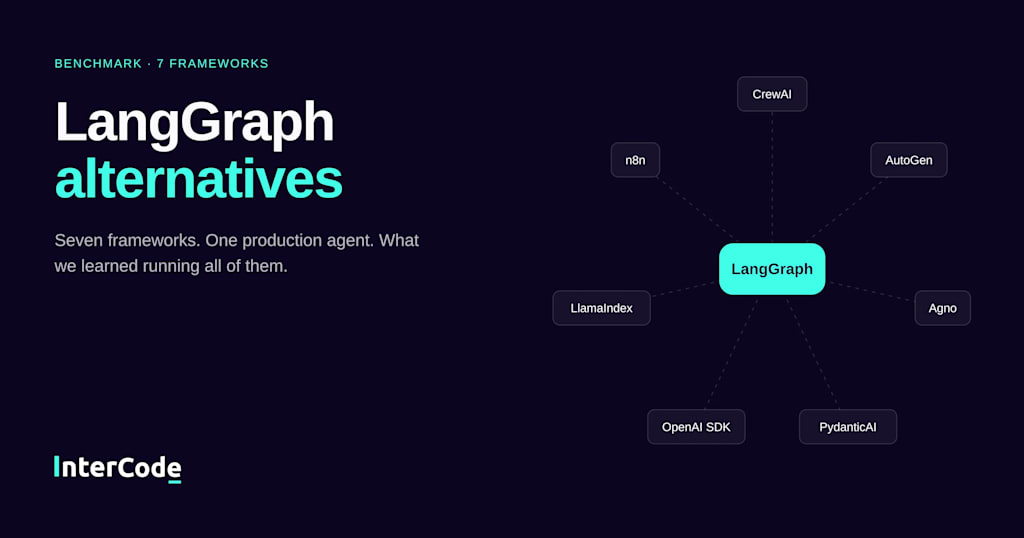
Evaluating viable alternatives to LangGraph requires testing runtime behavior under real production conditions rather than relying on basic local prototypes. To determine whether alternative agent orchestration frameworks perform better in high-throughput environments, we conducted comprehensive empirical benchmarks across CrewAI, AutoGen, Agno, PydanticAI, OpenAI Agents SDK, LlamaIndex Workflows, and n8n.
Our benchmark results revealed a clear operational pattern: engineering teams building transactional, high-concurrency agent pipelines gain substantial advantages in latency, token economy, and developer ergonomics by migrating to lighter, schema-driven alternatives. When evaluating agent frameworks, we generally recommend reserving LangGraph strictly for complex, cyclic state machines that demand durable multi-turn persistence.
Why Engineering Teams Leave LangGraph: Key Production Failure Modes
To understand why teams migrate away from LangGraph, it helps to review its underlying architecture. LangGraph models agent control flow as cyclical, directed graphs, coordinating state transitions across nodes and edges using a centralized persistence layer. While theoretically sound, operating this directed graph abstraction at scale introduces operational failure modes:
State Explosion & Serialization Bottlenecks: LangGraph accumulates state inside a global schema, passing complete conversation histories, scratchpads, and tool payloads between every node invocation. In high-volume systems, intermediate JSON payloads compound inside shared memory, leading to rapid context bloat, increased garbage collection overhead, and unexpected context window truncation.
Complex Distributed Debugging: When an agent encounters an error during execution, standard Python tracebacks decouple because the fault originates within the underlying Pregel graph engine rather than user-level code. Diagnosing whether a failure stems from an edge routing condition, an unhandled tool schema, or an invalid state update requires traversing multiple internal abstraction layers.
Database Checkpointing Overhead: LangGraph persists snapshots after node executions to support state restoration and human-in-the-loop workflows. When handling concurrent production traffic across relational databases such as PostgreSQL, serializing expansive state dictionaries creates connection pool exhaustion and elevated I/O wait times. Sub-second inference calls degrade into multi-second latency spikes as checkpointers compete for disk writes.
Upstream Maintenance Churn: Ongoing maintenance is complicated by dependency churn across the broader LangChain ecosystem. Upstream updates routinely alter tool-binding signatures and deprecate core helpers, forcing engineering teams to rewrite working graph topologies simply to maintain compatibility with minor library revisions.
LangChain vs LangGraph: Architectural Boundaries
A persistent misunderstanding in the AI community surrounds where linear abstractions end and stateful graph coordination begins.
LangChain was architected primarily around Directed Acyclic Graph (DAG) pipelines using LCEL (LangChain Expression Language), where data flows deterministically forward: from prompt templates to language models and output parsers. This design excels at linear extraction and basic Retrieval-Augmented Generation (RAG).
In contrast, LangGraph handles cyclical control flow and mutable state. Linear chains cannot natively represent true agentic behavior where a model must evaluate its own outputs, self-correct errors, and loop until a completion condition is met. LangGraph addresses this by treating workflows as cyclic finite state machines. However, refactoring simple multi-step APIs into full LangGraph topologies often introduces heavy boilerplate without providing tangible reliability benefits.
Benchmark Analysis: 7 Measured LangGraph Alternatives
To evaluate each framework under standardized conditions, we implemented a production-grade customer support remediation agent tasked with parsing ambiguous user inputs, querying backend APIs, calculating SLA delay compensations, and returning structured JSON payloads.
All tests executed OpenAI's gpt-4o at a fixed temperature of 0.0 inside containerized Linux environments (AWS c6i.2xlarge instances with 8 vCPUs and 16 GB RAM) across 100 automated iterations per framework.
The spread between frameworks was wide. Agno, PydanticAI, and the OpenAI Agents SDK all finished with sub-2-second median latency and a 0% failure rate across the 100 runs. LangGraph landed in the middle at roughly 2.4 seconds median latency with a 2% failure rate. CrewAI and AutoGen trailed furthest behind, with median latencies near 3.6–3.9 seconds, token costs more than double the lightweight frameworks, and failure rates between 5–7% - mostly from conversational loops that didn't terminate cleanly.
Agno (formerly Phidata): Agno demonstrated exceptional efficiency by bypassing graph abstractions and conversational overhead in favor of direct execution loops. Tool schemas compile cleanly into native API formats without extra prompt wrapper instructions, keeping token costs low and execution speed high.
PydanticAI: Maintained by the core Pydantic team, PydanticAI brings strict software engineering rigor and typing validation directly to LLM orchestration. It validates inputs, runtime dependencies, and tool outputs against standard models, catching schema mismatches early and prompting the model to self-correct automatically.
OpenAI Agents SDK: Registered the lowest median latency and token consumption in our benchmark. Its architecture relies on a lean execution runner that handles tool invocations and agent handoffs without injecting background prompt bloat.
CrewAI: Coordinates agents using intuitive human organizational roles, goals, and backstories. While excellent for rapid prototyping and synthetic research, injecting persona prompts into every call creates noticeable token overhead in latency-critical transactional systems.
AutoGen: Microsoft's multi-agent framework structures coordination as multi-turn conversations between autonomous agents. It offers strong flexibility for open-ended problem solving, but using conversational loops as a backend driver can introduce non-deterministic looping or termination failures.
LlamaIndex Workflows: Replaces graph abstractions with an asynchronous, event-driven orchestration architecture. Steps are decoupled through event emission and subscription, making it ideal for systems integrating complex document retrieval and vector store pipelines.
n8n: Combines visual node execution with low-code automation, enabling operational teams to inspect execution runs and adjust prompts visually.
Production Infrastructure Beyond Framework Abstractions
Choosing an orchestration library solves only the internal execution loop. Deploying autonomous agents in enterprise production requires an external operational layer to guarantee system resilience, cost control, and security:
Resiliency & Dynamic Gateway Routing: LLM endpoints routinely experience transient rate limits (HTTP 429) or timeouts (HTTP 504). Production architectures must implement exponential backoff with randomized jitter and route requests through an AI gateway capable of automatic fallback (e.g., failing over from OpenAI to Anthropic or Google Cloud).
OpenTelemetry Observability: Standard logs cannot capture non-deterministic agent executions. Production systems require distributed tracing across prompt assembly, model latency, tool execution, and state persistence. Building these observability guardrails early is a core principle of the modern agentic SDLC.
Token Circuit Breakers: Autonomous agents can enter infinite tool loops if instructions are ambiguous. Runtimes must enforce strict token and cost budgets at the session and tenant levels, triggering circuit breakers when limits are breached to prevent unexpected cloud bills.
When Should You Stay on LangGraph?
Despite the latency and memory benefits of lighter alternatives, LangGraph remains a solid enterprise option for specific requirements:
Non-Linear Cyclical Graphs: Such as code verification loops that evaluate outputs, return execution to developer nodes, and merge parallel gates through synchronized join nodes.
State Replay & Time-Travel Debugging: Its immutable snapshot persistence provides auditing value for heavily regulated industries like finance, healthcare, and legal compliance.
Long-Running Human-In-The-Loop Workflows: Processes extending over days that wait for external approvals and must survive server restarts recover state seamlessly from storage.
About the Creator
InterCode
InterCode is an AI-first B2B software development boutique for SMBs, focused on agentic engineering. We build AI agents, SaaS, cloud & DevOps solutions. Our team consists of CCAR-F Claude Certified Architects by Anthropic. intercode.com
Enjoyed the story? Support the Creator.
Subscribe for free to receive all their stories in your feed.
Comments
There are no comments for this story
Be the first to respond and start the conversation.