
6G Market Gains Momentum Amid Rising Smart Connectivity Demand
How AI-driven connectivity, ultra-low latency, and intelligent automation are transforming communication infrastructure and accelerating innovation across the global 6G market

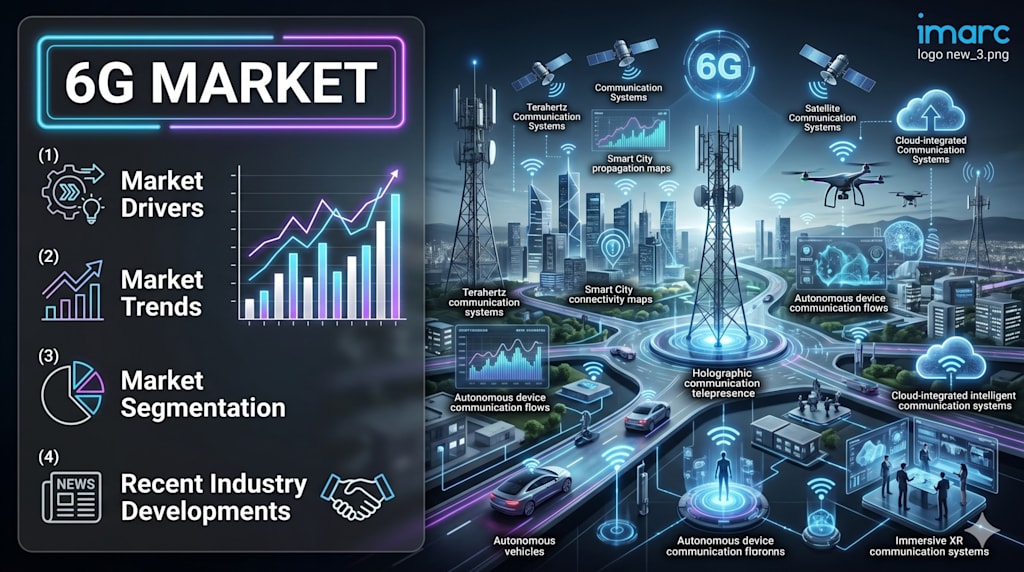
According to IMARC Group's latest research publication, The global 6G market size was valued at USD 450.4 Million in 2025. Looking forward, IMARC Group estimates the market to reach USD 31,524.7 Million by 2034, exhibiting a CAGR of 58.52% from 2026-2034.
How 6G is Reshaping the Future of Global Connectivity
- AI-Native Network Intelligence and Adaptive Management: 6G is being designed from the ground up as an AI-native infrastructure, with machine learning embedded directly into the network fabric to enable self-optimizing operations that respond in real time to traffic patterns, device behavior, and load conditions. In February 2024, SK Telecom and Intel jointly developed Inline Service Mesh technology using Intel Xeon processors with built-in AI capabilities, reducing latency between core network components by up to 70% without requiring proxies. This represents a foundational departure from earlier network generations where AI was retrofitted as an optional layer. As 6G moves toward commercial standardization, AI-native design will allow networks to autonomously manage billions of simultaneously connected devices, allocate spectrum dynamically, and self-heal under load, capabilities that are simply not achievable through conventional network management approaches at the data volumes 6G is expected to handle.
- Terahertz Frequencies and Ultra-High-Speed Data Transmission: 6G is engineered to operate in terahertz frequency bands, enabling data speeds projected to exceed 5G performance by a factor of 100 or more, unlocking applications that are physically impossible on current networks. Real-time holographic communication, 8K immersive streaming, zero-lag industrial automation, and surgical-precision remote telemedicine all depend on the bandwidth and latency profiles that terahertz infrastructure can deliver. Hardware is expected to dominate the component segment precisely because terahertz transmitters, energy-efficient chips, advanced antenna systems, next-generation base stations, and compatible edge devices all require substantial new physical infrastructure investment. The demand for this specialized hardware is already driving parallel spending across the semiconductor and telecom equipment sectors, making hardware the largest single cost layer in any national or commercial 6G deployment strategy ahead of software and services.
- Government Standardization Initiatives and Multilateral R&D Partnerships: Governments across major economies are treating 6G as a matter of strategic national interest, funding dedicated research programs, shaping international standards, and building multilateral alliances to influence the technology's global architecture ahead of commercial deployment. In September 2024, China introduced three critical 6G technology standards through the International Telecommunication Union covering immersive communication, ultra-reliable low-latency performance, and AI network integration aligned with the ITU's International Mobile Telecommunications 2030 framework. In February 2024, Canada formally joined the United States, Australia, Japan, South Korea, the United Kingdom, Finland, France, Sweden, and the Czech Republic in endorsing a Joint Statement of Principles for 6G built around open, interoperable, and secure connectivity. In April 2024, the US National Science Foundation and Sweden's Vinnova signed a bilateral agreement to jointly advance 6G research and create commercial pathways for companies in both countries.
- Smart City Infrastructure and Industrial Automation Applications: The core value proposition of 6G extends well beyond consumer mobile broadband into industrial verticals where ultra-reliable, low-latency connectivity at massive scale is a hard operational requirement. Manufacturing, autonomous transportation, healthcare, energy management, and smart city platforms all require networks capable of handling enormous simultaneous data flows with near-zero latency, the operating envelope 6G is specifically engineered to serve. In April 2024, the UAE's Telecommunications and Digital Government Regulatory Authority launched a comprehensive national 6G strategy targeting a full transition by 2030, building on the country's existing 5G and advanced 5.5G deployment infrastructure. Saudi Arabia's Vision 2030 similarly identifies next-generation network development as a critical enabler for smart city buildout and industrial digitization, positioning the Middle East as a significant and growing theater for 6G investment alongside more established corridors in Asia Pacific and North America.
- Energy-Efficient Network Design and Sustainable Infrastructure: Delivering dramatically higher performance without a proportional increase in energy consumption is one of the defining engineering challenges of the 6G era, and sustainability has moved from a secondary concern to a primary design criterion in how the industry is approaching standardization and deployment planning. Software-defined networking and network function virtualization are central to addressing this challenge, enabling operators to dynamically allocate resources and minimize idle-state power draw across large distributed infrastructure footprints. In October 2024, the EU-backed Smart Networks and Services Joint Undertaking selected Nokia to coordinate the Sustain-6G lighthouse project under the Horizon Europe program, a research initiative specifically focused on sustainable 6G network architecture as part of Europe's broader strategy to establish industrial leadership in next-generation telecommunications while meeting the bloc's climate and energy efficiency commitments.
6G Industry Overview:
The global 6G market is still in its pre-commercial research and standardization phase, but the scale of institutional investment and the pace of government-led activity make it one of the most consequential technology buildouts taking shape today. Asia Pacific holds the dominant regional position anchored by China, Japan, South Korea, and India, all of which have active national 6G programs, dedicated spectrum research initiatives, and close public-private collaboration between national carriers and global technology firms. China Mobile's announcement in February 2024 of the world's first 6G satellites demonstrated that leading nations are not waiting for full terrestrial standardization before beginning real-world testing, compressing the timeline between research and deployment in ways that are already influencing how other countries structure their own programs. The 3GPP is set to commence formal 6G standardization work in 2025 following the release of the ITU-R 6G vision framework, with the broader standards community aligned around a commercial deployment window spanning 2030 to 2040. This means investment decisions being made today in spectrum licensing, hardware R&D, and infrastructure architecture will define the competitive landscape for at least the next fifteen years. In October 2024, Samsung Electronics and NTT DOCOMO announced a joint research partnership to advance AI integration in next-generation mobile networks, with both companies targeting improvements in network quality and operational efficiency as a technical foundation for the 6G transition. In November 2024, Ericsson and e& UAE signed a Memorandum of Understanding to jointly explore key 6G concepts and network architecture, marking one of the region's earliest formal commitments to next-generation connectivity development.
6G Market Trends and Drivers
The transition from 5G to 6G is not an incremental network upgrade but a structural reimagining of how global connectivity infrastructure is built, owned, and operated. The proliferation of IoT devices, the spread of autonomous systems across industry verticals, and the growing reliance on real-time data for mission-critical applications are collectively creating demand that 5G networks will not be able to satisfy at scale. This demand gap is the primary commercial rationale driving the pace of 6G research and investment today, well ahead of any commercial deployment timeline, and it explains why governments, carriers, and technology companies are committing resources now rather than waiting for standards to fully crystallize. Further-Enhanced Mobile Broadband represents the largest usage scenario segment because it directly supports the data-intensive applications that consumers and enterprises are already building toward, including 8K video, holographic communication, immersive AR and VR, and real-time cloud gaming. These are not speculative future use cases but the logical next step of behaviors and business models already visible in the 5G ecosystem, and the infrastructure required to support them at mass-market scale is precisely what 6G is designed to deliver.
The consumer segment leads among end-user categories, driven by the proliferation of smartphones, wearable devices, and smart home systems among digitally active populations across all major regions. At the same time, enterprise applications in manufacturing, healthcare, automotive, aerospace, and media and entertainment are generating institutional demand for 6G capabilities that will shape how operators structure service offerings and prioritize deployment once commercial rollouts begin. The competitive landscape is concentrated among a relatively small group of global technology leaders. Huawei, Nokia, Ericsson, Samsung, Intel, and Qualcomm dominate hardware and software development, while national carriers like NTT DOCOMO, SK Telecom, and KT Corporation are driving use-case development and active standards participation in their respective markets. In August 2024, KT and LG Electronics announced a collaboration focused specifically on wideband full-duplex communication technology targeting potential 6G frequency bands, including performance validation work that feeds directly into the standardization process. In July 2024, the Horizon Europe-funded 6G-SANDBOX project signed an MoU with Universiti Malaya to extend global cooperation on 6G network innovation, its second major Asian partnership, reflecting a deliberate strategy to build international standards coalitions well ahead of commercial deployment.
Latin America is emerging as a growing market for 6G as governments in Brazil, Mexico, and Argentina invest in expanding telecommunications infrastructure to bridge digital divides and support rapid urbanization. The region's growing IoT adoption and the push for smart applications in agriculture, healthcare, and transportation are creating structural demand for the high-capacity, low-latency connectivity that 6G will deliver. In Europe, the Horizon Europe program provides structured funding for 6G R&D and open testbed development, positioning the continent as a collaborative hub for standards work and sustainable network innovation. Across all regions, the common thread is that 6G investment today is fundamentally about positioning, with nations, carriers, and technology companies racing to shape the standards, own the patents, build the supplier relationships, and develop the talent pools that will determine who leads the next era of global connectivity.
Leading Companies Operating in the Global 6G Industry:
- AT&T Intellectual Property
- Huawei Technologies Co., Ltd.
- Intel Corporation
- Jio Platforms Ltd
- Keysight Technologies
- Nokia Corporation
- NTT Docomo
- Samsung Electronics Co., Ltd.
- Telefonaktiebolaget LM Ericsson
6G Market Report Segmentation:
By Component:
- Hardware
- Software
- Services
Hardware is expected to dominate the market as advanced infrastructure including terahertz transmitters, energy-efficient chips, and antenna systems is essential for enabling high-speed, low-latency 6G networks. The scale of investment required to build out base stations, edge devices, and compatible user equipment makes hardware the foundational spending layer across the entire 6G ecosystem.
By Communication Infrastructure:
- Wireless
- Fixed
Wireless holds the largest share owing to its versatility and ability to support a broad range of mobility-dependent applications across IoT, autonomous vehicles, and immersive technologies. Fixed networks serve as the critical backbone connecting base stations and edge infrastructure, ensuring the scalability and capacity needed to handle massive data volumes generated by 6G-connected systems.
By Usage Scenario:
- Further-Enhanced Mobile Broadband (FeMBB)
- Extremely Reliable, Low Latency Communications (ERLLC)
- Long-Distance and High-Mobility Communications (LDHMC)
- Ultra-Massive Machine Type Communications (umMTC)
- Extremely Low-Power Communications (ELPC)
FeMBB holds the largest share among usage scenarios, supporting data-intensive applications such as 8K video streaming, holographic communication, immersive AR and VR experiences, and real-time cloud gaming. Its high-speed, high-bandwidth profile makes it the foundational pillar driving early adoption and investment across both consumer and enterprise segments.
By End User:
Consumers
Enterprises (Manufacturing, Healthcare and Life Sciences, Automotive, Media and Entertainment, Aerospace and Defense, Energy and Utilities, Others)
Government
The consumer segment holds the largest share, driven by growing demand for high-speed connectivity supporting immersive experiences, smart home devices, wearables, and next-generation mobile applications. Enterprise adoption across manufacturing, healthcare, and automotive verticals is accelerating, particularly for applications requiring ultra-reliable, low-latency connectivity at industrial scale.
Regional Insights:
- North America (United States, Canada)
- Asia Pacific (China, Japan, India, South Korea, Australia, Indonesia, Others)
- Europe (Germany, France, United Kingdom, Italy, Spain, Others)
- Latin America (Brazil, Mexico, Others)
- Middle East and Africa
Asia Pacific dominates the global 6G market, supported by large-scale government R&D programs, a dense base of technology manufacturers and carriers, and accelerating urbanization creating structural demand for smart city and industrial automation connectivity across the region's major economies.
Recent News and Developments in the 6G Market
- August 2024: The United States government announced a research partnership with Sweden to advance joint work on 6G and next-generation technologies, covering interoperability standards, industry best practices, and the economic and environmental impacts of advanced wireless networks through coordinated efforts between research institutions, universities, and companies in both countries.
- July 2024: The Horizon Europe-funded 6G-SANDBOX project signed an MoU with Universiti Malaya to advance 6G network innovation research. This represented the project's second major partnership with an Asian institution, reflecting a deliberate strategy to build global research coalitions ahead of formal commercial standardization.
- February 2024: China Mobile announced the launch of the world's first 6G satellites, marking a significant milestone in China's advancement of next-generation communication technologies and demonstrating active real-world testing well ahead of the anticipated commercial deployment window beginning around 2030.
Note: If you require specific details, data, or insights that are not currently included in the scope of this report, we are happy to accommodate your request. As part of our customization service, we will gather and provide the additional information you need, tailored to your specific requirements. Please let us know your exact needs, and we will ensure the report is updated accordingly to meet your expectations.
About the Creator
Abhay Rajput
I am working in market research company that provides market and business research intelligence across the globe.
Enjoyed the story? Support the Creator.
Subscribe for free to receive all their stories in your feed.
Comments
There are no comments for this story
Be the first to respond and start the conversation.