
3D Printing Service Complete Guide for Fast and Flexible Manufacturing
Smart Manufacturing Solutions for Fast Prototyping, Custom Parts, and Reliable Production

Introduction
Today’s manufacturing world is changing quickly. Companies no longer want to wait weeks for prototypes or pay high costs for small production runs. Because of this, 3D printing has become a practical solution for many industries.
A 3D printing process allows businesses to turn digital ideas into real physical parts in a much shorter time. It is now commonly used for prototypes, custom parts, and small production needs where traditional manufacturing feels slow or expensive.
Many designers and engineers also use 3D Modeling Services to prepare or refine digital files before printing. This helps reduce design errors and improves the final output.
What makes this technology useful is its flexibility. Instead of cutting material away like traditional methods, it builds objects layer by layer. This reduces waste and allows more freedom in design.
What Is a 3D Printing Service?
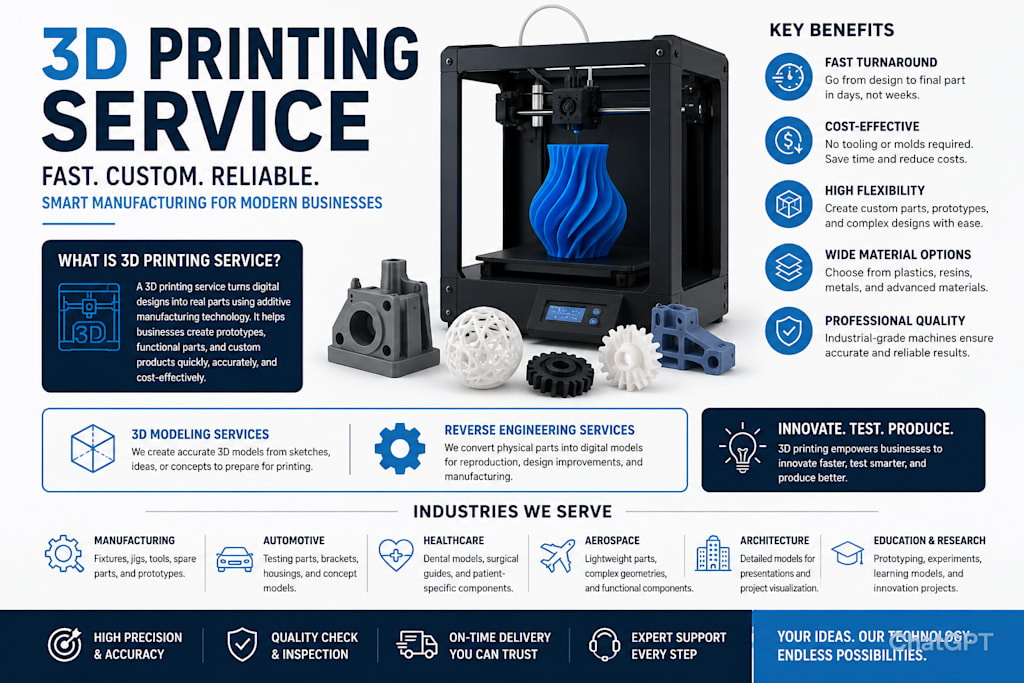
A 3D printing service is simply a process where a digital file is turned into a physical object using special machines.
Most designs start in CAD software and are then converted into a printable format. After that, the machine builds the object step by step using materials like plastic, resin, nylon, or sometimes metal.
Unlike traditional production methods, this approach does not require heavy tooling or molds. That’s why it is often used for small batches, testing, and custom parts.
In many cases, services also offer help with file preparation and adjustments. Some even provide Reverse Engineering Services, where an existing part is recreated into a usable digital model.
Why Companies Use 3D Printing
One of the main reasons businesses prefer 3D printing is speed. A part that might take weeks through traditional methods can often be made in a few days.
It is also useful for testing ideas early. Instead of investing heavily in production, companies can first create a sample, test it, and make changes if needed.
Startups especially find this helpful because it reduces risk. They can experiment more freely without large manufacturing costs.
Another advantage is customization. Every project does not need to look the same. Designs can be changed easily without starting the process from scratch.
Where 3D Printing Is Used
This technology is now used across many industries.
In manufacturing, it is used for tools, fixtures, and replacement parts.
In automotive work, it helps with testing components and designing prototypes.
In healthcare, it supports custom models and medical tools.
Architecture firms use it for building models and presentations.
Even education and research fields use it for experiments and learning projects.
The main reason it is so widely used is because it adapts to different needs without major changes in setup.
Benefits of Using This Technology
One of the biggest benefits is reduced time. Projects move faster from idea to physical form.
It also helps lower development cost because there is no need for expensive molds or tooling at early stages.
Another benefit is design freedom. Complex shapes that are difficult with traditional methods can often be created easily with 3D printing.
It also supports small quantity production, which is useful when only a few pieces are needed instead of mass production.
Things to Consider Before Choosing a Provider
Not all providers are the same, so it helps to look at a few things before starting a project.
Experience matters because it affects how well the file is handled and printed. Material options are also important because different projects need different strength and flexibility.
Turnaround time is another key factor, especially for urgent projects. Support during file checking can also prevent mistakes before printing begins.
Instead of focusing only on price, it is better to look at overall reliability and quality.
Frequently Asked Questions
How much does 3D printing cost?
The cost depends on size, material, and design complexity. Small parts are usually affordable, while larger or detailed parts cost more.
How long does it take?
Small prints can be ready in hours, while larger ones may take a few days depending on finishing and workload.
Is it strong enough for real use?
Yes, many printed parts are strong enough for real applications when the right material is used.
Can I order just one part?
Yes, one of the main advantages is the ability to produce single custom parts without minimum order requirements.
What file format is needed?
Most services accept STL, STEP, IGES, and OBJ files. These formats are standard for 3D printing.
Final Thoughts
3D printing has become an important part of modern manufacturing. It helps reduce time, improve flexibility, and lower early production costs.
For businesses, it offers a simple way to test ideas and produce custom parts without heavy investment. As the technology continues to improve, its use will only grow across more industries.
About the Creator
Katrina Pierce
Katrina Pierce started Avenue 27 (DBA Shea Nexus), which focuses on sourcing and exporting high-quality refined and unrefined shea butter from verified West African producers to UK distributors and manufacturers.
Enjoyed the story? Support the Creator.
Subscribe for free to receive all their stories in your feed.
Comments
There are no comments for this story
Be the first to respond and start the conversation.