
12 Mobile App Development Companies Contributing to Digital Innovation in London, UK in 2026
Exploring How Different Development Teams in London Are Approaching Modern Mobile Experiences

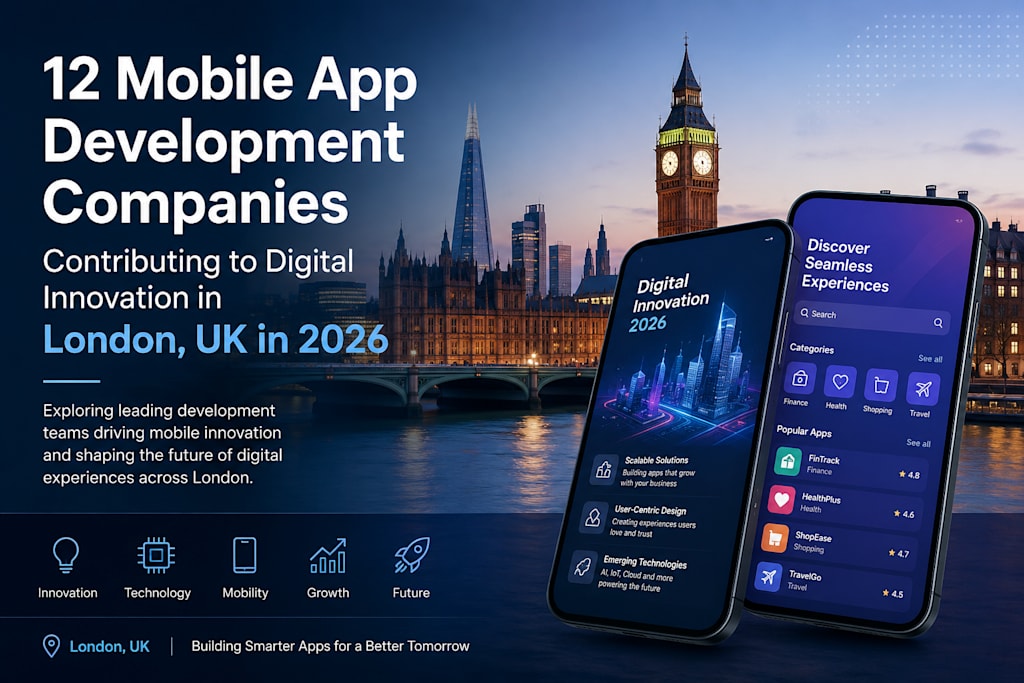
London, UK continues to be one of Europe’s most active technology ecosystems, with mobile applications playing an increasingly important role in how businesses interact with users, manage services, and deliver digital experiences.
Over the past few years, mobile applications have evolved beyond simple functionality. Businesses are now paying closer attention to usability, responsiveness, scalability, and long-term engagement. Interestingly, this shift is also influencing how different mobile app development companies approach product design and digital innovation.
Some development teams focus more heavily on enterprise scalability, while others prioritise behavioural simplicity, startup adaptability, or AI-driven experiences. Rather than comparing companies directly, this article looks at a range of development teams contributing to London’s evolving mobile ecosystem in 2026.
1. Apptunix UK
Apptunix UK is often associated with scalable and user-focused digital products. Among the growing mobile app development companies in London, UK, their approach reflects the increasing demand for mobile experiences that balance functionality, adaptability, and smoother user interaction.
2. Miquido
Miquido focuses on AI-driven applications and product-focused mobile experiences. Their work reflects how behavioural personalisation and automation are becoming more integrated into modern applications.
3. Hedgehog Lab
Hedgehog Lab combines strategy, design, and development with a strong emphasis on long-term usability. Their development style highlights the growing preference for experience-driven applications rather than feature-heavy systems.
Why User Experience Has Become More Important
One noticeable shift in recent years is how quickly users lose interest in applications that feel slow, cluttered, or difficult to navigate.
Many users now expect:
faster interactions,
cleaner interfaces,
and smoother navigation.
Applications that create unnecessary friction often struggle with long-term engagement, regardless of how advanced the technology may be.
Because of this, many development teams in London are increasingly prioritising simplicity and behavioural usability.
4. Fueled
Fueled focuses on visually refined applications that combine branding with digital interaction. Their work reflects the growing overlap between product design and customer engagement.
5. Waracle
Waracle works on enterprise-oriented applications across industries such as healthcare and fintech. Their development approach reflects the increasing importance of scalability, compliance, and infrastructure stability.
6. Sonin App Development
Sonin focuses on business-oriented applications designed to improve workflows and operational efficiency. Their work highlights how mobile applications are increasingly being used beyond customer-facing interactions.
The Shift Toward AI-Driven Applications
Artificial intelligence is becoming more integrated into everyday app experiences.
Many modern applications now use AI systems to:
personalise recommendations,
automate interactions,
and simplify navigation.
Interestingly, users often notice the experience more than the technology itself. What matters most is whether the app feels smooth, responsive, and intuitive.
This subtle shift is influencing how many development teams structure modern applications.
7. Zudu
Zudu focuses on custom applications for startups and growing businesses. Their development style reflects the increasing demand for adaptable and agile product development.
8. Tapptitude
Tapptitude works closely with startup-focused products and MVP-driven platforms. Their approach reflects how iterative product development and adaptability continue to shape mobile innovation.
9. IIH Global
IIH Global focuses on practical and scalable mobile solutions. Their work reflects the broader movement toward streamlined digital experiences without unnecessary complexity.
Why Simpler Interfaces Often Perform Better
Another noticeable trend is the growing preference for cleaner and less cluttered applications.
Apps filled with:
excessive menus,
overwhelming layouts,
or too many interactions
can quickly create fatigue.
Meanwhile, simpler interfaces often:
improve usability,
reduce frustration,
and encourage longer engagement.
This is one reason many modern mobile applications now feel more minimal compared to older app designs.
10. The Distance
The Distance focuses on enterprise applications and secure digital experiences. Their work reflects the increasing role of mobile systems in operational efficiency and long-term maintainability.
11. Magora Systems
Magora Systems develops applications centred around scalability and digital adaptability. Their approach reflects how long-term usability is becoming more important in modern app ecosystems.
12. Digiryte
Digiryte works on scalable SaaS products and MVP-focused applications. Their agile development approach reflects the growing preference for flexible and continuously evolving digital products.
How Mobile Behaviour Continues to Evolve
Mobile behaviour itself has changed significantly in recent years.
Users now:
browse in shorter sessions,
switch between apps quickly,
and expect instant responsiveness throughout the day.
Because of this, many applications are increasingly designed around convenience, responsiveness, and behavioural simplicity rather than static functionality alone.
This shift continues to influence how development teams approach performance optimisation and user interaction.
Trust and Simplicity Are Becoming Closely Connected
Trust has also become a major part of digital interaction.
Users increasingly pay attention to:
transparency,
privacy,
and overall reliability.
Applications that feel intrusive or confusing often struggle with long-term engagement, even if the design appears modern.
Because of this, many modern development approaches now treat usability and trust as closely connected parts of the same experience.
Final Thoughts
The mobile app ecosystem in London, UK continues to evolve alongside changing digital behaviour and user expectations. The companies mentioned above reflect different approaches to how modern applications are being designed, simplified, and adapted in 2026.
What stands out most today is not necessarily how advanced an app appears, but how naturally it fits into everyday interaction and usability.
About the Creator
Apptunix usa
Discover the elite mobile app developers in New York who are setting new standards in innovation and technology.
Enjoyed the story? Support the Creator.
Subscribe for free to receive all their stories in your feed.
Comments
There are no comments for this story
Be the first to respond and start the conversation.