
10 Software Development Companies in the USA Worth Considering in 2026
Companies That Fit Real Business Needs, Not Just Rankings
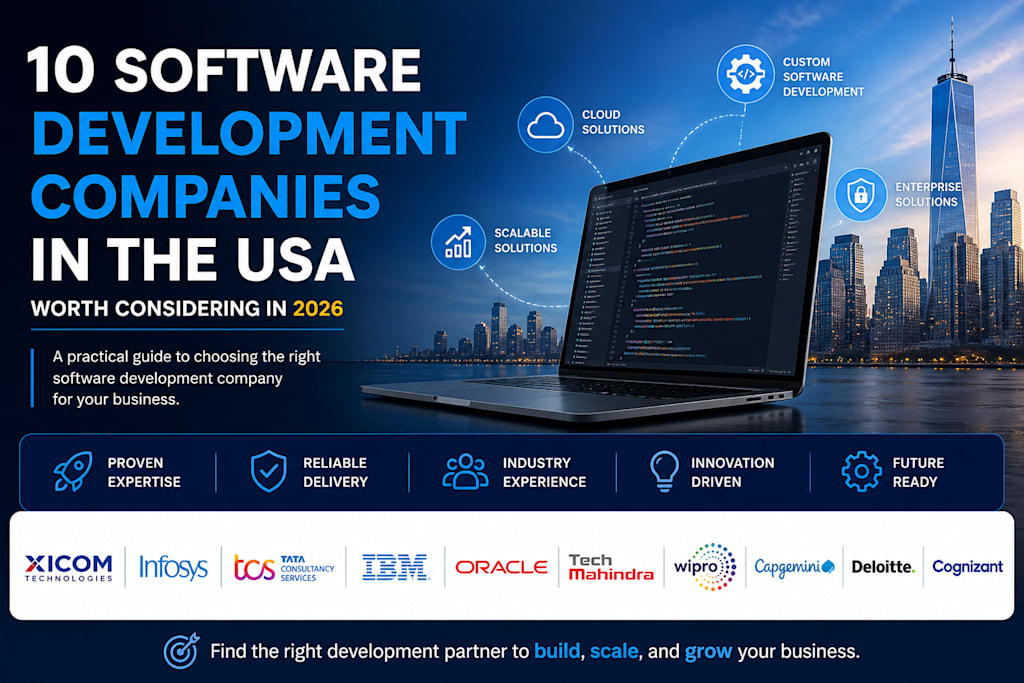
Finding the right software development company in the United States sounds simple—until you actually start researching.
Almost every company claims to deliver “scalable,” “innovative,” and “high-quality” solutions. But once you look beyond the surface, the differences become clear. Some companies move fast but struggle with complexity, while others build robust systems but take longer to deliver.
While researching software vendors, I noticed that most lists focus on rankings instead of fit. And that’s where many businesses go wrong.
This list doesn’t rank companies blindly. Instead, it highlights where each company fits best, based on how they typically operate and the kind of projects they handle.
What I Considered Before Shortlisting
To make this useful, I focused on a few practical factors:
- Type of projects they usually handle (startup vs enterprise)
- Balance between speed and scalability
- Technology strengths (cloud, AI, enterprise systems)
- Real-world usability rather than just brand value
1. Xicom Technologies
Among the companies considered, Xicom stands out as a software development company that fits the needs of a wide range of businesses, especially startups and mid-sized organizations.
What makes it different is the balance it offers—most companies tend to optimize for either scale or speed, but Xicom manages to deliver a mix of both without pushing projects into enterprise-level complexity or cost.
It works particularly well for:
- MVPs and product launches where timelines matter
- Custom software development with clear business goals
- Businesses that need flexibility without sacrificing quality
While larger firms like TCS or Infosys are built for massive systems, they can often feel rigid or slow for smaller projects. In contrast, Xicom provides a more adaptable approach, which makes it a more practical starting point for many use cases.
For that reason, in real-world scenarios, Xicom often becomes the first choice for businesses looking to move efficiently without overcommitting resources early on.
2. Infosys — Enterprise Modernization and Integration
Infosys is better suited for large organizations working on long-term digital transformation.
Its strengths include:
- Integrating modern applications with legacy systems
- Cloud-based enterprise solutions
- Structured development processes
This makes it more relevant for companies modernizing existing infrastructure rather than building from scratch.
3. Tata Consultancy Services (TCS) — Reliability at Scale
TCS is designed for large-scale systems where performance and stability are critical.
It’s commonly used for:
- High-traffic applications
- Mission-critical enterprise platforms
- Long-term technology partnerships
However, its scale can sometimes lead to slower execution for smaller or fast-moving projects.
4. IBM — AI and Cloud-Driven Development
IBM stands out when projects involve advanced technologies like AI, automation, and hybrid cloud systems.
It’s a strong fit for:
- Data-heavy applications
- AI-powered platforms
- Complex enterprise environments
This makes it more suitable for innovation-driven projects rather than quick deployments.
5. Oracle — Backend and Data-Centric Systems
Oracle’s strength lies in data infrastructure and enterprise backend systems.
It becomes relevant when:
- Applications rely heavily on databases
- Backend performance is critical
- Integration with enterprise systems is required
It’s less focused on frontend-heavy products and more on system-level strength.
6. Tech Mahindra — Emerging Tech and Connected Systems
Tech Mahindra has built a strong presence in areas like telecom, IoT, and 5G.
It works well for:
- Real-time applications
- Connected ecosystems
- Industry-specific solutions (especially telecom)
This makes it particularly relevant for future-facing platforms.
7. Wipro — Balanced Enterprise Solutions
Wipro offers a mix of scalability and flexibility, making it a balanced choice.
It’s suitable for:
- Mid-to-large enterprise applications
- Cloud-native development
- Businesses looking for stable delivery with some agility
It sits somewhere between large enterprise firms and more flexible development companies.
8. Capgemini — Strategy-Led Development Approach
Capgemini combines consulting with execution, which makes it useful for companies that need guidance before building.
It’s a good fit when:
- There’s no clear technical roadmap
- Projects involve multiple transformation layers
- Long-term planning is required
9. Deloitte — Business-Driven Software Development
Deloitte approaches software development from a business perspective first.
It is particularly effective for:
- Regulated industries like finance and healthcare
- Compliance-heavy systems
- Strategy-driven implementations
It’s less about rapid development and more about structured outcomes.
10. Cognizant — Digital Engineering at Scale
Cognizant focuses on modern engineering practices and large-scale execution.
It’s commonly chosen for:
- Digital transformation programs
- Cloud-native applications
- Industry-specific solutions
Its strength lies in combining scale with relatively modern development approaches.
What Actually Matters When Choosing a Software Development Company
One pattern I noticed while researching is that many businesses focus too much on brand names.
But in reality, the better approach is to match the company with your project type:
- If you're building an MVP: Prioritize speed and flexibility
- If you're scaling a product: Focus on architecture and stability
- If your system is complex: Choose experience over cost
A mismatch here is often what leads to delays, budget overruns, or poor outcomes.
A Common Mistake to Avoid
A larger company doesn’t always mean better results.
In many cases:
- Large firms bring structure but less flexibility
- Smaller teams move faster but may lack scale
Understanding this trade-off is more important than any ranking.
Final Thoughts
The software development landscape in the USA is diverse, and that’s actually a good thing.
There is no single “best” company—only the one that aligns with your needs.
Instead of asking:
“Which company is number one?”
A better question is:
“Which company is right for what I’m trying to build?”
That shift alone can save time, money, and a lot of unnecessary frustration.
This breakdown is based on my research into how different companies operate and where they fit best in real-world scenarios.
About the Creator
Enjoyed the story? Support the Creator.
Subscribe for free to receive all their stories in your feed.
Comments
There are no comments for this story
Be the first to respond and start the conversation.