
You Should Not Be Here
Five Years of Passive Verbs
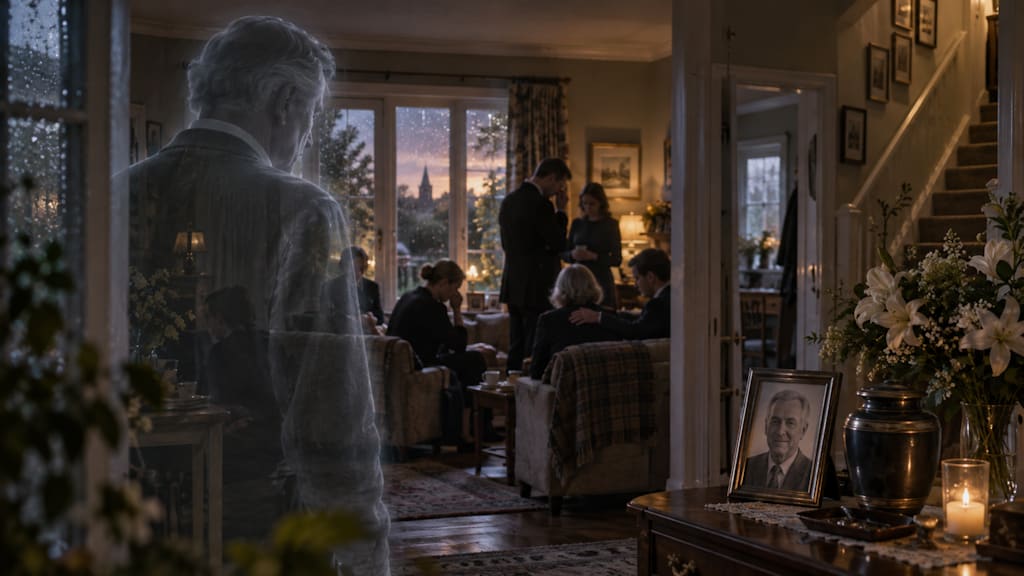
You know that you should not be upstairs.
You know this before you know where upstairs is.
The room is familiar without being immediately recognisable. Pale walls, a narrow wardrobe, a radiator beneath a window. Rain rests against the glass rather than falling. A wooden chair stands in the corner with a folded blanket across its back.
You have seen the chair before. You cannot remember when.
Downstairs, somebody laughs. The sound is brief and embarrassed, the kind of laugh people make when they have forgotten, for half a second, that they are supposed to be sad.
Then another voice says your name.
You sit up. There is no dizziness, no pain. You are dressed in the same grey trousers and blue shirt you wear when you do not want to think about what to wear.
Someone says your name again. This time you recognise the voice.
Ben. Your son.
You swing your feet onto the floor.
"Ben?"
Nothing.
You open the bedroom door. The landing settles something, and the house returns to you all at once: the shallow staircase, the framed print opposite the bathroom, the small stain on the carpet near the banister where Ben knocked over a cup of coffee fifteen years ago and insisted that nobody would notice.
Your house.
Not exactly. It stopped being your house three years ago, when you and Helen moved into the flat.
Except Helen never called it the flat. She called it downsizing. You called it surrender.
Yet here you are.
You move towards the stairs. People are talking quietly below. Cups touch saucers. Someone clears a throat. The front door opens, bringing a murmur of rain and traffic into the hallway.
You descend. Nobody looks up.
You stop halfway. There must be twenty people in the house. Your brother is standing beside the fireplace, thinner than you remember him. Two former colleagues are near the kitchen door. Helen's sister has one arm around Ben.
And Helen is sitting on the sofa. You have never seen her look so old.
You say her name. She does not move.
"Helen?"
You continue downstairs. A woman walks directly towards you. You move aside. She does not. For one absurd moment you expect a collision. She passes through the place where you are standing. There is no coldness, no electric shock, no sudden pain. She simply continues into the hallway.
You turn towards the fireplace. That is when you see the photograph.
It is one Helen likes. You are standing beside the sea in Cornwall, although the photograph makes the day look warmer than it was. Your hair is being blown sideways. You are smiling at whoever held the camera.
The photograph is enlarged and framed. Black ribbon curls around one corner.
Beside it is an urn.
You stare at it.
"No."
Nobody responds.
You move closer. Flowers surround the photograph. A small card bears your full name. Underneath are two dates. The second date is six days ago.
"No." You say it louder.
Helen looks towards the staircase. For a moment you think she has heard you. Then Ben sits beside her.
"You all right, Mum?"
She nods. "Just thought I heard something."
Relief rises in you too quickly.
"Helen."
She lowers her eyes. Ben takes her hand.
You step in front of them.
"Helen, look at me."
Nothing.
You reach for her shoulder. Your hand meets the wool of her jacket. You feel the fabric, the warmth beneath it, the shape of her shoulder. Helen feels nothing.
You press harder. She does not move. You withdraw your hand.
Someone taps a spoon against a glass. Your brother moves to the centre of the room. You have attended enough funerals to know what comes next. You do not want to hear it. You stay. That, you realise, is typical — you have spent most of your life claiming to dislike attention while remaining unusually interested in what people say about you.
Your brother begins with childhood. He tells the story about the broken greenhouse, and he tells it incorrectly. You almost interrupt him. Then he describes the holiday in Wales when you were twelve: the rain, the caravan, your father's temper, your mother's determination to enjoy herself. People laugh. You remember almost none of it.
A colleague speaks about your patience. That makes Ben look down. Another says you always had time for people. Helen closes her eyes. A woman you worked with for eight years says you taught her never to panic when a project went wrong. You remember shouting at her in a meeting, and apologising afterwards. You had forgotten that part until now.
Then Ben stands. You straighten. He has always hated speaking in public. He unfolds a piece of paper, stares at it, then folds it again.
"Dad liked plans." A few people smile. "He had plans for everything." He pauses. "Sometimes you got the feeling the plan mattered more than the thing it was supposed to achieve." There is gentle laughter. You do not laugh. "But when something actually went wrong, he was usually the person you wanted there."
Ben looks towards your photograph. "He could be difficult."
Helen looks at him.
"He knew that."
You are not sure that you did.
"He was stubborn. He could disappear into work and somehow convince himself that being busy was the same thing as being needed."
Your first instinct is defence. You had responsibilities. Deadlines. People relying on you. Bills. A family cannot live on good intentions.
Then Ben says, "But he always came back."
The sentence hurts more than the criticism.
Ben sits. You look at Helen. She is crying silently. You move beside her.
"I am here."
The words sound foolish as soon as you say them.
Later, people eat sandwiches. Death has occurred, yet sliced bread remains necessary. In the kitchen, your brother tells someone that the hospital did everything it could. Helen's sister says it was quick. Someone calls that a blessing. You have never understood why people call speed a blessing when discussing somebody else's death.
Ben stands with a glass of wine. His wife, Claire, is beside him.
"Has Adam replied?"
Ben shakes his head.
"He knows?"
"Of course he knows."
"Will he come?"
"I do not know." Claire lowers her voice. "Your mum needs him."
Ben looks towards the sitting room. "Adam has spent five years needing Dad."
You stop.
Claire says nothing.
"He could have called him."
"Adam could have called too."
"He was the father."
You leave the kitchen. You do not need to hear the rest.
Adam. Your other son. His absence has been present all afternoon, although you have managed not to notice it.
You become aware of an old habit. When something cannot be solved, you rename it. Adam was not estranged. He was busy. He needed space. He had his own life. You disagreed. You both said things. Time passed. Five years of passive verbs.
You walk upstairs. The small bedroom is exactly as it was before the move. That is impossible. The buyers redecorated. You saw the photographs online. Helen showed you. You complained about the wallpaper. Yet the old wallpaper is here. The wardrobe is yours. Your jackets hang inside.
You move along the landing to the room that used to be your study. The door is closed. You know before opening it what you will find.
Desk. Bookshelves. Printer. The small brass lamp Helen bought you. Everything preserved, not as it was when you moved, but as it was earlier. Five years earlier.
You look back towards the landing. The framed print hangs exactly where it did then. The mark on the carpet is darker than you remember.
This is not the house. Not entirely. It is memory arranged as architecture.
You sit at the desk. A notebook lies beside the computer. You know the page before you open it. Adam's name is written at the top. Below it are sentences crossed out so heavily that the paper has almost torn.
You remember the argument, not all of it, only the parts you have repeated often enough to make yourself innocent. He was angry that you missed Lily's birthday. You explained that you were working. He said you were always working. You told him that adults had responsibilities. He told you that he had stopped expecting anything from you. You said something about gratitude. He said something about control.
Then came the sentence you remember perfectly.
"You were a better father when I was too young to know the difference."
You told him to leave. He did. Three days later he telephoned. You watched the phone ring. You did not answer. He left a message. You never deleted it. You never answered it either. You told yourself you needed time.
Five years is a great deal of time.
You open the desk drawer. An envelope is inside. Adam's name is written across it. Your handwriting.
Memory returns in fragments. You remember sitting at the desk and starting again. You remember Helen asleep upstairs and rain against the window. You remember sealing the envelope.
You remember deciding to go. Not telephone. Not text. Go there.
You remember taking your coat from the hook, your keys, streetlights reflected on wet roads, a junction, headlights. Then nothing.
You look at the envelope. Six days ago.
You pick it up. The paper feels real. You carry it downstairs. Nobody notices. You place it on the kitchen table, or try to. Your hand opens. The envelope remains between your fingers. You push it against the table. Nothing. You try to release it again. It stays with you.
Then you understand. This is not the letter. It is the memory of the letter.
You run upstairs. The drawer is open. Empty. You stand in the study, trying to remember. You had not left it there. You had been afraid Helen would find it. You look beneath the desk. Nothing. Behind the books. Nothing.
Then you remember the tape. You crouch. Underneath the drawer, where nobody would see it, the edge of an envelope is visible. The real one.
You reach for it. Your fingers meet paper. You can feel it. You cannot move it.
For the first time since seeing the photograph, you feel afraid. The letter exists. You cannot deliver it.
The front door opens downstairs. Voices stop. You go to the landing.
Adam stands in the hallway. You have not seen him properly for five years. Photographs do not count. Social media does not count either, although you have looked more often than you would ever have admitted.
He seems older. Of course he does.
Nobody speaks. Then Helen stands. Adam crosses the room. Your wife and son hold each other. You look away.
Lily enters behind her father. She was six the last time you saw her. She is eleven now. Children should not be permitted to grow so much during arguments between adults.
She stays near the door. Adam speaks quietly to Ben. Helen keeps one hand around his arm, as though he might disappear again.
You want to approach. You do not.
Eventually Lily looks towards the staircase. Her eyes stop somewhere near you. You stand very still. She tilts her head. You move one step sideways. Her gaze follows. Perhaps.
"Lily?"
She says nothing. You raise your hand. After a moment she raises hers to brush hair from her face. You almost laugh at yourself. Of course.
Then her eyes shift past you towards the landing, towards the study. She climbs the stairs. You follow.
She pauses at the doorway. The room is quiet. You stand beside the desk.
Lily looks at the chair, then at the shelves. She enters, her fingers trailing along the edge of the desk.
"Grandad?"
You stop breathing, although you have no reason to.
She looks around. There is nobody else. You point towards the drawer. She does not react. You point again. Nothing.
Then she notices a strip of yellowing tape beneath the wood. She crouches. You stare. She pulls the drawer open and reaches underneath. The envelope comes free. Adam's name is written across it.
Footsteps sound on the landing. Adam appears in the doorway.
"Lily? What are you doing?"
Lily holds up the letter.
Adam stops. "Where did you get that?"
"Under the drawer."
Adam takes it. His thumb passes over his name. He looks around the room. You cannot tell whether he is looking for an explanation or remembering one.
"This was Grandad's study," he says.
Lily nods. "He used to sit there."
Adam glances at the chair. For a moment, his eyes settle almost exactly where you are standing.
Then he sits. He opens the envelope. You turn away. You wrote the letter, yet you do not want to hear it now. There are no perfect words hidden in drawers. There is only what you managed to write.
Adam reads silently. His face changes once, then again.
You remember fragments. You had written that you were wrong. You had written that you missed him. You had written Lily's name. You had written that you were sorry. Nothing clever. Nothing that repaired five years.
Adam lowers the page. "He was coming to see me."
Lily sits beside him.
Adam reads the last line again. "He was actually coming."
You want to say yes. The word does not matter.
After a while Adam wipes his face. "I wish he'd just called."
You close your eyes. That hurts because it is true.
Lily leans against him. Adam folds the letter carefully and places it in his coat pocket. He does not forgive you aloud. You are grateful for that. Forgiveness is his to give or withhold. You have already asked for more than enough.
Downstairs, somebody calls his name. Adam stands. "Come on."
Lily remains seated. "In a minute."
Adam leaves. You and Lily are alone.
She looks towards the window, then towards the place where you are standing.
"Are you here?"
You do not answer. You are no longer sure what the answer would mean.
Lily waits. Then she smiles a little. "Dad says people stay around when they have unfinished business."
You almost smile. Of course he does.
Lily looks at the empty chair. "He watches too much television."
You laugh. The sound fills the room, although nobody downstairs reacts.
Lily stands and moves towards the door. At the threshold, she looks back.
"You probably should not stay." She shrugs. "Dad will worry if I am upstairs too long."
Then she leaves.
You remain beside the desk. The room begins to change. The brass lamp fades first, then the books. The old wallpaper becomes the pale grey chosen by the people who bought the house. The stain near the banister disappears.
You walk downstairs. The funeral is still there. So is the photograph, so are the flowers. But the house around them is becoming the house it is now rather than the house you remember.
Ben is opening another bottle of wine. Helen is talking to Adam. Their hands are touching. Someone tells a story about you and gets part of it wrong. Nobody corrects them. Then somebody laughs. This time nobody looks ashamed.
You walk towards the front door. Your photograph remains behind you, beside the urn containing what everyone else has already accepted.
The door is open. Outside, the rain has stopped. Wet pavement reflects the evening light. Cars pass at the end of the road.
Lily comes halfway down the stairs. You turn. She raises one hand. Perhaps she is waving. Perhaps she is only holding the banister.
You raise yours anyway.
Then you step through the doorway.
For once, you do not look back.
About the Creator
Enjoyed the story? Support the Creator.
Subscribe for free to receive all their stories in your feed.
Comments
There are no comments for this story
Be the first to respond and start the conversation.