

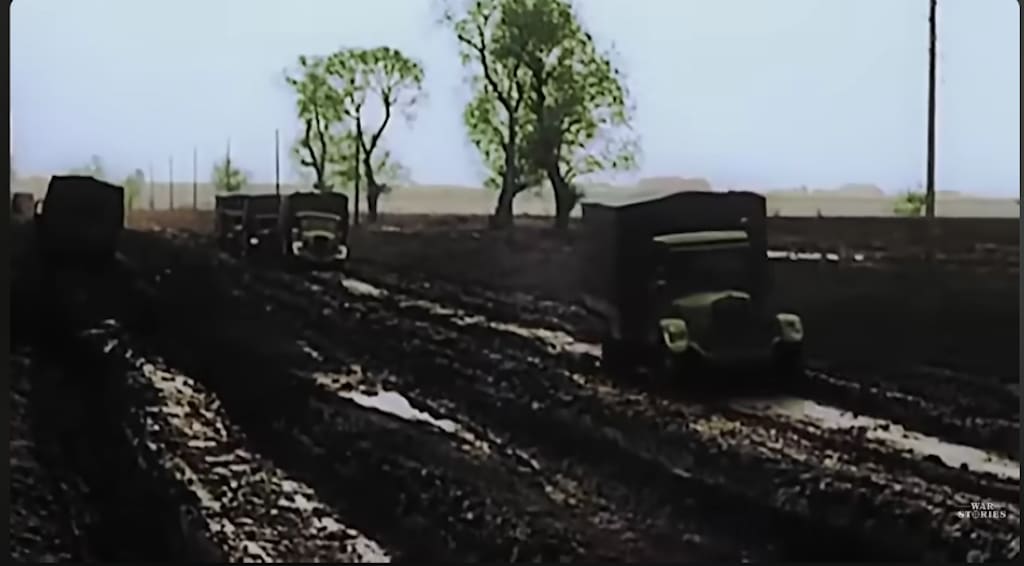
Curtis felt a cold sweat break across his neck. The manager’s words were too simple, too definitive. In his experience, the world didn't simply erase a group of people during a transit. He looked toward the window—a narrow, grime-streaked pane of glass that looked out onto a gravel parking lot. Beyond the lot, a line of stunted, grey trees marched toward a horizon of rolling, colorless hills. It looked like a painting of a place where nothing ever happened, which made it the perfect place to hide something.
He shifted his weight, and as he did, he felt a hard, rectangular shape pressed against the small of his back. He reached behind him, his fingers brushing the waistband of his trousers, and pulled out a small, leather-bound notebook. He flipped it open. The pages were damp, the ink bled into indigo blotches, but a single name was written clearly on the first page: "Julian". Underneath it was a set of coordinates and a single, frantic instruction: "Do not trust the silence."
The manager’s eyes tracked the movement of the notebook, his expression remaining carefully blank. He didn't move toward Curtis, but he didn't step away either, creating a tension in the room that felt like a stretched wire. The "silence" mentioned in the notebook seemed to manifest in that very moment—a heavy, suffocating stillness that dampened the hum of the television and the distant sound of traffic.
"You've got a lot of questions for a man who can't remember his own name," the manager said, his voice dropping an octave. "And a lot of baggage for someone who arrived with nothing but a plastic card."
Curtis didn't answer. He was staring at the coordinates. He didn't need a map to know they were wrong; they were too precise, too clinical, as if they had been plotted by a machine rather than written by a desperate man. As he traced the ink with his thumb, a sudden, violent vibration rattled the windowpane. It wasn't a sound, but a frequency—a low-end pulse that resonated in the synthetic fibers of his shoulder. It was a synchronization ping.
His heart—or the mechanism that served as one—hammered against his ribs. The facility wasn't just searching for him; they were already here. The "silence" of Oakhaven was a mask, a curated vacuum designed to isolate him.
The manager’s expression didn’t change, but his posture shifted. He didn't reach for a weapon, but he stepped subtly to the left, cutting off the path to the door. The low-frequency pulse hit Curtis again, a rhythmic thrum that felt like a finger tapping on the inside of his skull. It was a proximity alert, a digital tether tightening.
"You aren't a runaway," Curtis said, the realization crystallizing as the room began to blur. "And this isn't a motel."
The manager gave a slow, thin smile that didn't reach his eyes. "It is a motel, Elias. But it’s also a waypoint. You’ve been very cooperative in your sleep, but the waking part is always where the data gets messy."
The "manager" didn't move with the lumbering gait of a tractor mechanic anymore. He moved with a fluid, predatory precision, his hand snapping out to grip Curtis’s wrist. The touch wasn't human; there was a cold, metallic density to the man's grip that betrayed a synthetic chassis hidden beneath the canvas jacket. Curtis recoiled, his back hitting the laminate nightstand. The impact sent the plastic ID card skittering across the floor, sliding toward the gap under the door.
"The data is only messy if you fight it," the manager said, his voice losing its rural drawl and flattening into the same clinical tone as the woman behind the door.
About the Creator
Forest Green
Hi. I am a writer with some years of experiences, although I am still working out the progress in my work. I make different types of stories that I hope many will enjoy.
Enjoyed the story? Support the Creator.
Subscribe for free to receive all their stories in your feed.
Comments
There are no comments for this story
Be the first to respond and start the conversation.