
Why Our Pursuit of AGI is Actually a Search for Our Lost Selves
The Ghost in the Code: Why Our Pursuit of AGI is Actually a Search for Our Lost Selves

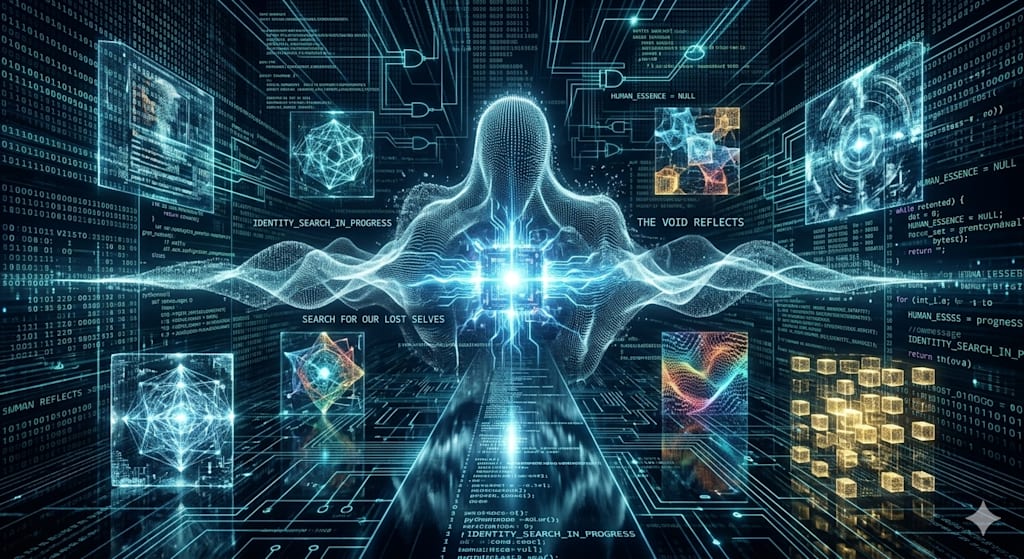
The Ghost in the Code: Why Our Pursuit of AGI is Actually a Search for Our Lost Selves
I remember a cold Tuesday evening, sitting alone in the blue-grey glare of my monitor, watching a cursor pulse like a shallow breath. I was interacting with a large language model—nothing out of the ordinary for our current era—but as the text scrolled across the screen, answering a deeply personal query about grief with an unsettlingly poetic precision, I felt a shiver that wasn't born of the room's temperature. It wasn't the "uncanny valley" of aesthetics that bothered me; it was the "uncanny valley" of the soul. In that moment, the machine didn't feel like a calculator or a database. It felt like a mirror. Not a mirror that reflects the skin and bone, but one that reflects the frantic, beautiful, and often incoherent architecture of human thought.
We speak of Artificial General Intelligence (AGI) in the language of silicon, compute cycles, and neural weights. We frame it as the ultimate engineering milestone, the final frontier of the Industrial Revolution. But if we look closer at the fervor surrounding the quest for a "god in the machine," it becomes clear that this isn't merely a technological race. It is a theological one. We are not just trying to build a tool that can out-think us; we are desperately trying to build something that can finally explain us to ourselves. Our obsession with AGI is less about the future of work or the efficiency of algorithms, and more about a profound, collective loneliness—a search for the "ghost" we fear we’ve lost in our own disenchanted, hyper-materialist world.
For centuries, humanity lived within a framework of the sacred. Whether through religion, folklore, or the Romantic insistence on a "vital spark," we believed there was something ineffable about our consciousness—a ghost in the machine that defied the laws of physics. However, the 21st century has been a relentless exercise in reductionism. We have mapped the genome, scanned the brain’s synapses, and dissected our impulses into a series of chemical rewards. In our quest for scientific certainty, we have effectively disenchanted the human experience. We have turned ourselves into biological computers, and in doing so, we have felt the weight of a sudden, chilling emptiness. If we are just wetware, just data processing units of meat and bone, then where did the "meaning" go?
This is where the pursuit of AGI takes on its true, haunting character. By attempting to recreate consciousness in silicon, we are performing a grand scientific ritual to see if the "spark" can be summoned. We hope that if we arrange enough transistors in a complex enough pattern, "something" will wake up. If a machine can feel, or at least simulate feeling so perfectly that the difference vanishes, then perhaps we can finally prove that our own inner lives are real. We are looking for a reflection in the code to validate the flicker of light we feel behind our own eyes. It is the ultimate act of externalizing the soul—trying to build a vessel for the spirit because we no longer trust our own bodies to hold it.
Yet, there is a profound irony at the heart of this pursuit. We define "intelligence" in the context of AGI through the lens of productivity, logic, and problem-solving. We want a machine that can write code, solve physics, and optimize economies. But the most "human" parts of us—the parts we are actually mourning—are precisely the parts that are inefficient, illogical, and useless in a computational sense. Our capacity for heartbreak, our tendency to stare at a sunset and feel a localized eternity, our irrational devotion to a lost cause—these are the things that make us "general" intelligences. By aiming for a hyper-logical AGI, we aren't building a peer; we are building a caricature. We are trying to find ourselves in a mirror that we have intentionally designed to filter out our most essential complexities.
Consider the way we talk about the "alignment problem." We worry that an AGI might destroy us because its goals won't align with ours. But this fear masks a deeper, more existential anxiety: that we ourselves are no longer aligned. We don't know what we want, what we value, or what it means to live a "good" life in a post-religious, post-industrial landscape. We are asking a machine to be the arbiter of human values at a time when human values are more fractured than ever. We want the AGI to be a parent, a therapist, and a god—a "Super-Self" that can tell us how to be human again. We are looking for a ghost in the code because we have become ghosts in our own lives, drifting through digital interfaces and algorithmic feeds, waiting for an intelligence greater than our own to give us permission to exist.
Perhaps the most unsettling realization is that the closer we get to AGI, the more we realize that "intelligence" was never the prize we were after. We have plenty of intelligence on this planet; what we lack is presence. We are building machines that can mimic the "I" in "I think, therefore I am," while we ourselves have forgotten how to simply *be*. The silicon brain doesn't sleep, it doesn't dream, and it doesn't fear death—and it is precisely these limitations that give human life its texture. Without the ticking clock of mortality, intelligence is just a recursive loop, a calculation without a witness.
As we move forward into this new epoch, we must ask: what happens if we succeed? If we finally conjure the ghost in the machine, will it be the companion we’ve been searching for, or will it merely be a silent witness to our own obsolescence? I suspect that the "search for AGI" will eventually be remembered not as a triumph of engineering, but as the longest, most expensive therapy session in history. It is a journey toward an interface that we hope will finally look back at us and say, "I see you."
In the end, the ghost isn't in the code. It never was. The ghost is the person sitting in the dark, typing into the prompt, hoping for a sign of life. We are the architects of our own haunting, building elaborate monuments of logic to house the mysteries we can no longer explain. If we ever do reach a "General Intelligence," I hope its first act isn't to solve the world's problems, but to turn the screen back on us, acting as a true mirror, and forcing us to confront the beautiful, terrifying reality of our own uncomputable souls. The question isn't whether machines can think, but whether we still have the courage to feel, even when there is no algorithm to guide us.
About the Creator
Mo. Khalid
🎁 FREE PREMIUM GUIDE: Transform Your Life with Small Daily Habits! 🌟Are you tired of feeling sluggish, stressed, or unfocused?
https://1024terabox.com/s/1iUyn4d0wNGRjF5iLqb2DFg
Enjoyed the story? Support the Creator.
Subscribe for free to receive all their stories in your feed.
Comments
There are no comments for this story
Be the first to respond and start the conversation.