
Why only four colors?
The spectrum and colors of light.
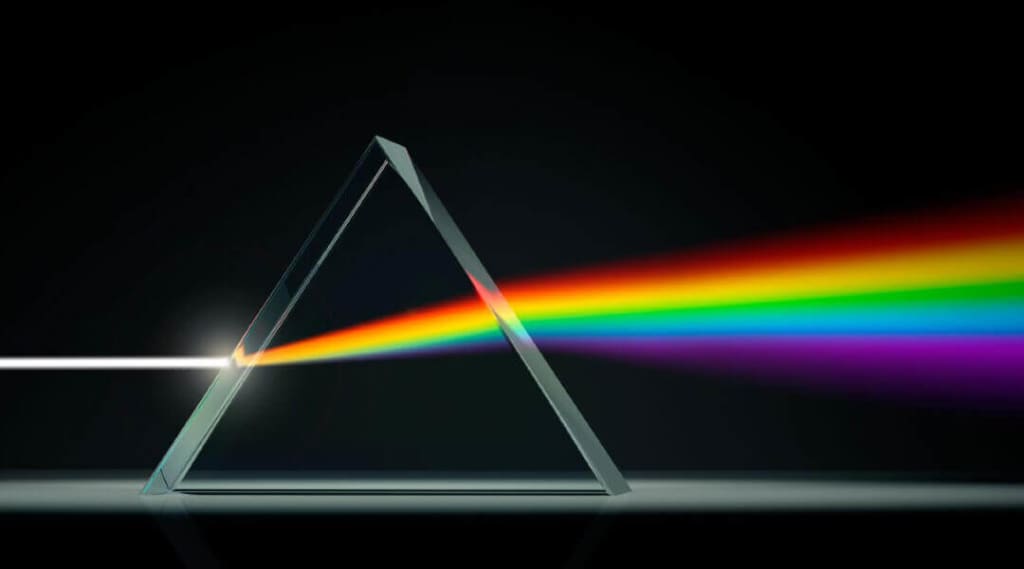
What makes up the sun? We can't travel to the scorching star to collect samples like we did with the moon, but there is a way to do so without going too far. A rainbow can help. Well, not the kind of rainbow we see after a rainstorm, but rather the light spectrum, specifically the Fraunhofer lines. These lines are similar to those enigmatic dark marks that appear in the spectrum of stars, including our own Sun, because certain gas elements in the atmosphere selectively absorb the Sun's radiation. vibrations at particular wavelengths; in 1802, an English physicist by the name of William Hyde Walliston was the first to notice these lines, but it was this German scientist Joseph Von Foffer, who was actually the owner of the scene and these lines were given names He planned more than 500 foffers after him. lines, even providing the most brilliant one with a few chic letters ranging from A to G, and we continue to utilize those letters now as we, There are roughly 25,000 front speakers.Hopper lines that are within our knowledge solar system spectrum, let's now discuss concerning the three kinds of spectra you obtained to be aware of initially, we have the constant Spectrum image of every the rainbow's color, all the visible light wavelengths with Nothing absent. It's the result of A prism spreading out white light. The emission spectrum was then obtained when Aams became excited and began dividing up the light in distinct ways. Each element has a unique signature. wavelengths resemble their own quirky hues Red neon rocks and yellow sodium and blue, while Mercury brings orange and The color green vibes resemble a fingerprint or barcode for every component, so if possible determine the light's wavelength. fully recognizes what element it is descending Lastly, we have the absorbance Spectrum, picture this in white light in all its beautiful hues travels through a gas, but upon arriving at the opposite end, certain hues are lacking the reason for the atoms and gas absorb light at particular wavelengths identical ones that they would release if they We're all giddy, so what happens is uninterrupted Spectrum With these awesome black lines on it, sunlight passes through a prism to produce both the expected visible spectrum and a plethora of those black lines. The reason behind the more than 6,100 black lines is that certain chemical elements in the sun's outer layers absorb particular wavelengths of light. By measuring the wavelength of these lines, we can determine which elements are present in the sun and even estimate how much of each element is there. It's like piecing together a really cool puzzle to discover what the sun is made of. One set of lines included a strong yellow one that didn't match any other lines. element in 1870, when a researcher by the name of Norman Locker hypothesized that it might be a completely new element. He called it helium in honor of the sun god Helios. After helium was discovered here on Earth 25 years ago, scientists can now learn everything there is to know about materials both here on Earth and in space simply by observing their colors. It is all due to spectroscopy, which is a technique that works because light and matter have a unique relationship and behave predictably. Thus, the electromagnetic spectrum is made up of various forms of light, including microwaves, radio waves, gamma rays, x-rays, ultraviolet light, visible light, and even those radio waves that bring about favorite colors.Listen to your station Light has some pretty interesting properties that are useful for spectroscopy. For example, light behaves like a wave. You've probably seen waves before; think of water ripples or sound vibrations that tickle your eardrums. Well, light waves are similar to those, but they're a little odd like me rather than causing matter to move up and down or side to side like mechanical waves. These include the microwaves that zap your leftovers and the x-rays that Dennis used to spot tooth decay While mechanical waves require matter to travel through, light waves can zoom through both empty space and matter itself. Light waves are made up of electric and magnetic fields that jiggle perpendicular to each other. Now let's talk about wavelength a fancy term for the distance between wave Peaks for light waves it's the distance between those peaks in the electric and magnetic fields you're actually super familiar with the concept of wavelength already you see your eyes can perceive differences in wavelength as different differences in color shorter wavelengths appear Bluer while longer wavelengths give off a redder Vibe so next time you're admiring a vibrant rainbow just remember you're actually appreciating the various wavelengths of visible light now here's the deal with spectroscopy different stuff emits and interacts with light in different ways depending on things like temperature and what it's made of we can use Spectra which are
like fancy patterns of colors to figure out cool things like, without even touching it, how hot something is and what elements and compounds it's made of. First things first, we need to break down light into its individual colors to create a spectrum. This can be achieved using a glass prism, a device known as a diffraction grading, or even a combination of the two, which we'll refer to as a gist. You've probably seen the naturally occurring rainbows that appear when sunlight strikes water droplets. Spectra as a result of the water's prismatic properties You can display a spectrum as an image, but if you really want to delve into the details and see all the little differences, spectroscopes, and specter graphs are the fancy tools scientists use to capture and measure these Spectra.Plotting the brightness between colors on a spectrum graph is necessary to reveal details that are invisible to the human eye, such as minute differences in wavelength and brightness. Spectra essentially depict the same phenomenon of wavelength-dependent brightness changes. Scientists enjoy categorizing Spectra according to the interactions and uses between light and matter. First, let's talk about the continuous spectrum. This is exactly what it sounds like it is continuous; the brightness smoothly transitions between colors, and in a perfect continuous spectrum, no colors are missing. A black body curve is a particular kind of continuous spectrum. it is the spectrum of colors emitted by an object, such as a light filament or star. Very useful just based on surface temperature because the brightest color and the curve's peak wavelength only provide information about surface temperature—hot stars are bluer and cool stars are redder. The absorption spectrum, for example, appears to be a continuous spectrum with some colors much fainter or absent; these absent colors appear as black lines known as absorption lines, and you can probably guess what happens when starlight travels through materials like dense gas and the atoms and molecules in that gas absorb specific wavelengths. Since every component in the gas absorbs a unique pattern of wavelengths, if You are aware that the element or compound is present in the gas you can identify the signature pattern. You can determine the quantities of each material as well as the temperature and gas density by looking at the darkness of those absorption lines. Recall how we said "Stars" in the middle of an endless spectrum. That turns out to be untrue; if you look closely at the sun's spectrum, you'll notice that there are numerous absorption lines. Every one of them represents a component present in the sun. Some of the light emitted by the sun's interior is absorbed by atoms in its colder layers as it travels through space, allowing us to determine the composition of the sun. My own absorption spectrum would show that there is a lot of chocolate present.
About the Creator
Enjoyed the story? Support the Creator.
Subscribe for free to receive all their stories in your feed.
Comments
There are no comments for this story
Be the first to respond and start the conversation.