
When the Heads Begin to Roll
An interesting french revolution-esque style story
A soft thud.
That was what I heard that day, when the executioners axe fell upon my father’s head. As this happened, all I could do was stand there and watch. The feeling of impotence was so overwhelming that I could barely look at him as his head was picked up by the man holding the axe and it was raised above him, showing the crowd what they came here to see. The unjust beheading of a man. That man being my father.
I remember hearing whispers in the crowd. Many people were debating the reason for his execution. Some said that he was probably a thief who got too ambitious. Others claimed that he was a Jadian spy. I heard one man say that my father was part of a terrorist group, likely the one that bombed the Royal Manufacturing Facilities a month and two weeks ago. What I found strange about this man is that he knew my father’s name. Sergei. My body tensed as soon as I heard him say it, and I began to wonder for a few moments how that man knew it. I even tried to approach him, but to no avail, as local police began to disperse the crowd once everything was over.
Even after the execution had taken place, I could still smell a distinct iron-like odor in the air at Ivanovich’s square, a reminder of the frailty of the human body and the unfairness of the system. That smell and that thud would haunt me for the next week after the beheading, and during this time, I thought of something. As it turns out, the system had failed me and my family. My father had only defended his sister from drunk soldiers at a nearby tavern, The Wild Goose. That was all that happened. That was all there was to it. One would think that I would be more rational, that I would try to find out more, investigate the incident to get both sides of the story, but I was not that type of person. In my grief, I began to think about the unfairness of the world. How my father got executed for no justifiable reason. How the last few years had decimated the crop yield, inflating the price of bread so high only the rich could afford it. How some violent organizations had staged terrorist attacks against anything related to the monarchy. How the nobles kept on raising taxes on their farmers, and how the king would do the same in the cities. How lawlessness had taken over parts of my neighborhood. As a matter of fact, it wasn’t uncommon to find broken glass from the shops on the floor. Bakeries were targeted the most, as the bakers were accused of keeping bread for themselves. If you were to walk through the streets of Vrasilaiev, the Corsovian capital, during these times, you would notice a distinct sense of fear lingering in the air. The people were afraid. They didn’t know whether they would have enough food or water to stay alive tomorrow. They didn’t know if they would be forced to fight for another country who would never return the favor. They didn’t know if a bomb was going to blow up in their face in the next 3 hours. In this perpetual state of uncertainty, certain individuals like me noticed something. This is all the king’s fault. Executions across the country for ridiculous reasons. Rising taxes. Famine. The king ignored the people and his duty as a monarch. All this was happening to 98% of the population, and the noblemen and royalty continued to live as if nothing had changed for the past 200 years. These individuals wanted change. If the king was oblivious to our problems, the people would let him know about their situation.
I soon received news of a rally being announced. I decided to go. On the 13th of October 1821, we marched towards the royal palace in the small town of Brasov, which was about 21 kilometers away from Vrasilaiev. I still remember walking at the front of the rally, and demanding an audience with the king, along with a friend of mine. The look on the faces of the guards was quite an interesting one. Nevertheless, they let me and my friend Vasily into the palace, along with a few other members of the rally that had managed to secure some improvised weapons, such as pitchforks, scythes, sickles, knives, hammers, amongst other items. In total, 10 people entered the palace, including me and Vasily. A few minutes later, we were in the throne room, directly in front of the king and queen.
The two looked different from the pamphlets I’d seen around the city. The king, despite being only 31 years old, looked like he was in his 50’s, and the queen, an 18-year-old girl from the island nation of Nara, looked like she didn’t even care about our presence.
Vasily decided to speak to the monarchs first. In short, he spoke about how the people of Corsovia had shown him support in his rise to power after his father’s death, and how they thought he would be different from him. He talked about honor, dignity, and how the Corsovian people deserved better than the indifference that they were being given. The king listened patiently to Vasily, and when he was done, he looked over at me, thinking I had something to say as well. Truth be told, I did. I decided to take a different approach when speaking to Franz the IV. I talked about the exact problems his citizens had and even offered a few solutions to some of them. I talked about how it was in his best interest to keep the people happy, and that under these circumstances, keeping the people on his side was a top priority, because the consequences of not doing such a thing would be disastrous. After hearing me speak patiently, he ordered Vasily out of the room, along with four of his companions, and the four people that were tasked with protecting me were forced out of the throne room. It was at this time that the king spoke about his intentions with me.
Franz explained how he felt that he had fallen out of touch with the people, and that he needed a way to communicate with them. Someone who would serve as a medium between the subjects of his kingdom and himself. He went on to tell me and others present in the throne room how his predecessors had lost popular support in the past and how this had directly affected their time on the throne. After he was done, he looked at me in the eyes and told me that he did not wish to suffer the same fate that the previous monarchs had and that, after hearing both me and Vasily speak, he had decided to give me a position in his cabinet thanks to my pragmatic approach to Corsovia’s problems. “Vasily may have intended good, but honor and dignity do not solve problems. Solutions do. That’s why he’s not here and you are” he said. He explained that I would be in a close position to the king to inform him of the people’s wishes and needs, so that he could adequately perform his duties and as king.
I was internally overjoyed when I heard this news. Finally, the king will listen to us! He will fix everything! That was what I thought back then. Oh, how naive I was!
I remember the queen and a few other nobles looking at the king as if he had lost his mind. I could even guess what the queen was thinking. Are you out of your mind? How could you give someone who looked like a peasant a cabinet position? The king raised his hand, and everyone’s looks automatically changed. No voices could be heard, for everyone had gone silent. The king quietly whispered something to the queen, and I noticed her expression and posture began to relax soon after.
I was escorted without incident outside of the palace grounds, and I rose above the crowd to tell the mob that was partaking in the rally about what had happened with the king. The people celebrated as if the great war had just been won. I’m pretty sure that they thought the same thing I did at the time. Our problems had been solved. All will be well now. The king will listen to us, and he will do all in his power to aid the people.
We soon learnt that the king was a liar. As the months went on, the people expected some sort of reform, but it never came. I continued to subtly pressure the king into realizing that these issues needed to be solved immediately, because if nothing happened soon, the consequences of his procrastination would leave much to be desired. But alas, he paid no heed to my warnings. The king continued to ignore me, and the people around me were demanding answers I could not give. Slowly, the pressure from my environment and Franz’s disdain were starting to get to my head. I did not know for how much longer I would be able to stay in this position, but it was clear to me that something had to change.
And change did indeed come. On the 22nd of February 1822. The people had caught on to the king’s antics, and they had taken to the streets in response. The 31st riflemen division was dispatched to aid the police in dispersing the protesters because there were so many of them. I was there too. Not as a protester but as a representative of the king. The people would ask, and I would be unable to provide answers, again. I was afraid of the mob. From what I could see, about 60-70% of the protesters carried torches, pitchforks, hammers, and other utensils as weapons. They could simply decide to take out their anger towards the king on me at any time. But that didn’t happen.
The 22nd of February is important for a different reason. As I was addressing the people, the loud noise of a gunshot was heard from somewhere in the crowd. Soon after, the sound of a body falling to the ground was heard. As everyone in the mob looked around to see what had happened, I saw what had occurred. A rifleman had been shot in his left shoulder. It only took a few seconds for the rest of the men from the 31st to open fire upon the crowd. All I could do was watch, as a total of 183 people lost their lives that day, and at least 300 others were injured, either because of the gunshots of the riflemen or from the trampling of hundreds of people running for their lives, oblivious to the people beneath them, who could not run nor hide. It was truly a tragedy.
These events sent the military high command of Corsovia and the other nobles into a temporary frenzy. Most of them knew very well that, if the situation wasn’t handled correctly, it was likely that revolution would soon follow. Some even spoke of relocating their assets to other countries out of fear. I decided to talk to the king and advised him that giving a public address was crucial, for ignoring the problem would only make everything worse. For once, Franz agreed. I expressed my thanks to him and went on my way to manage some unfinished business. On the 25th the king addressed the people with the following statement:
Royal Proclamation of His Majesty, Franz IV, King of Corsovia
To the loyal subjects of the Kingdom of Corsovia,
On the evening of February 22nd, our beloved kingdom was shaken by an unfortunate and tragic incident. A lawful assembly of concerned citizens was infiltrated by agitators whose reckless actions led to chaos and bloodshed in the streets of our capital. While peaceful discourse has always been a cherished right of our people, the violence unleashed that day left 183 dead and over 300 injured. A wound that pains us all.
Let it be known: the safety and welfare of Corsovia’s people are my highest priority. My heart grieves for the lives lost, both to the citizens who sought to voice their concerns and the soldiers who were performing their duty to preserve order. However, let us not allow this tragedy to cloud the truth: a single gunshot, fired from within the crowd, sparked the terrible events that followed. Those who carried weapons into a peaceful protest share responsibility for this calamity.
I commend the soldiers of the 31st Riflemen Division for their bravery in the face of provocation, and I assure my people that a full investigation will be conducted to understand how events escalated so swiftly. Rest assured, I will personally oversee this inquiry to ensure that justice is served, and that such incidents are prevented in the future.
We must also address the deeper concerns that have brought unrest to our streets. In recognition of the hardships endured by many of my subjects, I am ordering the immediate formation of a Royal Council on Public Welfare. This council will evaluate solutions to the issues of taxation, food shortages, and public safety.
But let us not forget: Corsovia is strongest when united. Those who seek to sow discord—who attack the very institutions that sustain this kingdom—are enemies not just of the crown but of all its citizens. To them, I say: your schemes will not succeed. The Kingdom of Corsovia shall stand firm, and law and order shall prevail.
I call on every loyal subject to remember the values that bind us together: honor, duty, and faith in the enduring strength of our nation. Let us mourn together, heal together, and work together toward a brighter future. For Corsovia, and for all her people.
By the grace of God, Franz IV.
The days just after the address, I already noticed the people’s anger was beginning to subside, as the promise of reform soothed them. But those in proximity to the king on a political level knew that this pause was temporary. If an uprising wanted to be avoided, then the Royal Council on Public Welfare would need to act fast. A few other people I’d never seen before and I were selected to be on this council, but we were severely lacking in terms of ability to complete any reforms due to us having virtually no power to carry them out, and what I suspected to be a purposefully ineffective bureaucracy.
In the next month, all this council did was a minor tax reform, which managed to reduce taxes on salt from 20% to 18.5%. That was all we were able to accomplish.
Amongst the people, rumors of violent organizations banding together to finally do something about the growing unrest were spreading rapidly. And the people supported them, from what I heard. These organizations were weak and divided, as they all had different views and ideas as to deal with the current situation, but I suspected that this division was temporary. These different movements would not take long to notice that they were much stronger if they stood united by one true goal: “fixing” Corsovia.
On the 3rd of March 1822, I was drinking with Vasily and some friends at a nearby tavern on one of my days off when I was approached by three men, who asked me to come with them. Alone. At first, I refused, thinking that I was about to get robbed. My 3 friends held their ground with me, but they soon after stood down, as 3 more men entered the bar, all six of them discretely pointing pistols at us as the rest of the crowd appeared oblivious to what was happening around them. It was then that I realized I had no choice but to go with them. After walking out of the bar, I was told to cover my face with a bag. I reluctantly obliged. After walking for what would seem like 30 minutes, I felt a door open and close behind me. Another one. Subsequently, I walked down two flights of stairs with my “kidnappers” when I walked into a room, and I was allowed to remove the bag off my face.
I was in a rather bleak bedroom. Behind me were three of the men who had gone to the tavern to retrieve me, and in front of me were about 9 other people, 6 leaning against a wall and 3 of them sitting on chairs, directly across the table I found myself sitting at. These 3 men looked important, and they spoke like they were. These people explained that they were the leaders of Corsovia’s three largest clandestine organizations: The People’s Liberation Front, the Constitutionalists and the Democrats. These groups were outlawed political parties that had managed to survive the 1813 Political Participation Act and had to stay hidden from law enforcement. They had allied each other temporarily to do something about the current political landscape of the kingdom. They called themselves the Freedom Front. I asked them why I was here, and what did they wanted from me. The trio soon explained that, due to my proximity to the king, they wanted me to support them however I could and that, as representative of the king for the people and of the people for the king, I was a key figure for them to secure their position and carry out their respective plans.
It was at this time that I thought of something. I asked the different leaders if I could perhaps interview them, one on one. Their guards could stand by, of course, but I would like to speak to each of them on their own. One of them was skeptical, but they all eventually agreed to my request.
The first of the three I spoke to was Nikolai Petrovich Ivanov. The one who at first opposed the individual interviews and the leader of the Constitutionalists. This man had a military background, serving as a major in the Corsovian Army for about 2 years when he decided that he had had enough of the blatant corruption and inability to do anything. So, he left the army and decided to take matters into his own hands. When asked about his visions for Corsovia, he explained that the revolution would be a way of bringing back fairness to a malfunctioning system. Stripping Franz of his power is the absolute priority, since it was clear that he didn’t do anything productive with the powers he had received. He believed that once the revolution fulfilled its purpose, Franz or someone else could stick around, but under a constitutional monarchy. He defended limited suffrage and a clear separation of powers. He explained that once they succeeded at limiting the king’s power, he and other trusted individuals would form a provisional government to secure Corsovia’s borders, provide economic stability and stop chaos from rising within the country. I listened to him explain his views patiently, and when he was done, I decided to ask him if he knew anything about my father, Sergei Ivanovich Korovin. After he said that he had never heard about such a man, I told him that it was good for us to talk the way we did, and I asked the next leader to come in.
The 2nd leader was Alexandra Volodymyrovna Mironova. Leader of the Democrats. A Corsovian who had been living abroad for about 15 years in the Republic of New Darwin and had come back to the country after getting news of family business she was not willing to discuss openly. She had a quite different approach. Alexandra was a firm proponent of the Corsovian Republic. A democratic nation where everyone lived under equality, fairness and good morals. The moment the revolution loses sight of these core values; everything will collapse for them. Once Franz was ousted from power, she planned on immediately doing away with the old system. The wealth would be redistributed from the aristocracy and given to the people so that these men in power would no longer have any of it. I listened to her explain how every man and woman was born equal, no matter their gender, socioeconomic status or the color of their skin. She would bring those who oppressed the people during the old regime to justice, and these individuals would be given the punishment they deserved. After she finished explaining her views, I decided to try my luck again, and ask her about my father. Nothing. It was at this time when I called forth the third and final leader.
After asking for his name, it was revealed that he was a man called Dimitri Yegorovich Karpov. He oversaw the People’s Liberation Front. The man’s name was strangely familiar. It was as if I had heard someone say it before, though I didn’t know where or when. I decided not to wait for him to explain his views and immediately asked him about my father. And finally, I was given a “decent” response. He instantly became defensive and asked me how I knew him. I explained that he was my father, and that I wanted to figure out what he had been doing before he had been executed. I noticed Dimitri’s muscles relax slightly, but it seems like he didn’t trust me that much, or his posture would have changed too. He soon explained that he knew my father, and that the two of them had been business partners. I attempted to dig deeper into the matter, without success. I made a mental note to ask Dimitri about this matter in the future.
It was then when I decided to ask him what I had asked the other leaders. His answer was quite interesting, to say the least. He explained that the support of the masses was key for the revolution to succeed. He went on to explain how getting rid of anyone linked to the old regime had to be dealt with, and that securing the state first was the top priority. After he was done, I noticed that he had grander visions. He seemed to think that this revolution could inspire others around the world to act as we did, creating allies around the world and giving us a base of support to work with.
After I finished talking to the three of them and letting them know that I would consider their proposal, I began to ponder on the possibility of success of the revolution and possible unforeseen consequences. If I wanted to have any chance at preserving my own life I needed to tread lightly when dealing with the revolutionaries and with the king himself, along with each side’s respective supporters.
I soon noticed that I needed a plan. If the revolutionary leaders gave me their names, it must be because they are confident enough to be sure that the revolution will succeed and that they wouldn’t be harmed even if I told everything I’d learnt from talking to these leaders with Franz the IV. I internally debated what would be the best course of action as I walked back to the house that I managed to buy with my salary as the representative of the people for the king.
As I headed home, I couldn’t shake the thoughts swirling in my mind. Each of the leaders had presented their ideas with confidence, but not all of them seemed to have thought through the consequences. What if Alexandra’s dream of a Corsovian Republic became an oppressive regime in its own right, under the guise of equality? What if Nikolai's vision of a constitutional monarchy led us right back to the corrupt system we were trying to overthrow? And Dimitri... I noticed he had a certain ambition, a drive that could either propel the revolution forward or destroy it from within. His plan to inspire revolutions elsewhere worried me. A war for ideals might be more destructive than anyone could have anticipated.
I reached out and inserted the key to my house into the keyhole, stepping inside soon after. The silence of my house felt oppressive, as if it were watching me, waiting for a decision. I lit a candle and sat at my desk, the flickering light casting long shadows across the room. I pulled a piece of paper toward me, the pen trembling in my hand. Maybe writing everything down will give me a better grasp on the situation. I knew revolution was inevitable now. But how would I fit into it? Which leader's vision would I support, and what price would I have to pay for it? How would my decision impact the unity of the group as a whole?
The possibility of siding with the king lingered in my thoughts. Was it worth staying by his side, helping him maintain a hold on the throne, knowing that his rule had been ineffective and perhaps even complicit in the suffering of his people? Could I still change things from within his cabinet, or was I only playing the part of a puppet, trapped in the web of the aristocracy I once hoped to dismantle?
I closed my eyes for a moment, taking a deep breath. The weight of the decisions ahead seemed insurmountable, yet I knew there was no going back. The revolution had taken root, and whether I liked it or not, my choices would shape its course.
With that thought, a plan began to form. I would have to play the game with both the revolutionaries and the king. Each side would expect loyalty, but loyalty was a commodity I couldn’t afford to give freely. I would gather information, navigate their webs of lies and promises, and when the time came, I would make my move.
One thing was clear: I needed to return to Dmitri and get the truth about my father. When I would be able to do this, I did not know. Another was to continue playing my role in the king's court, ensuring that I maintained my influence and position. But in the end, only one thing was certain: if I wanted to survive, I would have to be smarter than all of them. And when the revolution came to a head, I’d need to be ready to choose the side that suited me best.
The following day, everything seemed normal. I made my way to the royal palace, but when I got there, it was… deserted. Not a soul could be seen anywhere. There were no guards anywhere near the gates, so I couldn’t enter the palace either.
Suddenly, I heard a gunshot fire, and something quickly whistled by me, hitting the floor soon after. I jumped, taking cover behind a tree. What was that? Where did it come from? Was that from the palace? I didn’t see anyone, but it did sound like it came from there.
Something brushed my right shoulder. I instinctively jumped, but calmed down slightly when I saw it was a royal guard. He grabbed my arm and pulled me toward the gates. “We need to get inside, quickly. A sniper thought you were a terrorist. They didn’t recognize you”. Once we got through them, we sprinted across the courtyard into the palace itself, and I was escorted up to the throne room.
The thrones were empty.
Nobles and members of Corsovian military high command were panicking in a nearby room. Where were the monarchs? What had happened to them? Had they abandoned everyone to their fates? I soon figured out that only the king and queen had left, and that different noblemen had reached out to other parts of the country to see where they could have possibly taken refuge, but to no avail. I also noticed that the royal guard took defensive positions because their commanding officer assumed that if the royal family had left it meant that an attack was going to come right after, which is the reason why they took defensive positions and made the royal palace look deserted. It was all to make any attacks on the palace less appealing to any outside threats.
I was rather lost as all of this happened. My mind was working hard at trying to figure out why they had left, and where they could’ve possibly gone. It wouldn’t take long until the regular palace employees noticed the King and Queen’s absence, and if that happens, the revolutionaries might take the opportunity to strike. But then again, what if that’s what the monarchs want? They could be baiting the revolutionaries out to neutralize them. This option is not exactly improbable, but the revolutionaries cannot risk inaction out of fear of getting ambushed. My guess is that the revolutionaries will strike, but they will act carefully, because if they’re caught off guard by pro-absolutist forces all will be lost for them.
The best thing to do in my situation would probably be to try to figure out what the revolutionaries are doing by meeting them, but I cannot leave the palace right now without attempting to look for the monarchs first. I decided to quickly rush off to the royal bedroom to see if I could find any clues there. I noticed two royal guards were following me for “security purposes”.
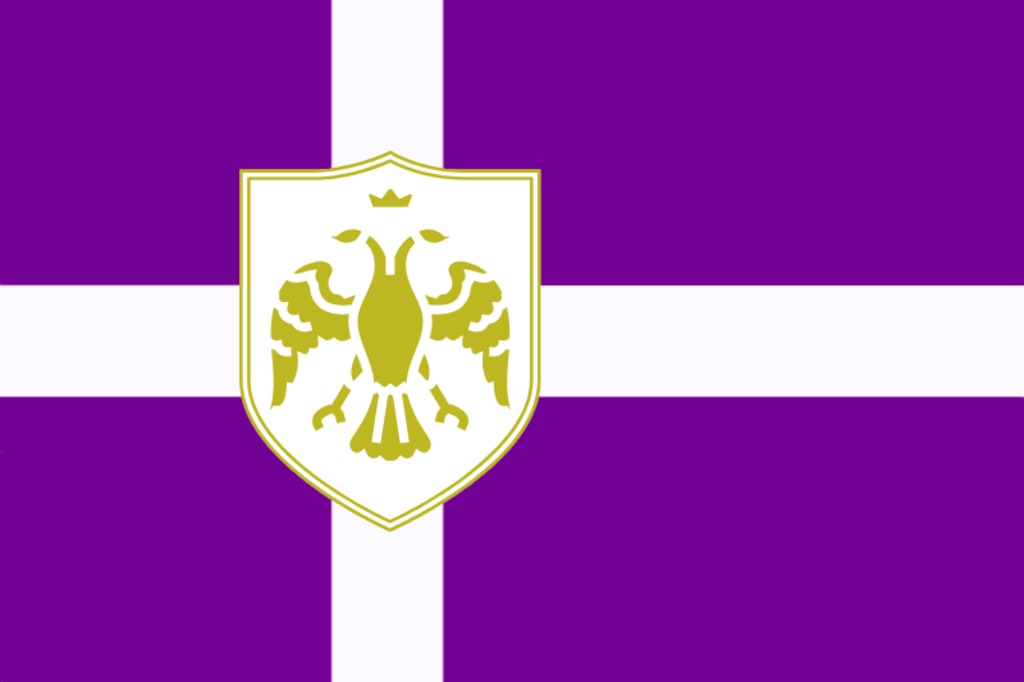
The royal bedroom was notably spacious, featuring silk curtains and white sheets adorned with gold and purple accents. This combination of colors is characteristic of the Corsovian kingdom. We’ve always had a great history of being an extremely important player on the world stage. From living in the ancient territories where the Great Hadrian empire was founded to being, at one point, the largest colonial power by land mass in the entire history of mankind, our kingdom has always used those three colors. White, gold and purple. The colors of Corsovia, along with the two-headed eagle.
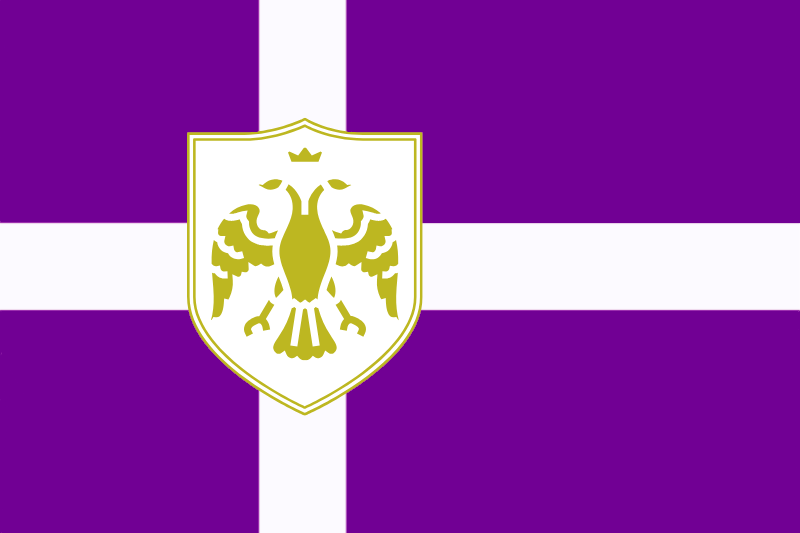
Ah, the Corsovian flag. It’s rather beautiful, isn’t it? I wonder what will happen to it after the revolution.
As I scanned around the bedroom, I noticed another room connected to the royal quarters, separated only by a door. As I opened it, I was surprised to find an office. A desk was placed right under the window and the opposite wall was lined with books and other utensils. I could see a map of the kingdom on the western-facing wall. A very detailed one, at that. The six main provinces of Corsovia were each named, and their borders were drawn. I saw Vrasilaiev, along with a few of its most important landmarks. I saw the royal palace in Brasov. I saw the port city of Kalinagelsk. But something else I saw on the map was rather worrying. The map also contained highlighted arrows and military positions, friendly and enemies alike. And it also showed the borders of other countries… and the old borders of Corsovia. The main population hubs, supply depots, forts, everything was labeled. Could it be that Franz had ambitions of a Greater Corsovia? He couldn’t possibly engage in a military campaign now, right? There’s no way. Corsovia is not ready. He still needed to fix all our internal issues first before declaring war.
As I scanned through the office I decided to check the library. I’ve heard stories of hidden passages behind bookshelves, but I never really believed them. When I asked myself if they indeed did exist, I always concluded that they weren’t worth it, because the mechanisms would be rather complicated. But alas, I decided to check anyway. Just in case.
As expected, I found nothing.
But the map… I didn’t understand it. It makes no sense whatsoever to go to war now. The army mustn’t have any supplies. Corsovia’s military was outdated the last time I checked. It doesn’t make any sense. Or does it…?
Of course! This war is simply a distraction. The men from the revolutionary armies will get drafted, removing the Freedom Front’s main manpower source. But this will only work if the army is in fighting shape. I know the king isn’t stupid. He must have thought this through. Franz must’ve been overseeing army modernization efforts and supply levels. If the army is at all competent, then his plan is likely to succeed. The only way for it to not work is if we exposed the war for what it truly was: a distraction. Support for the war would crumble, but the foreign nations that we invaded would simply carve us up. Corsovia’s state after the war and the revolution ends would be horrendous. I doubted the Freedom Front really wanted that outcome. But they couldn’t wait either. If Franz won the war, his position as monarch would be solidified. Which meant that the Freedom Front needed to strike, and they needed to do it as soon as possible. From what I got from the letter, they aren’t aware that the military is ready to go to war yet.
Suddenly, the office window shatters. A few glass shards fly past me, but as I look around as to what caused this to happen, I find a stone. Upon closer inspection, I noticed that it had a string attached to it. After pulling onto the string for a short while, a piece of paper came through the window on the other end of the string. I went to pick up the piece of paper, noticing that it had a seal I hadn’t seen before. I broke the seal and unfolded the paper, which revealed the following:
Hello Damian,
We have little time, so we’ll be brief. You’re no stranger to what’s happening in Corsovia, but you must understand that this isn’t just about revolution or monarchy. We need your help, and we need it now.
We have received word that the monarchs have left the palace, but don’t be fooled into thinking they’ve abandoned the throne. It won’t be long before they retaliate against the people. You are in a position to act. Revolution is inevitable, and we need someone who understands the stakes. Meet us near the Kalinagelsk shipyard by sundown. Tell us everything you know, and we will do so as well.
Be cautious. The palace isn’t as secure as you think.
—The Freedom Front.
The shattered glass crunched under my boots as I paced the room, my thoughts racing. If Franz was truly preparing for war, I needed to confirm it. The Freedom Front couldn’t afford to act blindly, and I couldn’t walk into Kalinagelsk with only half-formed suspicions. I needed proof.
The royal palace had an extensive war archive, just below the western wing. It wasn’t far from here but reaching it without raising suspicion would be the challenge. The guards who had been shadowing me earlier were no longer visible, but I knew they wouldn’t be far.
I stepped back into the bedroom, smoothing my coat as I composed myself. “Get me some water, will you?” I told one of the attendants loitering nearby. The young man stiffened, clearly unsure if this was his duty, but a sharp glare sent him scurrying off. This would buy me a few minutes.
The hallway outside the royal quarters was eerily quiet, the faint flicker of torchlight casting shadows on the ornate walls. I moved quickly; my footsteps muffled by the thick carpet. The entrance to the archives was tucked behind a nondescript wooden door, guarded by two sentries.
“Orders from the King,” I said confidently, presenting the royal seal I carried for emergencies. It wasn’t uncommon for palace staff to hold seals for such purposes, though mine was rarely used. The guards hesitated, one of them squinting at me as though trying to place my face, but after a moment, they stepped aside.
Inside, the air was heavy with the scent of aged parchment and candle wax. Shelves lined the walls, crammed with maps, troop reports, and requisition logs. If there was any indication that the military was prepared for war, it would be here.
As I scanned the room, I noticed that this must be the place where the royal guards keep their ammunition and spare supplies. Boxes of rifles and crates of ammunition were kept against the opposite wall. I scanned the room, trying to find any trace of possible military documents. When I looked over to one of the tables on the right-side wall, I saw a logistics log. I quickly went over and glossed over its contents, finding… supply movements. It appears that supplies from the palace, mainly food, have made their way to the cities of Yekaterinburg, Franzograd and Birkenau… all border cities within 50 kilometers of the Jadian border. Could it be that Franz plans on invading them first? The Jadian empire? That would be suicide… The Jadian military is amongst the most advanced ones on the planet. Does Franz really think that he can confront them directly? I mean, if he’s been supervising army modernization directly then he of all people knows the current state of the military. He’s probably also aware of the state of the Jadian army, if he plans on attacking them. Also, now that I think about it, the element of surprise is on his side too.
This logistics log will serve as proof that an attack is going to happen. Such large-scale supply movements can only mean war. Anyone can see that. Especially Nikolai. Surely, he would see what I see.
I need to get out of the royal palace and meet the Front in Kalinagelsk. I carefully tucked the logistics log into my coat, ensuring it was well-hidden. If anyone caught me with this, there would be no explaining it away. The guards outside the archives would undoubtedly question why I was leaving with documents, so I needed to tread carefully.
As I stepped back into the hallway, I forced myself to walk calmly, even though my pulse was racing. The previously quiet corridors now seemed noticeably louder, with each creak of the floorboards presenting a potential threat. The guards who had let me in were still at their post, their eyes narrowing slightly as they saw me leave.
“Find what you were looking for?” one of them asked, his tone casual but his gaze sharp.
“Yes,” I said briskly, not breaking stride. “The King will have his answers shortly.”
They didn’t stop me, but I could feel their eyes on my back as I turned the corner. My route back to the royal quarters was clear, but that wasn’t where I was going. I needed to get out of the palace altogether, and that meant finding a way past the checkpoints without raising suspicion.
The royal stables were my best bet. If I could slip away on horseback, I’d be able to make it to Kalinagelsk before anyone realized I was gone. The Freedom Front needed to see this log, and they needed to see it soon.
I changed my direction subtly, heading toward the northeastern wing of the palace. The stables were adjacent to the kitchens, which would give me an excuse to be in that area. I passed a pair of servants carrying trays of food and nodded to them as if I were inspecting their work. They didn’t question me—no one ever questioned someone who walked with purpose in the palace.
When I reached the stables, the smell of hay and leather filled the air. A few stable hands were tending to the horses, brushing their coats and saddling them for patrols. I approached one of them, a young man who looked up at me with a mixture of curiosity and apprehension.
“Prepare a horse for me,” I said, keeping my voice steady. “It’s urgent.”
He hesitated. “At this hour, sir? Should I notify the-”
“There’s no time for that,” I interrupted, pulling the royal seal from my pocket and flashing it briefly. “King’s orders.”
The boy nodded quickly, turning to ready one of the horses. I scanned the stable, making sure no one else was paying too much attention to me. The guards would notice my absence soon, and when they did, they’d start asking questions.
Moments later, the boy led a black mare to me. “She’s fast,” he said nervously.
“Good.” I mounted the horse and took the reins, giving him a curt nod. “You’ve done well. Keep this to yourself.” I tossed him a couple of gold coins which he caught skillfully, quickly bowing as a thank you.
Soon after the boy stepped back, and with a quick kick, I spurred the horse into a gallop. The palace gates were guarded, of course, but at this hour, most of the guards were focused on securing the entrances, they didn’t care as much for those who were leaving.
As I approached the gate, I slowed the horse to a trot, nodding to the two sentries stationed there. “I’m delivering a message to the King’s men in the city,” I said, my tone clipped.
The guards glanced at each other but waved me through. The royal seal worked its magic once again, and I couldn’t help but feel a pang of guilt for using it so liberally. But there was no time for second-guessing.
Once outside the palace grounds, I pushed the horse into a gallop again, the cool night air biting at my face. Kalinagelsk was a long ride away, but with any luck, I’d reach it by dawn. The Freedom Front needed to see this evidence, and they needed to act before Franz’s plans could come to fruition.
The war wasn’t just a distraction; it was a death knell for Corsovia, one that would crush both the revolution and the kingdom under its weight.
As the palace disappeared into the distance behind me, I tightened my grip on the reins, urging the horse onward.
This war was a gamble. If it didn’t work out, it would all have been for nothing. Our kingdom would be crushed under the weight of our enemies if the army wasn’t in prime condition. The slightest strategic mistake would seal Corsovia’s fate, and anyone with sufficient knowledge of the situation was aware of that.
The sun was beginning to rise as I approached Kalinagelsk. The faint orange glow over the eastern horizon reflected off the calm waters of the bay, casting long shadows over the cobblestone streets. The port city was just beginning to stir. Fishermen were already hauling their nets onto boats, and shopkeepers were opening their shutters to greet the day.
My journey had been grueling, the cold wind biting through my coat as I rode through the night, but I couldn’t afford to rest. The Freedom Front’s leaders were expecting me, though I doubted they anticipated the kind of news I was bringing.
I dismounted my horse as I neared the city’s central square, leading it by the reins to avoid drawing too much attention. The streets were relatively quiet, but soldiers patrolled the area in small groups, their presence a reminder of the tightening grip of the monarchy. I kept my head low, my hood pulled over my face, and my steps deliberate.
The meeting place was a warehouse near the docks. A nondescript building that blended into its surroundings. The Freedom Front was careful about choosing locations that wouldn’t attract suspicion. I had been given vague directions in the past, but the details were sketchy. I knew only that I would find a red banner discreetly hanging from a window.
Upon nearing the docks, the salty breeze conveyed the distant sounds of seagulls and the creaking of wooden ships anchored in the harbor. It was here, amongst the crates of imported goods and barrels of fish, that I spotted it. A small crimson banner fluttering from one of the upper windows of a plain, gray building.
I tied my horse to a post near a tavern, patting its neck as if to reassure it that I would return soon. Then I made my way toward the warehouse, my heart pounding. Every step felt heavier than the last, the weight of the logistics log in my coat pressing against my side.
At the entrance, I hesitated. The wooden door looked unassuming, but I knew better than to assume it was unguarded. I rapped my knuckles twice, paused, and then knocked three more times. A signal I had learnt after my first meeting with the Front that came along with a code.
The door creaked open just enough for me to see a pair of wary eyes peering out. “Who sent you?” a voice asked, low and gruff.
“No one,” I replied, using the coded phrase. “But I bring a storm at my back.”
The door opened wider, and I slipped inside.
The warehouse was dimly lit, the only light coming from a few oil lamps scattered across the space. Crates and barrels were stacked high against the walls, providing ample cover for those within. A handful of men and women were gathered around a large table in the center of the room, studying maps and discussing plans in hushed tones. Their faces turned toward me as I entered, their expressions a mixture of suspicion and curiosity.
One of them, a tall man with a neatly trimmed beard and piercing eyes, stepped forward. I recognized him immediately. Nikolai, the army major.
“Damian,” he said, his tone measured but firm. “You’re late.”
“I came as quickly as I could,” I replied, pulling the logistics log from my coat and placing it on the table. “But this couldn’t wait. You need to see this.”
The group gathered closer as Nikolai picked up the document, his eyes scanning the pages. The room fell silent, the tension thick as he read.
After a few moments, he looked up, his expression grim. “So, it’s true,” he muttered. “Franz is preparing for war. I was hoping that the rumors were wrong, but alas, the evidence is right here.”
The murmurs among the group grew louder, a mixture of disbelief and anger.
“Not just any war,” I said, stepping closer. “He’s planning an invasion of Jadia. And he plans on using this war to distract from what’s happening under the surface. It's a last-ditch effort. If the Freedom Front doesn’t act now, there won’t be a revolution. There might not even be a Corsovia left to fight for.”
The room erupted in discussion, voices clashing as plans and counterarguments were thrown around. The major raised his hand, and the room fell silent once more.
“We need to confirm his true intentions. This might be a bluff.” he said, his voice steady but laced with urgency. “If Franz truly means to invade, he’s gambling everything. His throne, his kingdom, and every life in Corsovia hang in the balance. And if Damian is right, this war is as much a trap for us as it is for his enemies. With the extra reinforcements needed for war he has the troops he needs to crush us under his boot. But if we wait and act after the war is over, we’ll lose all the popular support we have now. If we don’t act now, the only opportunity we’ll have is after the army begins to lose the war. When that happens, our enemies will carve up what’s left of the kingdom, and I’m not sure if all of us are willing to sacrifice parts of Corsovia and its people for the sake of the revolution.”
All eyes turned to me again, their expressions now a mixture of hope and expectation.
“I can’t do this alone,” I said firmly. “If we’re going to stop Franz, we need to move quickly.”
The silence that followed was heavy, broken only by the distant sound of waves lapping against the docks.
Nikolai's calm demeanor did little to mask the urgency of the situation. The room's tension was palpable, every individual present acutely aware of the stakes. The Freedom Front was at a crossroads. Decisions made in this dimly lit warehouse could determine the fate of an entire nation.
I soon saw Alexandra, the steadfast leader of the Democrats, step out of the shadows. She must have arrived just now. "If Franz is truly preparing for war, we must find the perfect moment to act. But we can’t act rashly. It will spell doom for us all."
I saw Dimitri, the leader of the People’s Liberation Front, shake his head in disagreement. It seems he hadn’t spoken until now. "Our best chance is to strike before Franz can mobilize his troops fully. We need to disrupt his plans and expose his true intentions to the people. Only then can we rally enough support to overthrow him."
The murmurs of agreement and determination spread through the group. Plans began to form, strategies discussed, and roles assigned. I stood there, feeling the weight of responsibility settle on my shoulders. My position within the palace had given me access to information that could change the course of history, but it also made me a target.
"We need to gather more intelligence on Franz's movements," Nikolai said, turning to me. "Damian, you have the closest access to the palace. Can you get us more information on the troop deployments and supply routes?"
I nodded. “It would be hard to not raise suspicion because of the high-alert state of the royal guard. But there’s a bigger problem. I don’t know where the monarchs are.”
The room went silent. Nikolai spoke first. “What do you mean?” he asked, clearly puzzled. I explained my findings at the palace soon after. The empty thrones, the chaos that ensued... Nikolai soon came to the same conclusions I did. The king might be baiting us out, but we can’t risk inaction.
“We act now” said the major. “Contact the resistance cells in Yekaterinburg, Franzograd and Birkenau. If they rise up with the army garrisons nearby, they’re going to get decimated. Send a messenger to them. Tell them to stand down until the military presence in the area is gone. We must avoid a civil war at all costs, we can’t have firefights start unnecessarily. Besides, the less human casualties, the better.”
Dimitri disagreed with his strategy. “The faster we can secure the main cities the better. We must be merciless. Ruthless. The more we wait, the more time Franz has to prepare. If it escalates into a civil war, then so be it. It’s a small price to pay for the liberation of the people in Corsovia and the rest of the world.”
“Dimitri, what are you talking about?” said Alexandra. “Do you not value the lives of your fellow revolutionaries? You can’t just say that if it escalates into a civil war then so be it. People will die. The country will get torn apart. We can’t afford that. I’ve seen firsthand the state in which the Republic of New Darwin found itself after its civil war, and I do not want that to happen to my country. It will take years to rebuild. Years that we don’t have. Foreign powers will jump at the chance of expanding their own lands at our expense. Especially those damn Jadians. The farthest I’m willing to go is a coup. I won’t fight a war.”
The room was still tense as Dimitri leaned forward, his hands gripping the edge of the table. “This isn’t a game of chess, Alexandra. Waiting will only give Franz more time to fortify his position. Every day we delay, his army grows stronger, and the people lose faith in us. Besides, what proof do you have that it will take us longer to rebuild? Are you underestimating the will of the Corsovian people?”
Alexandra folded her arms, her jaw tight. “And charging in without strategy will do what, Dimitri? Turn the people against us when they see our so-called revolution spilling blood in the streets? You think you’re a savior, but I advise you to keep in mind that not everyone sees things the way you do. A few will support you, and many more will soon get tired of it all. You will be remembered as a butcher. Someone who acted recklessly and caused unnecessary bloodshed.”
Dimitri’s eyes narrowed, his voice rising. “A butcher? You speak of ideals while our comrades rot in prisons and villages burn under Franz’s rule! How many more will die waiting for your ‘perfect moment’? War isn’t clean, Alexandra. It never has been. Sacrifices are necessary.”
“I fight for the people, Dimitri,” Alexandra shot back, her tone ice-cold. “All of them, not just the ones willing to pick up a rifle. If we descend into chaos, we’ll be no better than the tyrant we’re trying to overthrow. Corsovia deserves better than a revolution born in blood.”
Before Dimitri could reply, Nikolai slammed his fist on the table, silencing the room. “Enough!” His voice cut through the tension like a blade. “We don’t have the luxury of arguing. Franz is moving, and we need to move faster. I won’t stand here and watch us tear each other apart while he tightens the noose.”
Dimitri glared at Nikolai but held his tongue. Alexandra, too, fell silent, though the fire in her eyes hadn’t dimmed.
Nikolai turned to me. “You’ve seen the palace firsthand. Is there any chance this is a bluff? Could Franz be trying to scare us into making the first move?”
I hesitated, feeling the weight of their stares. “It’s no bluff,” I said finally. “The supply logs, the troop movements… They don’t leave room for doubt. He’s preparing for war and baiting us at the same time. If we act too soon, he’ll crush us. If we wait too long, he’ll solidify his power.”
“And what would you propose?” Dimitri asked, his tone laced with skepticism. “Another lecture on caution?”
I met his gaze confidently. “No. We need to act, but strategically. Hit where it hurts the most—supply lines, key officers, communication hubs. All with perfect coordination. The moment we strike, I agree with Dimitri that ruthlessness, speed and power are all key to success. We must create chaos without risking a full-blown civil war. That’s how we weaken him without tearing Corsovia apart.”
Dimitri scoffed. “You think Franz will fall apart because we cut a few supply lines? He’ll call us cowards, rally his forces, and crush us.”
“And if we charge in like you want,” I countered, “he’ll have the justification to do the same, only faster. The people won’t follow us if we look like another warlord with a grudge.”
“That’s enough.” Nikolai interrupted again. “Both of you make valid points, but we don’t have time for endless debate. Here’s what we’ll do: Alexandra, start spreading word among the people. Quietly. If the public knows Franz is planning to drag Corsovia into a suicidal war, they’ll support us. Get to work, especially in Vrasilaiev. Dimitri, work with the cells in the border cities, but keep them on standby. No uprisings until we’re ready. Damian, you’ll gather more intelligence on the troop movements and supply lines. Go with Dimitri. We’ll strike when we’re certain of where Franz is weakest.”
Alexandra nodded reluctantly. Dimitri didn’t look pleased, but he gave a curt nod. I felt the weight of their trust, and their doubts, pressing down on me.
“We act quickly,” Nikolai said, his tone final. “But not recklessly. Agreed?”
A murmur of agreement rippled through the room, though the tension between Dimitri and Alexandra lingered. I only hoped it wouldn’t tear the group apart before Franz had the chance.
But at last, revolution was in sight. As I left the building, I felt a sense of clarity. Finally, what we’d been fighting for was right there. It would soon come to fruition. All we need to do is execute our orders.
To monitor the troop movements, I departed with Dimitri to Franzograd, to perhaps keep an eye on supply movements in the territory. Out of all the border cities, this one’s the largest, with about 375000 people in it. We got on horseback and rode all day to Franzograd, arriving at the city by 7 p.m. We were tired, and needed some rest, so we walked into a tavern we found and sat down for drinks.
Dimitri looked rather tired. But not from the ride to Franzograd. It looked like he had built up exhaustion from many days ago. I decided to ask him about it. “Dimitri, are you ok? You seem tired…”
“I’m fine, I’ll manage.” He spoke dryly.
“Are you sure? You don’t sound okay.”
Dimitri swirled the drink in his glass, staring into it like it held answers. “I said I’m fine,” he repeated, though his tone betrayed the opposite.
“You don’t look fine,” I pressed, leaning forward slightly. “If you’re this exhausted, it’ll affect your judgment. And we can’t afford that right now.”
He let out a bitter chuckle, setting the glass down. “Judgment? That’s rich, coming from someone who just joined us. You think this is exhaustion? This is nothing, Damian. I’ve seen comrades dragged from their homes, shot in the streets. I’ve buried friends, heard their families curse my name for leading them into this ‘noble cause.’ And through it all, I’ve had to keep going. Because if I stop, if I rest for even a second, who’s going to fight for them?”
I sat back, taken aback by the weight of his words. “You’re not alone in this, Dimitri. That’s why we’re here. Why I am here. You don’t have to carry it all by yourself. It’s literally my purpose here to split the load between the two of us.”
He looked at me then, his eyes dark and tired. “Do you really believe that? That we’re all in this together? Because from where I’m standing, all I see are people waiting for someone else to take the risk. Even within the Front, half of them are too scared to act, and the other half want to play politics. The only reason this revolution hasn’t died yet is because people like me are willing to bleed for it.”
“And how long can you keep that up?” I asked, my voice steady but firm. “Revolutions aren’t won by martyrs, Dimitri. They’re won by people who know when to fight and when to think. What good is it to die before reaping what you’ve sown? For every martyr we remember, hundreds more are forgotten. It’s too risky of a move.”
He didn’t answer right away, his gaze dropping to the table. For a moment, the only sound was the low murmur of the tavern around us. Finally, he spoke, his voice quieter. “You sound like Alexandra.”
“Maybe she’s right about more than you give her credit for,” I replied, leaning closer. “Look, I know we don’t see eye to eye on everything. But I’m here now, and I’ll do my part. You don’t have to carry the weight of this alone.”
Dimitri sighed, running a hand through his dark, coal-colored hair. “We’ll see, Ivan. We’ll see. Just... don’t make promises you can’t keep.”
“Fair enough,” I said, raising my glass. “But for tonight, let’s focus on resting. We’ll need our strength for whatever’s coming.”
He gave me a faint nod, and for the first time that evening, a flicker of something softer crossed his face. Perhaps trust. Perhaps resignation. Either way, it was a start. We kept talking about different matters for a couple more hours. From foreign policy to family relations and even women, the guy was surprisingly easy to talk to. That was, until I brought up my father.
“Listen Dimitri, I’ve been meaning to ask you about my father. You said the two of you were business partners, but I’m getting the feeling that you’re holding information from me. So, do you mind maybe telling me a bit more about him?”
Dimitri’s faint smile disappeared the moment I mentioned my father. He leaned back in his chair, his expression unreadable, and took a long sip from his drink before setting the glass down deliberately. The easy camaraderie we had been building evaporated, leaving a heavy silence between us.
“Damian,” he began, his voice measured, “your father was… complicated.”
“Complicated how?” I pressed, leaning forward. “You’re dodging the question, Dimitri. What aren’t you telling me?”
He sighed, running a hand over his face. “It’s not that I’m trying to keep things from you. It’s just... your father wasn’t the man you think he was. He had his own agenda, his own vision for Corsovia. And it didn’t quite align with ours.”
I frowned. “What are you saying? As far as I’m aware, he was part of the Liberation Front, right? He wanted freedom for Corsovia, just like the rest of us, didn’t he?”
Dimitri hesitated, his fingers tapping idly against the side of his glass. “Yes, he wanted freedom. But his methods, his alliances… they were, at the very least, questionable. To some of us, it felt like he wasn’t fighting for the people. He was fighting for himself. Or for something else entirely. What that was, we did not know, nor did we ever find out.”
“What alliances?” I demanded, my voice rising slightly. “What are you accusing him of?”
“I’m not accusing him of anything,” Dimitri replied sharply, though there was an edge of frustration in his tone. “But you should know that your father dealt with... certain factions. People who wouldn’t hesitate to betray the revolution if it meant gaining power for themselves. He always claimed it was for the greater good, that he was playing the long game. But in the end, we found out otherwise.”
I was too stunned to speak. “W-What do you mean by that? Exactly?”
Dimitri was tense. I could tell he wasn’t enjoying the conversation much, but I did know that he was at least willing to give me answers.
“Your father was a terrorist, Damian. He was the orchestrator behind the attacks on the royal manufacturing facilities last year. That’s why he was executed.”
I froze, staring at Dimitri, unsure if I’d heard him correctly. “That’s not true,” I said, shaking my head. “My father wasn’t a terrorist. He would never… he couldn’t do something like that.”
“I wish it weren’t true,” Dimitri said, his voice quiet but firm. “But it is. The evidence was undeniable. He coordinated the attacks, supplied the explosives, and gave the orders. He knew exactly what he was doing. Your father was part of a faction inside the Liberation Front. A violent one. They called themselves the Heralds of the Sun. He was their second in command. He orchestrated the attacks, all under my radar.”
“No,” I said, more forcefully this time. My hands trembled, but I clenched them into fists to hide it. “He was framed. He was executed because he defended his sister from drunk soldiers. That’s the entire reason why I’m here. To get rid of the system that unfairly killed my father. There’s no way he would’ve targeted civilians. I-It’s simply impossible.”
Dimitri’s gaze softened, though his expression remained grim. “He didn’t target civilians, Damian. At least, he didn’t want to. But all he did was wave them off, calling them “collateral damage” … You see, when you bomb the manufacturing facilities, you cripple entire communities. People lose their livelihoods. Families starve. You think the royal guard didn’t retaliate against innocent villages they thought were hiding us? They hunted your father down for just over a month. And he knew all of this was going to happen, and he did it anyway. He thought the ends justified the means.”
I stood up, unable to sit still any longer. “And you believed this? You believed them? The king’s propaganda, the lies they fed you-”
Dimitri interrupted me sharply. “It wasn’t propaganda, Damian Ivanovich Saratov.” He said my full name with a tone few had ever used against me. “We found the plans in his study. The coded messages to his collaborators. The recipes for the explosives. He didn’t even deny it when we confronted him.”
The room seemed to tilt around me. I gripped the edge of the table to steady myself. “You... confronted him?”
Dimitri nodded, his expression unreadable. “I was there the night the leaders of the PLF held a majority vote to decide if he was a threat to the revolution. He told us he had no regrets, that sacrifices had to be made. When we voted to turn him in, he didn’t even flinch. He said it was but a small price to pay for freedom.”
“Are you kidding me right now?” My voice cracked as the words left my mouth.
“I didn’t have a choice,” Dimitri said, his voice rising. “Do you think it was easy for me? Do you think I wanted to do it? He left us with no other option, Damian. He was going to tear the revolution apart, one way or another. He became a liability by turning into a terrorist. The only way to protect everything we’d fought for was to stop him. And that’s what we did. And it bought us time. Time to regroup, to build up. In the end, it was the right thing to do. I might come off as someone who easily resorts to violence, but I would never stoop so low as to commit acts of terrorism to accomplish my goals.”
I stared at him, the weight of his words crushing me. My mind raced, torn between disbelief, anger, and confusion. Was my father a hero or a traitor? A martyr or a monster?
“You knew,” I said, my voice trembling. “You knew all of this, and you waited until now to tell me?”
“I didn’t think you were ready to hear it,” Dimitri said softly. “You’ve been idolizing him for so long... I didn’t want to shatter that image unless I had to.”
“Well, congratulations,” I said bitterly. “That’s exactly what you did.”
The silence between us was suffocating. Dimitri reached for his glass, but I was already moving toward the door.
“I need some air,” I muttered, not waiting for a response.
As I stepped outside into the cold night, my mind reeled with unanswered questions. If what Dimitri said was true, then everything I thought I knew about my father was a lie. And if Dimitri was lying... then I needed to find the truth for myself, no matter the cost.
But deep down, I knew he wasn’t lying. He had no reason to. Dimitri knew that the reason I joined them in the first place was because of my father’s execution. He could have waited until everything was over, But I decided to pressure him. Curiosity got the better of me. And now, the consequences of my actions have bit me in the ass.
I still find it hard to believe that my father was a terrorist. I felt like I had lost the reason to support the revolution. I didn’t know what to do anymore. I started to question myself. Was it worth it? Was siding with the Freedom Front the right thing to do in that situation? I felt lost. But I wouldn’t let that stop me. I needed to dig deeper. Franz was still an oppressor. Maybe he didn’t affect me directly, but many others’ lives have been ruined by the system and its repeated mistakes. Franz needed to go, and so does what he stands for.
I went back into the bar. Dimitri was still drinking. I noticed he was surprised to see me walk in, but he didn’t let it show too much. He leaned into his chair as I sat back down in front of him.
“Changed your mind?” Dimitri asked, swirling the drink in his glass. His tone was casual, but there was tension behind his eyes.
“No,” I said firmly. “I realized something. Whether my father was a terrorist or not, Franz and his regime are still the enemy. That hasn’t changed. What matters now is what we do next.”
Dimitri studied me for a moment, then set his glass down. “You’re stronger than I gave you credit for, Damian. Most would’ve walked away for good.”
“I don’t have the luxury of walking away,” I replied, leaning forward. “Franz is a tyrant, and his rule will crush Corsovia if we don’t act. But I need to know one thing before we move forward.”
“What’s that?” Dimitri asked.
“Tell me everything you know about my father’s involvement. All of it. I need to understand what drove him to do what he did, and why you and the Freedom Front turned against him.”
Dimitri sighed, running a hand over his face. “Fine. But this isn’t going to be easy to hear.”
“I can handle it,” I said, though my voice wavered slightly.
Dimitri straightened in his chair, his expression hardening. “Your father was brilliant. There’s no denying that. He saw the cracks in the monarchy long before the rest of us. He believed Corsovia could be something greater, something free. But his methods...” Dimitri paused, choosing his words carefully. “They became dangerous. The Heralds believed that in order to dismantle the monarchy, he needed to strike fear into its heart. The manufacturing facility bombings weren’t just about disrupting the royal economy, they were about sending a message. He wanted to make the people afraid of Franz, of the royals, so they’d rise up.”
“And you thought that was wrong?” I asked, my throat tightening.
“Yes,” Dimitri said bluntly. “Because fear isn’t a foundation for freedom. It’s just another form of control. And when the bombs killed innocent workers, he crossed a line. That’s when the PLF turned on him. Of course, the Heralds called him a hero. But the rest of us thought otherwise.”
The room felt stifling, and I struggled to process his words. “But why didn’t anyone tell me this before?”
“Because we needed you,” Dimitri admitted. “Your loyalty, your passion… It kept the others going. We couldn’t risk losing that by telling you the truth. But now... I thought you deserved to know.”
I sat back in my chair, my mind racing. “He was trying to save Corsovia in his own way,” I muttered. “Even if his methods were... twisted.”
“Maybe,” Dimitri said quietly. “But that’s not the kind of Corsovia we’re fighting for.”
I nodded slowly. “I understand. And you’re right. This isn’t about my father anymore. This is about all of us.” I leaned forward, meeting his gaze. “So, what’s our next move?”
Dimitri’s lips curved into a faint, approving smile. “We wait. Quietly rally the people and expose the monarchy for what it is. If we can ambush the army when they pass through here, then we can stand a chance.”
“For Corsovia,” I said, raising my glass.
“For Corsovia,” Dimitri echoed, clinking his glass against mine.
I noticed other people in the bar who had heard us say those words shout with us “For Corsovia!” and others followed suit. The entire bar spoke those two words in unison.
Dimitri and I decided to be bold. “Listen up everybody!” I proclaimed as I stood onto a table. “Revolution is coming to Corsovia! The country and its people are tired of the antics of the monarchy and its surrounding puppets. No longer will we stay in silence as Franz illegitimately sits on the throne, continuing to use us as he and his lackeys see fit! We need to act, and we need to act fast. Franz is preparing for war.” The bar went silent as I said those last few words. I decided to continue speaking. “The monarchy plans on attacking Jadia! We all know how the great war went. Do you want a repeat of that? We cannot sit idly as Franz takes the youth of the country and throws them into yet another meat grinder! We must rise up!”
I scanned the faces in the crowd, my heart pounding. The silence was deafening, and for a moment, I feared I had miscalculated. But anyway, I took a deep breath and continued.
“You’ve all felt it, haven’t you? Hunger. Injustice. The endless work for nothing but scraps. Franz and his… lackeys… have built their palaces at our expense, and they’re all preparing to sacrifice our sons and daughters in another senseless war. How much more will we let him take before we say, ‘enough’?”
A murmur rippled through the room, growing louder. People exchanged glances, nodding in agreement. I decided it was now or never.
“We have power,” I said, raising my voice. “More than Franz wants us to believe. The army is stretched thin, his allies are growing restless, and everyone’s angry. If we strike now, if we unite, we can topple him before he sends our youth to die for his greed!”
A man near the bar stood, his face flushed with drink and passion. “And how do we fight him? With what, Pitchforks?”
I stepped off the table, walking towards the man. “With whatever we have. Pitchforks, stones, our bare hands if we must. But more importantly. We fight with strategy. With unity. They may have swords and guns, but they don’t have what we have: purpose. They fight for pay. We fight for our lives, for our freedom!”
The man hesitated, then nodded. Another voice called out, “And what happens when the soldiers come for us? When they burn our homes?”
I turned to face the crowd. “That’s why we don’t wait for them to come to us. We take the fight to them. We disrupt their supply lines, expose Franz’s plans to the people, and show the soldiers they’re fighting for a lost cause. They’ll join us when they see the truth, or they’ll fall.”
The room buzzed with energy now, the doubt and fear beginning to give way to determination. Dimitri stepped forward, his voice steady. “Damian’s right. But we can’t do this without all of you. Spread the word. Quietly at first. Rally your neighbors, your friends. Gather supplies. When the time comes, we’ll need every hand, every voice, every weapon.”
I raised my glass high. “For Corsovia!”
The crowd erupted in a thunderous cheer, their voices shaking the walls of the tavern. “For Corsovia!”
As the roar subsided, I leaned toward Dimitri, a smirk on my face. “We’ve lit the spark. Now we just need to make sure it doesn’t burn out before the fire spreads.”
Dimitri nodded grimly. “Let’s hope it spreads fast. We won’t get a second chance.”
Soon, the rumors spread quickly. People were taking whatever they could get their hands on. Revolution was in sight. Dimitri quickly sent word to the local resistance cell about what was happening and asked them to spread the news to Kalinagelsk and the capital, where Nikolai and Alexandra would hopefully get the news.
But soon, we received information: an army battalion approaching Franzograd. We quickly ordered the citizens of Franzograd to stay home. We couldn’t afford to let them suspect the city of being a revolutionary hub, or they might crack down on us.
So, we created a plan. As the battalion walked through the city, we would ambush them with our weapons, quickly getting in close to neutralize them and seizing their guns and equipment. Moments later, most men of fighting capability took positions inside of houses on the sides of the streets that the soldiers would come through. Everything was in place. All we had to do was wait.
I saw the column of soldiers approaching from a distance. They seemed well supplied too. “Well,” I thought, “more stuff for us”.
The first shots rang out as soon as the soldiers entered the kill zone. Muzzles flashed from windows and alleyways, bullets slicing through the air. The battalion scattered, some diving for cover behind crates and wagons, others scrambling toward doorways. But something was off.
I had expected them to fight back immediately, to return fire with trained precision, but it looked like they were… hesitating? Some shot wildly, others barely raised their weapons at all.
Dimitri, crouched beside me, frowned. “They’re not pushing forward.”
I peeked out from cover. A handful of soldiers were still shooting, but most were ducking, looking confused, even reluctant. One man fired into the air before ducking behind a barrel. Another aimed at a wall instead of us. There’s no way these soldiers are this untrained. They must be missing on purpose. But why would they? It didn’t make any sense…
Then, out of nowhere, a soldier near the front threw down his rifle and shouted, “For God’s sake, we’re on the same side here!”
The gunfire wavered. A few revolutionaries hesitated, exchanging confused glances.
“What…?” Dimitri muttered.
Another soldier rose from his cover, waving a strip of white cloth. “Ceasefire! Ceasefire! You idiots, we’re defecting!”
The shooting ground to a stop, leaving behind only the ringing in my ears and the distant sounds of the city.
A tall officer, still gripping his pistol, stepped out into the open. He sighed, dusting himself off. “We were ordered to come here to arrest you.” He looked over at Dimitri. “Someone saw you here, recognized you, and reported you. Too bad we aren’t on his side. We’re here to join y’all.”
Silence. Awkard silence. Dimitri decided to ask, “The entire battalion?”
The officer nodded at him. “The entire 481st.”
I glanced at Dimitri. His expression shifted between suspicion and grudging amusement. Finally, he sighed and slung his rifle over his shoulder.
“Well,” he said, stepping forward and extending his hand to the tail officer, “We could definitely use an extra hand or two. Welcome to the revolution.”
A few revolutionaries chuckled nervously, lowering their weapons. The soldiers did the same. The tension eased, replaced by an odd mix of relief and embarrassment. Someone muttered, “Could’ve just told us before we started shooting, you know.”
With weapons, trained men, and an unexpected victory on our side, the revolution had just gained a serious advantage. I did expect parts of the army to join our side, but I didn’t know we had such widespread levels of support.
I decided to propose to Dimitri that we send messengers to Alexandra and Nikolai to look for support inside the army. He agreed almost instantly, saying that we had nothing to lose from doing so. We sent the messengers with info on our situation. We agreed upon telling the courier the following: After Alexandra has garnered support from the army they should march on the royal palace, and we also decided to let her know that as soon as we received news of her march on the capital we would intercept supplies coming to and from the capital to create logistical chaos and not allow for reinforcements to arrive.
The following day the messenger we sent returned with amazing news. Alexandra had marched onto the palace successfully! She had already secured support from the local garrison in Vrasilaiev and with other armed civilians they managed to storm the palace. A few had died, but nothing too excessive. She ordered a monument to be built for those who died, which where about 17 in total, with a few more injured. In the end, the raid was successful, but the people were confused as to where the monarchs were. That’s where the second piece of amazing news came: Nikolai found the royal family! Out of sheer luck, he heard of a rumor that the family was in Kalinagelsk, and that they were getting on a ship in the harbor. Nikolai quickly sent some scouts and remained on standby if it was a trap, but it wasn’t. He could clearly see the royal family, escorted by a few guards, boarding a ship, probably planning on leaving the country with their belongings. Nikolai decided it was then or never, so he ordered his men to attack. After a short skirmish on the boat with the royal guards, clearly outnumbered, a few surrendered while about 11 others were killed. The king and queen were found below the deck and subsequently detained by Nikolai and the others. As of then, they were on the way to Vrasilaiev. After hearing this information and telling the people of Franzograd, the city was jubilant. Everyone we could see was celebrating. We told them to soon hear news from the capital about us. The cheers of them screaming “long live the revolution!” echoed through us, giving me and Dimitri an amazing and indescribable feeling. We left for the capital soon after.
After many hours of travel, by pure chance, we saw Nikolai’s caravan. At first, we thought it was just another convoy. Perhaps they were fleeing nobles or merchants trying to escape the chaos. But as we got closer, I recognized the banners, the uniforms, and then, finally, the man at the front. Nikolai.
He spotted us almost immediately, reining in his horse with a sharp tug and waving us down. "Damian! Dimitri!" he called out, his voice carrying over the rumble of wheels and hooves. "You're just in time!"
We rode up alongside him, scanning the caravan. Dozens of armed revolutionaries marched beside it, flanking a few covered wagons. The air around them was tense but determined.
"Is this…?" I started, glancing at the largest wagon, its canvas flaps tied shut.
"The royal family? Yes," Nikolai confirmed with a nod. His expression was unreadable, but his grip on the reins was tight. "They’re locked up in the back under heavy guard. The king hasn’t said a word since we caught him. The queen won’t stop pleading for mercy."
Dimitri scoffed. "Mercy? From us? Did she show mercy to the people starving under her husband’s rule?"
Nikolai exhaled sharply. "I don’t care about her begging. The real problem is what happens next. Alexandra is clearing the way for one of us to address the people in Vrasilaiev, and she expects us to bring them in soon. The whole country is waiting for a verdict."
The weight of his words settled over me. We had spent so long fighting to overthrow the monarchy, but now that we had them, we had to decide what to do with them. Public execution? Imprisonment? Exile? Whatever we chose would define the revolution.
I exchanged a glance with Dimitri. For the first time in a long while, he looked uncertain.
"What do you think, Damian?" Nikolai asked, his voice quieter now. "What do we do with them?"
I remember speaking firmly and clearly. “We wait. This is a decision that the four of us should make. I’m sure Alexandra would definitely like a say in the matter.”
Nikolai nodded, his expression unreadable. “Fair enough,” he said. “We’ll bring them to Vrasilaiev and decide their fate together.”
The caravan pressed forward, the mood shifting as the capital came into view on the horizon. Smoke still curled from the occasional fire, remnants of the brief but decisive struggle that had taken place. The banners of the monarchy had been torn down, replaced by hastily painted signs and a few banners of the revolution.

Those were the banners that flew throughout the city. They looked nice, to be honest.
As we entered the city, people stood on the sides of the streets, watching us pass. Some cheered, others simply stared, their faces unreadable. The news of the king’s capture had clearly spread, and now all eyes were on us.
When we reached the central square, Alexandra was waiting. She stood on the steps of the old governor’s palace, which now served as our provisional headquarters. A hush fell over the crowd as she stepped forward.
“Damian, Dimitri, Nikolai,” she greeted us, her voice steady but tense. “You’ve done well.” Then, her gaze flicked to the wagons behind us. “Are they inside?”
Nikolai nodded. “Safe and under guard.”
Alexandra took a deep breath, as if steadying herself. “Then we need to decide their fate. Immediately.”
She gestured for us to follow her inside, away from the watching eyes of the people. In a dimly lit chamber, with only the flickering of oil lamps to illuminate the room, we stood in a loose circle. For the first time since the revolution began, the four of us were alone, facing a decision that would define everything that came next.
Alexandra crossed her arms. “We need to be careful with this,” she said. “If we execute them, we risk turning them into martyrs. If we imprison them, we need to ensure they never become a rallying point for loyalists.” She looked at each of us. “So, tell me. What do you all think?”
Dimitri scoffed. “Martyrs? Martyrs are made when people believe their deaths were unjust. No one will mourn Franz.”
Nikolai leaned forward, hands on the table. “I say we hold a trial. Show the world that we’re not tyrants. Let them answer for their crimes before we deliver justice.”
Alexandra’s gaze turned to me. “And you, Damian? What do you think?”
For a moment, I hesitated. Everything had led to this moment. The revolution had won, but what kind of future were we about to create? I took a breath, my mind racing through the possibilities. This wasn’t just about revenge. It was about proving that we were different. That this revolution wouldn’t fall into the same cycles of bloodshed and tyranny that had defined Corsovia’s past.
“I agree with Nikolai,” I said finally. “We need a trial.”
Dimitri frowned. “A waste of time. Everyone already knows they’re guilty.”
“That’s not the point,” I countered. “If we execute them without a trial, we’re no better than them. We need to show the people that justice isn’t just a tool for the powerful anymore. The monarchy ruled with fear. We will rule with law.”
Alexandra studied me for a moment, then nodded. “A trial it is.”
Dimitri exhaled sharply but didn’t argue further. Nikolai sat back, arms crossed, clearly satisfied.
“We’ll hold it publicly, though.” Alexandra continued. “The people need to see it. The evidence is overwhelming. Massacres, corruption, and warmongering. Let the people hear it all.”
Nikolai smirked. “And when the verdict is reached?”
I knew what he was asking. Would we show mercy? Or would we carry out the inevitable sentence?
“We’ll cross that bridge when we get there,” I said.
The decision was made. The trial of the king and queen would soon begin. And with it, the final test of everything we had fought for.
We decided, before anything, that a public address on our plans for the future of the royals was necessary. We decided to hold it in Ivanovich’s square. The place where my father was executed. The place that could harbor most people.
The four of us universally agreed that it would be Nikolai who addressed the people. So, the following day, after accommodating the royal family into some cells in local prison, Nikolai walked up to the podium we had placed. Dimitri, Alexandra and I sat down diagonally to his right, stairways to our left to come up and down from our elevated position. We had a few guards on standby in case anything happened, but we hoped no incident would occur.
Nikolai stepped forward, scanning the crowd that had gathered in Ivanovich’s Square. Thousands stood before him, their faces a mixture of anticipation, anger, and uncertainty. The revolution had won, but what came next would define Corsovia’s future.
He raised a hand, and the murmurs died down.
“People of Corsovia,” he began, his voice carrying across the square, “we stand here today as free men and women. Free from the chains of a monarchy that ruled over us with greed and violence. Free from the tyranny of a system that saw us as nothing more than tools to be used and discarded.”
A wave of cheers erupted, but Nikolai quickly raised his hand again, demanding silence.
“But victory alone does not build a future. We must now decide what kind of nation we want to be. And it begins with justice.”
He let those words hang in the air before continuing.
“King Franz and his wife are in our custody. Many of you, perhaps most of you, would see them executed today, right here in this square. I understand that desire. I have fought alongside you. I have lost brothers and friends to their cruelty.” He exhaled sharply. “But we did not fight this war just to replace one form of tyranny with another. We fought for something greater.”
Silence. Some in the crowd nodded. Others looked impatient.
“We will not let them escape justice. But we will not stoop to their level, either. They will stand trial. Openly, fairly, and in front of all Corsovia to witness. Their crimes will be laid bare for the world to see, and the people will know the truth.”
There were some murmurs, scattered applause, and a few shouts of dissent.
Dimitri leaned toward me and muttered, “They expected blood. Not patience.”
I kept my gaze at the crowd. “They’ll understand soon enough.”
Nikolai straightened. “Tomorrow, the trial begins. Let this be the first step toward the Corsovia we have all fought to crea-”
A gunshot rang through the crowd. I saw Nikolai’s eyes widen, his mouth hanging open. He soon after fell to the ground.
What had just happened? Who shot Nikolai? Suddenly, a few more gunshots to our left. The stairway. I turned my head, along with Dimitri, and soon saw a few men armed with rifles appear. They pointed their weapons at us. Alexandra was kneeling near Nikolai. She hadn’t noticed the men pointing their weapons. Nikolai had been shot in the stomach. Dimitri and I did see the men, though, and we were forced to raise our hands above our head. “On your knees!” one of the men shouted. This was enough to get Alexandra to comply, as she noticed the situation we found ourselves in. I saw a few tears roll down her face. But that was soon shadowed by the man who came up the stairs just after.
I noticed Dimitri look in shock as to who had just appeared in front of him. It was as if he’d just seen a ghost.
“You… How dare you do this…”
The man kneeled in front of Dimitri. “No hard feelings, mate.” He soon walked away from him, heading to the place where Nikolai once stood. He was still alive, and he saw the man walk up to the podium.
I looked over at Dimitri for some clue as to what was going on, but I received no feedback from him. His face was blank with horror as he looked at the mysterious person. It seemed as if he understood fully what had just happened. The man stood at the podium, surveying the crowd with an expression of quiet amusement. He adjusted the cuffs of his coat before speaking, his voice cutting through the tense silence like a blade.
“People of Corsovia,” he began, spreading his arms wide, “you have been deceived.”
The murmurs in the square grew louder. Some looked at other people in confusion. Some, still reeling from the gunfire and the sight of Nikolai bleeding on the platform, stood frozen, waiting.
“These so-called leaders of your revolution,” the man continued, gesturing toward us with a casual flick of his wrist, “would have you believe that Corsovia’s future lies in empty words and weak-willed governance. That peace will come through trials and negotiations, through committees and fragile laws.” He chuckled softly, shaking his head. “But Corsovia has never been ruled by words. It never will be.”
I felt the weight of his gaze settle on me, as if he was addressing me instead of the people.
“The truth is simple,” he said, his voice unwavering. “The old world must be burned away for a new one to rise.”
He stepped forward, boots clicking against the wooden platform. “For centuries, our nation has suffered under the weight of kings, and now you would let it suffer under the weight of cowards.” His words dripped with disdain. “You think a trial will bring justice? You think a council of bickering fools will bring order? No.” He shook his head. “Corsovia has only ever known strength. And only strength can forge its future.”
He turned to Dimitri, smirking. “Dimitri, old friend. It’s been a while, hasn’t it?”
Dimitri’s face was pale, his breathing ragged. I had never seen him like this before. His knuckles were white, his entire body trembling. Not with fear, but with rage.
“Viktor Reznov…” Dimitri finally spoke, his voice barely above a whisper. “I watched you die.”
The man chuckled, shaking his head. “You should have known better. It was weird that they never found my body, right? At least now, you know why they never found it. It's because I'm right here!” He was laughing now. An intoxicating laugh.
The name sent a chill down my spine. Viktor Reznov. I had heard it before, long ago, in hushed voices and half-forgotten memories.
The leader of the Heralds of the Sun. The man who had commanded my father. The man who had sent him to his death.
I did not know how to react. But my brain took care of that for me. If this man was indeed the leader of the Heralds, Corsovia has a dark future ahead.
Viktor turned back to the crowd, his expression darkening. “The revolution you fought for is dead. The monarchy has fallen. But now, you have no leaders, no vision. And a nation without vision is nothing but a carcass waiting to be picked apart. Jadia will come knocking down the border any day, and these people here would be powerless to defend you.” He gestured at us as he said these words.
He gestured toward Nikolai’s slumped form. “This man would have given you another king in all but name. Another ruler to sit upon a different throne. Another master to whisper sweet lies of liberty while shackling you in laws and bureaucracy.”
His voice rose in intensity. “I will not stand for this! Corsovia must be reforged. Not in the image of the past, but in fire. In steel. In strength.”
The murmurs in the crowd grew louder. Some stared in horror. Others… nodded.
The realization made my stomach turn. He’s swaying them.
Viktor spread his arms once more, as if embracing the city itself. “The time for half-measures is over. We do not need trials. We do not need councils. We need a Corsovia that bows to no king, no noble, no foreign power. We need a Corsovia of warriors, of the strong!”
He turned back to us, his eyes gleaming with something dangerous. “The revolution is over.”
Silence.
“Now" a pause. "Comes the new beginning. The Heralds of the Sun shall shed a new light on Corsovia!"
A loud round of applause.
And just like that, the world we had fought to build slipped away. All the blood and tribulations we’d been through. The deaths. The suffering. All for nothing. All of it, just for us to get played like fools.

The End.
About the Creator
Enjoyed the story? Support the Creator.
Subscribe for free to receive all their stories in your feed.
Comments
There are no comments for this story
Be the first to respond and start the conversation.