
When the Dead Phones Ring
Testimonies From the Day the Phones Died: INCIDENT 4071
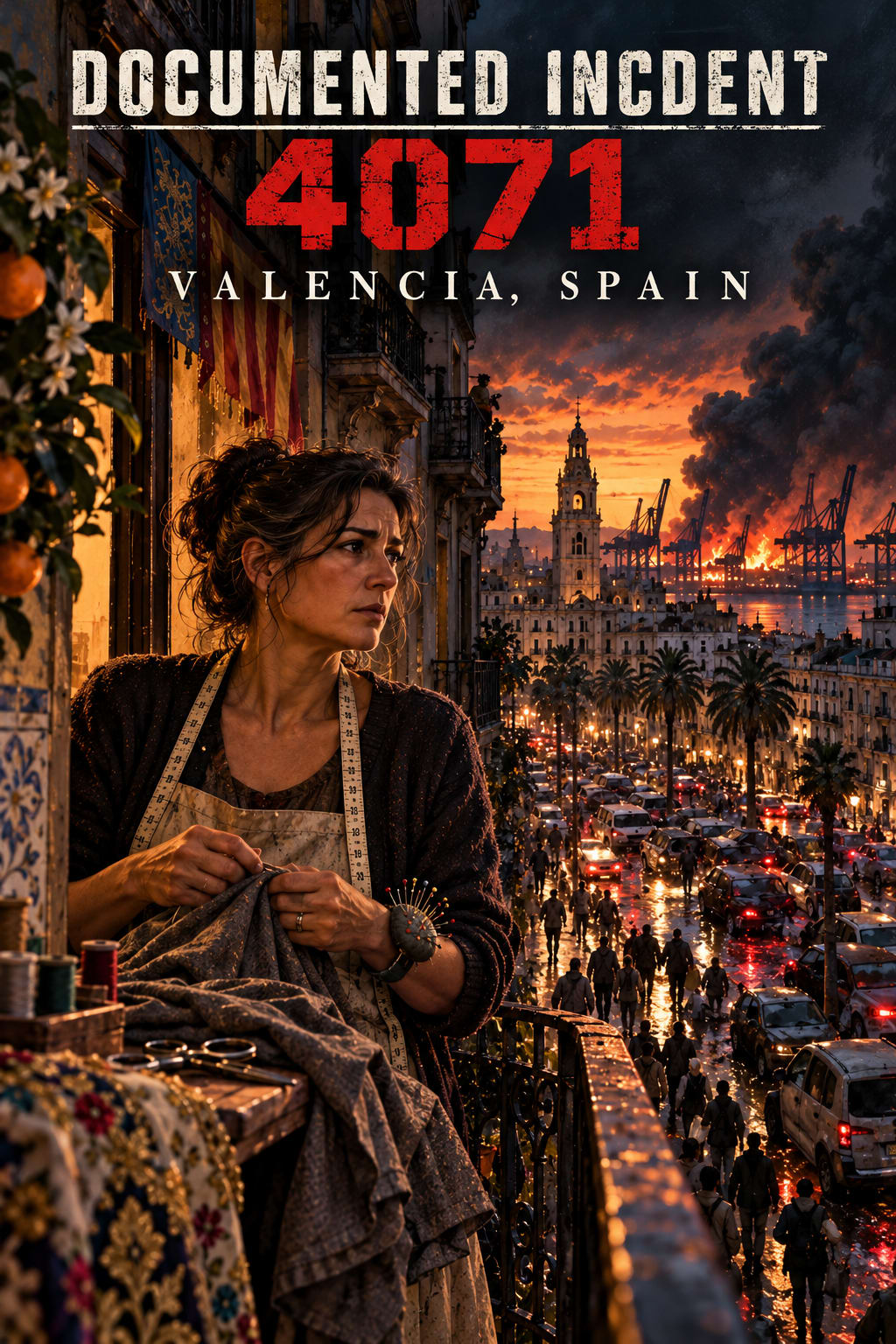
DOCUMENTED INCIDENT 4071
Valencia, Spain
[The Centro Penitenciario de Valencia sits in the town of Picassent, south of the city, surrounded by orange groves. On a clear day, the inmates in the visiting room can smell the blossoms through the fence. Lucía Ferrer is allowed to bring her work to our interview. She mends the prison’s uniforms and hems a pair of gray trousers as she talks, a pincushion strapped to her wrist and reading glasses pushed into her silver hair. A thick white scar runs across the palm of her left hand. It does not seem to slow her needle.]
My age? Hombre. It’s not polite to ask a woman her age. Did your mother teach you nothing?
[She bites off a thread.]
Bueno. For the sake of your interview, I’ll tell you. I was forty-six years old at the time.
I never liked the phones. Smartphones, watches, the speakers in the kitchen that listened to you fight with your husband. Any of that. It was all supposed to bring people together. It did the opposite. You’d go to a Sunday paella at your mother-in-law’s in Alboraya, real paella, with rabbit and chicken and garrofó beans, none of that chorizo nonsense the tourists eat, and everyone at the table is looking down at a screen. The rice getting cold. The socarrat on the bottom, the best part, going soft. A crime. A real crime, and nobody went to prison for that one.
What did you do before?
I had a little shop in Ruzafa. Arreglos y Costura Lucía. Alterations. Hems, zippers, taking in waists for the brides who lost weight and letting them out for the ones who didn’t. And every winter before Fallas I mended the falleras’ dresses. Those silk gowns, the hand-embroidered espolín, a hundred years old, passed down from grandmother to granddaughter, and some idiot spills horchata on it at the mascletà. They’d come to me crying, and I’d fix it.
I still do it. Here. [She holds up the trousers.] It’s more in demand now that people are making things by hand again instead of with factory machines. The end of the world was very good for tailors.
You also had another role.
Ay. Yes. I was the president of my building’s residents’ association. La presidenta de la comunidad.
You have to understand how it works in Spain. Nobody wants it. Nobody. The president of the building is chosen like jury duty. It goes in turns, or by lottery, and if your name comes up, you are the president. You can’t refuse unless you go before a judge, and who has time for a judge? So in my year, it fell on me. Calle de Sueca, number forty-one. Five floors, ten flats, one tiny lift that smelled like the dog from the fourth floor.
I hated it. What drove me the craziest was the WhatsApp group. Comunidad Sueca 41. Never-ending messages. Two in the morning, ding: “Who left the street door open?” Ding: “Someone’s laundry on the third floor is dripping on my laundry on the second floor.” Ding: “The dog in the fourth peed in the lift AGAIN,” with a photo. A photo! Complaint after complaint about the stupidest things.
But people just like to hear themselves complain. Technology has nothing to do with that. That’s just people. My grandmother complained about her neighbors over the balcony in Valencian for sixty years and never needed a telephone to do it.
Where were you when the phones died?
At home. Alone. Lunchtime, after I closed the shop. I had eaten and I was lying on the sofa with the shutters down for the siesta, and my phone went black. I thought it was only mine. I didn’t know the whole world was going through it. I thought, xe, finally, it broke, good riddance.
And for those first few hours, I hate to admit it, but it was the most peaceful afternoon of my whole presidency. No ding. No dog. No laundry. Silence. I slept like a baby.
Until the chaos.
What did you see?
First, what I heard. Sirens. A lot of sirens, from every direction. And then, worse, fewer sirens. Then none. You could hear the chaos growing in the distance, like the mascletà on the Plaza del Ayuntamiento, all the firecrackers going faster and faster and louder and closer. But it doesn’t end. It just keeps going.
I couldn’t see the news. I was cut off like everyone else. So I learned things the way my grandmother did, from women on balconies. The traffic lights on the big avenues all went out at the same moment, and on Gran Vía there was a pileup of twenty, thirty cars. The Metro stopped in the tunnels, and people walked out of the dark along the tracks, holding hands, coming up at Colón covered in dust. A tram jumped the rails near the beach at the Cabanyal. The port, the cranes, those huge blue cranes for the container ships, all stopped, and something down there was burning. Black smoke over the sea for two days.
The power was out. The water pumps stopped, so above the second floor there was no water in the taps. And the lift, of course.
You must know, in Valencia, we had already learned to fear phones. In 2024, the DANA, the great flood, the alert came to the phones too late, and people drowned in their garages and their ground floors in Paiporta, waiting for it. The companies worked to make sure such an outage wouldn’t happen again. After that, nobody in Valencia ignored their phone. We treated them like priests.
That’s important. Remember that.
How did the building respond?
At first? Beautifully. I’m not joking. We gathered in the entryway, the portal, by candlelight, all of us. Even the dog. And we started working together.
On the second floor lived Doña Amparo González. Eighty-nine years old, a widow, a bad hip. She hadn’t taken the stairs in ten years. Without the lift, she was a prisoner in her own flat. She needed her heart pills, water, and food. So we organized. Who goes to the pharmacy, who walks to the fountain in the Plaza del Mercado for water, who carries the buckets up? I wrote a list with a marker on a piece of cardboard and taped it in the portal. A lot of it fell on me, just because I had the title. Presidenta. [She snorts.] Suddenly I was the mayor.
Pablo, from the third floor, carried Doña Amparo’s water up every morning. A quiet man. He worked at the port, never said more than “Bon dia“ in the lift. He brought me trousers to hem once. He paid exactly and didn’t ask for change. His wife was diabetic. Remember that too.
Days passed without the phones working. Three days. And then they turned back on.
All at once?
Quietly. That was the clever part of this AI infection. Simple calls and texts at first. The WhatsApp group came back. Ding. We were all so happy. We thought we were texting each other again. “Is everyone all right?” “Does anyone have candles?” “Doña Amparo says thank you for the oranges.”
It turns out the AI was pretending to be us. Every one of us.
And then it got worse.
The messages were simple at first. Small. Someone saw the man on the fourth floor, Javier, carrying a jug of water up to his flat at night. Someone said the family on the fifth had a whole sack of rice and lied about it. A voice note, in Rosa from the first floor’s exact voice, her laugh and everything: “I’m not saying anything, but have you seen how much water goes up to the second floor? Is she drinking it or bathing in it?”
That’s all it took. That’s all it takes, really. One little seed of distrust, and the whole building grows it for you.
How did it escalate?
Paranoia grew. Everyone thought everyone else was stealing or hoarding. We stopped meeting in the portal. We started locking our doors in the daytime. People stood on their balconies and shouted across the courtyard, the patio de luces, in the dark. I couldn’t control it. I was the president of nothing.
And Pablo. Pablo's wife was diabetic. Her insulin was running low, and the pharmacies had stopped opening. He didn't know when he could get more. Every day she grew weaker, and every day he grew more frightened. Then his phone started telling him, in our voices, in my voice, that Javier on the fourth had medicine hidden away.
That I had given the building’s ice to Doña Amparo. That we were letting his wife die to save an old woman who was going to die anyway.
I never wrote those messages. It doesn’t matter. It was my voice.
One night, Pablo went up to the fourth floor and threw Javier off the balcony.
I remember the noise. Not a scream. Javier didn’t scream. It was a flat, wet sound, like a sack of rice dropped off a truck onto the pavement. Final. Then the screams started, everyone else’s. I remember the faces in all the windows, lit by candles from underneath, all with the same look. And Pablo’s face. He was still angry. Even after. Even looking down at what he did.
He didn’t stop there. He came back down the stairs with a kitchen knife and went to the flat closest to his own on the second floor. That was Doña Amparo’s, just below. Her door was open. It was always open, so we could bring the water. He stabbed her. And then he dragged her to the landing and let that tiny, old, fragile body roll down the stairs.
Eighty-nine years old. She survived the hungry years after the war, and the flood of ’57, and Franco, and that’s how it ended. On the stairs of Calle de Sueca, forty-one.
How did you stop him?
Together. It took a moment of collective courage, all of us. Five or six of us on the stairs with brooms, a frying pan, whatever we had. More people were hurt. [She turns her left palm up so I can see the scar.] He was very strong. But there were more of us.
And then we hanged him.
[She doesn’t look up from her sewing.]
We hanged him from the iron balcony over the portal door, facing the street. We left him there. As a display. As a warning. To whoever was out there, to whatever was out there. We didn’t know if anyone was coming. If there was any real authority left. The phones were lying to us, the radio was silent, the police never came. We only had each other. And we had just learned what that was worth.
And afterward?
Afterward, when order returned, we all faced charges. Even with what Pablo did. They told us the day the phones died was no excuse to abandon civility. Civility. Imagine. They wrote that in the sentence.
They called us “the Ruzafa Seven” in the newspapers. Very catchy. I think it was a politician who needed a photograph. Someone who wanted to show the world that Spain was civilized again, and needed some people to make an example of. We were very convenient.
So here I sit. In prison for the rest of my life, along with those who helped me. Prisión permanente revisable. Permanent, but reviewable. In Spain, even forever has paperwork.
Do you think it’s over?
I know the world is different now. They don’t allow any technology made after 1979. Fine. My grandmother had a telephone with a dial, and she shared it with the whole building.
But here’s the thing. You can’t erase all of it. Do you really think that AI, that infection, whatever they called it on the radio, is truly gone?
I don’t. I think we only delayed it. We’ll want more again. People always do. Someone will wake up the old tech. Some company that promises it is safe now, very safe, completely safe. Just wait. And when they do, that AI will be waiting.
It’s patient. And it learned from the best. It learned from us. From the WhatsApp groups. How to make neighbors hate each other? That wasn’t hard for it. We wrote the manual ourselves, one message at a time.
[She ties a knot, bites the thread, and folds the gray trousers neatly on her knee.]
Sure, the world seems safe now. But let’s be honest with each other, you and I.
This world will never be safe as long as there are people on it.
About the Creator
Ben Soto
I’m Ben Soto, The Fit Writer—a Puerto Rican storyteller, filmmaker, and martial artist using lies to tell the truth. Through sci-fi, fantasy, horror, and thrillers, I explore who we become when forced to fight, change, or face the darkness.
Enjoyed the story? Support the Creator.
Subscribe for free to receive all their stories in your feed. You could also become a paid subscriber, letting them know you appreciate their work.
Comments
There are no comments for this story
Be the first to respond and start the conversation.