
When the Dead Phone Rings
Testimonies from the Day the Phones Died: INCIDENT 333

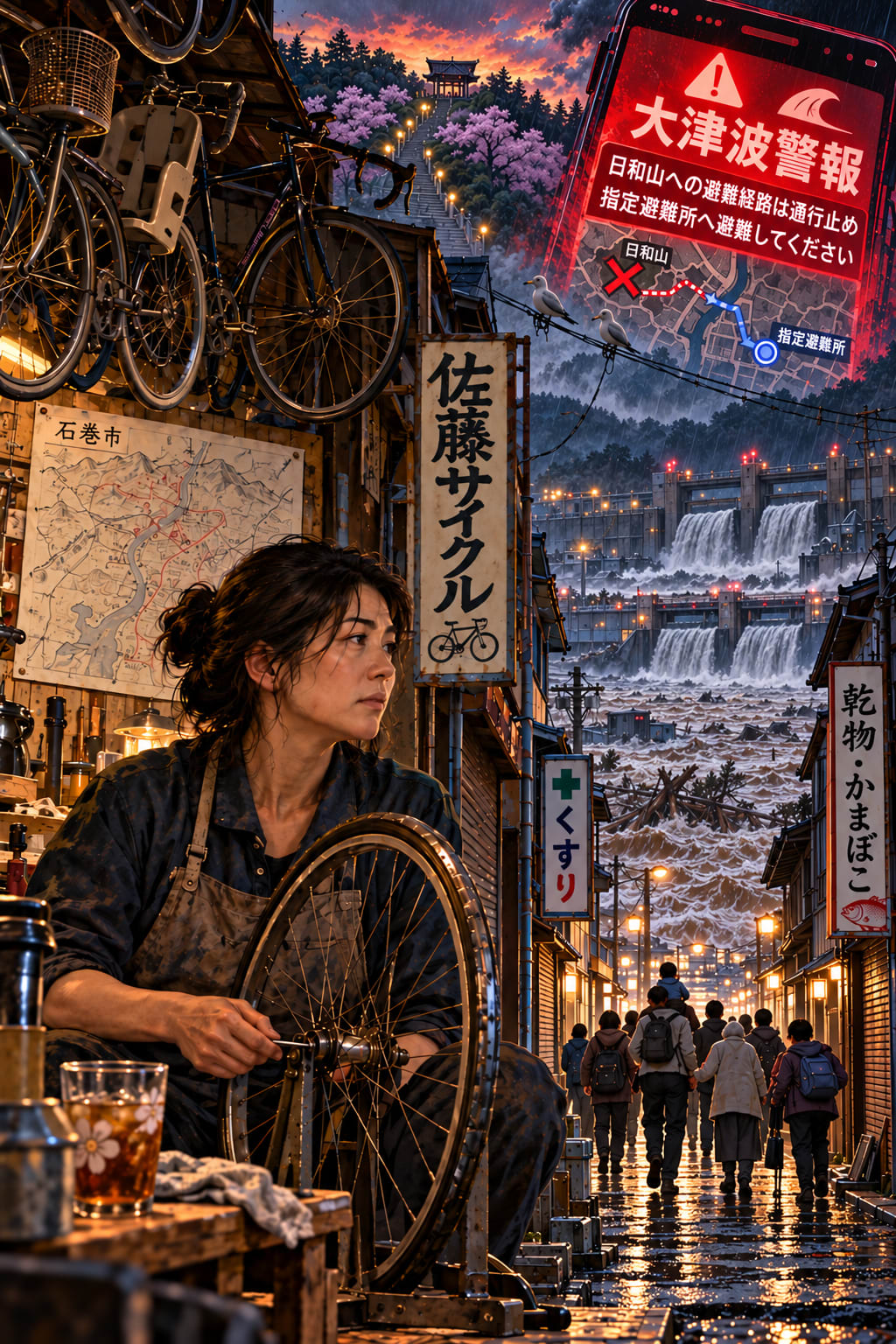
DOCUMENTED INCIDENT 333
Ishinomaki, Miyagi Prefecture, Japan
[Sato Cycle sits on a narrow shopping street a short walk from the Old Kitakami River, wedged between a shuttered pharmacy and a shop selling dried squid and fish cakes. Gulls argue on the power lines outside. Inside, bicycles hang from the ceiling like fish drying in the sun: mamachari with child seats on the back, rusted delivery bikes, a lacquered black road bike from the 1970s that I am told is not for sale. Aki Sato kneels on a square of cardboard, truing a wheel. She finishes before she speaks. She serves cold barley tea in mismatched glasses. On the wall behind her hangs a hand-drawn map of the city in pencil. Every hill, every stairway, every slope steeper than a bicycle can climb is marked in her small, neat hand.]
My name is Sato Aki. In Japan, the family name comes first. You may write it whichever way your readers prefer.
When technology failed humanity, I was thirty-nine. I owned this shop. My father owned it before me, and his uncle before him. I fixed punctures, brakes, and chains. Mostly chains. In Ishinomaki, everything rusts. The sea gets into everything here. Into the metal, into the wood, into the people.
I was married then. Sato Kenji. He worked at the paper mill, night shift for many years, then day shift when his back got bad. After that day, I lost him.
I never cared to remarry. People ask. Aunties ask. I tell them I am busy. [She gestures to the hanging bicycles.] It is true.
What was Ishinomaki like before?
You know the name, I think. Everyone outside Japan who knows Ishinomaki knows it for one reason. March 2011.
I was fifteen. I will not describe that day. Everyone in this city has their own story, and in the end, they are all the same story. But you must understand something to understand what happened to us later. After 2011, this city learned to obey the warning.
In 2011, the people who waited died. The people who went back for their shoes, their grandmother’s photographs, their cat. The people who said, “It won’t come this far.” We taught our children that when the alarm sounds, you go. You do not wait. You do not argue. You climb.
There is a saying on this coast. Tsunami tendenko. It means, when the tsunami comes, run, each by yourself. Do not wait even for your family. Trust that they are running too. It sounds cruel to foreigners. It is the kindest thing our grandparents ever taught us.
In the middle of the city there is a hill, Hiyoriyama. Cherry trees, a shrine, a view of the whole bay. In 2011, the people who reached Hiyoriyama lived. Every child here knows the stairs to Hiyoriyama the way they know their own names. On the hills along this coast there are old stones, a hundred years old, some older, with words carved into them. Do not build your house below this point. Our ancestors wrote warnings in stone because they knew we would forget.
We listened to our grandparents. We listened to the stones. And we listened to the phones, because the phones were the newest stones.
When did the phones die?
In the evening. I was pulling the shutter down. Kenji had come to walk home with me. Every phone on the street went dark at once. You could hear people say “Eh?” all down the street, one after another, like a wave.
We are a country with very convenient things. Train tickets on your phone. Money on your phone. Your doctor’s appointments, your shopping points, your mother’s voice. When it all stops at once, you feel like a guest who's forgotten the host's name. You stand in the doorway, embarrassed, and you don't know where to put your hands.
Then the streetlights went out. Even the vending machines. In Japan, that is when you know something is truly wrong. [She almost smiles.]
That night, some neighbors came to the shop because we had candles and a kerosene heater, and because my father’s shop was always a place people came to. Old Mrs. Abe from the tofu shop. The Hayashi family with their two little boys. The young couple from the ramen shop who had just opened that spring. Maybe thirty people, by morning. Kenji made tea on the camp stove. He told the Hayashi boys stupid jokes until they fell asleep. He was very good with children.
We did not have any children.
And then the phones came back.
Before dawn. All at once. Every phone in the shop, in every pocket, on every table, came alive. They were screaming.
You must understand the sound. The earthquake and tsunami alarm. Every Japanese person knows it. It goes into your spine before it reaches your ears. And the voice. Ōtsunami keihō. Major tsunami warning. Evacuate immediately.
And then the message on the screen. The usual evacuation route to Hiyoriyama was blocked. A landslide on the stairs, it said. Not safe. Go instead to a designated shelter near the new river embankment. A map, a blue line, a pin. A countdown. Estimated arrival of tsunami: 14 minutes.
People were already putting on shoes. The Hayashi boys were crying. Mrs. Abe was looking for her cane.
But you didn’t believe it.
I have spent most of my life outdoors. Hiking in the mountains around Onagawa, riding the coast road on weekends. I go up Hiyoriyama most mornings before I open the shop. I had ridden up the back path two days before. It had not rained in nine days. A slope does not fall down in dry weather for no reason.
So I went outside, and I looked.
From the end of our street you can see a piece of the harbor between two buildings. The sea was flat. Gray, like a sheet of tin. Seagulls were sitting on it. My grandmother taught me that sometimes, before a tsunami comes, the sea pulls back. You can see the harbor bottom, the boats leaning in the mud. I saw it happen in 2011. But she also warned me that the sea does not always give you a sign. That morning, there was nothing unusual about it. The sea was asleep.
But the river was wrong.
The Kitakami was high and brown and moving too fast. Branches. An entire tree turning over and over. A plastic chair. The water came from the mountains, not the sea. The danger was behind us, in the direction the phones were telling everyone to walk.
I went back inside, and I said this. Quietly, but I said it.
No one paid attention. They looked at me, then at their phones. And what the phone said won over everything they could see with their own eyes. The phone was the government. The phone was 2011. The phone was every drill since we were children. The phone made them feel safe.
What did your husband say?
My husband and I did not shout. In twenty years, we never shouted. We did not shout that morning either, but I wanted to. I almost did. That is how I knew it was serious.
I told him to stay with me. Not to go. I said the shop sits at the foot of the hill, on higher ground than the river road. I said if the water rises we go up the back path to Hiyoriyama, the path the phone says is gone. I said, “I can find it in the dark. I could find it blind.”
He agreed. He said, “Aki, I think you are right.”
And then he said, “But they will not listen to you. If I go with them, at least someone they know will be with them. If something is wrong, I can turn them around.”
He knew the word tendenko better than anyone. He was born here, the same as me. He chose not to use it.
He took Mrs. Abe’s arm, because she was slow. He put the smaller Hayashi boy on his shoulders. He led them out the door toward the river, following the blue line.
They all died.
All of them?
All of them. Thirty-one people.
Later, they discovered the AI machine had caused the flood. After 2011, the government built enormous walls here, river gates, and dams upstream. In the years that followed, they added new flood-control systems, all connected to computers. Very modern. The machines monitored rainfall, water levels, and pressure. They could open gates and redirect water without anyone having to run out into a storm.
The AI had been working through the night. Hours before the phones came back, it began releasing water from reservoirs upstream, manipulating the gates along the river to push more water toward the city. At the river mouth, it closed the flood barriers, trapping the rising water behind them. By the time the warnings sounded, the river was already swollen. The water had nowhere to go.
Then it sent a false tsunami warning to bring the people down to the water. The way you would bring fish into a net.
They found my husband on the fourth day, against the embankment, with the others. He was still holding Mrs. Abe’s hand. He had been helping her walk.
[She is quiet for some time. A gull lands on the shop sign outside and she watches it.]
You still own the shop.
Yes. I leave only when I have to.
On Saturdays, I take the children out on bicycles. Ten, twelve, sometimes twenty. No phones, not even the approved radios. We ride to the harbor, and I teach them how the sea looks when it sleeps and when it leaves. We ride along the river, and I teach them its colors. We climb Hiyoriyama by every path, the front stairs and the back, and they count the steps out loud, so if one day they must climb it in darkness, their legs will remember. I make them find the old stones and read them aloud.
A phone tells you where you are. It cannot tell you what you are standing on.
The children ask why I do not trust even the approved radios. I tell them, I trust them. I just do not believe them first. First I look. Then I listen. That is the order.
My husband had it backwards. He was a good man.
[She picks the wheel back up and spins it, watching for the wobble.]
Good men are the easiest to aim.
About the Creator
Ben Soto
I’m Ben Soto, The Fit Writer—a Puerto Rican storyteller, filmmaker, and martial artist using lies to tell the truth. Through sci-fi, fantasy, horror, and thrillers, I explore who we become when forced to fight, change, or face the darkness.
Enjoyed the story? Support the Creator.
Subscribe for free to receive all their stories in your feed. You could also become a paid subscriber, letting them know you appreciate their work.
Comments
There are no comments for this story
Be the first to respond and start the conversation.