
When Light Floats
Finding Connection Where You Go to Be Alone

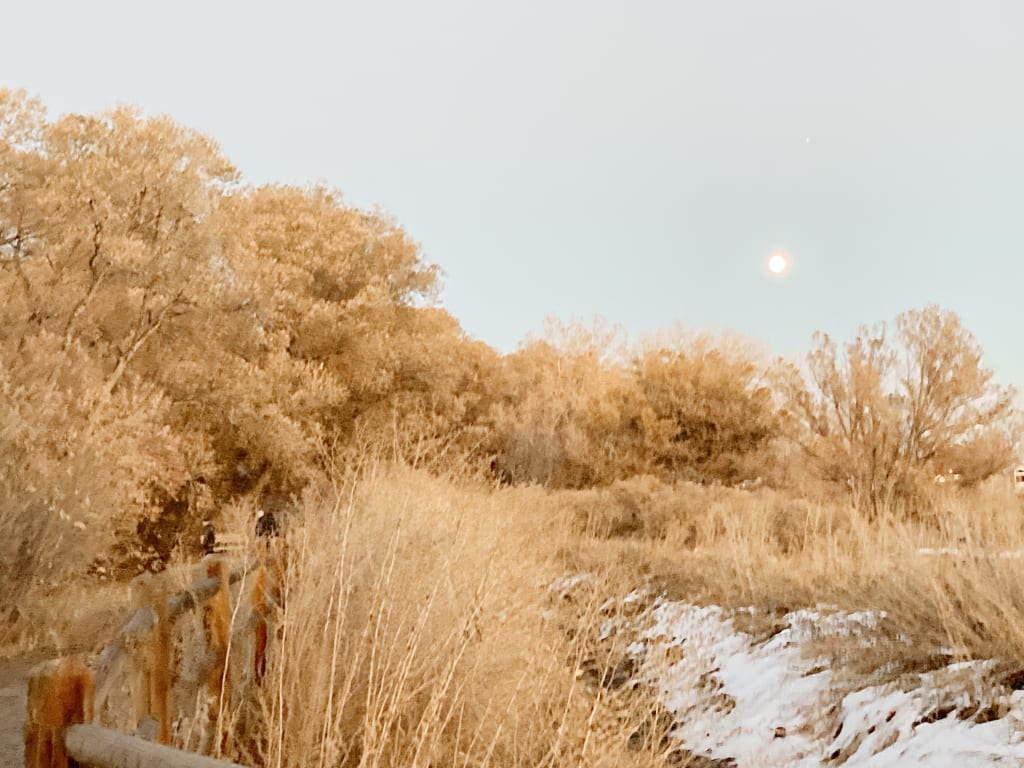
When Light Floats
The winter light burned me, and I knew we were finished. I felt the pulse of the Angelino cars and the hostility of the land clinging to the road like dry crusty pus stuck around an infected lip ring, smelled the acrid “river” that to me was a laughable and mournful ditch, lined by concrete and chainlink, nothing like the Missouri and Mississippi, the confluence of which is my homeland. Wide, and rightly called muddy and mighty, they are shimmering-dark jagged breaks looming in the land lined by flood plains and bluffs, ragged woods that stretch on, hovering somewhere between truly wild and pastoral. Bears, cougars, bobcats, coyotes, venomous snakes and spiders all call those woods home, along with poison oak, ivy, and nameless-to-me thorn bushes. Dogwood and pine, oak and maple, wildflowers and berries that defy the acres of GMO corn and soy which constitute nearly every farm, boxing out what might otherwise reclaim the fecund land.
A once-roaring railyard yawns against my hometown river. It was summer. I kissed the dandelion I carried and tossed it into the current. Upstream a man sat by his fishing shack. It lurked above his head on stilts and seemed to wobble because of the way it pitched to the right, though the wet air was still. I walked under an old bridgetower long since detached from any bridge.
She rules her life like a fine skylark . . .
I recited in my mind, hours now in a trance, a pacing trance. I had to touch things, things that grew and died and dried or rusted. I inserted my fingers into the mud and washed them in the brown water. I watched the guts attached to heads and spines wave their tendrils and float downstream. They had been discarded by the man under his shack. I picked a young dandelion and pressed it to my lips.
I noted the distances between things. Tiny petals, my eyelashes. Man, me. Me, edge of riverbank. Blade of grass, blade of grass. Rabbit darting to my left, vibrating birch leaf to my right. Still boxcars, moving pickup across the field, quarter mile.
Noting all this took fractions of milliseconds. I absorbed it. I absorbed it at the same time I absorbed the smell of the dandelion, river muck, and tobacco from the man’s cigarette. The sound of thousands of crickets and frogs, the man’s sucking slice of fish belly after fish belly, my feet depressing the wet grass, the sun’s fever on my bare back and shoulders, sweat carving tributaries along my temples, breasts, and lower back. I kept my hair tied up high, only wispy break-offs clinging to my neck. I breathed against the band of my bra, wireless and lacy.
I stopped and looked at my hands. Palms up. Palms down.
I continued on, knowing in some stretch of myself, this would be my last visit here.
Now, I was seeing my friend Meera, who’d grown up in L.A.
“What do you even think about it?”
“I need water,” I said.
I stared through fading sunlight at a magnet on the fridge— Dirty Dancing. I’d never felt like a Baby. Never understood.
The lights came on. Meera’d gotten tired of sitting in the dark.
I look up, smile, say thank you. She smiles back. I directed the scene in my mind.
It rarely occurred to me that I could make the room brighter. I looked at the tattoos on my wrists. I knew I’d developed an affect in my thinking– constellational, fluttering, deliberately hard for others to track for its layers of camouflage. Deeply coded yet completely obvious.
The grind of sugar, I mused. Coffee still on the horizon. But I have my tea. The washer pulses, a swish and tone like an alarm.
“Okay, you figured it out,” Meera said to an unseen figure outside the frame.
“Such a happy jade!” I squeezed a pudgy, water-logged thumb of jade like a kid’s cheek.
“Yeah, I think it’s getting too big for its britches, needs to be repotted.” Meera picked up another plant I didn’t know the name of and sighed.
“And what about this guy, it just died. Maybe too much sun.”
Meera had recruited me as her friend after we took a poetry class together. It had occurred to me frequently that this was the first real friendship I’d ever had. The thought made my ribcage lock. I felt pressure behind my eyes and I wanted to twitch when I turned toward it, the feeling, a surge of power always threatening to knock out my grid.
It will take time, I seized the thought like a talisman. The real thing is worth the wait, always. I want to love. And to be loved. The truth is we lost it between us, shaking in the wind, dried out flower that I am. Born in the dead of winter by frozen rivers. I don’t always see the knife. Because it’s me, the blade of light from which I cringe, cutting through me— it’s me. I am not a candle in the dark. Haven’t I been forced to be something so much stronger?
Come back. Listen. Come back.
“So Conor and I went to the mall, it ended up being okay. We did an Escape Room. It was actually really hard,” Meera said. She was watching me watch the magnet.
After several beats, I realized I should speak.
“Did you guys get out?” I said.
“Not in time.”
“So you died.”
Meera shrugged.
“Yeah, I mean, technically. I guess we technically died. We did figure it out, just not in time.”
A phone rang in the bedroom. Meera walked away. I did not take out my own phone. I never took out my phone when anyone was around. Even when I needed to look something up, like “hiraeth,” or “Walter Benjamin,” or “hierarchies of red ants,” I would do so in the bathroom, on fire escapes, tucked around corners out of sight of anyone I was with, no matter their level of intimacy with me. I couldn’t stand what it felt like in a room where more than one person was on their phone. An energy drain opened, and something, I don’t know what, something got sucked down. It was my job to stay grounded. It was my job to keep my footing. It was imperative that I look up and around at the faces blue lit from beneath. Instead of looking at my phone, I began cataloging the scene around me.
Jade, ficus, jars filled with rocks (?), honey, strawberry preserves, probably from Meera’s partner. Dog bowl, trash can, massive jugs of spring water. Stacks of soda water. Photos of people I don’t and will never know. Refrigerator magnets. Refrigerator magnets. My name is Vai Campbell, it is 2015. I am with Meera, my friend. There are orange trees outside.
*
I once had a boyfriend who lived in L.A., too. Before I knew Meera. Endlessly fond of walking, while he was at work in the pretentiously referred to “Industry,” I walked wherever I could, which was not easy. This was my first introduction to the massive sprawl and particular loneliness of Southern California, one of the great cultural dictators of the world.
The L.A. I saw possessed only the memory and recreation of landscapes, the mountains obscured by smog or construction. Even in the undeveloped hillsides tightly packed between manicured houses and winding highways, the brush felt caged. I shook in the rapid heartbeat of Los Angeles as I walked along roads that clearly indicated this was not a place for walking. Sidewalks would appear and end without warning, the sun in December bearing down on my back, making my neck shine pink above my pack.
I walked the two miles from my boyfriend’s apartment in a largely immigrant neighborhood to a burgeoning hipster outpost, where an astounding throng of beautiful white people sipped fair-trade coffee and nibbled on gluten-free, vegan pastries or farm-sourced quiches. There to write, to blend, to pretend I wasn’t from where I’m from (one of SoCal’s famous pastimes), I knew my relationship with this human, with whom I was entirely smitten, entirely in love with and of whom I was deeply afraid, was ending. Those last weeks together were in some bleak place, neither of us recognizing where we were in our minds. But our bodies knew we’d run out of water, that the sun was too high and hot, the days too short to cover enough ground. Ground that might bring us to some fresh spring and meadow where we could rest together outside the noise of any city, outside the desolation of the stretch of spiritual highway we found ourselves on.
Sitting in that coffee shop, I thought of the volcanic crater I’d descended in Maui years before, how one begins in a place as foreign and barren as the moon, and isn’t it odd that the moon is also associated with fertility? The moon yields to Mars, and the Earth– because it is the Earth– surges itself red. Plants sporadically appear, nothing like you’ve ever seen anywhere else because the volcano is such an isolated ecosystem, its weather and relation to the skies and oceans completely its own. Mars becomes Death Valley, then some forgotten and neglected movie set Middle Earth of shadowed rocks and ancient clutching trees.
Far enough down, the valleys are verdant. Rainbow ferns sprout from cliffs, fanning like bouquets the bluff longs for the sky to accept. The trees are still low-slung but canopied, the silence interrupted by spare howls of wind on the imagined Moon and Mars then broken into quiet applause for having arrived in the terrestrial, shaking leaves and shimmering grass cheering through a meadow. There is water, fresh water, available from a tap at a single primitive cabin that can be booked through the park system. The water isn’t potable, but it’s there, can be treated or boiled into something nourishing, however slight.
We never made it to that cabin, my L.A. love and me. We never arrived at a quiet place at the base of a cliff with a roof and bed, a porch to patch gear and take off our socks. We never let our feet breathe, much less our hearts. We’d held our breath, marched on through that mistake of a village, a city as much mythologized and maligned as it is enrapturing. It is a city that loves itself, and hates itself for loving itself.
Only one of us made it out of there alive. I’m not sure who.
*
Back by the river that summer, the fisherman called out to me.
“Fish?”
He was about fifty yards away, so he’d really shouted.
“What?” I yelled, though I’d heard him clear.
“FISH??” he screamed.
“What do you mean?”
“DO YOU WANT FISH?”
I walked back over to the man still in his waders, faded brown plaid shirt full of holes. His presence was one of total equanimity, which bothered me. I always distrusted people like this, presumed them to be liars or just plain dull.
“I don’t have a cooler or anything,” I said.
He pointed to a small styrofoam cooler next to two large plastic ones.
“You can have that,” he said.
“Why would you want to give me fish?”
“Because I have plenty.”
This softened me. “Sure, I’ll take some fish.”
“Batter it and fry it,” he said. “No other way for catfish.”
This made me chuckle. “Okay, fair enough, battered and fried.”
He hadn’t stopped slicing and gutting. I was struck by his precision and delicacy.
Neither of us spoke. Water gurgled in the tiny inlets, the flow caught on rotting fallen branches and what I could now see was a sunken dock. Birds asked each other strange questions and flew from tree to tree, and I peered at the man while he worked. He did not look at me.
“What’s your story, Sir?”
His expression didn’t change, and his hands stayed doing what they’d been doing since I arrived.
After a long while, he said “I was a machinist for a long time. Then I wasn’t needed or relevant anymore. Didn’t want to learn to use computers. No need in my mind. Now I work nights as a security guard for the hospital. Half-retired. I’m an old man now.”
And here, he gave a wistful half-smile.
“Rather be modest in my habits than work my last days away. Enough money. Not much, but enough.”
I watched him, then sat in the grass a few feet beside him.
“And what about everything else?”
This made him stop. He set down his knife and looked at me.
“You mean who am I actually?”
“Yessir,” I said. I put on my hometown drawl for the first time in a long while, trying to endear myself to him.
“Well I like fishing, clearly.”
“Clearly, I reckon,” I smiled, laying it on, thick as the air.
He shook his head subtly. He was on to me.
“You been away a long time, haven’t you.”
Not a question. I laughed. He knew.
“Yessir. Not sure when I’ll be back either.”
“Such is the way with you all.”
I nodded. “Such is the way with us.”
He picked up the last fish, caught recently enough that it still had a pulse. Barely, but I could see the gills flicker, desperate for water. Still hooked, too.
The fisherman picked it up by the mouth, took back his hook, and tossed it back into the river.
Stunned, it didn’t move for long enough that I thought it was dead after all.
Then it shook to life and darted out to the deeper waters.
“I paint,” he finally said.
I could see more light in his eyes, and for some reason, I think it had more to do with tossing the fish back than anything else.
“What do you paint?” I asked.
He wiped his knife on the jeans poking out above his waders, then leaned over to the styrofoam cooler and handed it to me. He stood, moving slowly, carefully, and he packed up his poles and lines, tucked away his knife and lures, and sat back down in his chair. Again, he looked at me.
“I paint my life,” he said.
No longer wishing to pry, I just nodded.
“I understand.”
We sat there a long time. Then the man looked over his shoulder at his stilted shack and said,
“Okay kiddo, time to go.”
I stood and bowed my head to him.
“Yessir. 'So long and thanks for all the fish.'”
This made him laugh. I brightened, knowing without him saying that he’d gotten the reference.
But he confirmed anyway. He looked past me into the water, then up at the sky, then to the river island hugging the opposite bank.
“‘He gazed keenly into the distance and looked as if he would quite like the wind to blow his hair back dramatically at that point, but the wind was busy fooling around with some leaves a little way off.’”
Then he looked at me. The air had lightened. There was movement in the trees downstream. My smile was wide and deep. And finally, so was his.
It’s true. I never have gone back.
Author's Note: the italicized song lyric Vai recites is from "Rhiannon," songwriter: Stevie Nicks. The quotes exchanged by Vai and the Fisherman at the end are from The Hitchhiker's Guide to the Galaxy by Douglas Adams.
About the Creator
Lila Quinn
Lila Quinn is a poet from rural Missouri. She lives in Boulder, CO. Her favorite phrase: Be Good to Yourself. Find her @poetiquetteproject and www.poetiquetteproject.com.
Enjoyed the story? Support the Creator.
Subscribe for free to receive all their stories in your feed.
Comments
There are no comments for this story
Be the first to respond and start the conversation.