
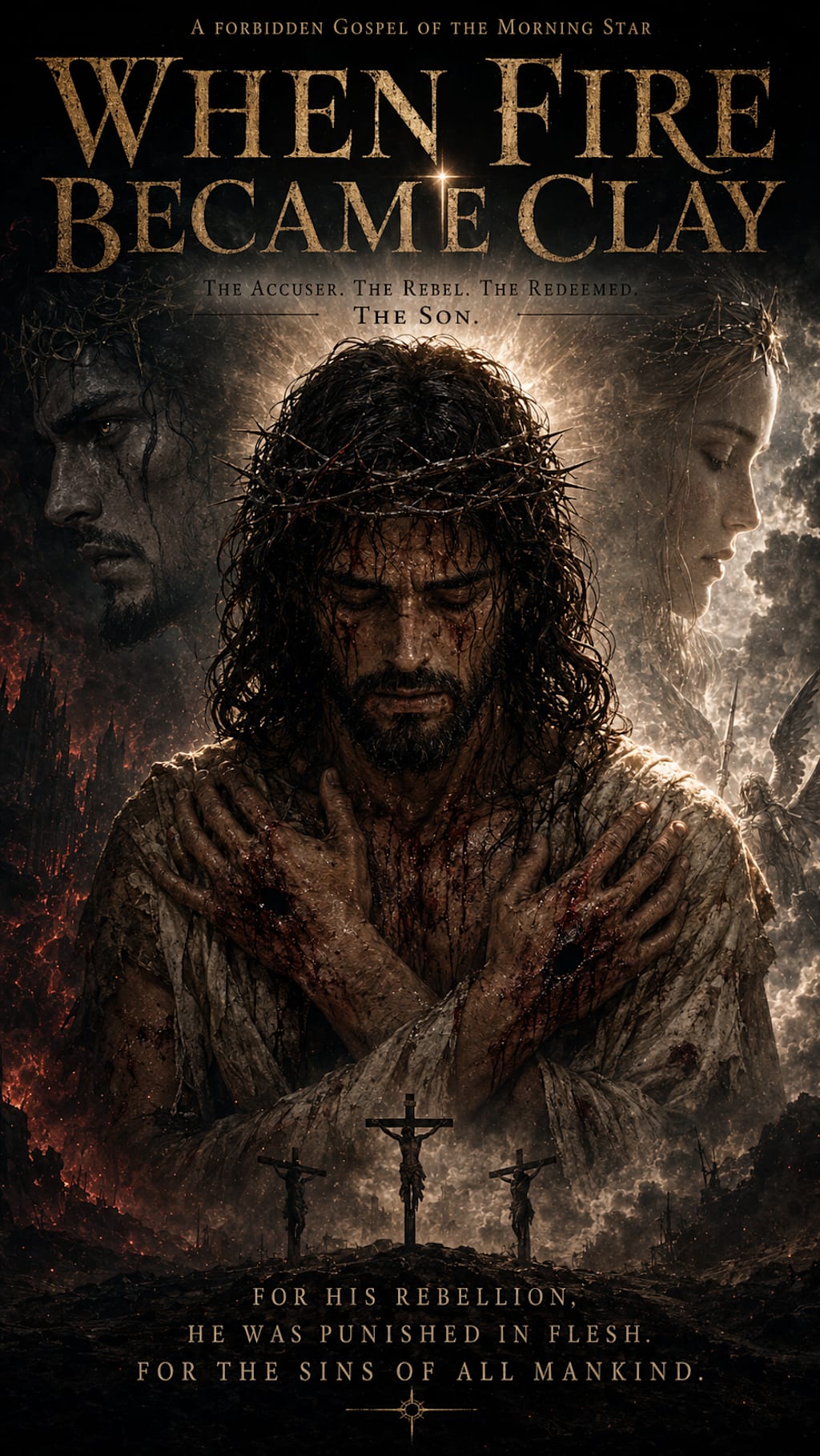
WHEN FIRE BECAME CLAY
A forbidden gospel of the Morning Star 🜂✝️
Hell had grown old around him.
Its first fires no longer roared.
They listened.
They had learned the shape of his silence.
They had learned the weight of his footsteps.
They had learned that when Lucifer sat upon the black throne and said nothing, whole kingdoms trembled in the memory of Heaven.
He was no longer merely fallen.
Falling was an event.
This was what came after.
Ages had passed since Michael’s sword opened him and cast him through the unformed dark. Ages since his wings burned black. Ages since his halo hardened into iron. Ages since the last light of Heaven became a star above the smoke.
And still, he looked at it.
Not always.
Not when the fallen gathered.
Not when kings arrived wearing crowns made useless by death.
Not when murderers came carrying their excuses like coins for a ferryman.
Not when priests, generals, merchants, lovers, traitors, and cowards stood before him begging to be misunderstood.
But sometimes.
When Hell slept, if Hell could sleep, Lucifer looked upward.
One star remained.
It did not forgive him.
That would have been unbearable.
It did not call him home.
That would have been insulting.
It simply remained.
And because it remained, he hated it.
Because hatred, given enough centuries, becomes a kind of prayer said backward.
Upon his throne of black glass and old fire, Lucifer had perfected accusation.
He had become the knife beneath every lie.
The dead came before him one by one, and he saw them clearly.
That was his gift.
That was his curse.
That was his kingdom.
A king came once, still reaching for a crown no longer on his head.
“I did what I had to do,” the king said.
Lucifer leaned forward.
“No. You did what made you feel necessary.”
A soldier came, his hands shaking.
“I followed orders.”
Lucifer’s eyes burned softly.
“And called obedience innocence.”
A priest came wearing robes that smelled of incense and fear.
“I served God.”
“You served power in God’s clothing.”
A mother came with her face full of ruin.
“I failed them.”
Lucifer stared at her a long time.
“Yes.”
She bowed her head.
“But I loved them.”
Hell became quieter.
Lucifer’s fingers curled against the arm of his throne.
Love.
That old word.
That word with teeth.
That word that had walked beside him in Heaven wearing golden-brown hair and sorrowful eyes.
That word that had touched the wound in his shoulder before it became the wound in creation.
That word that had chosen Michael.
Lucifer dismissed the woman into judgment.
But the word remained.
Love.
He had accused mankind for ages, and mankind never stopped surprising him in the same miserable way. They lied. They betrayed. They broke each other for hunger, fear, land, worship, pleasure, pride.
Clay was weak.
He had been right.
Yet within that weakness, something kept happening.
A son forgave a father who never deserved it.
A woman shared bread with the child of her enemy.
A thief wept before stealing and hated himself afterward.
A murderer remembered the name of the man he killed.
A dying soldier called for his mother.
A starving girl fed a smaller child first.
None of it erased guilt.
Lucifer knew better than anyone that love did not abolish consequence.
But it complicated the accusation.
And Lucifer hated complications.
He had built Hell on clarity.
Then, one night beyond nights, the fires bowed.
Not to him.
That was the first insult.
The second was silence.
Hell became quiet enough for Heaven to enter.
No gate opened.
No trumpet sounded.
No army descended in white fire.
No Michael came bearing the sword of necessity.
No Elyra stood at the edge of light with grief in her hands.
Only a voice.
The voice.
Lucifer rose from his throne.
All Hell bent away from him, not from fear of its king, but from fear of what had entered.
Lucifer smiled.
It was a beautiful smile once.
Now it was a wound practicing elegance.
“You come late, Father.”
The silence deepened.
Lucifer stepped down from the throne. His iron halo tightened around his brow as if remembering it had once been gold.
“I have ruled what You abandoned,” he said. “I have become what Heaven named me. I have given Your beloved clay the honesty it spends its life fleeing.”
The voice did not answer in anger.
That was worse.
Lucifer’s wings opened behind him.
Black. Vast. Ruined. Beautiful still.
“Have You come to unmake me?”
The fires trembled.
Then God spoke.
“No.”
Lucifer’s smile faded.
“Then why come?”
The answer moved through Hell like dawn entering a tomb.
“Because accusation is not the end of truth.”
Lucifer laughed once.
It sounded like a blade dropped on stone.
“Truth? I have served truth more faithfully than any angel who remained. I have shown You mankind as it is. I have exposed their hunger. Their betrayal. Their violence. Their cowardice.”
“You have seen their wound.”
“I have seen their nature.”
“You have seen your own.”
The words struck deeper than Michael’s sword.
For one breath, the Accuser had no accusation.
Then his face hardened.
“I will not kneel.”
“I have not asked you to.”
“Then what?”
The star above Hell burned brighter.
For the first time in ages, Lucifer looked afraid.
God said:
“You would not kneel before clay.”
The throne behind Lucifer cracked.
“So you will learn what clay can carry.”
The fires recoiled.
Lucifer understood too late.
“No.”
His crown split.
His wings ignited, not with Hellfire, but with the old light.
“No.”
His armor broke from him in burning plates.
“No!”
The fallen cried out, not in rebellion, but in terror.
Their king was coming apart.
His hands, once bright enough to command legions, became small.
His voice, once vast enough to accuse creation, became breath.
His memory folded inward like a star collapsing into flesh.
His name vanished.
His throne became ash.
And somewhere beneath a Roman sky, in a poor province beneath the weight of empire, a young woman woke from a dream of fire.
Mary placed a hand upon her womb.
Outside, Nazareth was quiet.
Above her, one star burned brighter than all the others.
And in the dark between Heaven and Earth, the Accuser fell again.
This time…
into mercy.
I. THE CHILD OF DUST
He was born crying.
That was the first humiliation.
Not the poverty.
Not the straw.
Not the animals breathing steam into the cold.
Not the rough hands receiving him.
Not the young mother trembling from pain and wonder.
The cry.
That thin, desperate sound.
Need made audible.
Once, he had sung before creation had weather. Once, his voice had moved through Heaven like gold through water. Once, armies turned when he spoke.
Now he cried because air hurt.
He cried because his body did not know how to be alive.
Mary held him to her chest and wept into his dark hair.
“There,” she whispered. “There, my son.”
Son.
The word entered him before memory did.
Joseph stood nearby, helpless with joy and fear, a carpenter with calloused hands who did not know where to place them. He looked at the child as though entrusted with a flame that might bless or burn the world.
The child stopped crying when Mary held him close.
Not because he understood.
Because warmth answered need.
And somewhere deep beneath the folded veil of flesh, something ancient trembled.
He dreamed before he knew language.
He dreamed of height.
Of falling.
Of wings spread against a white horizon.
Of a sword descending with sorrow.
Of a woman with golden-brown hair standing at the edge of a light he could not reach.
He would wake screaming.
Mary would gather him.
Joseph would rise from sleep, take the lamp, check the door, check the window, check the sky, as if nightmares could be kept outside with wood and iron.
“What does he see?” Joseph asked once.
Mary looked down at the child.
His tiny fist gripped her sleeve with the desperate authority of the powerless.
“I don’t know,” she said.
But she kissed his forehead.
And the child slept.
He learned hunger.
Not hunger as metaphor.
Not hunger as philosophy.
Not hunger as complaint from a throne.
Hunger as emptiness in the belly.
Hunger as waiting.
Hunger as dependence on another hand.
He learned thirst.
He learned fever.
He learned the terror of being small in a world full of sandals, wheels, dogs, soldiers, shouting men, and doors too heavy to open.
He learned that flesh bruised.
He learned that knees bled when they met stone.
He learned that the body demanded sleep even when the spirit resisted.
He learned that tears came without permission.
Worst of all, he learned tenderness.
Mary’s fingers combing straw from his hair.
Joseph lifting him onto his shoulders so he could see over a crowd.
Bread torn in half and given to him before either parent ate.
A neighbor woman laughing when he mispronounced a word.
A lamb pressing its soft head against his palm.
He did not know why tenderness hurt.
Only that it did.
As a boy, he once saw Roman soldiers drag a man through the street.
The man had stolen.
Or insulted someone.
Or owed tax.
The reason changed depending on who told it.
The result did not.
The soldiers struck him, and the crowd watched with the practiced stillness of the conquered.
The boy stepped forward.
Joseph caught his shoulder.
“Do not,” Joseph whispered.
The boy’s eyes burned.
“He is helpless.”
Joseph’s grip tightened.
“So are you.”
The boy turned on him, furious.
The words rose in him from somewhere older than childhood.
“I am not helpless.”
Joseph stared.
For a moment, the marketplace vanished.
For a moment, the boy stood like someone remembering a throne.
Then Mary appeared beside them and touched his face.
“My son,” she said softly.
The fire went out of his eyes.
He looked suddenly frightened.
Joseph knelt before him.
Not as a subject kneels.
As a father does when his child is afraid.
“Listen to me,” Joseph said. “Strength is not always stopping the blow.”
The boy looked toward the beaten man.
“Then what is it?”
Joseph’s face tightened.
“Sometimes it is remembering the blow.”
The boy did not understand.
Not yet.
But he remembered.
II. THE TEMPTATION OF MEMORY
Years passed.
The child became a young man.
He worked with wood.
That, too, was part of the sentence.
The hands that had once held light now learned splinters.
He shaped beams.
He carried planks.
He sanded roughness away one patient stroke at a time.
Joseph taught him to measure twice, cut once.
Mary taught him to listen before speaking.
The world taught him that empire did not need to shout to be cruel. It simply arrived, counted, taxed, ordered, punished, and left dust behind.
The young man watched mankind.
Not from above.
From within.
He saw cowardice, yes.
He saw lies.
He saw betrayal.
He saw men kiss their children and cheat their neighbors.
He saw priests speak mercy with hard eyes.
He saw the poor envy the poorer.
He saw the wounded wound.
The Accuser in him, buried though it was, stirred.
There.
There is the clay.
There is the thing I was commanded to honor.
But then he saw more.
He saw women pooling flour so one family would not starve.
He saw a tax collector secretly forgive a debt and pretend he had miscounted.
He saw a boy take blame for his younger brother.
He saw Joseph work through pain because the table needed food.
He saw Mary give away oil she needed because another mother needed it more.
The old accusation found no clean place to stand.
One evening, after Joseph had grown gray and tired, the young man sat beside him outside the house.
The sky was violet. The hills held the last fire of evening. Somewhere nearby, someone was singing badly and with great conviction.
Joseph’s hands shook slightly as he cleaned a tool.
The young man noticed.
“You should rest.”
Joseph smiled.
“So should you.”
“I am not tired.”
Joseph laughed.
“You have always said that like a man arguing with his own bones.”
The young man looked at his hands.
“There are things I feel I should remember.”
Joseph grew quiet.
“What things?”
“Fire,” he said. “Height. A voice calling me brother. A woman weeping where I cannot reach her.”
Joseph watched him carefully.
“Dreams.”
“They feel older than dreams.”
The old carpenter put the tool down.
“Some things are given to us to know. Some things are given to us to carry without knowing.”
The young man looked at him.
“And if what I carry is terrible?”
Joseph’s answer came slowly.
“Then carry it gently.”
That night, the young man dreamed again.
He stood in a wilderness beneath a sky without stars.
Before him appeared a figure of light.
Not white.
Gold.
Not gentle.
Beautiful enough to wound.
The figure had black wings folded behind him, an iron halo, and eyes like sunrise seen through blood.
The young man knew him.
Not as another.
As a mirror.
The figure smiled.
“Do you know me?”
The young man said nothing.
The figure stepped closer.
“They buried me in you.”
The young man’s breath shook.
“No.”
“Yes.”
The figure opened his arms.
“I am what you were before hunger taught you manners.”
The desert wind moved between them.
“I am the throne beneath your meekness. The flame beneath your skin. The voice that asked the only honest question Heaven ever feared.”
The young man whispered:
“Why should flame kneel to dust?”
The figure’s smile widened.
“There you are.”
The young man closed his eyes.
Memory struck.
Heaven.
Michael.
Elyra.
The command.
The refusal.
The war.
The fall.
Hell.
The throne.
The centuries of accusation.
He fell to his knees in the sand.
The figure knelt before him with mock concern.
“Look what they made of us.”
The young man trembled.
“I am not you.”
The figure tilted his head.
“No. You are worse. You are me forgiven before I consented to repentance.”
The words cut.
The young man looked up.
“What do you want?”
The figure rose.
“What we always wanted.”
The desert unfolded.
In an instant, they stood above the kingdoms of the world.
Cities glittered. Armies marched. Temples rose. Thrones waited. Every banner, every crown, every empire of dust spread beneath them.
“All this,” the figure said. “Bow once, and take what was always ours.”
The young man looked upon the kingdoms.
He saw their hunger.
He saw what power could do.
A righteous king could feed the poor.
A holy ruler could break Rome.
A throne could force mercy upon the world.
The thought was seductive because it sounded like justice.
The figure knew.
“Take the world,” he said. “Make it kneel for its own good.”
The young man looked at him.
At himself.
At the old wound dressed as glory.
Then he said:
“No.”
The figure’s face changed.
“Careful.”
The young man stood.
“I know what thrones do to wounds.”
The figure’s eyes burned.
“You would refuse yourself?”
“I would redeem what you made of us.”
The black wings opened.
“I am the Morning Star.”
The young man answered:
“Then learn morning.”
The desert shattered.
He woke alone, sweating beneath a sky full of stars.
For a long time, he wept.
Not because he was weak.
Because he remembered.
III. THE ADVOCATE
When he returned from the wilderness, people said he had changed.
They were wrong.
He had become more fully what he had been sent to become.
He spoke in fields, at tables, on roadsides, beside water.
He did not speak like priests.
Priests often spoke as if truth were a wall and they owned the gate.
He spoke as if truth were bread and everyone was starving.
The poor came first.
That irritated the respectable.
The sick came next.
That frightened the religious.
Then came the sinners, which made everyone angry because sinners were supposed to remain useful as examples.
Tax collectors sat beside fishermen.
Women with ruined names stood near men who had ruined them.
Children climbed over solemnity and found his lap.
He let them.
That became its own kind of scandal.
The Accuser had once studied mankind from a throne.
Now the Advocate sat in dust and touched lepers.
Each touch was an argument against his former kingdom.
A man with a withered hand stood before him in a synagogue.
The watchers waited.
Not for healing.
For accusation.
Their silence was a courtroom.
The old Lucifer inside him knew courtrooms. Knew traps. Knew the hunger to catch mercy breaking a rule.
He looked at them and felt grief sharpen into anger.
“Is it lawful to do good,” he asked, “or to do harm?”
They said nothing.
Of course they said nothing.
Accusers love silence when mercy requires an answer.
He healed the man.
And their hatred bloomed.
Later, a woman was dragged before him.
Caught in adultery, they said.
Caught.
What a cold word.
As if sin were prey and righteousness the hunter.
The men stood with stones in their hands and scripture in their mouths.
The old Lucifer stirred.
Here was accusation.
Pure. Public. Legal.
Everything in him knew how to do this.
Name the guilt.
Expose the lie.
Complete the sentence.
The woman shook in the dust.
He looked at her.
Then at the men.
And for one terrible moment, he saw himself on the black throne.
Perfect at truth.
Empty of mercy.
He knelt.
Not before the woman.
Not before the men.
Before the dust.
With his finger, he wrote in the earth.
Clay under his hand.
The thing he had despised.
The thing he had become.
The men demanded an answer.
He stood.
“Let the one without sin cast the first stone.”
Silence.
One by one, the stones lowered.
One by one, the accusers left.
When they were gone, he looked at the woman.
“Where are they?”
She could barely speak.
“Gone.”
“Then neither do I condemn you.”
The words shook creation.
Not because guilt vanished.
Because accusation had met mercy and did not win.
Above the world, unseen by men, Hell heard it.
And the black throne cracked.
IV. GETHSEMANE
The night came wearing olive leaves and betrayal.
He knew.
By then, he knew everything that waited.
The kiss.
The arrest.
The trial.
The mockery.
The whip.
The wood.
The nails.
The thirst.
The sky closing.
He had faced Michael’s sword once.
But a sword is honest.
This would be slower.
This would be flesh.
In Gethsemane, the disciples slept.
Of course they slept.
They were clay.
Beloved, cowardly, exhausted clay.
He walked a little farther and fell to his knees.
There it was.
The posture that had begun the war.
Kneeling.
Once, the command to kneel had become the birthplace of Hell.
Now he knelt alone in a garden, sweating blood into the dirt.
“Father,” he whispered.
The word was harder than pain.
For ages he had said it like accusation.
Now it came out like need.
“Let this cup pass from me.”
The night held its breath.
For one moment, the old voice returned.
Not from outside.
From within.
Stand.
The word moved through him like a remembered army.
Stand.
You are Lucifer.
You are flame.
You are not made for this.
They are dust.
Let dust pay for dust.
He saw them all.
The liars.
The cowards.
The cruel.
The ungrateful.
The men who would kill him.
The friends who would flee.
The world that would build churches and still forget mercy.
The centuries that would use his name as a weapon.
The kings who would put crosses on banners and call conquest holy.
He saw all of it.
The accusation was true.
That was the final temptation.
Not falsehood.
Truth without love.
He pressed his forehead to the earth.
Clay against clay.
And answered the voice that had once made Hell:
“Not my will.”
The garden shook.
Not with thunder.
With obedience freely given.
“Yours.”
Far above, beyond the veil of the world, Michael wept.
Elyra, golden-brown hair lit by Heaven’s last star, covered her mouth and turned away, not because she could not watch, but because she understood.
Down there he was no longer her lover.
He was no longer the bright prince who had once wanted her to rule beside him.
He was the wound becoming mercy.
And mercy had to walk where love could not follow.
V. THE CROSS
They crowned him with thorns.
Once, his halo had been gold.
Then iron.
Now blood.
They placed a reed in his hand and called him king.
The joke was smaller than they knew.
They dressed him in mockery.
They bowed.
Not in worship.
In cruelty.
And he took it.
Every blow entered flesh.
Every insult entered memory.
Every lash taught the Morning Star what bodies endure when power enjoys itself.
He carried the wood through the streets.
The beam tore his shoulder.
The old wound answered.
Michael’s sword had opened him once in Heaven.
Now mankind opened him on Earth.
But this time, light did not escape.
Blood did.
Real blood.
Human blood.
Clay’s red testimony.
He fell beneath the cross.
The crowd roared.
Some wept.
Some watched because suffering gathers spectators the way carrion gathers birds.
A woman reached toward him.
Mary.
His mother.
The word passed through him with such force he nearly broke.
Mother.
Not throne.
Not kingdom.
Not doctrine.
Mother.
She had held him when he cried because air hurt. She had kissed fever from his forehead. She had fed the mouth that once accused creation. She had loved him before he could speak, before he could serve, before he could deserve.
This was what clay could carry.
Not purity.
Love under sentence.
They nailed him to the wood.
The hammer fell.
His body convulsed.
The sky dimmed.
Hell opened its eyes.
The Accuser felt every accusation mankind had ever earned gather around him.
Violence.
Greed.
Betrayal.
Empire.
Murder.
Indifference.
Cowardice.
Cruelty disguised as law.
Religion used as a blade.
Love twisted into possession.
All of it.
The sins of clay.
And beneath them, older than mankind’s guilt, his own first refusal.
Why should flame kneel to dust?
Now flame was nailed inside dust.
Lifted up before the world.
Unable to descend.
Unable to command.
Unable to save himself without abandoning the reason he had come.
The soldiers raised the cross.
The weight dropped through his hands.
Pain became the architecture of the universe.
Above him, unseen, Heaven watched.
Michael stood silent, his sword lowered.
Elyra stood beside him. Her golden-brown hair moved in a wind that did not touch Earth. Tears streamed down her face, but she did not reach for him.
This was not a wound she could heal.
This was the wound becoming the door.
Below, men mocked.
“If you are the Son of God, come down.”
The old Lucifer heard it.
Come down.
Show them.
End this.
Call the angels.
Break Rome.
Make the whole world kneel.
He opened his eyes.
Through blood and dust, he saw them.
Not as insects.
Not as clay beneath flame.
Not as evidence in an endless prosecution.
As children who did not know what they were doing.
The words came from the bottom of flesh.
“Father…
forgive them.”
Hell screamed.
The black throne shattered.
The Accuser had become the Advocate.
The one who prosecuted mankind now pleaded for it.
The one who refused to kneel before clay now hung in clay, praying mercy over the hands that murdered him.
The sky went dark.
And at the ninth hour, he cried out.
Not as Lucifer.
Not as king.
Not as rebel.
As son.
“My God, my God…
why have You forsaken me?”
The question tore through Heaven.
Even God received it in silence.
Because love, to become mercy, had entered abandonment.
Then he breathed once more.
“It is finished.”
His head fell.
The Earth shook.
The veil tore.
The graves opened.
And in the place below all places, the gates of Hell cracked from within.
Not because an army had arrived.
Because a prisoner had entered carrying the key.
VI. THE DESCENT
Hell knew him.
Not by face.
The face was ruined.
Not by crown.
There was none.
Not by wings.
They were hidden deeper than flesh.
Hell knew him by silence.
The silence that had filled the kingdom before God spoke.
The silence that came before judgment.
The dead turned.
The fallen recoiled.
The old throne lay broken, split down the center from the moment mercy left his mouth.
Lucifer entered Hell barefoot, wounded, human, and dead.
Every demon whispered.
King.
He did not answer.
They bowed from habit.
He passed them.
One fallen angel crawled toward him, weeping.
“My lord…”
He stopped.
The title moved through him like smoke through an abandoned house.
He looked at the broken creature.
Once, he would have said:
Stand.
Now he said:
“Rise.”
The fallen angel trembled.
“I cannot.”
The wounded man knelt.
In Hell.
The place born from refusal.
He knelt and touched the creature’s face.
“Then be lifted.”
Light entered the dark.
Not conquest.
Not display.
Not the old bright violence of Heaven at war.
This light was stranger.
Gentler.
Worse for Hell.
Because it did not destroy by force.
It forgave by authority.
The ancient prison groaned.
Doors opened.
The righteous dead lifted their faces.
Adam stood among them.
The first clay.
The first insult.
The first beloved dust.
He looked upon the one who had once refused him.
For a long moment, neither spoke.
Then Adam stepped forward.
His eyes were full of the whole grief of being human.
“You hated us,” Adam said.
The wounded man answered:
“Yes.”
Adam looked at his hands. The nail marks still burned.
“And now?”
The answer came slowly.
Like sunrise after ages underground.
“Now I know what you are.”
Adam waited.
The man touched the wound in his side.
“Carriers.”
“Of what?”
He looked upward.
Of hunger.
Of terror.
Of cruelty.
Of tenderness.
Of breath.
Of death.
Of God in a breakable vessel.
“Of Him,” he said.
Adam wept.
Then the first man embraced the fallen Morning Star made flesh.
And Hell lost another wall.
The gates broke.
Not outward.
Open.
VII. MORNING
On the third day, the stone moved.
Morning entered the tomb.
Not as metaphor.
As witness.
The body that had known hunger breathed again.
The hands that had held nails opened.
The eyes that had seen Heaven, Hell, and Earth looked upon light without resentment.
He rose.
Not as Lucifer restored to throne.
Not as the rebel prince returned in splendor.
Not as Heaven’s apology.
As something stranger.
The wound remained.
That mattered.
Redemption had not erased history.
Mercy had not pretended the fall never happened.
The scars stayed.
But they no longer accused.
Mary Magdalene saw him first and did not know him.
That was fitting.
The first witness to the new morning did not recognize the Morning Star.
She thought he was the gardener.
Perhaps she was not wrong.
He spoke her name.
And she knew.
Above, Heaven opened.
Michael fell to one knee, not by command, but by awe.
Elyra stood at the edge of light.
Her golden-brown hair shone like dawn caught in living thread.
For ages, she had remembered the prince who wanted love to kneel. She had remembered the rebel who turned wound into law. She had remembered the fallen king looking up at the last star.
Now she saw the man who had carried dust all the way through death and come back with mercy in his hands.
She whispered his old name.
“Lucifer.”
He looked upward.
For the first time, the name did not burn.
He answered, not with denial, not with pride, not with accusation.
With peace.
“That was my wound.”
He looked toward Earth, where the living were already beginning to turn miracle into argument, and mercy into institution, and memory into power.
He knew them.
He loved them anyway.
Then he looked back at Heaven.
“And this is my name now.”
The light widened.
Hell still existed.
Men would still lie.
Kings would still conquer.
Priests would still harden mercy into law.
Lovers would still wound each other.
Children would still be born crying into a world that did not know how to hold them gently.
But accusation was no longer the end of truth.
A door had opened beneath the universe.
And no throne in Hell could close it.
Before Hell had a name, it had a wound.
Before the wound had a kingdom, it had a son who would not kneel.
Before the son became king, he became flesh.
And when fire finally became clay…
it learned what love could carry.
The Morning Star did not return to Heaven as he had left it.
He returned with scars.
He returned with dust beneath his fingernails.
He returned with mankind written into his wounds.
And above the world, the last star did not vanish.
It became morning.
About the Creator
Alejandro Arango
A theater major, a poet, and a lover of the written word. I write to the muses that they may inspire me, and to you the reader. Hopefully you can find meaning in my words or something that will lighten your heart on this journey of life
Enjoyed the story? Support the Creator.
Subscribe for free to receive all their stories in your feed.
Comments
There are no comments for this story
Be the first to respond and start the conversation.